
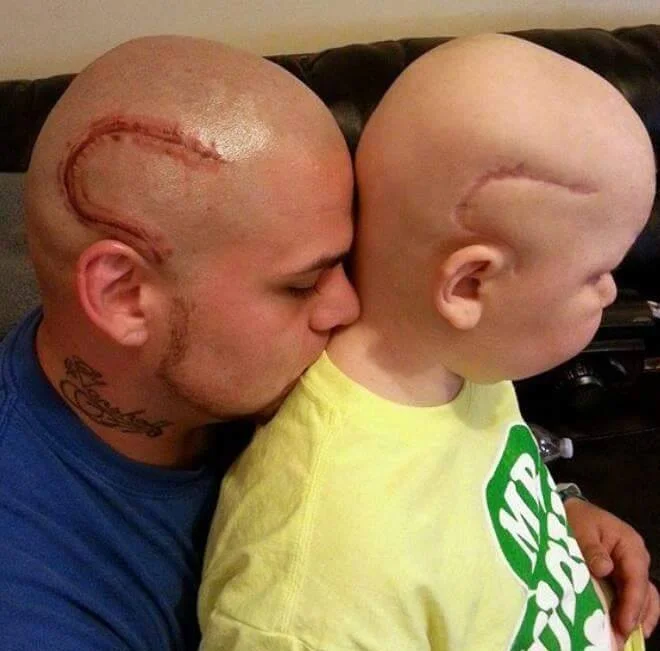
The Kansas sun slanted gently through the blinds that afternoon, casting a warm, golden light across the small bedroom where ten-year-old Gabriel Marshall stood in front of the mirror. His fingers traced the pale, crescent-shaped scar etched across his head, a mark that shimmered faintly in the light—a permanent reminder of the brain tumor surgery that had saved his life two years earlier. To any observer, it might have seemed a badge of courage. But to Gabriel, it was a wound that refused to heal, a visible symbol of fear and difference he wasn’t ready to embrace.
The boy’s reflection stirred memories of a life before the illness, a life where laughter came easily and every day was a playground of adventures. Now, every glance in the mirror reminded him of pain, vulnerability, and the uncertainty that had shadowed his world since the diagnosis. At just eight years old, Gabriel had been told he had a brain tumor. The word “malignant” held little meaning for him, but he felt its weight through the tension in his parents’ faces, the quiet sobs they tried to hide, and the anxious whispers of doctors in white coats.
The surgery to remove the tumor was long and complex. Doctors shaved Gabriel’s head and carefully excised the mass that threatened his young life. When he awoke, he found himself surrounded by the rhythmic beeping of monitors, the sterile scent of antiseptic, and the steady trembling of his father’s hands hovering nearby. He had survived. Yet the victory came with a cost—both physical and emotional.
In the months that followed, Gabriel’s bravery was celebrated with balloons, cards, and gifts from friends and relatives. But once the bandages were removed, reactions changed. Some people smiled too broadly, as if uncomfortable; others stared a fraction too long. Gabriel recoiled. His laughter waned, his confidence diminished, and he retreated behind a wall of hats—worn inside, outside, even to bed. The world had made him self-conscious of the mark that was supposed to symbolize survival.
Josh Marshall, Gabriel’s father, noticed the shift immediately. He was a man of broad shoulders, calloused hands, and quiet strength, but tenderness guided his actions when it came to his son. He watched Gabriel shrink away from mirrors and flinch at the whispers of others. One night, in the stillness of their home, Gabriel’s small voice trembled, “Dad… I look like a monster.”
Something inside Josh shattered. That night, while his son slept, he sat alone in the living room, flipping through old photographs. He saw Gabriel at five, dressed as a superhero, his grin so wide it nearly erased his eyes. The boy had called himself “Ironheart,” proud of his bravery. Now, he could barely face his reflection. Josh’s heart ached, torn between helplessness and determination. He could not undo the surgery or erase the scar, but he could show Gabriel that he was not alone in carrying it.
The next morning, a bold and unconventional idea came to him, one that felt both instinctive and courageous. He printed a photo of Gabriel’s scar and drove to a tattoo studio in Wichita. The artist looked up, intrigued by the unusual request. Josh placed the photograph on the counter.
“I want this,” he said simply, “exactly like this—on my head.”
The artist paused, taken aback. “That’s… a surgery scar,” she murmured.
Josh nodded. “It’s my son’s. He hates it. I want him to know there’s nothing to be ashamed of.”
The artist softened, sensing the depth of Josh’s intent. “Alright. Let’s do it,” she said.
The tattoo machine buzzed to life. Needles traced the curve of the scar on Josh’s scalp, each vibration echoing the suffering his son had endured. Pain shot through him, a stark reminder of Gabriel’s journey, yet it was a pain imbued with meaning. When the procedure was complete, Josh looked in the mirror. The scar was perfectly replicated in bold black ink. It was more than a tattoo—it was a promise, a tangible act of solidarity with his son.
That evening, he called Gabriel into the living room. The boy trudged forward, hat pulled low over his eyes, hesitant and unsure. Josh lifted his own hat slowly, revealing the identical mark inked onto his head. For a moment, there was only silence. Then Gabriel’s eyes widened, his mouth parted in surprise.
“That’s… my scar!” he whispered, voice a mix of shock and curiosity.
Josh smiled gently. “Yep. Now it’s mine too.”
Gabriel blinked. “But… why?”
Josh leaned closer, his gaze steady and reassuring. “So you’ll never feel alone. Every time you see your scar, you’ll know I have one too. People stare? They’ll see both of us. You’re brave, Gabe. Braver than anyone I know.”
Tears welled in Gabriel’s eyes. He placed a small hand over the tattoo, feeling the shared mark. “Does it hurt?” he asked softly.
Josh chuckled through the sting. “Yes. But not anymore. And neither does yours.”
Something shifted in that instant, invisible yet profound. Gabriel’s shame began to lift. For the first time since the surgery, he removed his hat and smiled. The next morning, he walked down the stairs hatless. His mother gasped, tears streaming. Gabriel proudly pointed to his scar.
“Look! Dad has one too!”
From that day forward, Gabriel no longer hid. He swam, played outside, and embraced life fully. When friends asked about his scar, he grinned, “It’s where they healed my brain—and my dad has the same one!”
Photos of the father-son duo soon spread online—two smiling faces, one marked by surgery, the other by ink. Their courage and devotion captured the hearts of viewers worldwide, hailed as one of the most moving acts of parental love in recent memory. Later, Josh entered a St. Baldrick’s Foundation contest for “Best Bald Dad,” earning lighthearted recognition. Yet for him, the real victory was seeing Gabriel’s confidence restored.
When asked why he did it, Josh explained simply, “When your child is in pain, you’ll do anything to ease it. I couldn’t operate on him, but I could carry the scar myself.”

Six months later, doctors discovered the tumor had returned—smaller, slower, yet still present. The news might have crushed many families, but for Josh and Gabriel, it was a challenge to face together. In a CNN interview, Josh smiled warmly, “It’s back, yes. But we’re not afraid. We beat it once, and we’ll do it again. My son is the toughest kid I know.”
Years later, Gabriel reflected on the tattoo with gratitude. “It made me feel whole again. It made me feel brave,” he said. The scar faded over time; the ink lightened, but neither mark disappeared. Together, they remained a symbol of survival, love, and the extraordinary bond between father and son.
The story of Josh and Gabriel Marshall is a reminder that love is not always quiet comfort—it can be bold, visible, and even challenging. It does not erase pain but shares it, honors it, and turns vulnerability into courage. Josh’s decision to mirror his son’s scar transformed both of their lives, proving that acts of love can heal in ways medicine cannot.
In the end, what remained was not just ink on skin, but an enduring testament to empathy, resilience, and the unbreakable connection between parent and child. Josh carried the scar for his son—and in doing so, healed them both.