
When I stepped in to help a stranger at the grocery store, I never imagined that a simple moment of kindness — something I expected nothing from except maybe a grateful smile — would slowly unravel the life I thought I’d resigned myself to, and quietly open the door to a second chance I never saw coming.

Two days before payday, with only $27 left in my account and a toddler glued to my hip, I found myself standing in line at the grocery store, silently bargaining with the universe for just a sliver of mercy.
Just five more minutes of calm, I begged inwardly. No tantrums, no surprises.
Naturally, Owen had other plans.
He squirmed in my arms with the determination of someone twice his age, reaching toward the candy rack as if it were his life’s mission. His fingers stretched out toward the sour worms, and he wore that mischievous glint in his eyes I knew far too well.
“No, buddy,” I whispered, hoisting him higher on my hip. “Don’t even think about it.”
He blinked up at me, his big brown eyes wide with fake innocence.
“But they’re sour worms, Mommy,” he protested with a pout.
I sighed. It had been one of those evenings — the kind that creeps in heavy and slow, leaving you drained and anxious all at once. My back ached from carrying more than my fair share, and my brain buzzed with caffeine and worry. If life were different, I’d have let Owen run wild through the candy aisle and pick whatever he wanted. But reality was harsh: 48 more exhausting hours until my paycheck landed, and my poor debit card had already given dramatic sighs at the gas pump earlier.
I gave him my firmest not today look. He giggled and dropped his hand.
“Next time, I promise,” I said — though I wasn’t sure whether I was reassuring him or myself.
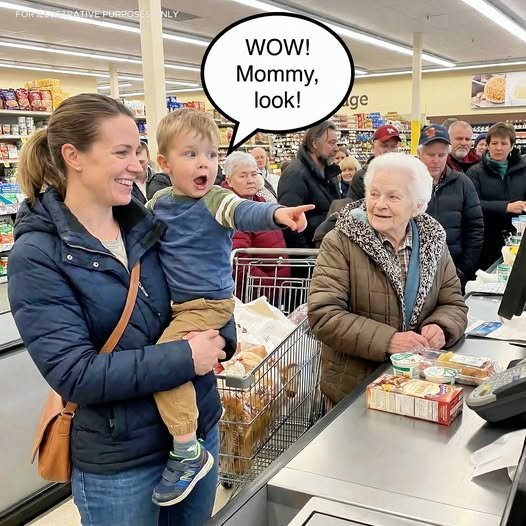
In front of us stood an elderly woman who looked to be in her late 70s. Her hair was pinned back in a soft bun, wisps of silver curling gently by her ears. She wore a pale green cardigan that looked lovingly worn, the elbows stretched from years of use.
Her cart wasn’t overflowing; it held the simple essentials I knew all too well: bread, milk, a few cans of soup, a bag of potatoes, and a small apple pie with a sugar-dusted crust that reminded me of autumn and my grandmother’s kitchen.
She watched each item scan, her lips moving faintly as though she were counting under her breath. I noticed the tension in her shoulders, the way she gripped her purse with purpose.
When the total flashed on the screen, she hesitated. Not for long — just long enough for the air around us to subtly shift.
Then she reached for her card.
The cashier, a teenage girl with smudged eyeliner and chipped polish, barely glanced up as she took it. The machine beeped once.
Declined.
“Oh, no!” the woman murmured. “Maybe I put in the wrong password.”
She tried again, slower.
Declined.

Behind me, someone let out a loud, irritated sigh.
“For crying out loud,” a man grumbled. “It’s always someone.”
Another voice snapped with impatient sharpness:
“If you can’t afford groceries, what on earth are you doing here? Go to a soup kitchen or something.”
The woman’s cheeks flushed with embarrassment.
“I can put the pie back,” she said quietly to the cashier. “It’s not important.”
Something inside me twisted. Owen shifted on my hip, his small arms curled around my neck. That pie — that little bit of sweetness — was probably the one tiny joy she’d allowed herself. For Owen and me, that joy was a small jar of custard this time.
“Don’t worry,” I heard myself say, louder than I meant to. “I’ve got it, ma’am.”
She turned toward me, startled. Her eyes glistened — eyes that had lived a long life and had endured far too many moments like this.
“You don’t have to do that, dear,” she said softly. “I can manage.”
“Please, let me,” I said, already pulling out my card.
The cashier raised an eyebrow but didn’t comment as I tapped the machine.
The woman looked at me as though I had handed her something far more precious than a bag of groceries.
“Thank you,” she whispered. “You have no idea what this means. But… I can pay you back, I promise.”
“Please, just take it,” I told her, gently brushing away the idea.
Owen, ever observant, lifted his tiny hand and waved at her.
“Bye-bye, Grandma! Have a good day!” he chirped.
He must have learned it from me — something I said to him every morning at daycare, mostly out of habit. But when she smiled through her tears and waved back, those familiar words took on a sacred weight.
“You too, sweet boy,” she said, her voice thick with gratitude.
She left slowly, holding the pie to her chest, and the line behind us shifted back into its usual impatience — indifferent, already forgetting.

Two days later, I returned to the same store. Owen held my hand, dragging his feet as we entered through the sliding doors.
“Mommy, can I get some chocolate milk?” he asked, pointing eagerly toward the refrigerators.
“Yes, but only if it’s on sale,” I answered. “And do you know what that means, Owen? It means if there’s a red sticker on the price.”
But he wasn’t listening. Instead, he gasped and froze in place.
“Wow! Mommy, look!”
Near the entrance, beside the bulletin board cluttered with flyers and missing pet posters, stood a cardboard display. And on it was a glossy printed image of my face — my messy bun, Owen’s grin, and the unmistakable confirmation that it was a still from the store’s security camera.
A handwritten note taped above it read: “Please call me. You helped my mom, and we want to thank you.”
For a moment, my whole body tightened. I felt exposed, as though someone had taken a private moment and put it on display for the entire town. Something I had done instinctively and quietly now felt painfully public.
I went straight to customer service. The store manager, Rick, came out when called.
“I’m sorry, Monica,” he said as soon as I introduced myself. “The man came in yesterday, explained what happened, and asked if he could view the footage. He requested permission to post this. It seemed like a kind gesture, so I allowed it.”
“I get it,” I said — though truthfully, I didn’t. “But I’d like to take it down.”
“Of course,” he said, removing it and handing it to me.
Owen grabbed it right out of my hand and stared at it proudly, as if it belonged in an art gallery.
Later that night, after Owen fell asleep on the couch, clutching a nearly empty sippy cup of chocolate milk, I sat beside him with the poster in my lap. The number etched in thick black marker seemed to call out to me.
So I dialed it.
“Hello?” a man answered on the second ring.
“Hi,” I said, a little more defensively than I intended. “I saw my photo on a poster at the grocery store. Why would you do that? You can’t just post someone’s face without permission.”
There was a brief pause, then a voice softened by clear relief.
“Wait — are you the woman with the little boy? The one who helped my mom with her groceries?”
“Yes,” I answered, hesitating. “I suppose I am.”
“She hasn’t stopped talking about you. And your boy. Please… would you be willing to meet us? She wants to thank you properly.”
Something about his tone disarmed me. It wasn’t forced or embellished. It felt sincere — gentle. Against my better judgment, and maybe because something about his voice felt safe, I agreed.

We met the next day at a small coffee shop near the grocery store — the cozy kind filled with mismatched mugs, hand-painted menus, and the warm scent of cinnamon and fresh bread.
Owen sat beside me in the booth, swinging his legs and devouring a muffin like it held the secrets of the universe.
About fifteen minutes later, the woman from the store walked in, now wearing a neatly buttoned soft blue cardigan and a smile full of warmth.
Beside her stood a man I didn’t recognize — though even before he sat down, something about him felt strangely familiar.
“Oh, sweetheart!” the elderly woman exclaimed, reaching across the table to hug me. “You came!”
“Thank you for meeting us,” the man said, offering his hand. “I’m John, and this is my mom, Margaret.”
“I’m Monica,” I replied, shaking his hand. “And this little muffin devourer is Owen.”
Owen looked up, crumbs smeared across his cheeks.
“Hi,” he said, voice muffled with muffin.
“Hi, buddy,” John chuckled.
They slid into the booth across from us, and a gentle quiet settled in — the kind that sits comfortably between people who aren’t quite strangers anymore, but not something else yet either.
“My mom’s been talking about you,” John began. “She’s not struggling financially. She’s just… frugal. She always has been. And most of what she has, she gives away.”
Margaret nodded, folding her hands neatly on the table.
“That day at the store, Monica, my card had expired. I didn’t even realize it. When the people in line started saying those things, I felt… ashamed. More than I care to admit.”
Her voice trembled. The helplessness, the public embarrassment — I recognized it instantly. I’d felt it myself, too many times.
“But you reminded me that kindness isn’t lost,” she said, turning toward me with tears in her eyes. “You didn’t just help me, sweetheart. You helped me feel seen.”
“I didn’t do it for attention,” I said, my throat tightening. “I just… I didn’t want you to feel small. No one deserves to feel that way. I’d know.”
Margaret reached across the table, her hand warm as she rested it on mine.
“And that,” she said gently, “is exactly why I want to give something back. Kindness like that shouldn’t go unanswered.”
Then came the part that nearly knocked the breath out of me.
“This little one called me Grandma, and that stuck with me, Monica,” she said. “So, I’d like to set up a savings account in Owen’s name. We can start with $10,000. For his future.”
“Wait — what?!” I gasped.
“It’s not charity, please don’t misunderstand me. It’s gratitude.”
“I can’t… I can’t accept that.”
“Yes, you can,” she said firmly. “Because he deserves a better start in life. We can help set him on that path.”

I hadn’t meant to cry, but the tears came anyway. Something inside me — something tight and tired from years of survival — loosened.
After coffee, John offered to drive us home.
“We’re not far,” I said. “We can walk.”
“Yes, we can,” he agreed, ordering another muffin for Owen to take with him.
We walked together, talking the whole way. Not small talk — real conversation. Margaret held Owen’s hand, asking him about daycare.
Then John spoke quietly.
“My wife left six months ago,” he said. “She met someone else and broke my heart. I’ve been spending more time with my mom, just making up for lost time and making sure she’s okay.”
I gave him a sad, understanding smile.
“My husband left when Owen was a year old. He said he needed space, but then I found out he had been seeing another woman during my pregnancy.”
“I’m sorry,” he said simply.
And somehow, that simple acknowledgment was enough — enough for something steady and quiet to begin forming between us.
After that, coffee turned into dinners. Dinners turned into ice cream outings with Owen. My son adored John. Slowly, I did too.
Margaret, of course, was delighted. I think she’d hoped for it from the start, though she never said so. She nudged things along so gently you could almost miss it — the meals she made for all four of us, the way her eyes lit up when John and I laughed together.
“You know,” she said one afternoon as we sat together in her garden, “I saw it in John’s eyes the moment he looked at you. He didn’t say anything — but I know that boy well enough.”
“I think I knew too,” I admitted, watching Owen run barefoot through the grass. “It was… something about his voice. I just didn’t want to trust it right away.”
She squeezed my hand softly.
“Trust is earned, Monica,” she said. “You did right by waiting.”
A year after that day in the store, John and I married beneath the old oak tree in Margaret’s backyard. The ceremony was small and simple, filled only with people who truly mattered. Owen wore a tiny navy bow tie and spent the entire ceremony clutching the ring pillow, grinning proudly.
Three months later, John legally adopted him.
“Does this mean I get to call him Dad now?” Owen asked.
“You already do, baby,” I said.
And now, every night when I tuck him into bed, he still brings up that first day.
“Mommy, remember when we met Grandma Margaret at the store?”
I always smile and nod.
“Of course, I remember,” I tell him.
Because that day — that moment of generosity sparked by a single apple pie, one trembling voice, and one instinctive act of kindness — became the beginning of something I never expected.
A second chance. A better one — for all of us.