
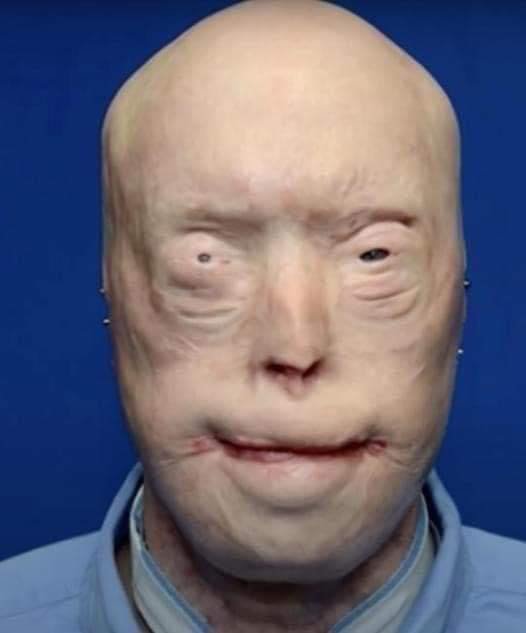
Before the world knew his name, Patrick Hardison was simply a volunteer firefighter from Mississippi — an ordinary man who lived for his children, his community, and the quiet satisfaction of helping others. In 2001, when a call came about a woman trapped inside a burning home, he ran in without hesitation. The roof collapsed within seconds, trapping him in an inferno that melted his mask and consumed his face. He survived, but the man who climbed out of that fire was unrecognizable even to himself. Third-degree burns destroyed his ears, lips, nose, eyelids, and most of his face. For years afterward, Patrick couldn’t step into public without children recoiling or adults staring. He hid behind sunglasses, prosthetic ears, and a hat pulled low, carrying the weight of a face that no longer felt like his own.
More than seventy surgeries followed — endless grafts, reconstruction attempts, and procedures designed not to restore beauty, but simply to keep him alive. Eating hurt. Talking was difficult. Without eyelids, he risked losing his vision entirely. Depression settled over him like ash. “I never got a day off from the injury,” he once said, and he meant it. Loneliness became as constant as his pain. But everything changed the day he learned about the world’s first partial face transplant. For the first time since the fire, he felt a spark of hope. He met Dr. Eduardo Rodriguez, who didn’t promise miracles — only a fighting chance. And after months of waiting, a match arrived: a young cyclist named David Rodebaugh, whose mother, Nancy Millar, made the agonizing decision to donate her son’s organs, including his face.
In a 26-hour surgery involving more than 100 medical professionals, Patrick was given a new face — David’s face — complete with scalp, ears, eyelids that blinked, and skin soft enough to feel life again. The odds had been 50/50, but he survived. When the swelling faded, he could finally close his eyes after fifteen long years. He could speak clearly. He could walk into a room without fear. Later, when he met Nancy, she asked only for one thing: to kiss him on the forehead, the same place she had kissed her son every night. Patrick bowed his head, and in that silent, trembling moment, grief and gratitude intertwined — two lives forever bound by sacrifice, courage, and a mother’s final gift.
Today, Patrick still navigates the challenges of transplant medications and an identity reshaped by both trauma and hope. Yet he no longer hides. He speaks publicly, writes, and lives with the confidence he thought he lost forever. He calls himself lucky, not because the fire spared him, but because he found people who refused to let him disappear into the shadows. “There’s always hope,” he says. “You don’t have to live life broken. You can get up. You can change everything.” Patrick’s journey is more than a medical miracle — it is a testament to human resilience, to the beauty of second chances, and to the extraordinary power of one mother’s love to restore not just a face, but a life.