
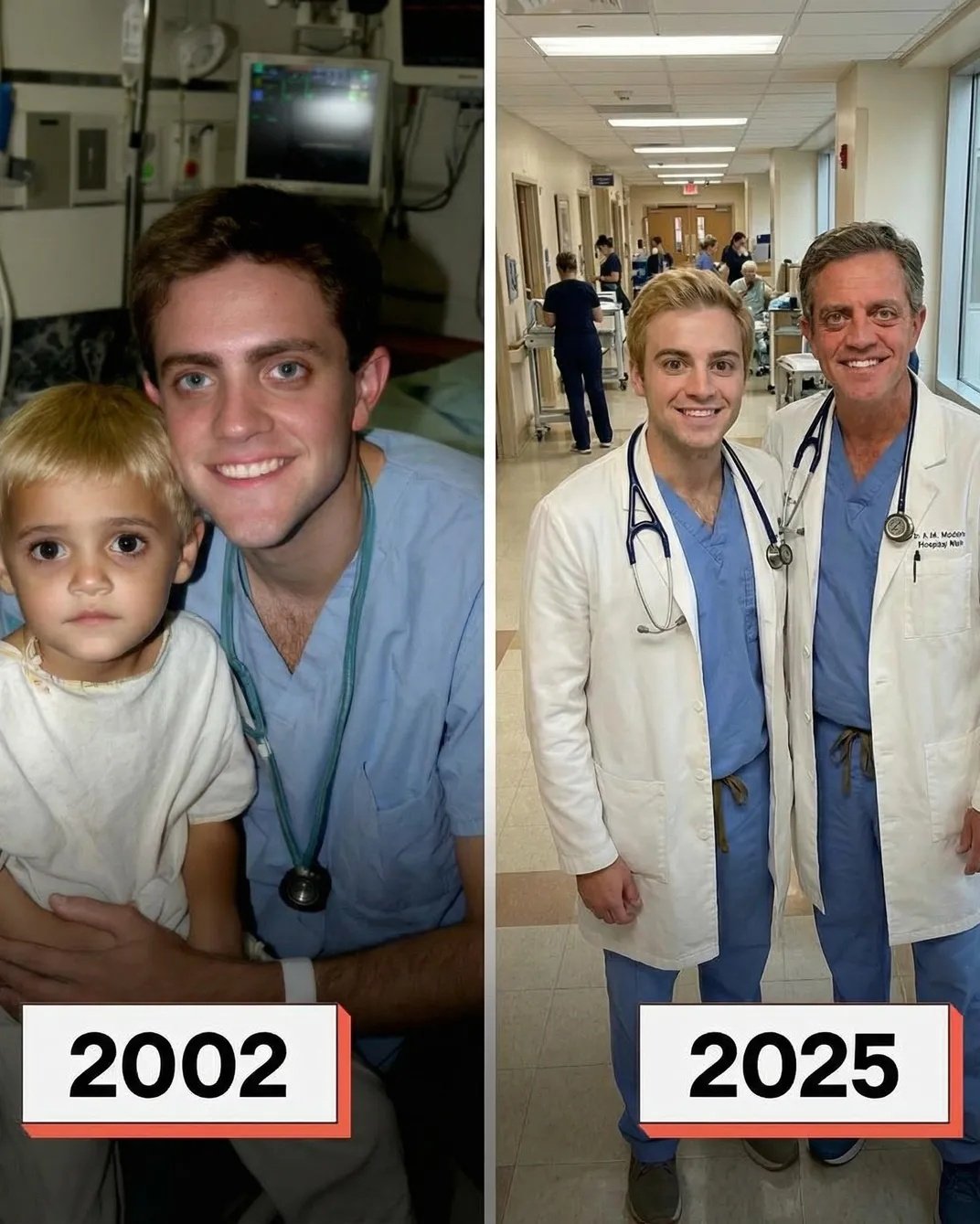
A lifetime in medicine teaches you how fragile a heart can be, but nothing prepared me for the boy I met so many years ago, small and pale in a hospital bed, trying to be brave while his life hung on a surgeon’s precision. His condition was serious, the kind that steals breath and childhood all at once, yet he faced it with a quiet gentleness that stayed with me long after the operation ended. The surgery went better than expected, his heartbeat steadier by morning, his future suddenly possible, but when I went to check on him, the room was unbearably still. His parents were gone, his bag untouched, and a stuffed dinosaur lay alone on the pillow, as if waiting for someone who never came back, and in that moment I understood that saving a life sometimes means far more than repairing a body.
My wife and I met him the following day, unsure of anything except that no child should face recovery alone, and what began as temporary care slowly became something permanent and sacred. He arrived in our home guarded and unsure, sleeping beside his bed instead of in it, calling us “Doctor” and “Ma’am,” as though love were something formal and conditional. Trust crept in quietly through scraped knees, late night fevers, and whispered words he didn’t realize he believed yet, until one day “Mom” and “Dad” came naturally, like they had always been there. He grew into a young man defined by empathy and determination, choosing medicine not for prestige but purpose, and when he matched as a surgical resident at the very hospital that once saved him, he stood in our kitchen with tears in his eyes and told me that moment had given him a reason to live fully.
Years later, fate found us again in an emergency room, this time when my wife was brought in after an accident, shaken but stable, her hand held by a woman none of us recognized. The stranger’s clothes were worn, her hands rough, her eyes heavy with years of struggle, yet she had stayed with my wife until help arrived, refusing to leave. When she looked at my son, everything changed, her gaze falling to the faint scar above his heart, her voice breaking as she spoke his name like a prayer she had carried too long. She confessed then that she was the one who had brought him to the hospital all those years ago and the one who had walked away, trapped by fear and circumstances she never believed she could survive, and now, in a cruel twist of grace, she had saved the woman who raised the child she never stopped loving.
What followed was not easy, but it was honest, shaped by pain, understanding, and the courage to face both, as my son listened and chose compassion over resentment. He offered her something she had denied herself for decades, a chance to begin again, and together we helped her find stability and care, not as repayment but as humanity. That Thanksgiving, she sat at our table beside the family built from resilience rather than blood, a small stuffed dinosaur placed gently in front of her as a symbol of what was lost and what survived. As we raised our glasses, I realized that healing a heart is not always a surgical act, but a decision to stay, to forgive, and to let love finish the work medicine alone never can.