
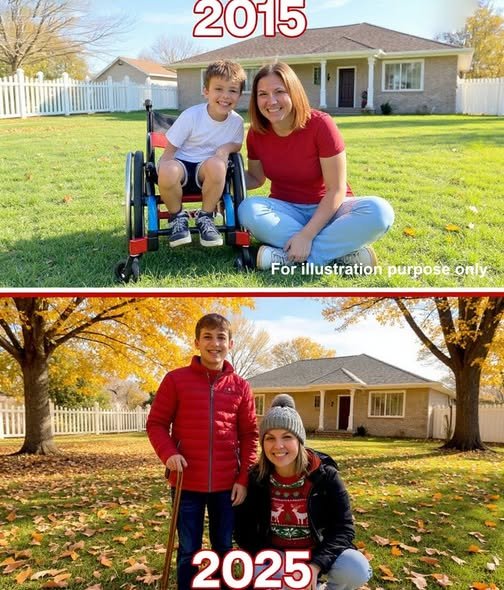
She left her disabled son with me and vanished. I thought I’d never see her again — until the day she showed up with a lawyer and a demand that turned my stomach.
My name is Ellis. I’m thirty-seven now, but back then I was twenty-seven, exhausted, broke, and barely hanging on in a cramped apartment in Queens.
I worked two jobs: mornings at a greasy diner, evenings in a quiet bookstore. It was far from glamorous, but it kept the rent paid and the fridge from being completely empty.
I never imagined I’d become anyone’s mother. I was just trying to survive the city with sore feet, chipped nails, and dreams I’d long tucked away.
I’d always adored my nephew, Milo. He arrived when I was still in college — big curious eyes, soft lashes, and a laugh that could melt the worst day.
Life dealt him a tough hand from the beginning. He was born with a condition that weakened both legs. Braces, endless therapy, nights when the pain made him cry just from trying to stand.
Yet he stayed the sweetest, most joyful kid I’d ever known.
Then one Friday night everything shattered.
I’d just dragged myself home after a double shift, hair smelling of hash browns and old paper, legs screaming. All I wanted was a shower and mindless TV.
Instead, I turned the corner and saw her.
Mara.
My older sister stood under the flickering streetlight in a beige coat, hair pulled tight, face blank. Beside her was four-year-old Milo clutching a tiny sticker-covered suitcase. His braces glinted beneath his jeans.
“Mara?” I blinked, unsure I wasn’t hallucinating.
She didn’t move. One hand rested on his shoulder like it was holding her up. No tears. No feeling. Just that cold, final look.
“Ellis,” she said, eyes on the pavement. “I can’t do this anymore.”
The winter air crawled straight into my bones.
“What do you mean you can’t do this?”
She took a breath and gently nudged Milo toward me.
“I met someone. He doesn’t want kids. He’s offering me a clean start. I deserve better.”
My heart crashed to the ground.
“So you’re abandoning your son?”
Her jaw clenched. “You don’t understand how draining it is. I want a normal life.”
I wrapped my arm around Milo’s tiny shoulders without thinking. He looked up at me, confused and quiet.
“You’ve always loved him,” Mara said, voice suddenly softer. “You’ll be better at this than I ever was.”
Then, like she’d rehearsed every step, she kissed his forehead once, set the suitcase down, turned, and walked to a waiting black car.
She never looked back.
Milo tugged my sleeve. His voice was barely a whisper.
“Auntie… where’s Mommy going?”
I dropped to my knees on the freezing sidewalk and pulled him close.
“I’m here,” I said. “I’m not going anywhere. I promise.”
Inside I was panicking — no space, no money, no plan. But I had him, and that had to be enough.
That night I made hot chocolate piled with marshmallows and let him sleep in my bed. I sat beside him for hours listening to his breathing, wondering how any mother could leave a child like him.
The days that followed were chaos. I called, texted, emailed, messaged on every platform. Silence.
She had simply vanished from his life.
I spent hours on the phone with doctors, therapists, and his preschool, piecing together a schedule I’d never prepared for. Questions I never thought I’d ask poured out: Which braces? How many sessions a week? Will Medicaid help?
I was drowning.
One night, after he finally fell asleep, I sat on the bathroom floor staring at forty-three dollars in my account and rent due in days. I didn’t know how I’d buy groceries, let alone new braces.
But every time I felt myself cracking, I remembered the way he looked at me — like I was his whole world now.
That look kept me upright.
The early months were brutal. I sold my car, took the bus everywhere, worked sixteen-hour days when I could. My apartment overflowed with therapy mats, special chairs, foam rollers. The landlord complained about the noise; I stopped caring.
Milo never complained once.
He smiled through every painful session, every fall.
“Auntie,” he’d say, squeezing my hand, “one day I’m gonna run. You’ll see.”
That stubborn hope carried us both.
People stared in public, whispered. Some mothers pulled their children away at the playground. It stung, but Milo was too busy trying to climb the slide to notice.
Teachers assumed he’d fall behind.
He didn’t. He learned to read early, devoured puzzles, asked huge questions about the stars. He worked twice as hard and quietly proved everyone wrong.
By age ten he could walk short distances with crutches. Doctors called it remarkable.
I called it love and pure grit.
Ten years slipped by. I landed a better job managing a little neighborhood bookstore. We moved into a small house with a backyard big enough for therapy. Milo finally had his own room and a sunny desk where he loved to draw.
By then I was “Mom” in every way that counted.
Then came the day I’ll never forget.
He burst through the door after school, cheeks red from the cold, grinning wider than ever.
“Guess what?” he said, dropping his bag.
He held up a certificate: Best Academic Achievement.
“I’m going to be a physical therapist,” he announced, still breathless. “I want to help kids like me.”
I laughed through sudden tears and hugged him until he squeaked.
Every sacrifice suddenly felt worth it.
I really thought we’d earned our happy ending.
We hadn’t.
Exactly one week later there was a knock at the door.
I opened it expecting pizza or a neighbor.
Instead I found Mara.
Eleven years older, thinner, eyes harder, perfect makeup hiding the same selfish spark.
Behind her stood a man in a charcoal suit holding a leather briefcase.
“Hi, Ellis,” she said, like she’d just been on vacation.
I couldn’t speak.
“We need to talk.”
I stepped onto the porch, pulled the door almost closed, and folded my arms.
“You have some nerve.”
“I know I made a mistake,” she said quickly. “A huge one. I want Milo back. I want to be his mother again.”
The ground tilted under me.
“You want him back now? After everything he went through without you?”
The lawyer cleared his throat. “I’m Daniel, Ms. Mara’s attorney. We’d prefer an amicable agreement before court.”
I laughed — sharp and bitter.
“You think you can stroll in after abandoning him and just take him? Not one dollar, not one card, not one call in eleven years. And now you want to play mommy?”
“I heard he’s doing amazing,” Mara said. “Colleges are interested. Scholarships love stories like his — resilience, inspiration. He’s… valuable now.”
Valuable.
The word turned my blood to ice.
“You don’t want your son,” I said quietly. “You want a redemption arc and a paycheck.”
The door creaked open.
“Everything okay, Mom?” Milo’s voice.
He stepped out — fifteen, taller, still leaning on crutches, eyes wary as they landed on the woman who once left him on a sidewalk.
Mara’s face lit up. “Sweetheart! It’s me!”
She opened her arms.
Milo took one step back and slipped his hand into mine.
“You’re not my mom,” he said, calm and clear. “She is.”
Mara’s smile collapsed. “Milo—”
“You left,” he said. “She stayed.”
No anger. Just truth. It hurt her more than any scream could.
The porch went dead silent.
Milo looked up at me. “Do I have to talk to her?”
“No, baby,” I said loudly. “You don’t.”
I moved in front of him. “Leave. Now.”
The lawyer touched Mara’s shoulder. “Let’s go.”
She glared once more, then turned and left.
That night I didn’t sleep. I knew she wasn’t finished.
A week later the custody papers arrived.
I hired the best lawyer I could afford. We gathered every record, every letter from teachers, therapists, neighbors — everyone who’d watched me raise him.
The fight dragged on for months. Mara painted herself as young and overwhelmed, showed photos of a brand-new nursery, as if fresh paint could erase a decade.
But truth is louder than staged photographs.
Milo insisted on testifying.
He sat in court, braces on, crutches beside him, voice steady.
“I remember feeling like trash that night,” he said. “Like I wasn’t worth keeping. Ellis taught me how to walk. She never left. She’s my mom.”
Half the courtroom cried with me.
When the judge granted me full permanent custody and zero visitation rights to Mara, I finally exhaled.
On the way home we stopped for ice cream — simple, quiet, perfect.
A few days later Milo walked in holding a manila envelope.
“I want to do it,” he said.
“Do what?”
“I want you to adopt me. Officially.”
My heart stopped.
“Milo…”
“I already call you Mom. I just want the paper to match.”
A few more months, a few more signatures, and then we walked out of the courthouse hand in hand.
Sunlight hit his face as he looked up and grinned.
“Mom,” he whispered, “we did it.”
After all the pain, fear, and years of loving him with every piece of me, that was the happiest moment of my life.