
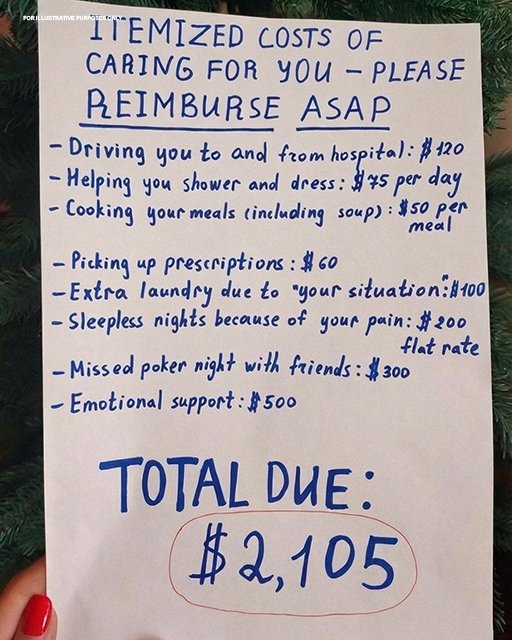
When I found the itemized invoice taped neatly to our refrigerator three days after my hysterectomy, I realized my husband had been quietly keeping score of every act of care. What he did not know was that I was about to become a far more thorough and far more ruthless accountant than he had ever been.
For seven years, I believed my marriage was built on a quiet, steady kind of happiness.
My husband, Aaron, and I had created what looked like a solid life together. We owned a modest house with white siding and a creaky porch swing that swayed gently in the evenings.
On warm summer nights, we would sit there with iced tea, watching the sun sink behind the trees while fireflies blinked in and out of the dark.
We both had stable jobs that paid the bills on time, allowed the occasional weekend getaway, and let us imagine a future without constant financial anxiety.
We talked often about “someday” having children. Not urgently and not with desperation, but with the assumption that time was on our side. We wanted to be prepared emotionally, practically, and financially. From the outside, we probably looked like one of those couples who already had everything figured out.
“We’ve got time,” Aaron would say whenever the conversation drifted toward baby names or nursery colors. “Let’s get the mortgage down a bit more. Maybe finally take that trip to Italy we keep postponing.”
I would smile and agree, believing that we were building toward something beautiful together, brick by brick.
The foundation of our marriage felt strong. We rarely argued. We split household chores evenly, or so I thought. We still laughed at each other’s bad jokes over morning coffee. He brought me my favorite pastries on Sundays. I folded his laundry the way he liked it, with socks paired and shirts pressed just right.
Yes, he could be rigid about money and schedules. He tracked expenses carefully, categorized every purchase, and reviewed our joint account with the seriousness of a quarterly audit. I chalked that up to his profession. He worked in finance, and precision was his nature. I used to call it “detail-oriented” with a fond smile.
I had no idea that the same mindset would later be turned against me.
Life, as it turns out, has very little respect for careful planning.
Last month, what began as routine checkups quickly spiraled into emergency appointments. I had been dealing with pain for weeks, the kind that stole your breath and left you doubled over in the grocery store aisle, pretending to examine cereal boxes until the wave passed. When the doctor finally sat across from me with a serious expression, my heart already knew the news before my mind caught up.
“We need to operate immediately,” he said.
The hysterectomy itself was medically necessary. Complications during surgery, however, left me with a reality I had not prepared for. I would never be able to carry children. Pregnancy was no longer possible.
The dream Aaron and I used to whisper about in the dark, the names we had casually debated, and the imaginary family holidays collapsed into silence. Grief hit me in waves, relentless and suffocating. It felt like drowning in something invisible, something no one else could see.
Aaron said the right things at first.
“We’ll get through this together,” he told me, holding my hand in the hospital room. “It’s us that matters, not whether we have kids. We have each other.”
I believed him. I needed to believe him.
During the long, painful days of recovery, when standing felt like an impossible task and every movement sent sharp reminders through my abdomen, I clung to those words. When friends asked how I was coping, I repeated his reassurances like a script, hoping that saying them aloud would make them permanently true.
Three days after my surgery, I shuffled into the kitchen for the first time. The pain medication made everything hazy, but I was desperate for something normal. I wanted a cup of tea, sunlight through the curtains, and proof that the world still existed beyond my bedroom.
I half expected to find a small kindness waiting for me. A note on the counter. Flowers. Anything that said, “I see you. I care.”
Instead, I found a piece of paper taped squarely to the refrigerator door.
At first, I thought it might be hospital instructions or a grocery list. But as I leaned closer, my stomach clenched with something far worse than physical pain.

It was an invoice.
“Itemized Costs of Caring for You. Please Reimburse Promptly.”
The handwriting was unmistakably Aaron’s. It was neat and precise, the same careful script he used for our monthly budget spreadsheets.
Below the heading was a list that made my vision blur.
Driving you to and from the hospital: $120
Helping you shower and dress: $75 per day (3 days)
Cooking your meals, including soup: $50 per meal (9 meals)
Picking up prescriptions: $60
Extra laundry due to “your situation”: $100
Missed poker night with the guys: $300
Emotional support and reassurance: $500
At the bottom, circled in red, were the words:
TOTAL DUE: $2,105
My legs nearly gave out. I gripped the refrigerator handle just to stay upright.
This was not a joke. This was not sarcasm or dark humor. It was a genuine bill, presented with the seriousness of a utility notice.
“What kind of man does this?” I whispered to the empty kitchen.
In that moment, the house felt different. Colder, like a place that no longer belonged to me.
My phone buzzed. It was a message from my best friend, Lena.
“How are you feeling today? Do you need anything?”
Two days earlier, Lena had driven forty minutes to bring me homemade soup. She had stayed for hours, helping me organize my medications and distracting me with stories. She had not asked for anything in return. She certainly had not sent me a bill.
Something inside me hardened.
If Aaron wanted to treat my recovery like a transaction, I would give him exactly what he asked for. My accounting, however, would be far more comprehensive than his.
I took a photo of the invoice and opened my laptop.
For the next three weeks, I kept meticulous records.
Every dinner I cooked, despite still healing, was logged at $80, including labor and ingredients. Each shirt I ironed for his work wardrobe cost $15. Every errand I ran while managing post-surgical fatigue was billed at $45, plus mileage. Grocery shopping while exhausted came with a pain and suffering surcharge.
I documented conversations, too.
Listening to him complain about difficult clients was listed at $75 per session for therapeutic listening services. Providing reassurance about his mother’s pointed comments regarding our lack of children came with a $150 flat rate for emotional labor.
I even added retroactive charges.
Marital intimacy previously rendered was calculated conservatively over seven years, with a generous discount applied.
Laundry. Cleaning. Social planning. Remembering birthdays. Buying gifts for his relatives. Managing household logistics. Everything suddenly had a price tag.
By the end of the month, my spreadsheet showed that Aaron owed me $18,247.
I printed it on heavy paper, stamped “FINAL NOTICE. PAYMENT DUE IMMEDIATELY” across the top, and slipped it into a manila envelope with his name written carefully on the front.
That Saturday morning was gray and drizzly. Aaron sat at the kitchen table, sipping coffee and scrolling through his phone.
I placed the envelope beside his mug.
“Here’s your invoice,” I said evenly.
He frowned and opened it. As he read, his expression shifted from confusion to disbelief, and then to something close to panic.
“What is this?” he demanded.
“It’s the itemized cost of being your wife,” I replied calmly. “You set the precedent.”
“This is ridiculous,” he said, his voice rising. “You can’t seriously expect me to—”
“Pay it?” I interrupted. “Why not? You expected me to reimburse you for caring for me after surgery.”
Silence stretched between us.
Finally, he looked down, shame flickering across his face.
“I’m sorry,” he said quietly.
“For which part?” I asked. “For billing me, or for treating my pain like a burden?”
He crumpled the original invoice and dropped it into the trash.
“You’re right,” he said. “This isn’t who I want to be.”
“No,” I agreed. “It isn’t.”
I gathered my papers. “We’re going to therapy. And you’re going to learn that love isn’t a transaction.”
I turned toward the stairs, pausing only once.
“Some debts,” I said, “can never be repaid once they’re called in.”
From that day forward, no invoices ever appeared on our refrigerator again. Because he finally understood that some lessons cost far more than money, and some prices are simply too high to pay.