
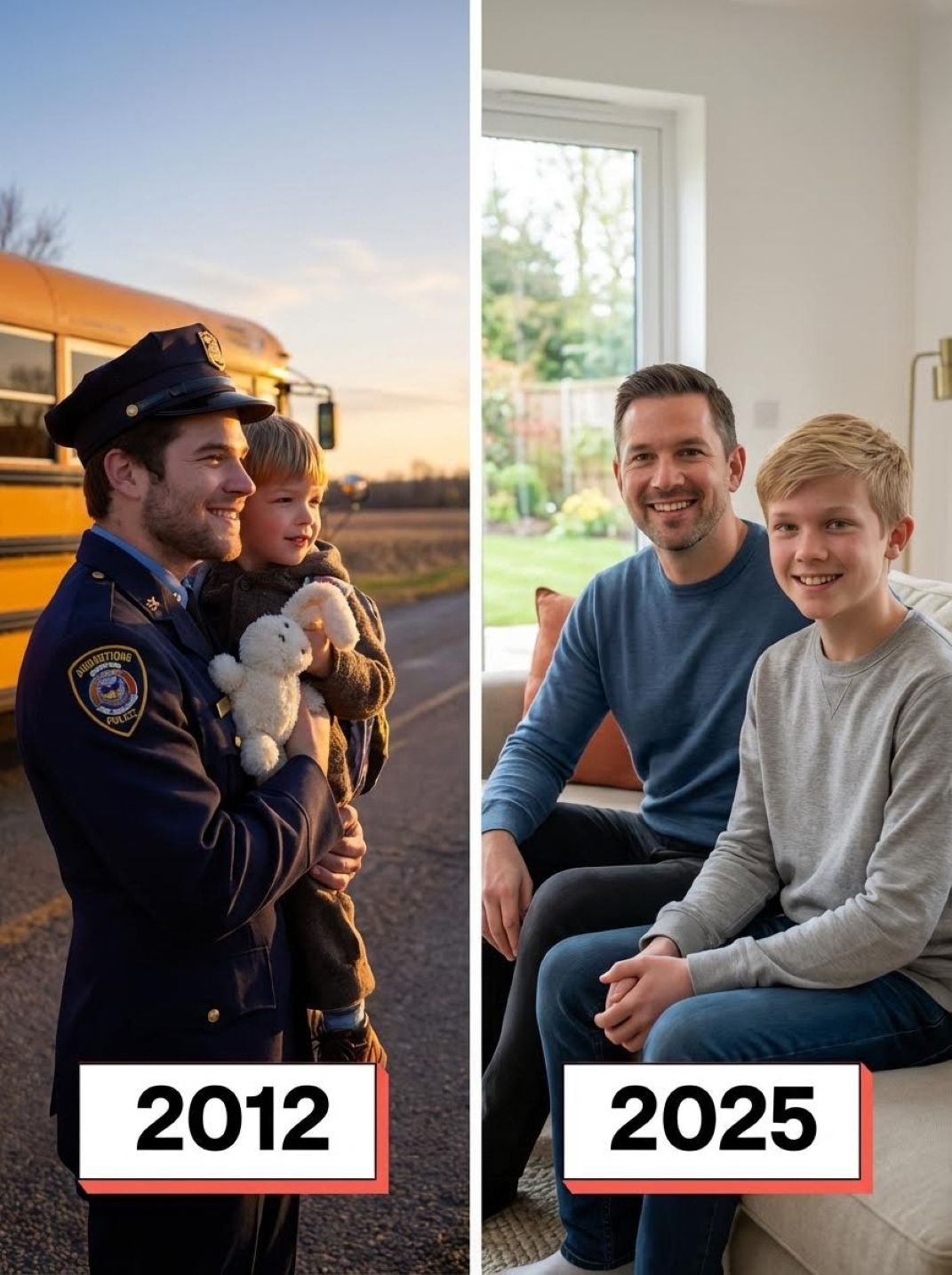
When I was twenty-five, I worked as a school bus driver.
It wasn’t my dream job.
But it paid the bills.
That night—just a few days before Christmas—I had already dropped off the last child and was driving the empty bus back to the depot. Snow dusted the road in thin white streaks, and the streetlights cast long shadows across the pavement.
That’s when I saw him.
A small figure on the side of the road, walking slowly in the dark.
I slammed on the brakes.
He couldn’t have been more than six years old. Too small to be out there alone, especially in the cold. He wore a thin jacket, carried a worn backpack, and clutched a ripped stuffed bunny with one ear hanging loose.
I opened the bus door and called out gently.
“Hey, buddy. Are you okay?”
He looked up at me with eyes far too old for his face.
“My mom died today,” he said quietly.
“They wanted to take me somewhere. I didn’t want to go.”
My chest tightened so hard I thought I might stop breathing.
I learned later that his mother had collapsed at work. No warning. No goodbye. She had no living relatives. No one to take him in. Social services had arrived, and in his fear and confusion, he ran.
I drove him back.
I stayed with him until everything was sorted—until the paperwork was filed and a temporary placement was found. He barely spoke, just held onto that bunny like it was the last thing keeping him tethered to the world.
Before I left, I knelt down in front of him and made a promise.
“I’ll come visit you,” I said.
“You won’t be alone.”
And I meant it.
I visited once.
Then again.
Then again.
Something about him pulled at me in a way I couldn’t explain. He reminded me of my twin brother—the one I lost when we were kids. Swept away by a fast river during a summer trip. One moment he was there. The next, gone forever.
Losing this boy too felt unbearable.
Before Christmas, I filed the papers.
I adopted him.
I told myself it was fate.
A sign.
A miracle wrapped in grief.
For years, I worked nonstop. Bus driver. Taxi driver. Eventually, I saved enough to start renting out cars. Every dollar I earned went toward giving my son a stable life.
He never lacked love.
Or safety.
He called me “Dad” before he learned to write his own name.
I gave him everything I had.
And I would have given more.
Then, thirteen years later, I came home early one evening.
And froze.
My son was sitting on the couch.
Crying.
Next to him sat a woman in her forties. Well-dressed. Perfect posture. Calm in a way that felt dangerous.
My son looked up at me, eyes red and swollen.
“Dad,” he said, his voice breaking,
“I have to go. We’ll never see each other again. I love you. Thank you for everything.”
The room spun.
“Who are you?” I demanded, stepping forward.
“And what did you tell my son?”
The woman folded her hands.
“I’d sit if I were you,” she said calmly.
“You’ve been living a lie for thirteen years. And you’re not going to like what comes next.”
I didn’t sit.
“You don’t get to walk into my house and tear my family apart,” I snapped.
She finally looked at me—really looked.
“I’m his biological aunt,” she said.
“My sister didn’t die of a heart attack. She was murdered.”
The word hit me like a punch to the chest.
“What?”
“She was killed by her husband,” the woman continued. “My brother-in-law. He vanished the same night. We spent years searching for him.”
My legs weakened.
“And now?” I asked.
“And now,” she said quietly, “we found him.”
She slid a photo across the table.
It was me.
My face. My beard. My eyes.
But the name underneath wasn’t mine.
My heart stopped.
“That’s not—” I whispered.
“Your twin brother,” she finished.
“He survived the river. Changed his identity. Built a new life. And thirteen years ago, he tracked down his son.”
The room felt like it was collapsing inward.
“You’re saying… I adopted my brother’s child?”
“Yes.”
My son sobbed harder.
“And they found him last month,” she continued. “He’s in prison now. But legally, custody must return to next of kin.”
I shook my head.
“No. No. I raised him. I’m his father.”
She nodded slowly.
“And that’s why this is complicated.”
Three weeks later, we stood in a courtroom.
My son sat beside me, gripping my hand like he did when he was six.
The judge listened. The lawyers argued. Papers were reviewed.
Then the judge looked at my son.
“Who do you consider your father?” she asked.
He stood.
The room went silent.
“The man who stopped for me on the side of the road,” he said.
“The man who never left.”
The judge ruled in my favor.
The woman cried—not from anger, but relief.
Before she left, she stopped in front of me.
“You saved him,” she said.
“My sister would be grateful.”
That night, my son hugged me tighter than ever.
“You didn’t lie to me,” he said.
“You found me.”
And for the first time in thirteen years, I finally believed something I’d always felt in my bones.
Family isn’t blood.
It’s the choice to stop—
In the dark.
In the cold.
And never walk away.