
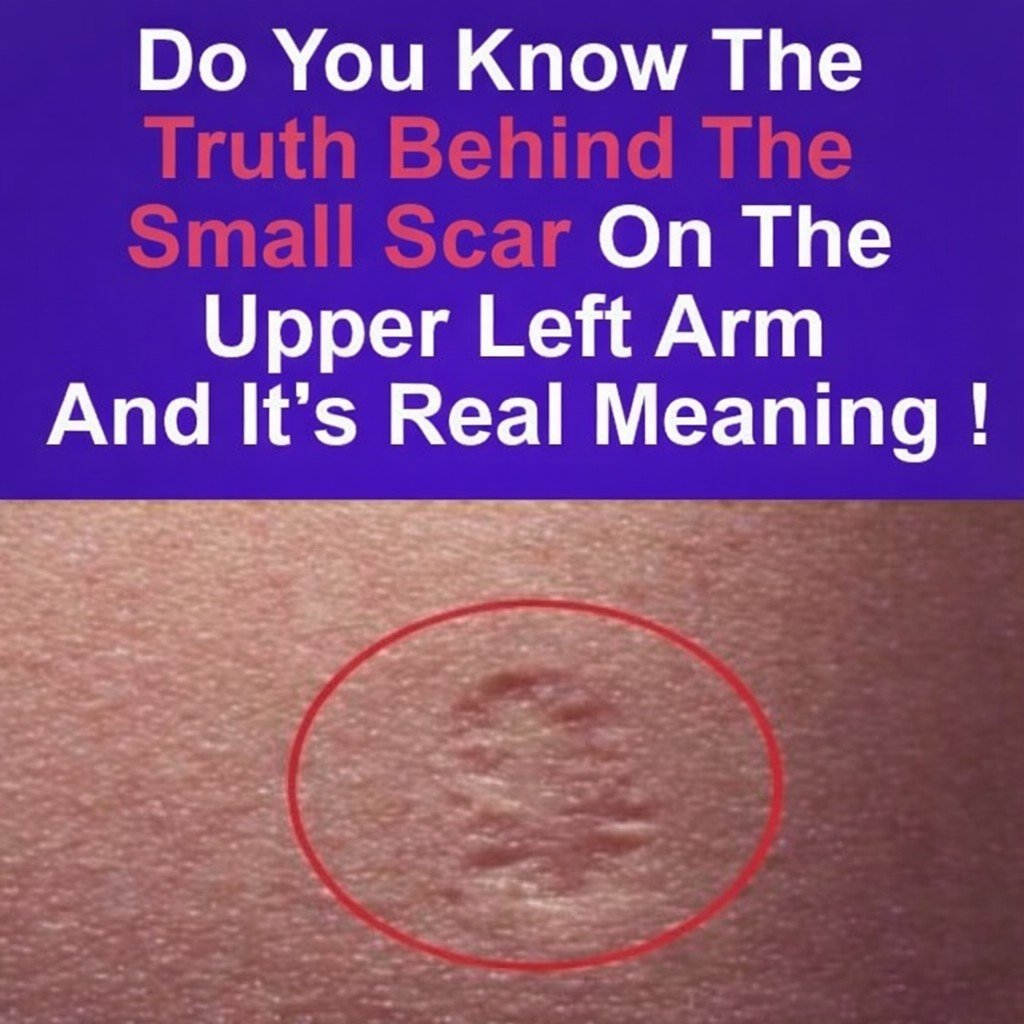
For many of us, childhood memories are anchored not by big events, but by small, puzzling details. A familiar creak in the hallway, the scent of an old kitchen, or a strange mark on a parent’s arm that never seemed to have an explanation. For decades, countless children noticed the same curious feature on their parents or grandparents: a round scar high on the upper arm, often sunken in the center and ringed with tiny pits. It was so common it faded into normalcy, yet mysterious enough to linger in the back of the mind. I remember the first time I noticed it on my mother, a pale circular imprint that looked almost like a coin pressed into her skin. I asked about it once and received an answer that meant nothing to me at the time. Years later, seeing the same mark on a stranger’s arm brought the question rushing back with new weight.
The truth behind that scar is tied to one of the deadliest diseases humanity has ever faced. Smallpox was not just an illness; it was a global terror that shaped civilizations for thousands of years. It spread easily, brought crushing fevers, and left victims covered in painful sores that often scarred for life. Many never survived at all. In the twentieth century alone, hundreds of millions of people died from smallpox, with no regard for borders, wealth, or status. Families vanished, communities were devastated, and fear followed outbreaks wherever they appeared. The scar I had seen so casually was connected to a time when survival itself was uncertain and protection was a matter of urgency.
Unlike modern vaccinations, the smallpox vaccine was delivered using a distinctive technique. Medical workers used a special two-pronged needle to puncture the skin multiple times in quick succession, placing the vaccine just beneath the surface. This method triggered a strong reaction in the body. Within days, a sore would form, then blister, then scab over. When the scab eventually fell away, it left behind a permanent mark. That scar was not a side effect—it was proof. It showed the immune system had responded, that protection had been built. In an era before digital records, it also served as visible evidence of immunity, a silent passport recognized across borders.
Over time, that scar became a symbol of something much larger than a single injection. It represented a worldwide effort unlike anything seen before, as scientists and health workers joined forces to eliminate a common enemy. Through determination, coordination, and trust in science, smallpox was finally eradicated. Routine vaccinations stopped, and new generations grew up without the mark. Today, the absence of that scar is itself a quiet victory. Yet for those who still carry it, the smallpox vaccine scar is more than a medical memory. It is a living piece of history, a reminder of what humanity can achieve when it chooses cooperation over fear. Each fading circle tells a story of survival, resilience, and a moment when the world decided that suffering on that scale would no longer be accepted.