
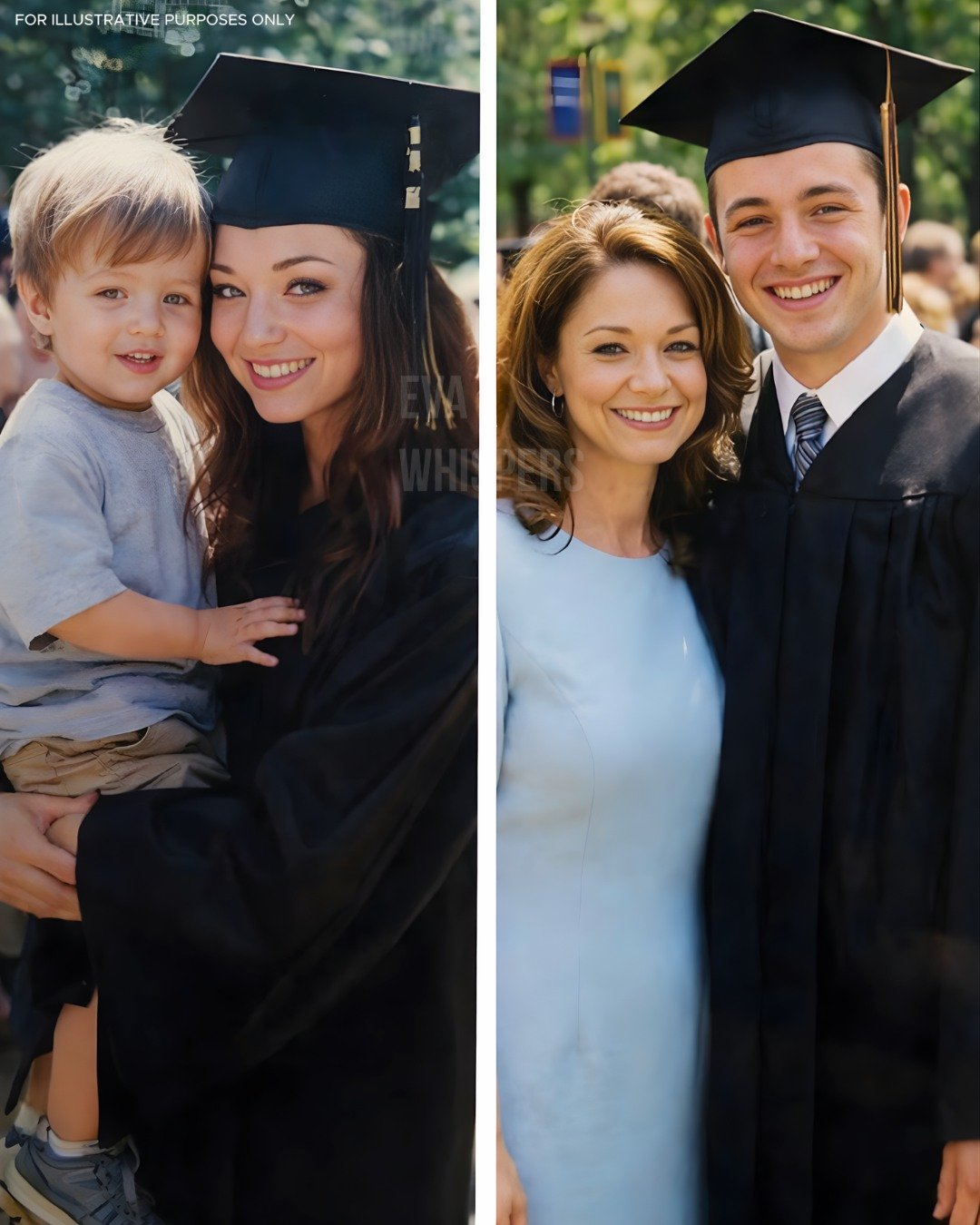
I had always imagined my college graduation as a day of triumph, a day when my mother and I would stand together, smiling, knowing we had conquered every obstacle life had thrown at us. For twenty-two years, she had been my anchor, my guiding star, the one person who never faltered. She had raised me alone, sacrificed her youth, and poured every ounce of her energy into making sure I had a chance at a better life.
That morning, she looked radiant. Her soft light-blue dress shimmered in the sunlight, and her smile was brighter than any I had ever seen. She fussed over my graduation gown, tugging at the folds, insisting on one more photo, then another. I laughed, indulging her, because I knew this day meant as much to her as it did to me.
But then I noticed him.

A man stood off to the side, watching me with an intensity that made my skin prickle. He was tall, well-dressed, with neatly combed hair and a face that carried both age and authority. At first, I assumed he was someone’s father, waiting for his child to cross the stage. But when he stepped forward, my mother’s smile vanished. Her face drained of color, her hands trembling as she clutched her purse.
He tapped me on the shoulder.
“Son,” he said, his voice low but firm. “I’ve been looking for you for a long time. I’m your biological father. Could we talk, please?”
The words hit me like a thunderclap. My body froze, my mind scrambled. My mother’s eyes filled with tears, and she looked as though the ground beneath her had given way.
Then came the words that shattered everything.
“Your mother lied to you your entire life. You deserve to know the truth!”
I stared at him, my heart pounding. My mother’s lips parted, but no sound came out. She looked at me, pleading silently, as if begging me not to listen.
“Lied?” I whispered, my voice trembling.
“Yes,” he said, his jaw tightening. “She told you I abandoned you. That I wanted nothing to do with you. But that’s not the truth. I fought for you. I wanted to be in your life. She kept me away.”
My mother shook her head violently. “No! That’s not true!” Her voice cracked, raw with emotion. “Don’t listen to him. Please.”
The crowd around us seemed to fade. The laughter, the chatter, the clicking of cameras—all of it dissolved into a suffocating silence.
I looked at my mother, then at the man who claimed to be my father. My stomach twisted, torn between loyalty and curiosity.
We moved to a quieter corner of the campus, away from the crowd. My mother clutched my arm, refusing to let go, while the man—my supposed father—stood tall, his eyes burning with determination.
“I was twenty-three when you were born,” he began. “I was in law school. Your mother and I were young, scared, but I wanted to make it work. I wanted to marry her, raise you together. But she—” He pointed at my mother, his voice rising. “She shut me out. She told me I wasn’t good enough. She told me I’d ruin her life. And then she disappeared.”
My mother’s tears spilled freely now. “That’s not how it happened,” she said, her voice trembling. “He left. He chose his career, his freedom. He didn’t want the burden of a child. I begged him to stay, but he walked away.”

The contradiction was unbearable. Two versions of the same story, each delivered with conviction, each dripping with pain.
“Why now?” I asked him, my voice breaking. “Why show up after twenty-two years? Why today?”
He sighed, his shoulders slumping. “Because I couldn’t find you. She made sure of that. And when I finally did, I wanted to wait until you were old enough to understand. Old enough to hear the truth.”
I felt like the ground beneath me was splitting in two. My mother, the woman who had sacrificed everything, who had been my hero, was now accused of lying. And this man, who had been a ghost my entire life, stood before me demanding to be heard.
“Mom,” I whispered, turning to her. “Did you lie to me?”
Her face crumpled. “I did what I had to do,” she said softly. “I wanted to protect you. I didn’t want you to grow up with disappointment, with broken promises. I wanted you to have stability, not chaos.”
Her words pierced me, but so did his.
“You deserved a father,” he said firmly. “You deserved to know me. She robbed you of that.”
The rest of the day passed in a blur. I walked across the stage, shook hands, accepted my diploma, but my mind was elsewhere. My mother clapped and cheered, her smile forced, her eyes red from crying. My father stood at the back, watching silently, his presence heavy and unrelenting.
That evening, I sat alone in my room, staring at the diploma on my desk. It should have been a symbol of triumph, but instead it felt like a reminder of the fracture in my life.
I thought about my childhood—the nights my mother stayed up late sewing my torn clothes, the mornings she skipped breakfast so I could eat, the way she cheered at every soccer game, every school play. She had been everything.
But I also thought about the emptiness I had carried, the unanswered questions, the longing for a father I never knew.
A week later, I agreed to meet him. We sat in a quiet café, the air thick with tension.
“I don’t expect you to forgive me,” he said, his voice softer now. “I just want you to know my side. I loved your mother. I wanted to be there. But she pushed me away. And when I tried to fight, she made it impossible. I was young, I made mistakes, but I never stopped thinking about you.”
I listened, my heart aching. His words carried sincerity, but so did my mother’s.
“Why didn’t you try harder?” I asked. “Why didn’t you fight for me?”
He looked down, shame flickering across his face. “Because I was weak. Because I let fear control me. And I regret it every single day.”

Later that night, I confronted my mother again.
“Did you keep him away?” I asked.
She closed her eyes, her hands trembling. “Yes,” she whispered. “I did. Because I didn’t trust him. Because he was reckless, selfish. Because I was terrified he would hurt you. I thought I was protecting you.”
Her confession cut deep. She hadn’t lied about his absence, but she had hidden the truth. She had chosen for me, decided I was better off without him.
The weeks that followed were filled with turmoil. I met with him again, slowly peeling back the layers of his story. I spent nights talking with my mother, trying to understand her choices.
In the end, I realized there was no simple truth. Both of them had been young, scared, flawed. Both had made mistakes. My mother had sacrificed everything to raise me, but she had also denied me the chance to know my father. My father had wanted to be there, but he hadn’t fought hard enough.
And I was the one left to carry the weight of their decisions.
On a quiet Sunday afternoon, I invited them both to meet. We sat in the park, the air heavy with unspoken words.
“I don’t know who’s right or wrong,” I said, my voice steady. “Maybe you both are. Maybe you both aren’t. But I’m tired of living in the shadow of your choices. I want to move forward. I want to know my father. And I want to keep loving my mother. I refuse to choose between you.”
My mother’s eyes filled with tears, but she nodded. My father looked at me, his expression softening.
It wasn’t forgiveness, not yet. It wasn’t healing, not completely. But it was a start.
Graduation was supposed to mark the end of one chapter and the beginning of another. Instead, it tore open the past and forced me to confront the truth.
I learned that parents are not perfect. They are human, flawed, capable of both love and mistakes. My mother had lied, but out of fear and protection. My father had left, but out of weakness and confusion.
And I, their child, had to find my own truth.
At twenty-two, I realized that family is not about perfection. It’s about facing the pain, acknowledging the flaws, and choosing to move forward.
My story didn’t end with betrayal or anger. It began with understanding.
And as I held my diploma, I knew that my greatest lesson wasn’t from college—it was from life itself.