
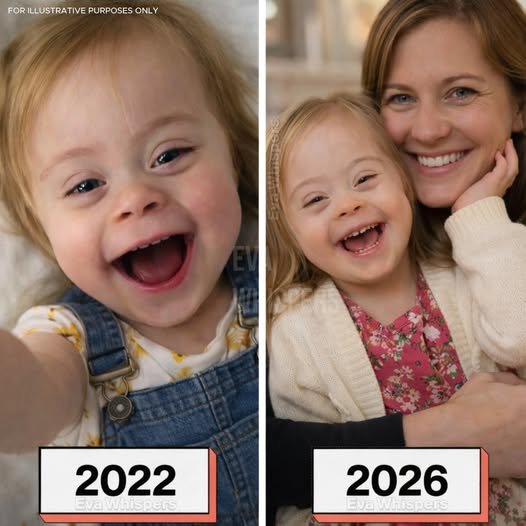
I still remember the first time I saw Evelyn.
She was sitting in a hospital crib, barely eighteen months old, her tiny hands wrapped around the bars as if she were holding herself upright against the world. She didn’t cry when the nurse stepped away. She didn’t reach out either. She just watched—quiet, alert, and heartbreakingly calm for a baby who had already learned what it meant to be left behind.
Her file was thin.
Female. Down syndrome. Abandoned at birth.
Tucked inside was a folded piece of paper, yellowed at the edges.
“We can’t handle a special-needs baby. Please find her a better family.”
I read it once. Then again. Then I couldn’t read it anymore.

After three miscarriages, I had learned how silence could scream. I had learned how hope could shrink until it barely fit inside your chest. My husband, Daniel, had been my anchor through every loss—every ultrasound that ended too soon, every room that became empty before it ever felt full.
We had stopped talking about children altogether. Not because we didn’t want one—but because wanting had begun to hurt too much.
And then there was Evelyn.
She didn’t smile when I approached her crib. She didn’t flinch either. She simply tilted her head slightly, studying my face with dark, thoughtful eyes.
When I reached out, her fingers closed around mine with surprising strength.
Something inside me went still.
“She’s been passed over,” the nurse said gently. “Several families. Some don’t feel prepared.”
Prepared.
I wasn’t prepared for the miscarriages either. I wasn’t prepared for grief. I wasn’t prepared for how empty life could feel when the future you imagined disappears.
But I knew one thing with terrifying certainty.
I was prepared to love her.
Daniel didn’t hesitate when I told him. He read the note once, closed the file, and said, “She’s ours if they’ll let us have her.”
Evelyn didn’t heal everything—but she gave us something just as important.
Peace.
The house filled with sounds again. Soft babbling. Toys clattering across the floor. Laughter—real laughter, the kind that comes from the belly and surprises you when it escapes.
She learned to walk later than most children. She learned words slowly. But when she laughed, the whole room seemed to brighten. When she hugged you, she hugged with her entire body, like she was afraid you might disappear if she let go.
She became our lifeline.

Not everyone shared our joy.
My mother-in-law, Eliza, never tried to hide her disapproval.
“She’ll always need help,” she said once, her voice clipped. “Are you ready for that kind of burden?”
Burden.
Evelyn was sitting on the floor beside her, stacking wooden blocks, humming softly. When she heard Eliza’s voice, she looked up and smiled—a wide, hopeful smile meant for a grandmother she desperately wanted to love her back.
Eliza looked away.
She never held Evelyn. Never played with her. Never learned what made her laugh or what scared her at night. When Evelyn toddled toward her with arms raised, Eliza would step back, pretending to check her phone or rearrange something on the table.
At first, I tried to bridge the distance. I invited her over. I encouraged small moments. I told myself she just needed time.
But time didn’t soften her.
It hardened her.
One afternoon, after Evelyn reached for her again and was ignored again, Daniel quietly said, “That’s enough.”
We stopped visiting.
It wasn’t dramatic. There was no big argument. Just a slow, painful withdrawal. Holidays became quieter. Birthdays smaller. And life—beautiful, imperfect life—went on.
Years passed.
Evelyn turned five on a bright spring morning, her excitement bubbling over from the moment she woke up.
“Cake day!” she announced proudly, clapping her hands.
Friends were coming. Balloons waited in the kitchen. I had frosting under my fingernails and music playing too loudly as I hurried around the house.
When the doorbell rang, I smiled, wiping my hands on a towel.
I opened the door—and froze.
Eliza stood on the porch.
She looked older. Thinner. Her eyes searched my face with an intensity that made my stomach tighten.
“He still hasn’t told you anything?” she asked abruptly.
My smile faded. “Told me what?”
Without waiting for an answer, she walked past me into the house.
Daniel was sitting on the couch, helping Evelyn open a gift. When he looked up and saw his mother, the color drained from his face.

Eliza turned to me and took my hand—her grip firm, almost urgent.
“She needs to know the truth,” she said. “It’s better if you tell her.”
The room seemed to tilt.
Daniel stood slowly. For a moment, he said nothing. Evelyn looked between us, confused, clutching a stuffed rabbit to her chest.
“Daddy?” she asked softly.
He swallowed hard.
“It’s about Evelyn,” he said. “I’m sorry. I should’ve told you sooner.”
My heart began to race. “Told me what?”
He took a shaky breath. “Evelyn isn’t… she isn’t just adopted.”
I stared at him, not understanding.
“She’s my biological daughter.”
The words landed like a physical blow.
The room went silent except for the faint hum of the refrigerator and the sound of Evelyn’s breathing.
I felt weak. Disoriented. “What are you saying?”
Daniel’s voice broke. “Before we met… I was young. I made mistakes. Her birth mother left when she found out about the diagnosis. I panicked. I didn’t know how to do this alone. My mother convinced me to let the hospital handle the adoption.”
Eliza spoke quietly now. “I thought it was best. I thought distance would make it easier.”
My legs gave out. I sat down heavily in the chair behind me.
“You let me adopt your daughter,” I whispered.
“I was afraid,” Daniel said. “Afraid you’d see me differently. Afraid I’d lose you.”
Tears blurred my vision.
And then a small voice broke through.
“I’m right here,” Evelyn said, climbing into my lap. She cupped my face in her hands, just like she always did. “Mama sad?”

I held her tightly, my heart shattering and rebuilding all at once.
“Yes,” I whispered. “But Mama loves you. Always.”
Eliza’s voice trembled. “I stayed away because I was ashamed. I told myself it was about practicality. But really… I was afraid of loving her too.”
Evelyn looked at her, head tilted. After a moment, she smiled and held out her rabbit.
“For you,” she said simply.
Eliza broke.
She knelt in front of Evelyn and took her into her arms, sobbing openly. Years of fear and regret poured out in that embrace.
Nothing was magically fixed that day. Trust doesn’t work that way.
But something shifted.
The truth hurt—but it also freed us.
Evelyn didn’t lose anything that mattered. She had always been loved. She still was.
And as she blew out her birthday candles that afternoon, surrounded by people who finally chose honesty over fear, I realized something profound:
Families aren’t made perfect by biology or broken by truth.
They are made strong by love—the kind that stays, even when it’s hard.