
I never imagined that my grandmother’s will would tear through my family like a storm, but that’s exactly what happened.
I’m 27, and until about a month ago, my life was quiet and predictable. I rented a tiny apartment downtown, worked a mind-numbing insurance job, and spent most of my weekends at my grandma’s small blue house on the edge of our Midwestern town.
Her name was Margaret, though everyone called her Marg. When my older cousin was little, he couldn’t pronounce “Margaret,” and the nickname stuck for good.
She was the kind of woman who never forgot a birthday, who baked pies that made the entire block smell like cinnamon and butter, and who insisted on packing leftovers for you even after you swore you couldn’t eat another bite.

More than anything else in this world, she loved her dog, Bailey.
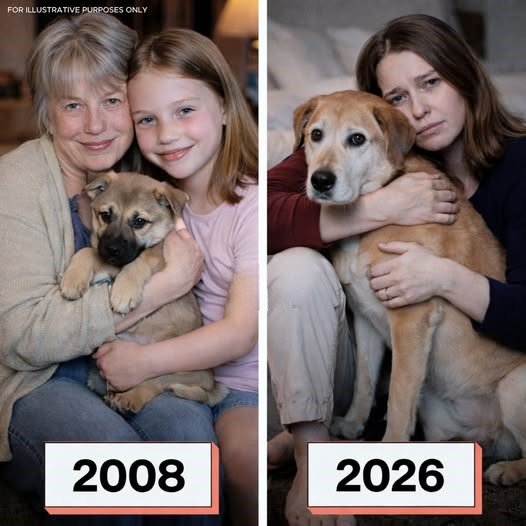
Bailey is a golden retriever mix with a white-frosted muzzle, stiff hips, and the saddest brown eyes you’ve ever seen on a creature that still tries—every single day—to wag his tail like he means it.
Every morning, he would station himself at Grandma’s feet while she sipped instant coffee, watched the local news, and fed him tiny pieces of toast as if they were participating in a sacred ritual known only to the two of them.
Whenever I came over, Bailey would scramble toward the door, his nails skittering wildly across the linoleum, as though I had returned from a long war instead of an office just twenty minutes away.
That’s the context. I was the grandchild who showed up every week. Zack, my cousin, was the one who appeared only when there was something to gain.
Zack is 29. Technically an adult. In reality, he treats responsibility like a casual suggestion rather than a requirement.
He has cycled through more jobs than I can count. He’s either hunting down limited-edition sneakers or posting party videos online. Somehow, he has been perpetually broke since age 16 while still owning better electronics than anyone else in the family.
Grandma defended him without fail.
She would pat my hand and say, “Some kids bloom late, Lily, and some just need more love poured on them like water on a stubborn seed.”
I wanted to believe her. But I had watched Zack take and take and take, leaving behind little more than new gray hairs.
Then Grandma got sick.
At first, she just said she felt tired more often. Then came a fall in the kitchen. Then a hospital stay. And then, far too quickly, a small bedroom in a local hospice.
Zack visited exactly twice. Both times he brought coffee—for himself—and some excuse about traffic or work or whatever had prevented him from coming sooner.
Grandma never complained. She squeezed his hand like his mere presence was the greatest gift imaginable.
She passed away on a clear Tuesday afternoon. I was sitting beside her bed, reading one of her favorite mystery novels—the kind where the killer always turns out to be the neighbor with the perfect lawn.

Bailey lay curled on the floor near her bed. When her breathing stopped, he slowly lifted his head and stared at her for a long moment. Then he made a soft, broken sound I didn’t know a dog was capable of making.
I stayed through the paperwork. Through the phone calls. Through the awkward condolences from neighbors carrying casseroles.
Bailey stayed too, pressed tightly against my ankles as if he feared I might disappear if he let me out of his sight.
At night, he refused to sleep unless my hand rested on him. His fur grew damp with my tears.
So when Mr. Harper, Grandma’s lawyer, called to schedule the will reading, I already knew I would be there—with Bailey.
I didn’t think much about what I would inherit. Grandma had a modest home, some savings, maybe a life insurance policy. Nothing that suggested hidden wealth.
I assumed everything would simply be split between Zack and me.
Zack, however, walked into the lawyer’s office as if he were claiming a prize he had already spent three times in his imagination.
He wore a black designer tracksuit with glossy stripes, a flashy watch that caught the light every time he moved, and sunglasses—despite being indoors on a cloudy day.
The first thing he said to me was, “Try not to cry when you get Grandma’s spoon collection, okay?”
I rolled my eyes and focused on Bailey, who was half-hidden under my chair, trembling so hard that the metal legs rattled.
I scratched his neck and whispered, “We are fine, buddy, I promise,” even though my stomach felt twisted into knots.
Mr. Harper cleared his throat, adjusted his glasses, and began to read.
He started with small bequests—donations to the church, something for a neighbor, something for my mom.
Then he said, “To my grandson, Zack, I leave one $100,000 in cash and bonds, my antique china set, my jewelry, and all proceeds from the sale of my home.”
Zack leaned back like royalty claiming a throne. He folded his arms and shot me a smug sideways grin.
“See?” he whispered. “Told you Grandma knew who the real favorite was.”

I swallowed the lump in my throat and continued rubbing Bailey’s ear.
Mr. Harper turned a page.
“To my granddaughter, Lily, I leave my beloved dog, Bailey.”
For a split second, I thought I had misheard.
Zack had not. He burst into uncontrollable, hiccupping laughter.
“Stop,” he wheezed, wiping his eyes. “Stop, I can’t breathe. She left you the dog? That old mutt? That’s it?”
He shook his head. “Tough break, cuz. All that time playing nurse, and you get a senior citizen dog with bad joints.”
Bailey pressed himself tighter against my legs, as if he understood every word.
I wrapped my arms around his neck and whispered into his fur, “It’s okay, boy, you’re all I need.”
And I meant it.
Grandma had entrusted me with the being she loved most in this world—the one constant companion of the last thirteen years of her life. I would have accepted that responsibility gladly, even if it came with nothing else.
But Mr. Harper cleared his throat again, his expression shifting to something more deliberate.
“There is one more document,” he said, lifting a blue envelope I hadn’t noticed before.
My heart skipped in that unsettling way it does when you nearly miss a step.
“This is your grandmother’s final instruction,” he explained. “She directed me to read it only after Bailey was officially accepted by his new owner.”
He looked at me. “You have accepted him, Lily?”
I nodded, confused. “Of course.”
Zack rolled his eyes. “Yeah, yeah, she’ll take the dog, whatever. Can we be done now?”
Mr. Harper ignored him.
“Your grandmother also asked me to tell you to turn Bailey’s collar around and take a good look,” he said. “Specifically, his tag.”
I blinked at him.
Bailey tilted his head and gave a soft whine, as if he had been waiting for this cue.
My hands trembled as I reached down and rotated the small round tag on his collar.
On the front was his name and the house phone number, worn nearly smooth.
On the back were three neat lines that changed everything.
A small bank logo.
A 10-digit code.
My grandmother’s initials.
“What the hell is that?” Zack demanded, already leaning over to see.

Mr. Harper folded his hands calmly.
“That tag is the key to your grandmother’s private trust account,” he said.
The room fell silent except for the ticking clock behind us.
Zack blinked. “Private what?”
“Your grandmother began the trust in 1989,” Mr. Harper explained. “She received a large inheritance from an elderly neighbor she had cared for at the end of his life. He left her his home and his savings. She sold the property, lived modestly, and invested the rest for the future.”
I remembered the neighbor—Mr. Kern—the man who used to hand out king-size candy bars on Halloween. I had never known about the money.
Zack cut to the point. “So how much is in it? Like, realistically?”
Mr. Harper glanced at a sheet of paper.
“As of last quarter, the balance is approximately $2.8 million.”
Zack made a strangled sound.
“She gave her the trust?” he shouted, pointing at me. “No way. No way. I was supposed to get the big stuff. Grandma told me I was special.”
Bailey rested his head in my lap, his eyes moving back and forth between us.
I stared at the tag in my fingers. If I looked up, I might laugh. Or scream.
Mr. Harper slid a folded note across the table.
“Your grandmother left you a personal message, Zack,” he said.
Zack grabbed it desperately and tore it open.
I watched his expression shift—from rage, to pale shock, to something like humiliation.
He crumpled the paper and slammed it on the table so hard Bailey flinched. The note slid toward me.
I read it.
“My darling boy, you always reached for the biggest prize on the shelf. But the biggest prizes belong to people with the biggest hearts. Real wealth is love that does not keep score. I hope one day you understand this. Love, Grandma.”
Zack shoved his chair back violently.
“She screwed me,” he yelled. “She lied to me my whole life. I won’t accept this. I’ll contest the will. I’ll make sure you don’t see a cent.”
He stormed out, slamming the door so hard a certificate on the wall tilted crooked.
The silence afterward felt enormous.
Bailey exhaled deeply, almost like relief, and rested his head on my knee.
I stared at the tiny metal tag that had just turned me into someone who technically possessed millions—while still driving a ten-year-old car with a cracked bumper.
“I don’t understand,” I said quietly. “Why would she give me all of that and leave Zack with only the house money and things?”
Mr. Harper removed his glasses and rubbed the bridge of his nose.
“Your grandmother came to see me three years ago,” he said. “She told me about you bringing her to appointments, helping with groceries, fixing her television, sitting with her when she was frightened. She said you never asked for anything. Never hinted about money.”
“I would have done those things even if she left me absolutely nothing,” I whispered.
He nodded. “She knew that. That is precisely why she trusted you with the larger responsibility. In her mind, this trust is not a lottery ticket. It’s a tool. She believed you would use it well.”
Tears filled my eyes again—but this time they were layered with something deeper than grief. Gratitude. Fear. The weight of responsibility.
“I have no idea what I’m doing,” I admitted. “I work in claims. I barely manage my own budget.”
Mr. Harper smiled gently. “Then your first step is to hire a good financial planner, not a sports car,” he said. “Your grandmother also left instructions that Bailey is to be cared for using this money if needed. She told me, and I quote, that the dog retires in style.”
I let out a choked laugh that turned into a sob.
Bailey licked my wrist, clearly approving.

The following weeks blurred into paperwork, phone calls, and whispered family gossip about what Grandma “would have wanted.”
Zack followed through on his threat and contested the will.
From what I heard, he burned through much of his $100,000 on lawyers, travel, and rage-driven spending before a judge ruled the will valid and reminded him that grief does not equal injustice.
The last time I glanced at his social media—something I probably shouldn’t have done—he was posting about fake family and sharing cryptic memes about snakes.
Meanwhile, I kept going to work.
I took Bailey on slow neighborhood walks.
I met with advisors in offices that smelled faintly of coffee and printer ink.
We created a plan: pay off my student loans, set aside enough to buy a small house with a yard someday, and continue investing the rest carefully and quietly—just as Grandma had done.
I established a scholarship fund in her name. I donated to local animal rescues. It felt wrong to hold so much without widening the circle.
On weekends, I sometimes drive past her old neighborhood and park in front of the little blue house, now owned by a young couple with flower boxes.
Bailey and I walk our old route.
The new owners sometimes wave politely from the porch. They have no idea that the aging dog sniffing their mailbox once carried the key to a hidden fortune on his collar.
Bailey grows slower each month.
His joints ache. His eyes are clouding. Sometimes he forgets where he was headed halfway down the hall.
But at night, when he curls beside my bed and releases a long, contented sigh, I feel a steady warmth—as though Grandma is still here, quietly overseeing everything.
Sometimes I hold his tag and trace the engraved code with my thumb—the tiny, ordinary object that concealed the biggest secret she had.
She used to say, “If you want to know who someone really is, watch how they treat someone who cannot give them anything back.”
As it turns out, the person who most needed to learn that lesson wasn’t me.