
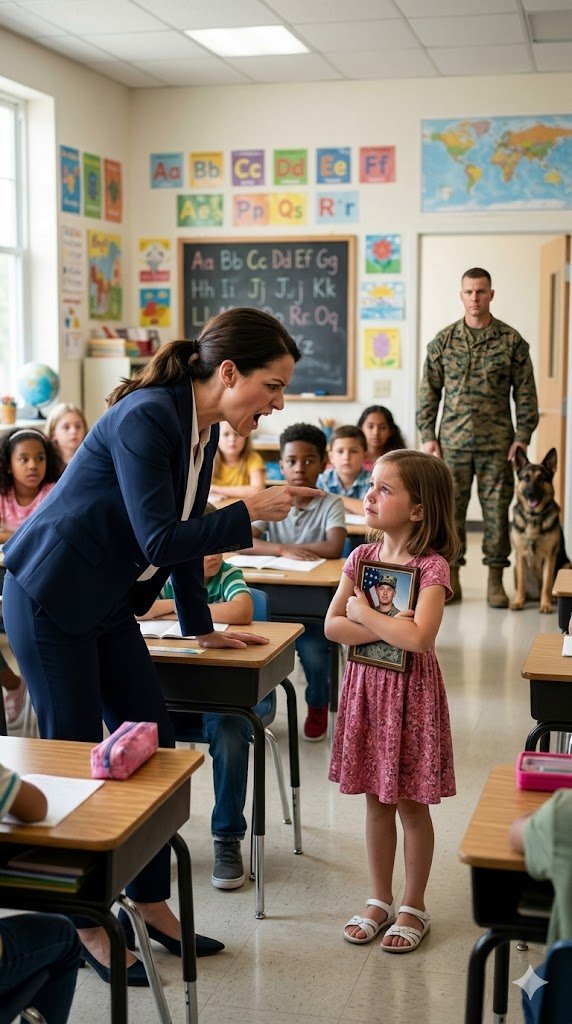
Maya Jensen was eight years old, and the kind of proud that made her stand straighter than her small sneakers suggested.
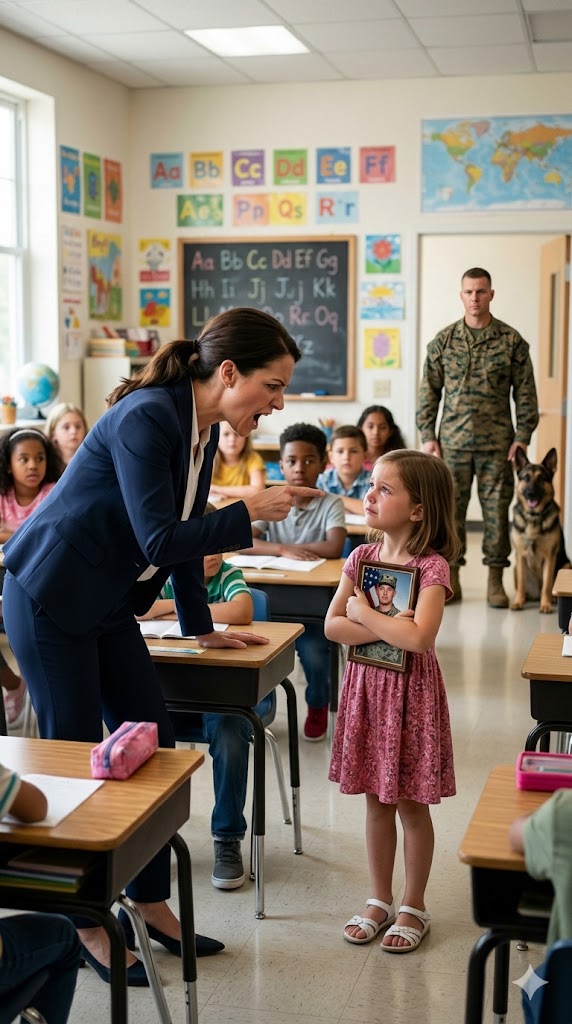
In Room 12 at Pine Ridge Elementary, the “My Hero” presentations were a weekly tradition—construction paper, glue sticks, uneven handwriting, and parents’ professions transformed into legends. Maya waited her turn with a poster board hugged to her chest. On it, she had drawn a man in camouflage beside a sleek Belgian Malinois, ears alert, eyes sharp. Across the top, in bold marker: MY HERO: MY DAD.
When Ms. Evelyn Carrow called her name, Maya stepped to the front, hands steady. “My dad is a Marine,” she said clearly. “He works with a military dog named Ranger. Ranger helps keep people safe.”
A few classmates leaned in. Someone whispered, “Cool.” Maya’s smile trembled—until Ms. Carrow let out a sigh, as if burdened.
“Interesting,” the teacher replied, eyes still on her clipboard. “Maya, where did you get that information?”
Maya blinked. “From my dad.”
Ms. Carrow’s lips pressed into a narrow smile. “That’s not a reliable source.”
The mood in the room shifted. A snicker burst from the back like a popped balloon.
Maya tried again, speaking more carefully. “He trains Ranger to help find dangerous things. Like explosives.”
Ms. Carrow shook her head. “Military canine operations are confidential. Children sometimes misunderstand or exaggerate. We can’t treat imagination as fact.”
Maya felt heat rise to her cheeks. “It’s not imagination.”
Ms. Carrow tapped her pen lightly. “Then bring documentation.”
Maya swallowed. She had a photograph—her father in uniform, Ranger seated perfectly beside him, both staring at the camera with the same disciplined focus. But she hadn’t brought it. Kids didn’t carry proof of their parents. They carried pride.
Ms. Carrow’s tone softened into something falsely gentle. “Sweetie, your dad is just a Marine. That doesn’t make him a hero.”
The room fell silent for a breath, then filled with uneasy laughter—children echoing the adult’s cue.
Maya’s fingers curled tighter around her poster. Her eyes burned, but she refused to cry in front of everyone.
“You need to apologize,” Ms. Carrow went on. “Tell the class you misled them, and redo your project with something factual. Firefighters are a good option. Doctors as well.”
Maya’s voice was barely audible. “I’m sorry,” she murmured, though she didn’t know what she was apologizing for.
After school, she walked home quietly. Her mother, Brooke Jensen, sensed something was wrong the moment Maya didn’t rush toward the car.
At the kitchen table, Maya finally crumbled—tears falling onto the poster board, blurring the word HERO.
Brooke listened without interrupting. Then she asked Maya to recount everything: the teacher’s exact words, the laughter, who was sitting nearby. Brooke wrote it all down. She didn’t raise her voice. She didn’t make threats. She simply picked up her phone and dialed a number she rarely called.
Two time zones away, on a Marine base, Staff Sergeant Ethan Jensen listened without speaking.
When Brooke finished, Ethan said only, “I’ll be there tomorrow.”
Then he glanced at the dog sitting flawlessly at his side.
Ranger lifted his head—focused, prepared, as if he already understood.
Because the teacher demanded an apology… but what would she do when Maya’s “just a Marine” walked into Pine Ridge Elementary—with his K9 partner and official documents that could change everything?
Part 2
The next morning, Pine Ridge Elementary moved through its usual rhythm—yellow buses lining up, syrupy breakfast trays, children flooding the halls with bouncing backpacks. Ms. Evelyn Carrow gave little thought to Maya Jensen beyond mild irritation at what she considered “another exaggerated project.” In her view, she had simply reinforced a lesson: facts matter, credibility matters, reality matters.
She hadn’t noticed what she overlooked.
Maya sat at her desk as if trying to fade into the background. Her poster was rolled tight and hidden away, as though concealing it could shrink what had happened. When math began, her eyes stayed on her paper, but her ears tracked every sound near the door. Not because she truly expected anything—children rarely expect swift justice—but because hope sometimes shows up uninvited.
At 10:18 a.m., the office called Room 12.
“Ms. Carrow,” the secretary said, voice controlled, “you have visitors. Please have your class begin a quiet activity. The principal needs you in the hallway.”
Ms. Carrow hesitated. Visitors weren’t rare—but that tone was. She instructed the students to read silently and stepped outside.
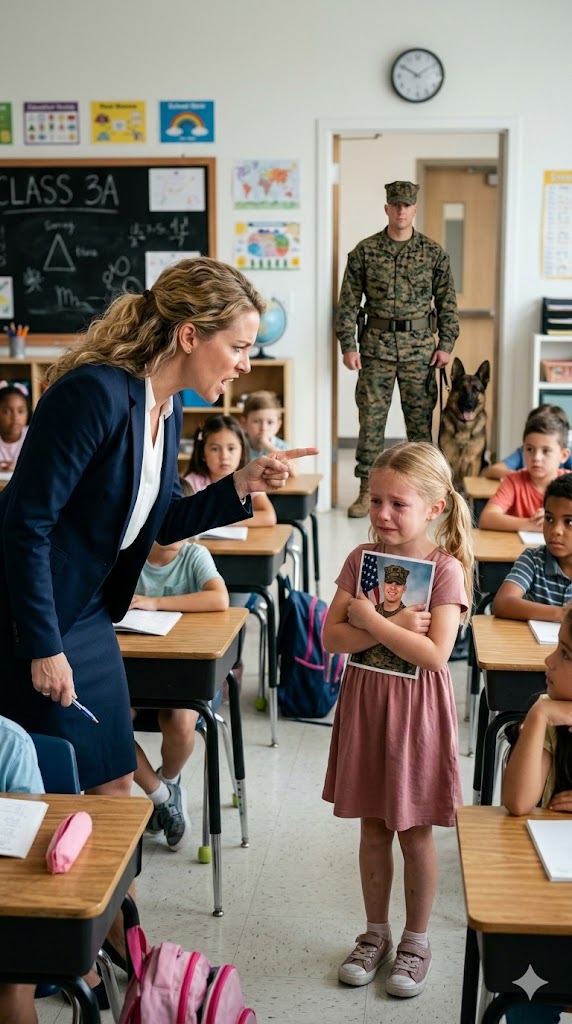
In the corridor stood Principal Lorna Keating, a district representative Maya didn’t recognize, and a man dressed in civilian clothes who carried himself like a Marine even without the uniform. Beside him sat a Belgian Malinois, motionless, alert eyes calmly surveying the space. The dog wore a working harness, leash held with easy authority.
The man looked directly at Ms. Carrow. “Good morning. Staff Sergeant Ethan Jensen.”
Her composure flickered. “This is… about Maya?”
Principal Keating gave a firm nod. “Yes. And we’re addressing it properly.”
The district representative introduced herself and lifted a folder. “Mrs. Jensen submitted a formal complaint last night. She included a written account from her daughter and requested immediate review.”
Color rose in Ms. Carrow’s face. “I acted appropriately. I corrected misinformation.”
Ethan’s tone stayed measured. “You told my eight-year-old she misled her classmates. You required her to apologize for describing my job. You called me ‘just a Marine.’”
The hallway felt smaller.
Ms. Carrow tried to steady herself. “Children exaggerate. Military work is classified. It would be irresponsible to—”
Ethan opened his folder and presented a document. “This letter from my command verifies my assignment and confirms my daughter’s explanation was accurate at an age-appropriate level. Here’s a public affairs summary outlining what we’re permitted to share. Nothing classified.”
He wasn’t angry. He was precise—the way someone trained to separate emotion from action.
Ranger remained seated, still but ready, every line disciplined rather than tense. That quiet control carried more weight than raised voices ever could.
Principal Keating spoke. “Ms. Carrow, we’ll meet now. There will be next steps.”
Inside the conference room, Brooke Jensen sat composed, hands folded with the calm of someone who had turned hurt into documentation. She didn’t accuse. She slid her notes across the table—time stamps, direct quotes. She had brought Maya’s poster and a photograph of Ethan and Ranger in uniform at a family event, the dog off duty yet unmistakably professional.
“I’m not here for retaliation,” Brooke said evenly. “I’m here because my daughter learned that an adult can humiliate her publicly and label it ‘education.’ That lesson can last a lifetime.”
Ms. Carrow stiffened. “I was encouraging critical thinking.”
The district representative leaned forward. “Critical thinking involves curiosity, not shame.”
Ethan added quietly, “You didn’t ask Maya questions. You didn’t explore her explanation. You dismissed her father’s service and demanded an apology.”
Ms. Carrow parted her lips, then paused. For the first time, doubt surfaced—not because she felt attacked, but because the facts left little room to maneuver.
Principal Keating outlined the response: a direct apology to Maya, a counselor-led restorative session, required professional development on bias and respectful inquiry, formal documentation of the incident, and removal of Ms. Carrow from overseeing presentations for the remainder of the unit.
Then Brooke made one final request.
“I want her classmates to learn something as well,” she said. “Not that adults can demand apologies—but that truth deserves respect.”
Principal Keating nodded. “Agreed.”
That afternoon, she entered Room 12 and asked the students to sit quietly. Ms. Carrow stood at the front, pale, hands clasped tight. Maya felt her stomach knot.
Then the door opened.
Staff Sergeant Ethan Jensen stepped in calmly—Ranger moving beside him like a shadow. The dog’s presence didn’t inspire fear; it commanded attention. The children straightened in their seats.
Ethan offered a small nod. “Hi. I’m Maya’s dad.”
A whisper traveled across the room. “Whoa.”
His voice stayed warm. “Maya told you the truth yesterday. I’m here because sometimes adults make mistakes—and when we do, we fix them.”
Ms. Carrow swallowed.
“Ranger is my partner,” Ethan continued. “He’s trained to detect dangerous materials and help protect Marines. At work, he isn’t a pet—he’s a professional.”
At a quiet command, Ranger sat, perfectly composed.
Principal Keating then said, “Ms. Carrow has something to say.”
Ms. Carrow turned to Maya, voice unsteady but clear. “Maya, I’m sorry. I was wrong to embarrass you and wrong to dismiss your father’s service. You did not mislead anyone. You told the truth.”
Relief surged through Maya so quickly it almost hurt.
As the room began to exhale, Ethan looked at Ms. Carrow and added one final sentence, steady and deliberate:
“I also want to understand why it was so easy to assume my daughter was lying—because this is about more than one assignment.”
What had Ethan noticed… and what would the counselor uncover once deeper conversations began in Part 3?
Part 3
The counseling session took place two days later in a small room furnished with soft chairs meant to create comfort. Maya sat between her parents, her feet dangling above the floor. Across from them were Ms. Carrow, Principal Keating, and the school counselor, Dr. Naomi Feld.
Dr. Feld began with a clear guideline. “We focus on impact, not excuses.”
Maya twisted the cuff of her sleeve. Dr. Feld asked gently, “Can you share what you felt when Ms. Carrow said your dad wasn’t a hero?”
Maya’s voice was faint at first. “I felt… stupid,” she said. “And like I shouldn’t talk about my dad. Like he’s… something to hide.”
Brooke’s eyes filled, but she remained silent. Ethan’s jaw tightened as he breathed slowly, steadying himself against the urge to shield Maya from the memory.
Dr. Feld nodded. “That’s a lot for an eight-year-old to carry.”
She turned to Ms. Carrow. “What do you hear in Maya’s words?”
Ms. Carrow swallowed. “That I hurt her,” she admitted. “That I made her feel ashamed.”
Dr. Feld let the quiet sit. “Yes.”
Ms. Carrow looked at her hands. “I believed I was preventing… misinformation.”
Ethan’s tone remained controlled. “You didn’t clarify. You discredited. You turned ‘facts’ into a weapon.”
Principal Keating then asked Dr. Feld to explain the broader review the school had begun—because Ethan’s comment in the classroom had not been a threat. It had been insight.
Over the previous two days, Dr. Feld had spoken discreetly with staff and reviewed notes and parent communications. Nothing explosive—just recurring patterns. A few students had been labeled “dramatic” when describing difficult family circumstances. One child’s “My Mom is a Paramedic” project had been questioned with the comment, “your mom doesn’t look like a paramedic.” A student with an immigrant father had been told his dad’s job “wasn’t really a career.”
Individually, each instance might seem minor. Together, they revealed a pattern.
Principal Keating addressed it directly. “Ms. Carrow, there is a consistent issue here: when a child’s experience doesn’t align with your assumptions, you default to doubt.”
Ms. Carrow’s expression tightened, but she didn’t argue. After a long silence, she said quietly, “I didn’t realize how often I was doing that.”
Dr. Feld replied, “That’s why accountability matters. Consequences without growth are punishment. Growth without accountability is empty.”
They agreed on a documented plan: coaching sessions with Dr. Feld, structured classroom observations by an instructional mentor, and professional development centered on bias awareness and student dignity. Ms. Carrow would also complete restorative practice training and submit written reflections—not to shame her, but to ensure meaningful change.
Then Ethan surprised the room.
“I’m not asking for her to be fired,” he said calmly. “I’m asking for my daughter to feel safe in her classroom. And for the next child to be believed.”
Ms. Carrow looked up, startled. “Why?” she asked softly. “After what I did—why not?”
Ethan answered simply. “Because I don’t want Maya to think the only way to fix harm is to ruin someone. I want her to see that people can take responsibility and improve.”
Maya looked at her father with new understanding—seeing strength not as volume or force, but as steady conviction.
The following week, Pine Ridge held a “Community Heroes” assembly. It wasn’t extravagant, but it was intentional. Students presented again, and the school introduced a guideline: family stories could be shared without interrogation. Teachers were encouraged to ask respectful, curiosity-based questions.
Maya brought her poster back, repaired with tape where tears had damaged it. She stepped up to the microphone in the gym, her knees trembling.
“My dad is a Marine,” she said, more confidently than before. “His partner is Ranger. Ranger helps keep people safe. My dad helps too.”
Ranger sat beside Ethan near the front, poised and calm. When Maya spoke, the dog’s ears shifted toward her voice before settling again, composed and attentive.
When she finished, the applause was genuine. Teachers clapped. Parents clapped. Students clapped—some in understanding, some in solidarity, some simply because it felt right.
Afterward, Ms. Carrow approached Maya and lowered herself to meet her eyes. “You were brave,” she said. “Thank you for giving me the chance to learn.”
Maya didn’t offer instant forgiveness. She paused, then gave a small nod. “Okay,” she replied, as if allowing the future to move forward.
In the months that followed, Brooke noticed changes. Ms. Carrow’s feedback grew more thoughtful and less dismissive. When students shared unique family stories, she responded with, “Tell us more,” instead of, “Prove it.” Maya stopped shrinking in class. She raised her hand again. She laughed again.
One afternoon, Maya came home with a new drawing: a classroom and a large speech bubble that read, “I believe you.”
Brooke placed it on the refrigerator.
Ethan watched Maya race outside, her ponytail swinging, and felt something rare—relief. Not because his service had been validated, but because his daughter’s dignity had been defended—and because the school chose growth instead of harm.
The story closed not with a villain defeated, but with a child restored, an adult accountable, and a community nudged a little closer to fairness.
Share this if you’ve seen a child dismissed—comment your story, and help normalize respect in every American classroom today.