
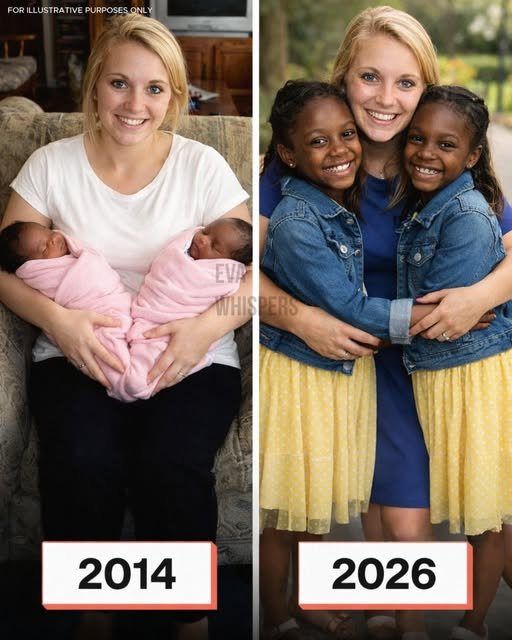
Twelve years ago, at 5 a.m. on my trash route, I stumbled upon a stroller abandoned on a frozen sidewalk. Inside were twin baby girls. That moment changed my life forever—I thought the wildest part of our story was how we found each other. But a phone call this year proved me wrong.
I’m 41 now, but back then, life was simple. I worked sanitation, driving one of those big trash trucks. At home, my husband Steven was recovering from surgery. That morning was bone-cold—the kind of cold that bites your cheeks and makes your eyes water. I had just changed his bandages, fed him, kissed his forehead, and told him, “Text me if you need anything.”
He grinned weakly. “Go save the city from banana peels, Abbie.”
It was just us then—Steven, me, our tiny house, and our bills. No kids. Just a quiet ache where we wished they were.
As I turned onto one of my usual streets, humming along to the radio, I saw it: a stroller sitting in the middle of the sidewalk. Not near a house, not by a car—just abandoned. My stomach dropped.
I slammed the truck into park, hazards flashing, and ran over. Two tiny babies. Twin girls. Maybe six months old. Curled under mismatched blankets, cheeks pink from the cold. They were breathing—I could see little puffs of air.
I looked up and down the street. No parent. No door opening. No one shouting.
“Hey, sweethearts,” I whispered. “Where’s your mom?”
One opened her eyes and looked right at me. I checked the diaper bag—half a can of formula, a couple of diapers. No note. No ID. Nothing. My hands shook as I dialed 911.
“Hi, I’m on my trash route,” I said, voice trembling. “There’s a stroller with two babies. They’re alone. It’s freezing.”
The dispatcher’s tone shifted instantly. “Stay with them. Police and CPS are on the way. Are they breathing?”
“Yes,” I said. “But they’re so small. I don’t know how long they’ve been here.”
“You’re not alone anymore,” she reassured me.
I pushed the stroller against a brick wall to block the wind and knocked on doors. Lights flicked on, curtains twitched, but no one opened up. So I sat on the curb beside them, knees pulled up, whispering, “It’s okay. You’re not alone anymore. I’m here. I won’t leave you.”
Eventually, police arrived, followed by a CPS worker in a beige coat. She checked them over, asked for my statement, then lifted one baby on each hip and carried them to her car.
“Where are they going?” I asked, chest aching.
“To a temporary foster home,” she said. “We’ll try to find family. I promise they’ll be safe tonight.”
The car drove away, leaving the stroller empty. Something inside me cracked open.
That night, I couldn’t stop seeing their faces. At dinner, I pushed food around my plate until Steven set his fork down.
“Okay,” he said. “What happened? You’ve been somewhere else all night.”
I told him everything—the stroller, the cold, the babies, watching them leave with CPS. “I can’t stop thinking about them,” I admitted. “What if no one takes them? What if they get split up?”
He went quiet, then said, “What if we tried to foster them?”
I laughed nervously. “Steven, they’re twins. Babies. We’re barely keeping up now.”
“You already love them,” he said, reaching for my hand. “I can see it. Let’s at least try.”
That night, we cried, talked, planned, and panicked. The next day, I called CPS.
We began the process—home visits, questions about our marriage, income, childhoods, trauma, even our fridge. A week later, the same social worker sat on our couch.
“There’s something you need to know about the twins,” she said gently. “They’re profoundly deaf. They’ll need early intervention, sign language, specialized support. A lot of families decline when they hear that.”
I looked at Steven. He didn’t even blink.
“I don’t care if they’re deaf,” I said firmly. “I care that someone left them on a sidewalk. We’ll learn whatever we need.”
Steven nodded. “We still want them.”
Her shoulders relaxed. “Okay. Then let’s move forward.”

A week later, they arrived—two car seats, two diaper bags, two sets of wide, curious eyes. “We’re calling them Hannah and Diana,” I told the worker, signing their names clumsily.
Those first months were chaos. They didn’t respond to loud noises, but they reacted to lights, movement, touch, and facial expressions. Steven and I took ASL classes at the community center, practiced in the bathroom mirror, watched videos at 1 a.m.
“Milk. More. Sleep. Mom. Dad.”
Sometimes I messed up, and Steven would tease, “You just asked the baby for a potato.”
Money was tight. I picked up extra shifts, Steven worked part-time from home. We sold things, bought secondhand baby clothes. Exhausted—but happier than ever.
On their first birthday, we celebrated with cupcakes and too many photos. When they signed “Mom” and “Dad” for the first time, I nearly fainted.
“They know,” Steven signed, eyes wet. “They know we’re theirs.”
Years flew by. We fought for interpreters at school, for services, for people to take them seriously. Hannah fell in love with drawing, designing clothes. Diana loved building—Legos, cardboard, broken electronics.
At 12, they came home excited. “We’re doing a contest at school,” Hannah signed. “Design clothes for kids with disabilities.”
“We’re a team,” Diana added. “Her art. My brain.”
Their designs were brilliant—hoodies with room for hearing devices, pants with side zippers, tags that didn’t itch. Bright, fun, adaptive clothing.
“We won’t win,” Hannah shrugged. “But it’s cool.”
“No matter what happens, I’m proud of you,” I signed.
Weeks later, while cooking, my phone rang. Unknown number.
“Hi, is this Mrs. Lester?” a warm voice asked. “This is Bethany from BrightSteps. We partnered with your daughters’ school on a design challenge. Hannah and Diana submitted a project.”
“Yes,” I said cautiously. “Is something wrong?”
“Quite the opposite,” she laughed. “Their designs were outstanding. We’d like to turn that project into a real collaboration. A paid line of adaptive clothing.”
My mouth went dry. “A real… line?”
“Yes,” she said. “Projected royalties around $530,000.”
I almost dropped the phone. “Did you say 530,000?”
“Yes, ma’am. Of course, it depends on sales, but that’s the estimate.”
I whispered, “My girls did that? Hannah and Diana?”
“You’ve raised very talented young women,” she said. “We’d love to set up a meeting—with interpreters, of course.”
When I hung up, I sat stunned. Steven walked in. “Abbie? You look like you saw a ghost.”
“Closer to an angel,” I said, half laughing, half crying.
I explained, and his jaw dropped. “You’re joking.”
“I wish I were,” I said. “Our girls. The ones someone left in a stroller. They did this.”

Later, Hannah and Diana stormed in. “We’re hungry,” Diana signed. “Feed us.”
“What’s wrong with your face?” Hannah asked. “You’ve been crying.”
“Sit,” I signed. “Both of you.”
I told them everything. Their eyes widened. “Are we in trouble?” Hannah asked.
“No,” I signed. “They loved your work. They want to make real clothes from your ideas. And they want to pay you.”
“How much?” Diana asked.
I signed the number. Silence. Then both signed at once: “WHAT?!”
Tears filled Diana’s eyes. “We just wanted shirts that don’t pull on hearing aids. Pants that are easier to put on. Stuff that makes life less annoying.”
“And that’s everything,” I signed back. “You used your experiences to help other kids. That’s huge.”
They launched at me, hugging hard. “I love you,” Hannah signed. “Thank you for learning our language.”
“Thank you for taking us in,” Diana added. “For not saying we were too much.”
I wiped my face. “I found you in a stroller on a cold sidewalk. I promised myself I wouldn’t leave you. Deaf, hearing, rich, broke—you’re my daughters.”
That night, we sat at the table, going through emails, writing questions, texting a lawyer. We talked about saving, college, giving back to their school’s deaf program, fixing up the house. Maybe I could finally quit the brutal early shift.
Later, when everyone was asleep, I looked at their old baby photos. Two tiny girls, abandoned in the cold. Two strong teens, designing a better world for kids like them.
People sometimes tell me, “You saved them.”
But the truth is, they saved me right back.
Those two tiny girls I found in a stroller on a freezing sidewalk grew into strong, creative teens who are designing a better world for kids like them. They gave me purpose, joy, and a family I never thought I’d have.
From mismatched blankets in the cold to signing “Mom” and “Dad” with proud little hands, to now shaping an entire clothing line that could change lives—their journey is extraordinary. And mine, alongside them, has been just as life-changing.
They weren’t too much. They were everything. And I’ll never stop being grateful that fate put us on the same street that morning.