
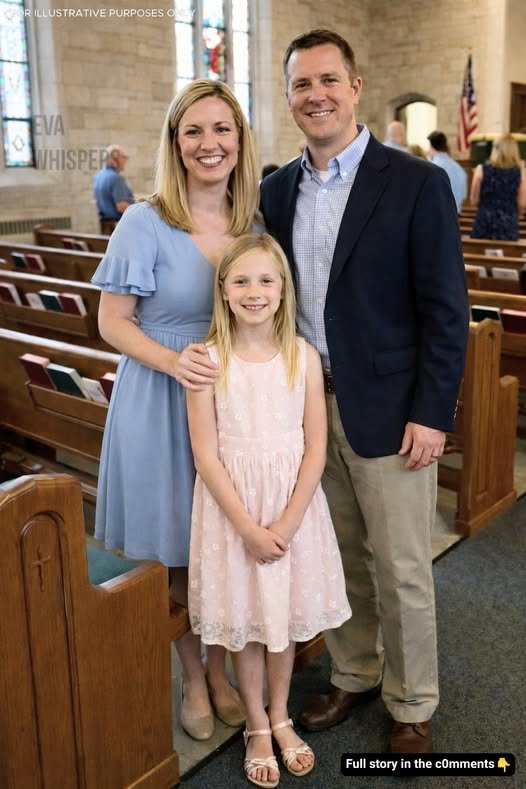
Brian and I had been together for twelve years, married for ten. Religion had never been part of our lives. We hadn’t set foot in a church as a couple — not for Easter, not for Christmas, not even for our wedding. That simply wasn’t us.
I worked in marketing for a nonprofit, while Brian managed corporate accounts in finance. Our lives were busy, structured, and ordinary. We had a daughter, Kiara, who had just turned nine.
Sundays were sacred in our household — not for scripture, but for sleeping in, pancakes, cartoons, and the occasional grocery run if we felt ambitious. It was our ritual, our version of peace.
So when Brian casually suggested going to church one Sunday, I thought he was joking. He wasn’t.
“Wait,” I asked, tilting my head. “Like… actually attend a service?”
“Yeah,” he said, not looking up from his eggs. “I think it’d be good for us. A reset or something.”
I laughed. “You? The man who once called a church wedding ‘a hostage situation with cake’? That man now wants to go to church?”
He gave a small smile, but it didn’t reach his eyes.
“Things change, Julie. I’ve been feeling… stressed lately. Like I’m carrying too much. Burning out. Work’s overwhelming. I just need a place to breathe.”
I studied him. His posture was tense, and he hadn’t been sleeping well.
He added, sincerely, “I feel really good when I’m there. I like the pastor’s message. It’s positive. And I want something we can do as a family. Community.”
I didn’t want to shut down what seemed like a healthy coping mechanism. So church became our new Sunday ritual.
The first time we went, I felt completely out of place. The building was pristine, the people unusually friendly. We sat in the fourth row, and Brian seemed to know exactly where he wanted to be. Kiara doodled on a kids’ bulletin while I scanned the stained-glass windows, wondering how long this would last.
But Brian looked peaceful. He nodded along with the sermon, even closed his eyes during prayer, as if he’d been doing it his whole life.
Week after week, it was the same. Same church, same row. Brian shook hands, smiled, helped carry donation bins. Honestly, it seemed fine. Eventually, I thought: Okay. Weird, but harmless.
Then one Sunday, after service, Brian told me, “Wait in the car. I just need to run to the bathroom.”
Ten minutes passed. I called, texted — no answer. Kiara tugged at my sleeve, asking when we’d leave. Something gnawed at me.
I asked Sister Marianne, a kind woman I’d seen before, to watch Kiara for a few minutes. Then I went back inside.
The men’s bathroom was empty.
That’s when I saw him. Through a half-open window in the hallway, Brian stood in the church garden, talking to a tall blonde woman in a cream sweater and pearls. She looked like the type who chaired book clubs and Homeowners’ Associations. Her arms were crossed tightly. Brian was animated, talking with his hands, stepping closer than I liked.
The window was cracked open, and I heard every word.
“Do you understand what I did?” Brian said, his voice low but raw. “I brought my family here… so that I could show you what you lost when you left me.”
My whole body went cold.
“We could’ve had it all,” he continued. “A family, a real life, more kids. You and me. If you wanted the perfect picture — the house, the church… I’m ready now. I’ll do anything. Anything.”
I froze, unable to breathe.
The woman’s reply was calm but steely. “I feel sorry for your wife. And your daughter. Because they have you for a husband and father.”
Brian blinked, stunned.
She pressed on. “We are never getting back together. You need to stop contacting me. This obsession you’ve had since high school? It’s not love. It’s creepy. Stalker-level creepy. If you ever contact me again, I’ll file a restraining order.”
She walked away without looking back. Brian stood hunched, defeated, as if watching his fantasy collapse.
I backed away from the window, shaken.
When I returned to the car, Kiara was happily chatting with Marianne, oblivious. Brian joined us minutes later, kissed Kiara’s forehead, and said casually, “Sorry I took so long. There was a line for the bathroom.”
I nodded, even smiled. But inside, I knew I needed proof.

The following Sunday, everything looked normal. Same routine, same row. After service, Brian again said, “Wait here. Bathroom.”
This time, I didn’t hesitate.
I found the blonde woman near the coffee table. She was stirring sugar into her cup. I approached softly. “Hi. I think we need to talk. I’m… Brian’s wife.”
Her jaw clenched. She didn’t look surprised, just tired.
“I heard everything,” I said. “Last week. The garden window was open. I didn’t mean to… but I did.”
She stared at me with pity and horror.
“I don’t know what’s happening,” I continued. “But I can’t go home and pretend I didn’t hear it. I need the truth.”
She sighed, pulled out her phone, and said, “My name is Rebecca. And you’re not imagining anything.”
She showed me years of texts — desperate, angry, poetic, unanswered. Recently, a photo of the church sign with his message: I see you. I know where you go now.
“He found out I was attending here because I posted one photo on Facebook,” she explained. “The next week, he was sitting behind me. With his family.”
She told me he’d been pursuing her since they were seventeen — letters in college, showing up at her first job, finding her after moves and number changes.
I whispered, “I’m so sorry.”
Her eyes hardened. “No. I’m sorry. That man is dangerous, even if he doesn’t look it. Be safe. And don’t let him twist this. He’s good at that.”
I returned to Kiara and Brian, smiling as if nothing had happened, though my body was cold and trembling.
That night, I couldn’t sleep. Every memory felt counterfeit — repurposed. Because it wasn’t just that he had chased another woman. It was that I was never the destination. I had been the prop.
The next evening, after Kiara went to bed, I confronted him.
“I know the truth,” I said calmly.
He froze. “What?”
“Church. Rebecca. All of it.”
His face paled, then he laughed nervously. “Wait, what? Julie, what are you talking about?”
“You know what I’m talking about. I heard you last week. In the garden.”
His eyes narrowed. “You followed me?”
“I looked for you. You said you were in the bathroom. You weren’t. I heard everything.”
I pressed on. “I know you told her you loved her. I know you said you brought us to church just to show her what she was missing. And I know she rejected you. Completely. Called you a stalker.”

His mask cracked, anger flickering. “I don’t think you understand what you heard. This isn’t what it—”
“It’s exactly what it looks like,” I cut in. “And I talked to her. I saw the messages. The photos. I saw how long this has been going on.”
He tried to minimize it. “Julie, come on. We’ve been married ten years. We have a daughter. That’s just ancient history.”
“Ancient history?” I echoed. “You messaged her last week!”
He swallowed hard.
“You kissed our daughter,” I said, voice shaking, “after telling another woman you’d leave us for her.”
“Nothing happened,” he said quickly. “She didn’t even say yes.”
“That’s your defense? That she said no?”
Silence.
I took a deep breath. “My attorney is sending the divorce paperwork this week.”
His face twisted. “Julie, please. We can fix this!”
“No, Brian. We can’t fix something that was never real. You used Kiara and me. And I refuse to let our daughter grow up thinking this is what love looks like.”
He sat stunned, as if consequences had never occurred to him. “What am I supposed to tell her?”
“Tell her the truth,” I said. “And then show her how to take responsibility.”
I walked out, paused at Kiara’s door, and watched her sleep under the glow of her nightlight. My chest filled not with heartbreak, but with resolve.
I couldn’t control what Brian had done. But I could control what came next. And I would never again let someone use me to chase a fantasy.