
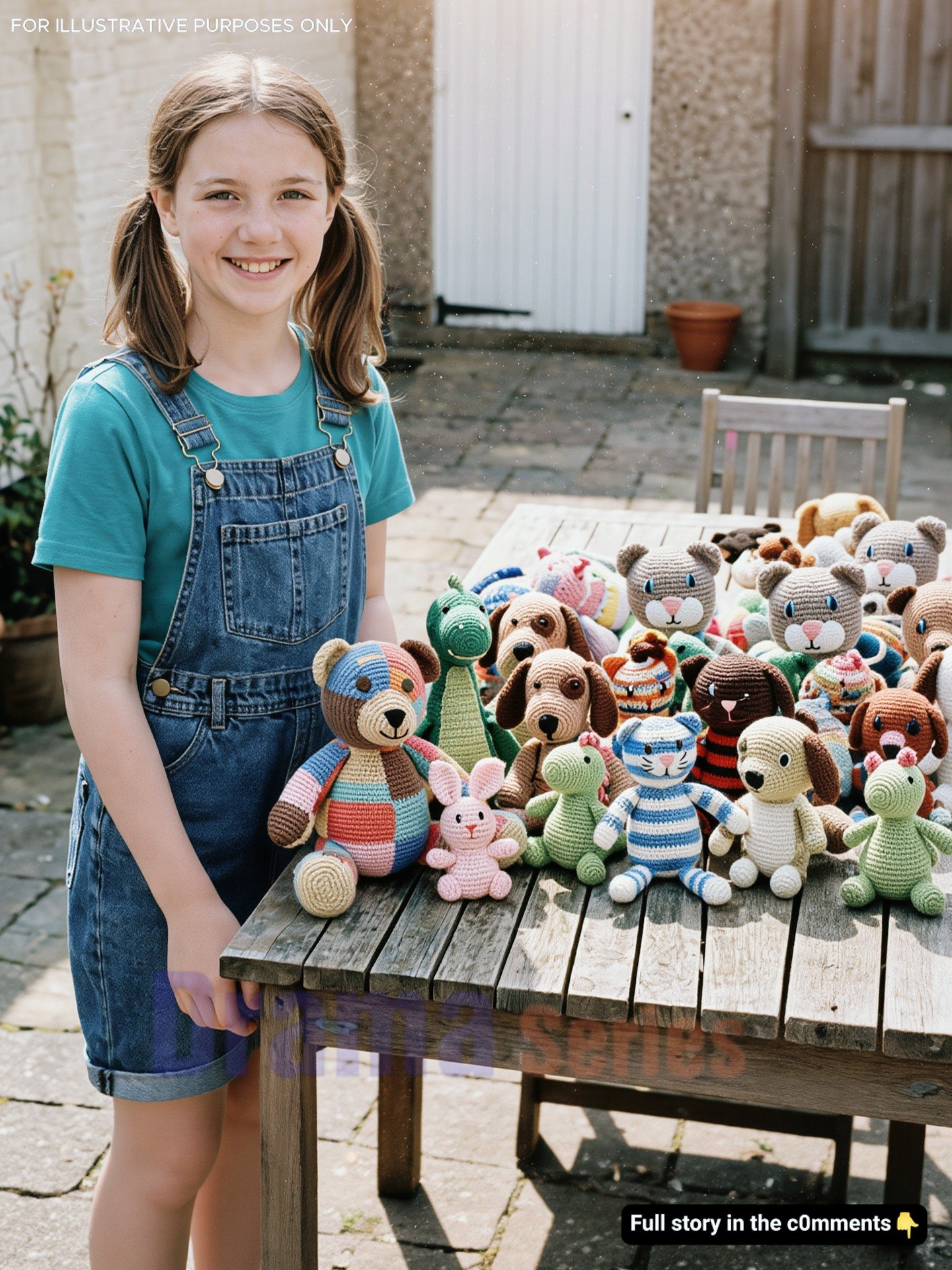
When my daughter set up a small table in our yard to sell the toys she crocheted, I thought she was simply trying to help with my medical bills. I never imagined a stranger on a motorcycle would arrive and turn our lives upside down. I certainly didn’t expect the truth he carried—or the justice we’d been denied for years.
Five years ago, hope sounded like Ava laughing in the kitchen.
Now, hope looked like my thirteen-year-old daughter sitting at a table, yarn looped around her fingers, her brow furrowed in concentration.
She called it crocheting. I saw it as her way of holding our lives together, one tiny animal at a time.

My name is Brooklyn. I’m 44 years old, a widow—and for the past year, a cancer patient.
My husband, David, died when Ava was just two. He left me with our house, a mountain of bills, and a toddler who still smelled like baby shampoo.
In those early days, his family stepped in. For a week after the funeral, our home was filled with sympathy casseroles, offers of help, and quiet conversations that stopped whenever I entered the room.
I could barely keep myself standing, let alone understand the insurance papers and legal documents they placed in front of me.
“Just sign here, Brooklyn,” my mother-in-law had said, her voice calm but distant. “We’ll take care of everything. You need to rest.”
I signed because I didn’t know better—and I didn’t have the strength to question anything.
That was eleven years ago.
After that, they slowly disappeared from our lives. No visits, no birthday cards, not even a call when Ava started kindergarten.
When I got sick, I told myself we would be okay. Insurance only covered part of the treatment, and most days it felt like trying to empty the ocean with a teaspoon.
Ava, now thirteen, was kind and perceptive. She noticed when I winced in pain or pushed food around my plate.
One afternoon, I came home from chemo and found her sitting on the living room rug, tongue peeking out as she worked carefully with her crochet hook.
“Did you make that fox all by yourself?” I asked, easing onto the sofa.
She looked up, smiling, and held up a bright orange toy. “It’s for you, Mom. I wanted it to look happy.”
I laughed softly, feeling the heaviness lift for a moment. “He looks like he could cheer anyone up.”
Her cheeks flushed. “Do you really think so? I keep trying to get the ears right. Grandma says it just takes practice.”
“They’re perfect,” I said. “And even if they weren’t, I’d love him anyway.”
She grinned. “I made more too—look!”
She pulled out a small pile: cats, bunnies, even a turtle with a slightly crooked shell.
“Do you think anyone else would want them?” she asked.
“I think you’d be surprised,” I replied, thinking of how she always gave them away—to Mrs. Sanders or our neighbors.

A few days later, I woke from a nap to the sound of something scraping outside.
Through the window, I saw Ava dragging our old card table onto the lawn. She carefully arranged her crocheted toys in neat rows, straightening their ears and placing tiny price tags beneath them.
She had even made a sign: “Handmade by Ava – For Mom’s Medicine” in uneven purple letters.
I stepped outside, wrapping my sweater tighter around me.
“Ava, what’s all this?”
She paused, then said gently, “I want to sell them, Mom. For your medicine. Maybe if I help, you’ll get better faster.”
My throat tightened. “Honey, you don’t have to—”
She rushed over and hugged me. “I want to. I like making them, I promise. And it makes me feel like I’m doing something.”
I hugged her back, blinking away tears. “You’re doing more than you know.”
Soon, neighbors began to gather.
Mrs. Sanders bought three toys and said, “Your momma’s got the bravest little nurse in town.”
Mr. Todd, who rarely spoke to me, handed Ava a crumpled twenty-dollar bill. “For the best crocheted dog I’ve ever seen.”
I kissed Ava’s head, my cheeks damp, and went inside to rest. Through the window, I could hear her soft voice:
“Thank you, ma’am. I made this one because Mom likes turtles.”
As the sky turned pink and gold, a new sound broke the quiet—a low rumble.
A motorcycle pulled up in front of the yard.
The rider wore a worn leather jacket and a scratched helmet. He shut off the engine and looked around.
I stepped onto the porch, uneasy.
“Hi, sir,” Ava said, her voice steady but slightly nervous. “Want to buy a toy? I made them myself. They’re for my mom’s medicine.”
The man crouched, picking up a crocheted bunny.
“You made these?”
Ava nodded. “My grandma taught me. Mom says I’m getting really good.”
He smiled. “They’re incredible. Your dad would’ve loved them. He once made me help build a birdhouse so crooked even the birds ignored it.”
Ava’s eyes widened. “You knew my dad?”

He paused. “Yeah. I did. I’ve been trying to find your mom for a long time.”
I stepped forward. “Ava, honey… why don’t you go inside and get some water? Check on dinner for me.”
She hesitated. “Will you be okay?”
“I’ll be fine, sweetheart.”
When she went inside, the man removed his helmet.
My breath caught.
“Marcus?”
He nodded. “Yeah, Brooklyn.”
I stepped back instinctively. “No. You don’t get to show up here.”
“I know how this looks,” he said.
“Do you?” My voice rose. “David died, and then you disappeared. Your parents said you left—that you wanted nothing to do with us.”
His expression hardened. “That’s a lie.”
I froze.
“I wrote to you. I called. I even came by. They told me you’d moved—that you didn’t want me around.”
“They told me you walked away,” I said.
“I didn’t,” he replied quietly. “I was shut out.”
Silence fell between us.
Then he added, “And that’s not even the worst thing they did.”
My mouth went dry. “What do you mean?”
“Let me come inside,” he said. “You need to hear this.”
Inside, Marcus took in the sight of pill bottles and unpaid bills.
“You’re really sick, B.”
“It’s been a rough year,” I said.
Ava hovered nearby. “Mom, do you need anything?”
“Just some water, honey.”
When she left, Marcus leaned forward.
“I’m sorry—for everything. For believing them… and for not finding you sooner.”
I gave a hollow laugh. “Well, you found me now.”
His jaw tightened. “And I found out what they did.”
He placed a folder on the table.
“They took from David’s child. I can live with a lot—but not that.”
My stomach dropped.
“A lawyer contacted me last winter,” he continued. “There were irregularities. Your signatures didn’t match.”
He slid the folder toward me.
“My parents forged your name. They stole the life insurance David left you and Ava.”
I couldn’t even touch it.
“No… I signed something. I remember signing.”
“You signed some documents,” he said gently. “Not these.”
I covered my mouth. “I was grieving. They sat in my kitchen while I fell apart.”
“I know,” he said.
“And they robbed us anyway.”
He nodded.
Ava returned, clutching two crocheted animals.
“Mom?”
I pulled her close. “It’s okay, baby. This is your uncle Marcus.”
He looked at her with warmth. “Your dad was my brother. And your mom should’ve known the truth a long time ago.”
Ava looked at me. “Did someone lie to you?”
“Yes,” I said softly. “But not anymore. We’re going to fix it.”

In the weeks that followed, Marcus helped me file a case.
The truth spread quickly.
When we confronted my in-laws at the lawyer’s office, my former mother-in-law sat there in pearls, wearing the same tight smile.
“This is ridiculous,” she said. “We did what needed to be done. You weren’t in a state to handle that money.”
I felt cold. “After your son died? When I was raising his child alone?”
“Someone had to be practical,” she replied.
Marcus scoffed.
I leaned forward. “You didn’t protect us. You robbed a grieving mother—and your own granddaughter.”
For the first time, her smile faltered.
The lawyer presented the forged signatures, the transfers, the evidence.
My father-in-law stared silently at the table.
She turned to Marcus. “You would do this to your own family?”
“You did this first,” he said. “David was my brother. And you shut me out—and stole from his child. You’re not my family anymore.”
The town quickly turned against them.
Marcus stayed with us.
He told Ava stories about David. Soon, the two of them were in the backyard building a crooked birdhouse that made me laugh the moment I saw it.
“Your dad would’ve loved your animals,” Marcus told her.
“I think he would’ve loved that birdhouse too,” Ava said.

When the settlement finally came, it meant more than money.
It was proof—proof that I hadn’t imagined the betrayal, and proof that Ava’s future could be rebuilt.
That night, as I tucked her into bed, she whispered, “Does this mean you’re going to get better, Mom?”
I stroked her hair. “I think it means I can finally rest.”
“I never minded helping,” she said. “I just wanted us to be okay.”
Marcus stood at the doorway. “You were always okay, kiddo. The grownups just needed to catch up.”
For the first time in years, I believed it.
Later, Marcus and I sat on the porch as the sun set.
He handed me a crooked wooden birdhouse.
“It’s not much,” he said. “But I made it.”
I laughed softly. “David would have loved it.”
He looked at me. “I can’t fix the past. But I’m here now—for you, for Ava… for our family.”
As the light faded, I realized something.
Ava had started making toys to save me.
But in doing so, she had rebuilt our life.
And for the first time in years…
I truly believed we were going to be okay.
Source: amomama.com
Note: This story is a work of fiction inspired by real events. Names, characters, and details have been altered. Any resemblance is coincidental. The author and publisher disclaim accuracy, liability, and responsibility for interpretations or reliance. All images are for illustration purposes only.