
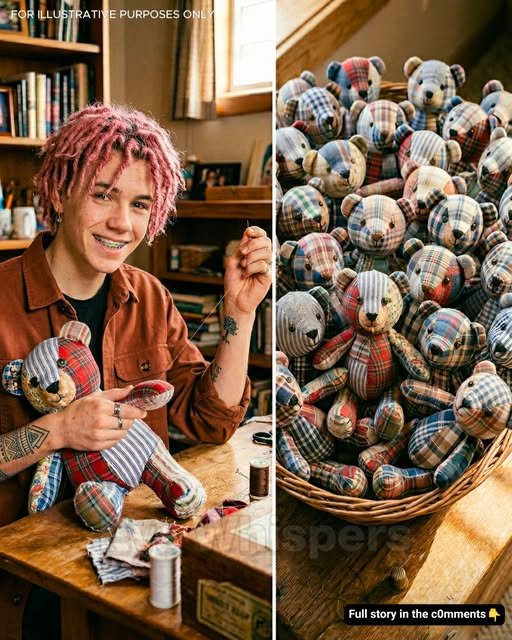
After losing my husband, I believed our world had shattered beyond repair—until my son began stitching hope out of heartbreak. And when a line of sheriff’s cruisers arrived before dawn, I realized that Ethan’s legacy—and Mason’s—were about to change in ways I could never have imagined.
You never truly understand how loud an empty house can be until you’re the only one left inside it. It’s not just silence—it’s the steady hum of the air, the quiet buzz of the refrigerator, the way the stillness presses against your chest when you’re trying to fall asleep.
Fourteen months ago, my husband Ethan was killed in the line of duty. He was the kind of police officer who ran toward danger without hesitation. On his last call, he didn’t come home.
I thought the funeral would be the hardest part, but I was wrong. The real weight came afterward—when the casseroles stopped arriving, the visitors faded away, and the house emptied out. I was left alone, staring at a pile of laundry on our bedroom floor that still carried his scent.
Since then, it has just been me and Mason.

Mason is fifteen now. He has always been a quiet child—the kind who would rather lie on the grass and watch clouds drift by than chase a football. After Ethan died, he grew even quieter. There was no rebellion, no anger, no shouting—just a slow retreat inward, as the silence in our home deepened around us.
He has always loved sewing. My mother taught me, and I passed it on to him. When he was little, he would sneak scraps from my sewing basket to make tiny pillows for his action figures. While other boys obsessed over sports, Mason was happiest sitting at the kitchen table, focused on a project, his hands steady and his eyes intent. The world teased him for it, but he never pushed back. He simply kept sewing.
A few weeks after Ethan’s funeral, I found Mason carefully stitching a patch onto his backpack. He held the thread between his teeth, working with quiet concentration.
“What are you working on now?” I asked, trying to keep my tone light.
“Just fixing the tear,” he shrugged.
The fabric in his hands caught my breath—it was from one of Ethan’s old shirts. Blue plaid. The one he used to wear on fishing trips.
“You miss him too, baby?”
Without lifting his eyes, Mason nodded. “Every day, Mom.”
In that moment, words felt completely useless.
In the months that followed, Mason threw himself into sewing. He repaired towels, hemmed jeans, made curtains—anything he could get his hands on. At night, I would hear the soft hum of the sewing machine long after I had gone to bed.
Slowly, Ethan’s belongings began to disappear—shirts, ties, even old charity T-shirts. At first, I thought Mason was simply holding on to what he had lost. But he wasn’t just holding on—he was creating something new. I just didn’t understand what yet.
One cold January afternoon, I found him standing in front of Ethan’s closet, his fists clenched at his sides.
“Mom, can I use Dad’s shirts?” he asked, his face pale.
The question pierced me. But I could see how much it mattered to him. He wasn’t being careless—he was being thoughtful, just like his father. He was grieving, too.
I took a slow breath, swallowing the instinct to refuse. Then I reached into the closet, pulled out Ethan’s favorite shirt, and placed it gently into Mason’s hands.
“Your father spent his life helping people,” I said softly. “I think he’d be proud of anything you make, honey.”
“Thank you, Mom.”

That night, Mason spread Ethan’s shirts across the dining table, carefully sorting them by color and texture. He measured, cut, and stitched in silence, occasionally humming a tune Ethan used to whistle.
I tried not to hover—but I couldn’t stop myself from watching him.
One morning, I found him slumped over the table, needle still in his hand, drooling slightly onto a sleeve of Ethan’s shirt.
“Mason,” I whispered, gently brushing his hair back. “Go to bed, sweetheart.”
He blinked up at me, smiling sleepily. “Almost done, Mom. I promise.”
By the second week, the kitchen looked like a fabric storm had torn through it—scraps scattered everywhere, buttons rolling across the counter, threads trailing from one surface to another, and piles of polyfill stacked near the fridge.
“Hey!” I called out, pretending to scold him. “Are you secretly building a teddy bear army in here?”
Mason laughed, his cheeks flushing. “It’s not an army, just… a rescue squad.”
Late one Sunday night, he finally finished.
Twenty teddy bears sat neatly lined up across the kitchen table. Each one was unique, with its own personality.
“Do you think… could I give them away?” he asked shyly.
“To who?” I asked, pulling one close. The scent of Ethan’s aftershave and laundry soap lingered on the fabric, nearly undoing me.
“The shelter, Mom. The kids there… they don’t have much. We’ve been talking about it at school.”
“Your dad would have loved that, Mason.”
Together, we packed the bears into boxes. Mason tucked a handwritten note into each one:
“Made with love. You are not alone. Mason.”
At the shelter, Spencer greeted us with amazement.
“Are these all yours, Mason?”
“Yes, sir,” Mason replied, nervously twisting his sleeve.
Spencer picked up one of the bears, his voice thick with emotion. “The kids are going to flip.”
From the next room, we could hear children’s voices. A little girl in pink pajamas peeked in, clutching her doll tightly.
Mason knelt down beside her. “Go on, pick one. They’re for you.”
Her face lit up instantly. “Thank you!”
Spencer turned to me with a warm smile. “You’re raising a good one, Catherine.”
I placed my hand on Mason’s shoulder. “He gets it from his dad. Ethan never did anything halfway.”
As I watched the children hug their new bears, something inside me began to lift.
Spencer showed Mason their sewing corner—an old machine, worn quilts, and bins of fabric scraps. Mason’s eyes sparkled.
“You sew here? Really?”
Spencer chuckled. “We try, but nothing fancy.”
“Maybe I could help sometime?” Mason asked.
“We’d love that. Some of the older kids would too!”
On the drive home, Mason was quiet—but it was a different kind of quiet. He gazed out the window, absentmindedly turning the button on his sleeve.
“Did you have fun, son?” I asked.
“Yeah,” he said softly. “I really did.”
That night, I found a small teddy bear resting on my pillow. It was made from Ethan’s fishing shirt.
“That’s for you, Mom. So you’re not lonely at night.”
I pulled him into a tight embrace, tears stinging my eyes. “Thank you, baby.”
For the first time in months, I truly believed we were going to be okay.

Wednesday morning shattered that fragile peace with loud pounding at the front door.
I jolted awake, my heart racing. The early sunlight barely filtered through the blinds. Outside, two sheriff’s cruisers and a dark town car were parked in the driveway.
“Mason,” I called, my voice trembling. “Get up, baby, put on shoes. Stay behind me.”
He stumbled into the hallway, still half-asleep. “What’s going on?”
“I don’t know,” I said, pulling on a sweater.
A tall deputy with a buzz cut stood at the door. “Ma’am, we need you and your son to step outside, please.”
I instinctively pulled Mason closer. “What’s going on? Is he in trouble?”
The deputy’s expression softened. “Just come outside, please.”
Across the street, curtains twitched. Neighbors watched in silence.
We stepped onto the driveway, Mason gripping my hand, his face pale.
The deputy walked to the cruiser and opened the trunk. My thoughts spiraled—had someone accused Mason of something? Had the shelter complained? Was this about Ethan?
“If you’re accusing my son of something, say it to my face,” I demanded.
The deputy bent down and lifted out a heavy trunk, then popped it open.
Inside were brand-new sewing machines, stacks of fabric, boxes of thread, buttons in every color—enough supplies to stock an entire workshop.
Another deputy handed me an envelope. “Ma’am, we need to know who made the bears for the shelter.”
“I did,” Mason admitted quickly. “All of them. I used my dad’s old shirts… even a police shirt. I didn’t know that was wrong…”
Before anyone could respond, a silver-haired man in a suit stepped forward.
“Catherine? Mason? My name is Henry.”
“Is this about my son?” I asked cautiously.
He shook his head. “No, ma’am. It started with your husband. But I’m here because of your boy too.”
He looked directly at Mason. “Years ago, your father saved my life on Route 17. I’ve carried that debt ever since. Yesterday, I saw what your son did for those children, and I knew exactly whose boy he was. I learned the man I’d been trying to thank was gone.”
“You may have missed Ethan,” I said quietly, my throat tightening. “But you didn’t miss what he left behind.”
Henry smiled gently. “I’m a benefactor for the shelter. Spencer told me everything.”
He gestured toward the supplies. “I want to help your son continue what his father started. These machines and materials are for the shelter. My foundation is funding a scholarship for Mason and a year-round sewing program for children in crisis. We’re calling it the Ethan and Mason Comfort Project.”
I stared down at the embossed letter in my hands, trying to process it.
“You’re telling me my son made twenty teddy bears, and this is what came back to him?” I asked.
“Oh, but it is,” Spencer said, stepping forward with the widest grin I had ever seen on him. “The county approved it first thing this morning. We’re turning that back room into a real sewing space. And Mason, if you’d like, we’d love for you to help teach the first class.”
Mason looked at me uncertainly. I squeezed his shoulder. “If you want to, I’ll drive you there whenever.”
He let out a small, genuine laugh. “Yeah, I’d like that.”
Henry then handed Mason a small box. “Go ahead, open it, son.”
Inside lay a silver thimble, gleaming softly, engraved with Ethan’s badge number and the words: “For hands that heal, not hurt.”
Henry crouched down to meet Mason’s gaze. “Someday, you’ll see what you’ve done, and you’ll know it matters.”

Mason closed his fingers around it, his cheeks flushed. “Thank you. I just… I didn’t want Dad’s shirts to sit in the closet forever.”
Henry held his gaze for a long moment. “Your father saved my life with his courage. You’re changing lives with your kindness. That matters just as much.”
I looked at my son—standing barefoot in the cold, carrying Ethan’s spirit in everything he did.
“Your father ran toward people in pain,” I said softly. “Mason just found his own way to do the same.”
Later that day, Mason set up one of the new sewing machines in the kitchen. As it hummed to life, he looked up at me, his eyes filled with something I hadn’t seen in a long time—hope.
That afternoon, the shelter echoed with laughter as Mason patiently showed a little girl how to thread a needle. I stood quietly in the doorway, watching.
I closed my eyes and let the sound of the sewing machine fill my heart.
It was no longer the sound of loneliness.
It was the sound of something new being built.
For fourteen months, grief had made our home feel smaller.
But now, for the first time since Ethan died, it felt like something new was being built inside it.
Not just bears. Not just memories. But a future.