
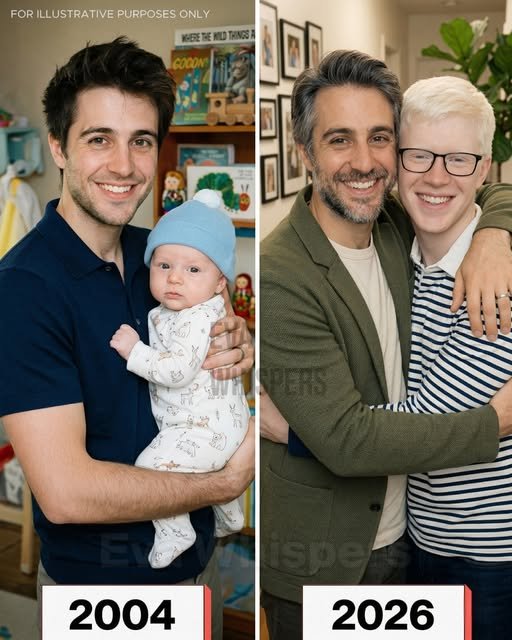
My name is Dylan, and for most of my life, my mother was less a person and more a sentence.
A brutal, unforgettable sentence.
According to my dad, on the day I was born, she looked at me once, turned to him, and said, “I’m not interested in parenting. I don’t want him. You can do it.”
Then she left.
No dramatic hesitation. No tears. No promises to come back. She didn’t ask for updates. She didn’t send birthday cards. She didn’t pay support. She didn’t even disappear in the way people usually do, with excuses and half-hearted attempts.
She just erased herself.
So my father became everything.

He was the one who learned how to warm bottles with one hand and hold me with the other. The one who sat beside my bed through fevers, rubbed my back when I was sick, and slept upright in a chair after double shifts because I had nightmares and didn’t want to be alone. He learned to braid shoelaces, sign permission slips, cook decent pancakes, and fake confidence on the first day of kindergarten when I cried so hard I threw up on his work boots.
We didn’t have much. He worked construction during the day and repaired appliances at night. His hands were always rough, his eyes always tired, but somehow, when he looked at me, he never made me feel like a burden.
He used to say, “It’s me and you, kid. We’re enough.”
And somehow, we were.
When I was old enough to understand what money was, I tried to make things easier. I chased scholarships like my life depended on them, because in a way, it did. I worked weekends, tutored high school kids, built websites for local businesses, sold old electronics online—anything to lighten his load.
By the time I got to college, I had this stubborn, burning need to build something of my own. I saw how many talented young people had ideas but no guidance, no connections, no one willing to take them seriously. So I started building a platform that matched young creators with experienced mentors and small-scale investors.
At first, it was just me, a laptop, and bad coffee.
Then a few people signed up.
Then more.
Then suddenly, investors were calling me.
Then one morning, I was sitting under studio lights while a cheerful host on a business segment said my name like it mattered.
My dad watched that interview standing up in our living room, arms folded, pretending he wasn’t emotional. But when the camera zoomed in on my face and they called me “one of the most promising young founders in the city,” I heard him let out this shaky breath from behind me.
When I turned around, his eyes were wet.
He laughed and wiped them fast. “Don’t get cocky.”
I grinned. “Too late.”
That night we ate takeout on the couch with the TV still on in the background. My phone buzzed all evening with congratulations. Friends, professors, people I barely knew.
And somewhere in the middle of all that noise, a quiet thought slipped in.
If she saw me now, would she be proud?
I hated that I wondered.
I hated that some small, stubborn part of me still cared.
Then last Saturday happened.

I was home for the weekend, helping Dad fix the back fence. It was late afternoon, hot and still, and we were arguing about whether the new post was straight when he suddenly looked past me toward the front yard.
“Dylan,” he said, in a voice I’d never heard before.
I turned.
There was a woman standing at the edge of our porch.
She was elegant in a polished, careful way. Expensive blouse. Perfect hair. Sunglasses pushed onto her head. She looked like someone who belonged in hotel lobbies and airport lounges, not on the cracked concrete step of our little house.
I knew who she was instantly.
Not because I remembered her.
Because I had imagined her face a thousand different ways, and somehow reality still recognized me first.
“Dylan,” she said softly. “It’s been a long time.”
My body went cold.
My dad didn’t speak. He just stood there beside me, shoulders tense, jaw locked so hard I could see the muscle twitch.
I didn’t hug her. Didn’t smile. Didn’t ask why she was here.
I just said, “What do you want?”
Her expression flickered, but only for a second. Then she reached into her tote bag and pulled out a large manila envelope.
“This is for you,” she said. “It’s a surprise.”
There are moments when your instincts scream before your brain catches up. That was one of them. My stomach dropped so hard it almost felt like a physical blow.
I took the envelope anyway.
Inside was a DNA test.
My hands started shaking before I even finished reading the first page.
“It proves this man,” she said, pointing casually toward my father as if he were a stranger, “is not your biological father.”
The world narrowed.
The sounds of the street disappeared. The birds. The traffic. Even my own breathing. All I could hear was the pounding in my ears.
I looked at my dad.
He looked like someone had drained the blood from his face.
“You knew?” I asked, but my voice barely came out.
He swallowed hard. “I found out when you were a baby,” he said quietly. “She told me before she left.”

I stared at him.
He took one step toward me, then stopped. “I was going to tell you,” he said. “Many times. I just… every year it got harder. And then you were my son in every way that mattered, and I didn’t want anything to touch that.”
My mother stepped in before I could answer.
“You’re mine,” she said, like she was offering me a prize. “We can finally start over.”
Then she pulled another document from the envelope and held it out.
“Now all that’s left is to sign.”
I looked down.
It was a legal statement authorizing access to personal identity records and acknowledging a parental claim. There was language about correcting family information, next-of-kin recognition, and representation in certain financial and medical matters.
The last page mentioned media management and estate coordination.
That’s when it clicked.
She hadn’t come because she missed me.
She had come because I was suddenly visible.
Because the interviews had aired. Because articles had my name in them. Because my company had value now.
I read the line twice, then a third time.
“Oh my God,” I whispered.
She mistook my horror for amazement and smiled.
“I know this is a lot,” she said gently, “but I’ve been watching from a distance. I always wanted to come back when the time was right. I think we both deserve a second chance.”
A second chance.
My dad made a strangled sound beside me, the kind a person makes when pain becomes too large to keep inside.
I looked at him.
He was trying not to fall apart in front of me.
And suddenly I saw everything at once: the years he skipped new clothes because I needed school supplies, the birthdays where he pretended not to want cake so I could have a bigger slice, the nights he sat at the kitchen table pretending bills were “just paperwork,” the mornings he left before sunrise and came home after dark and still asked about my day like mine was the important one.
Then I looked at her.
At the woman who had walked away from a baby and returned for a successful man.
Something inside me settled.
Not anger.
Clarity.
I set the papers back into the envelope, folded it closed, and placed it carefully on the porch railing.
Then I lifted my eyes to hers.
“You’re right,” I said. “This changes everything.”
She let out a relieved breath and stepped forward. “Dylan, I knew you’d understand—”
“No,” I said.
She stopped.
My voice didn’t rise. That was the strange part. It came out calm. Clear. Steady enough to surprise even me.
“This man may not be my biological father,” I said, turning slightly toward Dad, “but he is my real father. He’s the one who stayed. He’s the one who raised me. He’s the one who earned every right to that word.”
My mother’s face fell.
I kept going.
“You didn’t come back for me. You came back for what I became. You saw me on TV and thought you could walk in here with paperwork and rewrite the story.”
“Dylan—” she began.
“No. You don’t get to call this a fresh start when you skipped the start entirely.”
My dad covered his mouth with one hand. His eyes were shining.
My own throat tightened, but I forced the next words out because they were the truest words I had ever spoken.
“I spent years wondering if, if you ever saw me, you’d be proud of me.” I took a breath. “But I don’t need that anymore. Because the only parent whose pride matters is already standing right here.”
Dad broke then.
A single, ragged sob escaped him before he turned away and pressed his fist to his eyes.
My mother looked stunned, like reality had finally reached her and she had no idea what to do with it.
I turned fully toward my father.
“And there is one thing I am going to sign,” I said.
He looked at me, confused.
I smiled through tears. “Adult adoption papers.”
He just stared.
I stepped closer. “I already looked into it last year,” I admitted. “I never told you because I wanted the right moment. I guess this is it.”
His face crumpled.
“I want it legal,” I said. “I want it official. I want every document on earth to say what has always been true. You are my dad. Not by blood. By choice. By love. By every single day of the last twenty-two years.”
That was when both of them cried.
My father cried like a man who had carried fear for decades and finally got to put it down.
My mother cried like someone realizing too late that biology can open a door, but it cannot build a home.
I didn’t say anything cruel after that. I didn’t need to.
I picked up the envelope, held it out to her, and said, “You should go.”
She took it with trembling hands. For a second, I thought she might argue. Instead, she nodded once, a small broken motion, and walked back down the path.
She never looked back.
Dad and I stood on the porch in silence until her car disappeared.
Then he said, very quietly, “I’m sorry I never told you.”
I shook my head. “You never lied about the part that mattered.”
He looked at me, eyes red. “What part is that?”
I put my hand on his shoulder.
“That you’re my father.”
He pulled me into a hug then—tight, shaking, the kind of hug that says everything words can’t hold.
And standing there in the fading light, on the same porch where my past had come back carrying papers and demands, I understood something at last:
A parent is not the person who gives you life.
It’s the person who shows up and stays.