
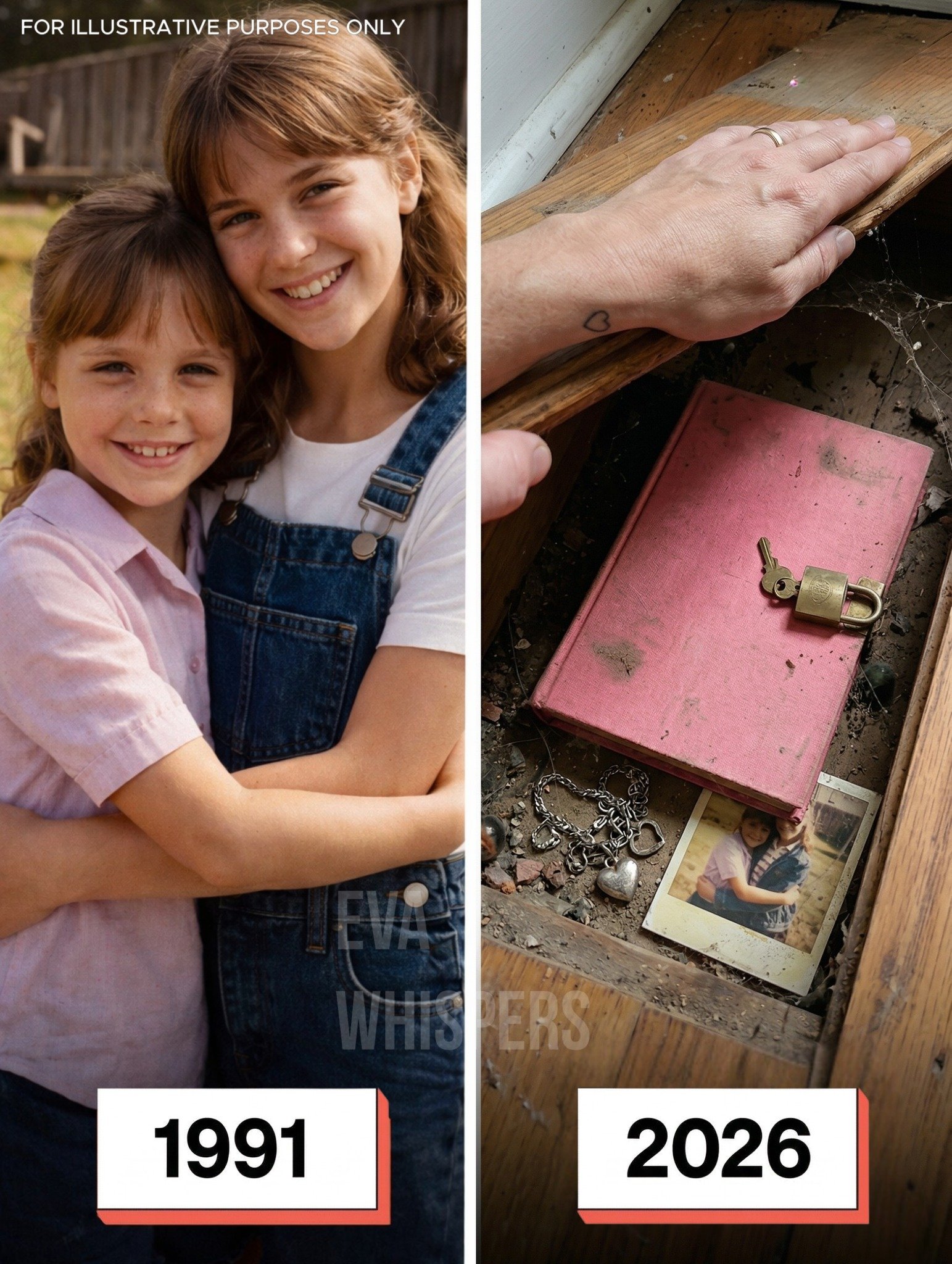
My sister disappeared before I had even turned ten, leaving behind a silence filled with questions no one could answer. More than three decades later, I uncovered something that finally revealed the truth about what happened that morning.
My sister, Adele, vanished when she was 14 years old. I’m Miranda, and at the time, I was only eight.
I remember that Tuesday morning as completely ordinary—which, somehow, makes everything feel even worse.
Adele came downstairs with her backpack slung over one shoulder, complaining about how she’d stayed up half the night studying for a math test. As usual, our mom, Heather, handed her the lunchbox she had packed.
Adele barely said goodbye. She grabbed a piece of toast and walked out the door.
She never made it to school.

At that age, I couldn’t understand how something like that could even happen. But even as a child, I remember what followed.
Our parents barely slept for days. They drove through the city late into the night, searching for her everywhere they could think of. They questioned Adele’s friends, hoping someone might know something.
Her photo appeared in store windows and was taped to street poles.
People came to help. Teachers, neighbors, even strangers joined organized search groups through her school.
The police got involved too. But days turned into weeks, and weeks slowly dissolved into silence.
Eventually, the way people spoke changed. They stopped saying “when she comes back” and began referring to her in the past tense.
Adele’s disappearance took a devastating toll on our parents—especially when the police told them she was most likely dead.
In time, they stopped expecting her to return.
Thirty-five years passed like that.
The house changed. The neighborhood changed. But one thing never did: Adele’s absence remained, deeply felt by all of us.
A few days ago, my mom called me.
Her voice sounded smaller than I had ever heard it before. “Your father’s gone,” she said.
I drove to my parents’ house that same afternoon.
My mom moved as if she were carrying something invisible but unbearably heavy.
I stayed to help with everything—the funeral arrangements, the paperwork, all the endless little decisions that come with saying goodbye.
But the truth was, I didn’t want to leave her alone in that house.
So I stayed.
On the second night, after Mom had gone to bed, I found myself wandering upstairs.
That’s when I noticed Adele’s bedroom door was closed.
I don’t know what drew me there, but I couldn’t resist. I reached out and slowly pushed the door open.
Nothing had changed.
Mom had preserved everything almost exactly as it had been. Adele’s bed was still made the way she used to leave it—slightly messy. Her books were still stacked neatly on the desk.
I stepped inside.
And then I heard it.
A sharp creak beneath my foot.
The house hadn’t been renovated in years, but this sound came from one specific spot.
I stepped back and pressed down again.
The same creak.
I looked down and noticed one of the floorboards seemed loose.
I knelt and carefully lifted it.
Beneath it was a hidden space.
My heart began to race.

Inside, wrapped in faded fabric, was a small notebook secured with a cheap metal lock.
I pulled it out and grabbed a pair of scissors to pry it open.
The moment I saw the handwriting, I knew.
It was Adele’s.
It was a diary.
The first few pages were exactly what you’d expect from a teenage girl—complaints about homework, notes about friends, little arguments with Mom.
But when I reached the final pages, my hands began to tremble.
The tone had changed.
The entries were shorter, tighter, more deliberate.
She had started writing about going somewhere before school.
The same place, over and over.
A bus stop on the edge of town.
I frowned.
Adele also mentioned someone she had been meeting there.
She never wrote the person’s name—only small clues:
“She listens.”
“She doesn’t rush me like everyone else.”
“She says I have options.”
A chill ran up my arms.
These weren’t casual conversations.
She had been planning something.
Then I reached the entry from the night before she disappeared.
“I packed a small bag, but I hid it. I don’t know if I’ll actually use it. I keep thinking about what he said. I wish I hadn’t heard it.”
My chest tightened.
I kept reading.
The final entry was written in messier handwriting, as if she’d been rushing.
“I’m going back there before school. I need to decide. She said she could help me hide, just for a little while. I don’t think I can stay here if it’s true.”
I swallowed hard.
The last line was underlined twice:
“If I don’t go today, I never will.”
In that moment, I realized something that hit me like a wave.
I had no idea what had been happening in my sister’s life.
I don’t even remember grabbing my jacket.
One moment, I was in Adele’s room. The next, I was outside, keys in my hand, my thoughts racing.
I drove to the bus stop.
It was still there—barely used now.
I stepped out of the car and stood still for a moment, trying to imagine her.
Fourteen years old. Alone. Standing exactly where I was.
What were you thinking, Adele?
What were you about to do?
Across the road stood a small grocery store. It looked old enough to have been there back then.
It was open 24 hours, so I went inside.
An older man stood behind the counter, flipping through a newspaper. He looked up as I approached.
“How can I help you?”
I hesitated, then said, “I’m looking for information about someone who used to come around here. A long time ago.”
He raised an eyebrow.
“My sister,” I added. “She used to wait at that bus stop. Early mornings. This was… 35 years ago.”
He thought for a moment, then asked, “A teenage girl? Dark hair? School bag?”
My breath caught.
“Yes!”
“I remember her,” he said. “She used to come by. Didn’t say much.”
Everything inside me went still.
“Was she alone?”
“Not always. There was a woman,” he said. “She used to pull up in an old car. They’d talk for a bit. Sometimes your sister would leave with her.”
My hands tightened.
“Do you know the woman?”
He shook his head. “No name. But I remember where she worked. Across town. A youth center. A place for kids who needed… somewhere else to go.”
He gave me the name.
I thanked him and left.

The drive across town felt endless.
The youth center sat on a quiet street, plain and easy to miss.
I parked and went inside.
The building felt warm. Voices echoed faintly down the hall.
A woman sat at the front desk sorting papers. She looked up.
“Hello, how can I help?”
“I’m looking for someone who worked here… a long time ago. Early 90s.”
She frowned. “Let me find someone.”
A minute later, she returned with an older woman with gray hair.
“What’s your sister’s name?” she asked.
“Adele.”
She didn’t hesitate.
“I remember her,” she said. “She came here a few mornings before school. Didn’t stay long. Just talked.”
“About what?”
The woman studied me carefully.
“This might be hard to hear. But you came for answers. Adele talked about leaving home.”
The words landed heavily.
“She didn’t feel like she belonged anymore,” the woman continued. “At first, I thought it was normal teenage frustration. But then she told me what she had overheard.”
My mind flashed to the diary.
“She heard your parents arguing,” the woman said. “Your father told your mother he was tired of raising her because she wasn’t his child—she was adopted.”
I couldn’t speak.
“Adele didn’t understand,” she went on. “She felt like her whole life was a lie. She was scared—but also determined. She kept saying she needed space. Time to think.”
“She came here one last time, didn’t she?”
The woman nodded.
“She had a small bag. She told me she’d thrown it out her window and picked it up from the backyard that morning. She said she was ready to leave.”
A chill ran through me.
“I told her we could figure things out properly—that she didn’t have to rush. But she said she needed to do something first. She asked to use the phone.”
“What happened next?”
“She made a call. Short. I only caught the name ‘Heather.’ But I remember her voice. She sounded like she had made a decision—and was trying to be brave.”
“What did she do after?”
“She left.”
“Where?”
“I don’t know. She just walked out.”
Not taken.
Not lost.
She walked away.
“Anything else?” I asked.
“The number,” she said slowly. “We used to log calls. I don’t have records now, but I remember—it was local.”
I knew who she had called.
I thanked her and left.
When I got home, Mom was in the kitchen.
“Where did you go?” she asked.
I placed Adele’s diary on the table.
“To find out what happened.”
Her hands froze.
“She didn’t just disappear,” I said. “She planned to leave.”
Silence.
“She made a call that morning.”
Mom’s face tightened.
“She called you, didn’t she?”
Her expression broke.
“She heard what Dad said about her being a burden… and adopted.”
“I didn’t know she was listening,” Mom whispered.
“But she was,” I said.
Tears streamed down her face.
“She called me,” she admitted. “Asked if it was true.”
“And you told her?”
She nodded.
“I told her we brought her home as a baby. That it didn’t change anything.”
“But it did,” I said quietly.
“She said if it didn’t matter, your father wouldn’t have said it like that.”
The silence was heavy.
“She said she needed space,” Mom continued. “Just a few days. She said she’d call when she was ready to come home.”
“And she never did.”
For 35 years, we had been asking the wrong question.
We thought something had been done to her.
But Adele had chosen to leave.
Maybe she was trying to find herself.
I ran my fingers over the worn diary.
“My sister didn’t leave because she didn’t care,” I said softly. “She left because she thought she didn’t belong.”
My mother broke down completely.
Years of silence finally shattered.
I let her cry.
Because for the first time, this didn’t feel like an ending.
It felt unfinished.
Still alive.
“We may not know where she is,” I said. “But we know why she left. And I don’t know if I’ll ever forgive you… or Dad.”
Mom pleaded through tears, explaining his stress, their struggles, his regret.
But it didn’t matter anymore.
“Adele is still gone,” I said. “And now so is Dad.”
I looked at her.
“This changes everything between us.”
I walked away.
For the first time in decades, I had found the truth.
But somehow, it felt like I had lost both parents in the process.
I stayed for the funeral.
And then I left.
And I never came back.