
I remember thinking that the hardest part was already behind us—that everything my son had fought for was finally within reach. I had no idea that one single decision on that track would test him in a way no race ever could.
What I remember most is the sound of the zipper.
Not the door closing. Not the words.
Just the sharp, final sound of a suitcase being zipped up after my husband, Edward, finished packing—as if he were leaving for a weekend trip, not walking out on his newborn son.
I was sitting on the edge of the bed, Brennan barely a week old in my arms.
Edward didn’t even glance at him when he spoke.
“I didn’t sign up for this.”
“This” was our son—born with one leg shorter than the other.
That was it.
One sentence. One suitcase.
And he was gone.

The next sixteen years were anything but easy.
There were endless doctor’s appointments, braces, and constant adjustments. Physical therapists pushed Brennan harder than I thought was fair—but he never complained. He just kept going.
I watched him learn to stand, to walk, wobbling as though the ground itself refused to cooperate. I saw him fall more times than I could count.
And every single time, he got back up.
When Brennan told me he wanted to run, I almost said no.
Not because I didn’t believe in him—but because I was afraid of watching him get hurt.
“Mom,” he said one night, “I don’t want to be careful. I want to be fast.”
After that, I couldn’t argue.
By sixteen, Brennan wasn’t just running—he was winning.
Local meets turned into regional competitions. Regional meets turned into state qualifiers for the fastest boys in the state.
Then came the calls—coaches, scouts, emails about scholarships. Opportunities I could never have given him on my own.
Running became his way forward.
His way out.
Yesterday was the state finals.
The biggest race of his life.
The stadium was packed.
I sat halfway up the bleachers, phone ready, my finger hovering over the record button.
Beside me sat Dana, Caleb’s mom. We had spent years sitting side by side at meets like this.
Her son used to run too—until a car accident took away his ability to walk, and with it, his dream.
Caleb was down on the field now, near the track, sitting in his wheelchair, watching.
He and Brennan had been inseparable since middle school.
The gun fired.
Brennan surged ahead early, running with a steady, controlled rhythm. Everything we had worked toward was unfolding right in front of me.
Then came the final stretch.
And suddenly—he slowed.
At first, I thought I imagined it.
But then he stopped.
And stepped off the track.
The entire stadium seemed to fall silent.
“What’s he doing?” Dana whispered.
I was already standing, my heart racing.

Brennan walked straight over to Caleb.
Caleb was shaking his head.
Later, I heard someone nearby say Caleb had whispered, “I can’t.”
But Brennan didn’t hesitate.
“Yeah, you can. We finish this together.”
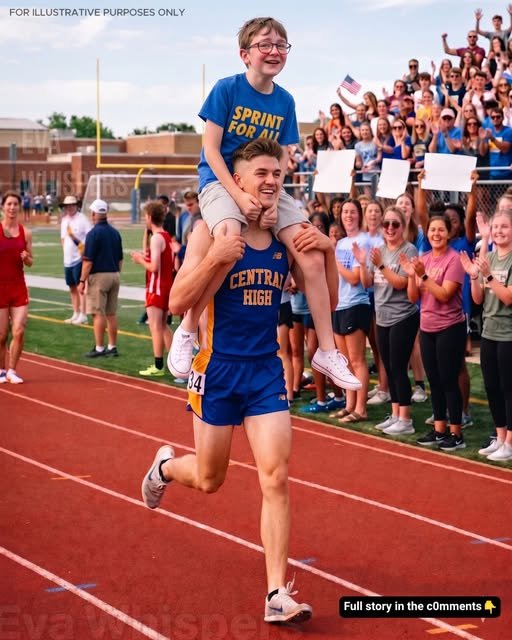
Before anyone could react, Brennan bent down, helped Caleb up—and lifted him onto his shoulders.
For one brief second, it looked impossible.
Then Brennan adjusted his stance.
And ran.
He wasn’t as fast anymore.
But he was steady.
Determined.
Every step looked heavy—but he didn’t stop.
The crowd gasped as Caleb clung to him.
Someone behind me muttered, “He’s throwing it away.”
But something unexpected happened.
The other runners slowed.
Then they stopped.
One by one, they stepped aside.
No one passed them.
Caleb buried his face against Brennan’s shoulder, laughing through tears.
Dana stood beside me, covering her mouth, shaking.
By the time they crossed the finish line together, the entire stadium was on its feet.
Not cheering for a winner.
But for something bigger.
Brennan gently lowered Caleb down.
And then the sound hit all at once.
Applause.
Shouts.
People rising to their feet.
I didn’t even realize I was crying until Dana pulled me into a hug.
Officials gathered near the track, conferring in hushed voices.
Then one judge stepped forward with a microphone.
“Today,” he announced, “we recognize something greater than speed.”
The stadium fell quiet again.
They called Brennan forward.
They placed a medal around his neck—awarding him a special first-place honor.
I watched him look down at it.
Then, without a word, he turned to Caleb…
…and placed the medal around his neck.
Later, Brennan told me what he had said:
“You were always the real champion.”
And that moment broke whatever composure remained in the crowd.
People cried openly.
I thought that was the end of the story.
It wasn’t.

The next morning, my phone rang just after 7 a.m.
“Nancy?” a voice said. “This is Mr. Henderson. I need you and Brennan in my office this morning.”
There was something in his tone that made my stomach tighten.
“We’ll be there,” I replied.
The school felt different that morning.
Quieter.
Heavier.
Brennan walked beside me, hands tucked into his pockets.
“You think I’m in trouble?” he asked.
I looked at him. “Did you do something wrong?”
He paused.
Then shook his head. “No.”
“Then we’ll deal with whatever it is.”
I said it confidently.
I wasn’t sure I believed it.
Mr. Henderson didn’t smile when we entered.
He stood behind his desk, a thick black folder in front of him.
“Have a seat.”
We did.
He took a deep breath.
“Do you even know what this reckless act will cost your son?”
My heart dropped.
Brennan said nothing.
He just waited.
Henderson opened the folder, pulled out a document, and slid it across the desk.
“This,” he said quietly, “explains all the consequences.”
Brennan picked it up, scanning the page.
His jaw tightened.
“What does it say?” I asked.
He didn’t answer—just handed it to me.
And as I began to read, it felt like everything we had built was slipping away.
It wasn’t a warning.
It wasn’t a suspension.
It was a withdrawal.
The scholarship committee—the state athletics board—had officially disqualified Brennan.
“Violation of race protocol.”
“Interference with a competitive outcome.”
Cold. Final.
My hands froze.
All the early mornings, the late-night drives, the times he pushed through pain and told me he was fine…
Reduced to a paragraph.
“I didn’t think…” Brennan began.
Then stopped.
He didn’t sound sorry.
Just calm.
Henderson leaned back.
“That race wasn’t just a race,” he said.
“The board reviewed everything—the footage, the reports. They ruled that by leaving your lane and assisting another participant, you interfered with the official outcome.”
“So that’s it?” I asked. “He’s out?”
“For that scholarship—yes.”
Before Brennan went to class, I stopped him.
“Are you okay? I’m sorry… everything you worked for…”
He looked at me.
“I knew it might happen.”
“You knew?”
“I didn’t know for sure. But I figured there’d be consequences.”
“And you still did it?”
“Yeah.”
No hesitation.
No regret.
Just certainty.
I didn’t say anything after that.
I spent the day replaying everything.
I couldn’t sit still.
Finally, I picked up my phone.
I had recorded the race.
My hands trembled as I watched it again.
It didn’t look like a mistake.
It looked like something rare.
Something people don’t often get to see.
I posted the video online.
No overthinking.
Just the truth.
What happened—and what it cost him.
At first, nothing.
Then the notifications began.
Comments.
Shares.
Messages from strangers—parents, coaches, former students.
By evening, it had spread further than I imagined.
I called the local paper.
“We’d like to cover the story,” the editor, Ted, said. “But we’ll need to speak with Brennan and Caleb.”
“I’ll talk to Caleb’s parents first,” I replied.
“Of course.”
When I hung up, I knew one thing:
This wasn’t about attention.
It was about making sure what Brennan did didn’t just cost him everything.

The next morning, my phone rang again.
“Nancy, we need you back at the school,” Henderson said. “There’s something we need to discuss.”
“Is Brennan in more trouble?”
“Just come in.”
When I arrived, Brennan was already there.
Henderson looked… different this time.
“Please, sit.”
He opened a folder again—but this time, he pulled out a single sheet.
No letterhead.
Just a typed note.
“A donor saw your video,” he said.
I glanced at Brennan.
“They fund a private foundation,” Henderson continued. “They look for something specific.”
“What?” Brennan asked.
“Character under pressure.”
My chest tightened again—but this time, not from fear.
“They saw a young man with everything to gain… walk away from it for someone else.”
Henderson tapped the paper.
“They’ve offered to cover full college tuition and medical support—for both Brennan and Caleb.”
“Both of us?” Brennan asked.
“Yes.”
We just stared at each other.
“And the scholarship?” I asked softly.
“Still gone.”
Brennan exhaled.
“I’d do it again.”
For the first time, Henderson smiled.
“I thought you would.”
That afternoon, Brennan asked me to drive him to Caleb’s house.
Dana opened the door before we knocked.
“I heard,” she said, hugging me. “Is it true?”
I nodded.
Inside, Caleb looked up as Brennan entered.
They both smiled.
Then hugged.
“You lost your scholarship because of me,” Caleb said quietly.
“But we gained more,” Brennan replied.
“What do you mean?”
“We got a new one. Both of us.”
He explained everything.
Caleb just stared.
“You’re serious?”
“Yep.”
“And you’re okay with this?”
Brennan shrugged.
“We finally got the recognition we deserve.”
Weeks later, the story spread even further.
But Brennan didn’t change.
He still woke up early.
Still trained.
Still showed up.
Only now—
He wasn’t alone.
Caleb came to practice too.
Not to race.
But to coach.
To guide.
To stay part of it.
Sixteen years ago, Edward walked away.
But watching my son now, I realized something.
He never stopped showing up.
Not for himself.
Not for others.
And now—
He wasn’t just running toward a future.
He was building one.
Side by side with his best friend.
Exactly the way he chose to cross that finish line.