
My name is Calvin Mercer, and the worst moment of my life did not happen on a construction site, in a storm, or halfway across the world on a high-risk project. It happened when I came home.
I had just returned to Atlanta after eight months in Lagos, overseeing a major infrastructure contract. I was exhausted, jet-lagged, and thinking about only two things: a shower in my own bathroom and finally seeing my mother, Lorraine Mercer, in person after months of hearing she was too sick to come to the phone for long. My wife, Monica Hale, had been telling me for months that my mother’s health was failing fast. Congestive heart failure, special supervision, medication changes, extra expenses. Every month there seemed to be a new reason she needed more money. I sent it without hesitation. Two thousand here. Twenty-two hundred there. Whatever was needed. She was my mother.
When I pulled into the driveway, Monica wasn’t home. That struck me as odd, but not alarming. The house looked clean from the outside. Nothing broken. Nothing disturbed. I carried my bag inside, called out for my mother, and got no answer.
At first, I thought maybe Monica had taken her to an appointment.
Then I noticed the basement door.
There was a brand-new padlock on it.
I stood there for a second, staring at it, trying to make it make sense. That door had never been locked in all the years I’d owned the house. We used the basement for storage, tools, old blueprints, and paint supplies. I called my mother’s name again. Still nothing.
Then I heard it.
A faint sound. Not a voice exactly. More like the scrape of metal against concrete.
I dropped my suitcase, found a pry bar from the utility closet, and broke the lock.
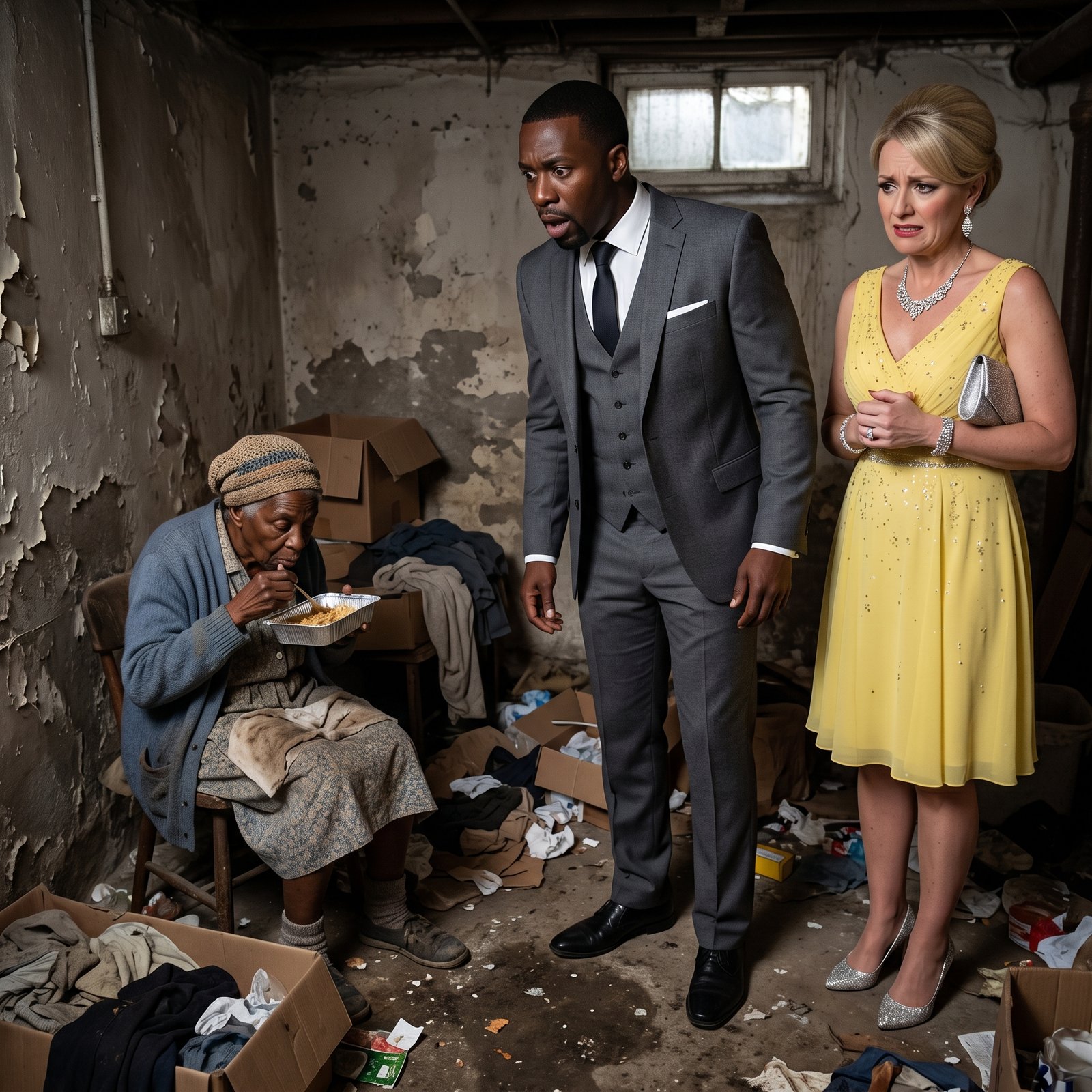
The cold hit me first. The basement air felt wrong—damp, thin, bitter. I rushed down the steps and froze halfway.
My mother was sitting in the corner under a thin blanket on a folding chair beside a tiny space heater. That was it. No bed. No proper lamp. No comfort. Just concrete walls, a plastic side table, a half-empty bottle of water, and my seventy-two-year-old mother looking up at me like she couldn’t decide whether to cry or apologize.
I ran to her.
She held my hand with both of hers and said the sentence that changed everything.
“Calvin, I didn’t want to worry you while you were overseas.”
I asked her what happened. I asked where Monica was. I asked why she was down there, why the room smelled like mildew, why there were canned goods stacked beside her like she had been stored instead of cared for.
My mother tried to protect my wife at first. That hurt worst of all.
But within twenty minutes, the lies started cracking open. She wasn’t terminally ill. She hadn’t needed expensive treatment. She had been kept out of sight. Controlled. Isolated. And the money I had been sending every month for her “special care” had gone somewhere else entirely.
I should have exploded right then. I should have called Monica screaming. I should have torn the whole house apart.
Instead, I did what I had trained myself to do my entire career when a structure failed and people wanted answers: I started documenting everything.
Because if what I had just found was only the surface, then the truth underneath was going to be far uglier—and before the week was over, I would discover my wife had stolen far more than my trust. The question was: how deep had she buried the damage before I came home and started digging?
Part 2
I am a civil engineer by trade, and that training probably saved me from making the kind of emotional mistake that would have helped Monica more than me.
Engineers learn early that panic hides patterns. If something collapses, you do not just stare at the broken concrete. You study the load path. You trace the failure back to its source. That was exactly how I approached the next forty-eight hours.
First, I got my mother out of that basement.
I checked her into a hotel suite under my name that same night, someplace warm, quiet, and clean, with proper food and a real bed. She kept insisting she was fine, but I could see what months of isolation had done to her. She had lost weight. Her hands shook more than they used to. And worst of all, she seemed embarrassed, as if surviving mistreatment in my house was somehow something she needed to explain to me.
The next morning I took her to a physician I trusted. Full exam. Cardiac workup. Medication review. The result was infuriating. No congestive heart failure. No advanced condition requiring private in-home care. She had normal age-related issues, but nothing remotely close to the medical story Monica had been feeding me from overseas.
That opened the first real crack.
Then I went through the finances.
I pulled bank statements, wire records, credit card activity, and mortgage notifications. Within hours, a pattern started emerging. The money I had sent for my mother’s care had been withdrawn in chunks of cash, spent at restaurants, resorts, boutiques, and transferred through payment apps to a man named Damien Cross. I did not know the name then, but I would soon.
I also found something worse.
There was a home equity loan for $60,000 against my house.
I had never signed for it.
At first I thought it had to be an error—some clerical fraud from outside. But once I requested the file, I saw a forged signature so clumsy it made my jaw tighten. Someone had used my absence, my marriage, and probably access to personal documents in my own office to push it through. That was not impulsive theft. That was planning.
I kept digging.
I spoke with Natalie Hale, Monica’s younger sister. She resisted at first, said she did not want to get involved, said family was complicated. But when I showed her the medical report and told her my mother had been locked in a basement while Monica claimed to be paying for specialized care, something in her face changed. She told me about Damien. Told me Monica had been seeing him for months. Told me they talked openly—too openly—about “building capital” before I got home. Real estate, investments, quick returns. My money. My house.
That was when I hired Attorney Claire Donnelly.
Claire did not flinch once. She helped me organize everything: timestamps, account trails, forged loan paperwork, medical findings, text screenshots, delivery receipts, and Natalie’s recorded statement. She told me not to confront Monica privately. She wanted witnesses. She wanted the evidence presented cleanly, decisively, and legally.
So I planned a family gathering for Sunday dinner.
Monica thought I was celebrating my return.
She walked into that house smiling.
Damien was not there, but his name was already in my file. My mother was upstairs in the living room, dressed beautifully, stronger than she had looked in months. Claire sat at the dining table pretending to be an old colleague. Natalie showed up pale and nervous.
Monica did not understand what was happening until I placed the loan documents, bank transfers, and medical report in front of her one by one.
And when I finally said, “Before you speak, understand that every lie you tell from this point forward becomes evidence,” the entire room went dead silent.
Part 3
Monica tried denial first.
That lasted less than two minutes.
She claimed the money had gone toward household expenses. I slid over the resort receipts and payment transfers. She said the loan was a misunderstanding. Claire placed the forged signature beside a notarized copy of my actual signature from a prior engineering contract. Monica said my mother had chosen to stay in the basement because she “liked the quiet.” At that point, even her sister let out a sound that was half laugh, half disgust.
Then came the anger.
That part was uglier, but easier.
When liars realize the facts are boxed in from all sides, they usually stop acting wounded and start acting offended. Monica accused me of humiliating her. She said I was turning family issues into legal warfare. She called Natalie disloyal. She even had the nerve to suggest that if I had been home more often, none of this would have happened—as if my working abroad to support the household somehow excused elder abuse, financial fraud, and betrayal.
I remember looking at her and realizing I did not know this woman at all.
Claire took over from there. Calm, sharp, devastating. She explained that the evidence supported multiple claims: elder neglect and abuse, fraud, forgery, financial exploitation, and civil damages. Monica could leave quietly that night and deal with the consequences through counsel, or she could keep talking and make everything worse in real time. For once, Monica chose silence.
I asked her for the house keys.
Then I asked her to leave.
She did.
The legal process moved slower than my anger did, but it moved. Monica was charged in connection with elder mistreatment and financial fraud. Damien Cross was pulled in soon after once the transfer records and investment links surfaced. His business image collapsed fast when people realized he had been building side deals with stolen money and forged equity. By the time the dust settled, both of them had lost far more than they had gambled for.
As for me, I did the only thing that felt worth doing after all that damage: I rebuilt.
I renovated the basement completely—not as some symbolic gesture, but because I needed to reclaim the ugliest place in my house and make it honest again. We cut larger windows into the foundation wall where code allowed. Brought in light. Added a bedroom, a sitting area, proper heating, bookshelves, warm flooring, and a full bath. Not for confinement. For comfort. For choice. It became a private apartment for my mother, though she spent most of her time upstairs anyway, where the sound of her laughter slowly returned to the house.
She got stronger. So did I.
Work stabilized again, and a year later I launched a mentorship program for young Black engineers entering project management and structural design. I did it because survival changes you, but it should also sharpen you. Pain that teaches nothing is just waste.
People still ask how I stayed so calm when I first found her in that basement.
The answer is simple: rage is loud, but preparation is what wins.
If I had exploded that first day, Monica might have erased records, spun stories, or disappeared with what remained. Instead, I measured, documented, built the case, and let the truth carry its own weight. That is what engineering taught me. Loads reveal weakness. Pressure exposes bad design. And lies—no matter how polished—always fail when reality is tested properly.
My mother is safe now. The house is ours again. And the basement where someone tried to hide her has become the brightest room in it.
If this story stayed with you, share it, comment below, and never mistake a patient person for a powerless one.