
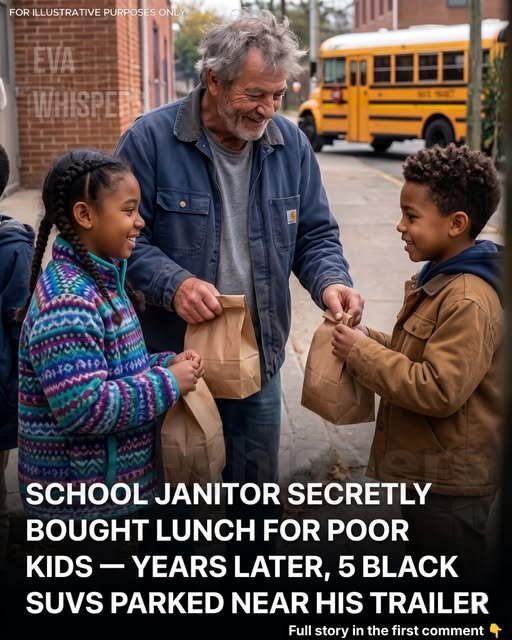
For nearly two decades, Mr. Lewis worked quietly as a janitor at a small-town school that most people passed without a second glance.
Children barely noticed him sweeping the halls after the final bell. Teachers nodded politely when a light bulb needed changing or a locker jammed. Parents walked past him in the lobby without ever learning his name.
To the town, he was simply the gray-haired man with a mop bucket.
But Mr. Lewis carried a secret.
Nearly half of his paycheck went toward cafeteria tickets for children whose parents couldn’t afford lunch. He recognized hunger better than anyone—the child staring at the floor near the cafeteria doors, the student pretending to be busy while others lined up for food, the quiet voice insisting, “I’m not hungry.”
One afternoon, he found a boy sitting alone near the gym, fiddling with a loose thread on his sleeve.
“Are you heading to lunch, Marcus?” Mr. Lewis asked gently, leaning on his broom.
The boy shook his head. “I forgot my lunch.”
“Is that right?”
“I’m not hungry anyway,” Marcus mumbled. But his stomach growled loudly enough to betray him.
Mr. Lewis said nothing at first. Then he reached into his pocket, pulled out a yellow cafeteria ticket, and slipped it into Marcus’ backpack.
“Go eat,” he whispered. “And don’t tell anyone where it came from.”
Marcus looked up, wide-eyed. “But I can’t pay you back.”
“I didn’t ask you to,” Mr. Lewis replied softly. “Just grow up strong enough to help someone else someday.”
That was how Mr. Lewis lived—quietly, gently, without applause.

He returned each night to his old trailer outside town. The roof leaked when it rained, his truck barely started in winter, and most cold nights he warmed his hands beside a rattling space heater. People called him a loser behind his back.
Principal Vance, sharp-suited and cruel, was the loudest of them all. He despised that Mr. Lewis showed up every morning at 5 a.m. with a smile, no matter how little he had.
Years passed. Thousands of children came and went. Mr. Lewis watched them grow, graduate, and disappear into lives he would never see.
Then, three weeks before his retirement, Principal Vance cornered him in the hallway.
“Lewis,” Vance said, holding out a white envelope. “Pack up your mop bucket.”
Mr. Lewis froze. “Excuse me, sir?”
“You heard me. You’re done here. Effective immediately.”
“But my pension starts next month. I’ve worked here nearly 20 years.”
“The school board is restructuring. Your position has been eliminated.”
Mr. Lewis’ hand trembled as he took the envelope. Inside was an eviction notice.
“The trailer park sits on school-owned land,” Vance explained smoothly. “I found a buyer. A corporate development group. They want the property cleared.”
“You can’t do this,” Mr. Lewis whispered. “That trailer is all I have.”
“You have until midnight tomorrow to vacate,” Vance said coldly. “Winter is coming? Then buy a coat.”
Mr. Lewis folded the paper with shaking hands. For the first time in years, he wondered if his kindness had made him a fool.
The next evening, as wind rattled the thin metal walls of his trailer, he packed his belongings into cardboard boxes. His neighbor Martha stood in the doorway, wrapped in a faded blue coat.
“You don’t have to leave tonight,” she said. “That man is trying to scare you.”
“The notice says midnight,” Mr. Lewis replied. “I don’t want trouble.”
“You gave your whole life to that school.”

He taped a box shut and smiled sadly. “And what do I have to show for it?”
“You are a good man,” Martha said firmly.
“Good men don’t end up homeless at 65.”
Later, Mr. Lewis sat outside with a cup of coffee, trying to memorize every sound and shadow of the place that had been his shelter.
Then headlights swept across the dirt road. One black SUV rolled toward the trailer. Then another. And another. Five in total.
Neighbors peeked through their curtains as the sleek vehicles stopped in front of the battered trailer. Mr. Lewis stepped off the porch, pulling his worn jacket tight.
The driver’s door of the first SUV opened. A tall man in an expensive suit stepped into the porch light.
Mr. Lewis froze. The jawline was older, the shoulders broader—but the eyes were the same.
“Marcus?” he whispered.
The man’s face softened. “It’s been a long time, Mr. Lewis.”
Tears filled Mr. Lewis’ eyes. “You used to hide behind the bleachers during lunch.”
Marcus nodded. “Because I was starving.”
“I gave you the yellow tickets.”
“You gave me a reason to keep going.”
Mr. Lewis looked at the others. “David?”
“Yes, sir,” David smiled.
“Thomas? Leo?”
“We’re here,” Thomas said, voice thick with emotion.
The fifth man removed his glasses. “I hope you haven’t forgotten me?”
Mr. Lewis laughed through tears. “Ah, little Benny. You cried when you dropped your lunch tray.”
Ben nodded. “And you bought me another one.”
Mr. Lewis gazed at them all. “Look at you. You grew up.”
Marcus smiled. “We did more than that. We built a company together.”
Before Mr. Lewis could respond, a silver car sped down the road. Principal Vance stepped out, clutching a briefcase.
“What is going on here?” he demanded. Then he saw the men in suits. His tone shifted instantly. “Oh, you must be the buyers.”
Marcus turned to him. “We are.”
Vance hurried forward, hand outstretched. “Principal Vance. I didn’t expect your development group to come personally.”
Marcus ignored the handshake. “We wanted to see the land. And the people living on it.”
Vance sneered at Mr. Lewis. “Don’t worry about him. I fired him today. He’ll be gone by morning.”
Marcus’ jaw tightened. “Where is he supposed to go?”
“Who cares? He’s just a janitor.”
The five men went silent.
“Just a janitor?” Marcus repeated.
“That’s right,” Vance smirked. “A nobody. Now, do we have a deal or not?”
Marcus stepped closer. “My name is Marcus. Twenty years ago, I was a starving student at this school.”
David moved beside him. “So was I.”
“And me,” Thomas said.
Leo folded his arms. “And me.”
Ben’s voice was quiet but firm. “All of us.”

Marcus pointed toward Mr. Lewis. “When children said they weren’t hungry, he knew they were lying. When the school ignored us, he fed us. When our parents were drowning, he made sure we ate.”
Vance rolled his eyes. “Touching, but business is business.”
“No,” Marcus said coldly. “Greed is greed. Business is what happens when grown men protect the people who protected them.”
Vance’s face reddened. “The sale is done. Once my commission clears, I’m leaving this town.”
“The sale is done,” Marcus agreed. “Through our private investment group.”
Vance blinked. “Your group?”
Marcus nodded. “You thought you were selling to strangers. You sold it to us.”
David pulled out a folder. “The land is no longer under your control.”
Thomas added, “We reviewed the rushed sale, the eviction notices, and Mr. Lewis’ termination.”
Leo’s voice dropped. “Our attorneys found enough irregularities to bury you.”
“You can’t threaten me,” Vance stammered.
Ben looked him in the eye. “Nobody threatened you. You signed everything yourself.”
Marcus held up a document. “Including a declaration stating you personally orchestrated the sale and approved the evictions without proper tenant review.”
Vance’s mouth opened, but no words came.
“As new owners of this land and major donors to the district’s funding board,” Marcus continued, “we’ve already requested your immediate removal pending investigation.”
“You’re ruining me over him?” Vance shouted, pointing at Mr. Lewis. “Over a broke old janitor?”
Mr. Lewis stepped forward, hands steady now. “I might not have money in the bank,” he said softly, “but I was never broke.”
“You’re still a loser,” Vance sneered.
Mr. Lewis looked at the five men. “No. A loser leaves people hungry when he has the power to help. I never did that.”
Marcus pointed toward the road. “Leave. Before we call the police.”
Vance’s confidence crumbled. He scrambled into his car and sped off.
Silence hung in the cold air until Marcus handed Mr. Lewis a folder.
“What is this?” Mr. Lewis asked.
“The deed,” Marcus said.
“The deed to what?”
“To this land,” David explained. “The trailer. The lot. Everything.”
Mr. Lewis shook his head. “No. I can’t accept this.”
“You can,” Thomas said gently.
“You fed us when we had nothing,” Leo added.
“You kept us from feeling ashamed,” Ben said quietly.
Marcus placed a hand on Mr. Lewis’ shoulder. “You told me to grow up strong enough to help someone else someday. We listened.”
Mr. Lewis clutched the deed to his chest, overwhelmed. Martha wiped her eyes from the porch, and across the dirt road, neighbors stood in their doorways, watching the man they had overlooked finally receive what he deserved.
For twenty years, Mr. Lewis had swept floors no one thanked him for. He had fixed lockers, cleaned spills, and slipped meal tickets into backpacks without asking for recognition. He believed his kindness had vanished into the past.
But that night, five black SUVs parked beside his old trailer, and five men returned to prove that his quiet generosity had grown into something far greater than he ever imagined.
Note: This story is a work of fiction inspired by real events. Names, characters, and details have been altered. Any resemblance is coincidental. The author and publisher disclaim accuracy, liability, and responsibility for interpretations or reliance. All images are for illustration purposes only.