
The Joke That Almost Broke Us
The first time someone said it out loud, it didn’t sound like an accusation—not really. It was wrapped in laughter and passed around the table like something harmless, something everyone was expected to pretend carried no weight at all.
“That baby doesn’t look anything like your husband… are you sure you don’t owe someone an explanation?”
My aunt Patricia said it with a wide, easy smile, the kind that made people hesitate before calling her out because technically, she hadn’t done anything “wrong.” At least not in a way anyone wanted to confront during Sunday lunch.
I was holding my daughter in my arms when she said it, still trying to understand the fragile, overwhelming reality that this tiny person was mine. Around the table, some relatives chuckled awkwardly while others lowered their eyes just enough to avoid getting involved.
My daughter’s name is Scarlett.
She was born with bright copper-red hair that caught the light in a way that made strangers stop and stare, as if she carried a small flame wherever she went. I have soft brown hair. My husband Daniel has deep black hair like most of his family, which made Scarlett stand out even more whenever we were together.
But genetics isn’t as simple as people pretend.
My grandmother on my mother’s side had the same red hair when she was young. Daniel’s grandfather had it too, according to faded photographs tucked inside old family albums. Even our pediatrician explained it calmly and clearly:
Recessive genes. Completely normal. Nothing unusual.
Everyone nodded.
Everyone understood.
Except Patricia.
The Kind Of Joke That Lingers
At first, the comments were small enough to dismiss if you wanted to protect the peace. But every single one left a mark that never fully faded.
At Scarlett’s baptism, Patricia leaned toward Daniel and said loudly enough for others to hear:
“So… should we invite the real father too, or are we keeping that a mystery?”
People laughed again. Softer this time, but still enough to make it feel like a shared joke instead of a private insult.
At Christmas, she handed Daniel a wrapped box and smirked:
“Don’t worry, it’s not what you think… unless you actually want it to be a DNA test.”
And during a backyard barbecue when Scarlett was barely six months old, she pointed at a delivery truck passing by and joked:
“Look, maybe that’s where she got the coloring from.”
The laughter that followed was quieter. More uncomfortable. Like people knew they were crossing a line but didn’t want to be the first person to step away from it.
Daniel never laughed.
Not once.
At the beginning, he would squeeze my hand beneath the table and whisper:
“Ignore her, she’s always been like this.”
But slowly, something changed.
Not all at once. Quietly. Piece by piece.
The kind of change that happens when doubt is repeated often enough that it starts sounding believable.
He began skipping family gatherings. Sometimes he claimed he had work. Other times he said he wasn’t feeling well.
But I knew the truth.
It wasn’t work.
It wasn’t illness.
It was the silence.
The way nobody stopped Patricia.
The way nobody said, “That’s enough.”
The way everyone allowed it to continue, as though part of them had started wondering the same thing.

When Doubt Finds A Way In
What hurt the most wasn’t Patricia.
It was everything that came after.
Daniel’s mother began asking careful questions. Not directly. Never openly confrontational. But in that soft, concerned tone that somehow made the words heavier.
Was he sure?
Had he ever thought about “checking,” just to be certain?
She said sometimes love makes people overlook things, as though she were offering wisdom instead of planting suspicion.
I watched Daniel change little by little while pretending not to notice, because acknowledging it felt like admitting something between us was already broken.
He still loved Scarlett—I saw it in the way he held her, in the way his voice softened whenever he spoke to her—but something else had appeared too.
Something quieter.
Something unsettled.
One night, I found him sitting in the dark, his face glowing from the light of his phone screen.
When I looked closer, I saw it.
Paternity testing centers.
He locked the screen quickly and said:
“It’s nothing, just something I saw online.”
But I knew.
And somehow, the worst part was that I didn’t feel angry at first.
The Birthday That Changed Everything
We didn’t invite Patricia to Scarlett’s first birthday.
For the first time, it felt like we were finally setting a boundary. But deep down, I already knew she wouldn’t respect it.
And she didn’t.
She arrived carrying a large pink gift bag and wearing the same smile I had come to dread—the smile that always appeared right before she said something cruel enough to wound, but subtle enough to later dismiss as “just a joke.”
When Scarlett opened the gift, the room went silent so quickly it felt like all the air had been sucked out of it.
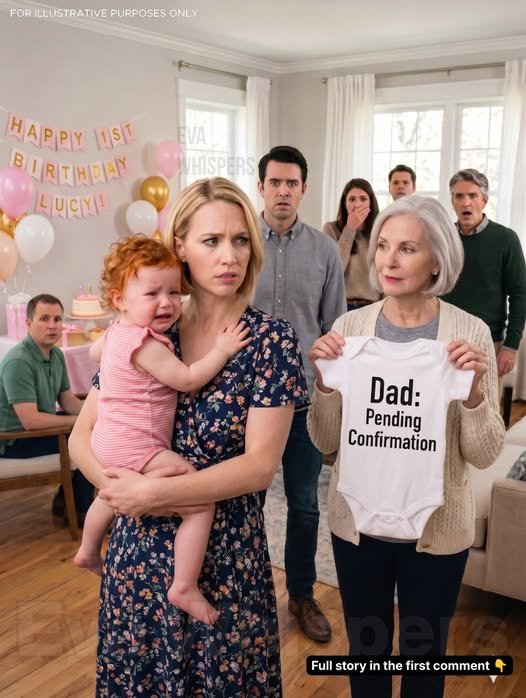
Inside the bag was a white onesie.
Across the front, in bold letters, were the words:
“Dad: Pending Confirmation.”
Daniel stood up immediately.
His face had gone pale. His hands only stayed steady because he was holding Scarlett.
Without saying a word, he carried our daughter into the bedroom and closed the door behind him.
Patricia laughed.
“Oh come on, don’t be so sensitive. It’s just a joke.”
That was the moment something inside me snapped.
Not slowly.
Not quietly.
Completely.
For the first time, I looked directly at her without feeling the need to keep the peace.
“A joke doesn’t tear apart a family,” I said, my voice steady even though my hands were shaking. “But since you like truth so much, maybe we should talk about the money you took from Grandma Eleanor before she passed.”
The Silence No One Could Ignore
The entire room froze.
Not the polite discomfort everyone had hidden behind before.
This silence was heavier.
Immediate.
Impossible to ignore.
Patricia’s smile vanished instantly, replaced by something I had never seen on her face before.
Fear.
“What are you talking about?” my mother asked quietly.
I never took my eyes off Patricia.
“I’m talking about checks signed when Grandma could barely hold a pen,” I said slowly. “I’m talking about transfers into your account. I’m talking about money disappearing while everyone believed you were taking care of her.”
Patricia tried to laugh, but it sounded uneven and weak.
“You sound ridiculous. You’re making things up because you can’t handle a joke.”
“I have copies,” I replied. “Bank statements. Signature comparisons. Dates.”
My father stood up, his expression harder than I had ever seen before.
“Patricia… tell me that isn’t true.”
She didn’t answer.
She grabbed her bag, shoved her chair backward, and walked out without another word.
No one followed her.
Within minutes, the party was over. Guests left quickly, avoiding eye contact as though remaining in the room would somehow make them responsible too.

The Truth Between Us
Later that night, after the house had gone quiet, Daniel came out of the bedroom carrying Scarlett asleep against his shoulder, her red curls resting softly against his cheek.
His eyes were swollen.
His voice barely above a whisper.
“I’m sorry,” he said. “I let it get to me.”
Part of me wanted to hold him.
Another part wanted to shake him.
Both feelings existed at the same time. Neither erased the other.
Then he told me something that hurt even more than I expected.
He had already scheduled a DNA test.
He had planned to do it without telling me.
Daniel sat down looking exhausted, completely worn down by months of doubt.
“Not because I don’t love her,” he said quickly. “I love her more than anything. But it got into my head, all of it… the comments, the looks… I couldn’t stop thinking about it.”
I took a deep breath before answering.
Because pretending it didn’t hurt would only make it worse later.
“Then we do it together,” I said. “Not to prove anything to you. To get rid of what she put into this house.”
What The Paper Couldn’t Fix
Three days later, the results arrived.
Daniel opened the envelope at the kitchen counter while Scarlett sat in her high chair happily banging a spoon against the tray, completely unaware that so much emotional weight rested on a single sheet of paper.
His hands trembled as he read the results.
Then he passed the paper to me.
99.99% probability.
Daniel broke down right there in the kitchen, holding onto me like something inside him had finally snapped after being stretched too far for too long.
But even with the relief, something painful still remained.
Because the paper confirmed biology.
It didn’t erase the doubt.
It didn’t undo the months where silence had spoken louder than trust.
The Truth That Went Further
My father personally filed the report against Patricia.
When investigators reviewed my grandmother’s accounts, they discovered far more than anyone expected: forged checks, suspicious withdrawals, and transfers made while my grandmother had been too weak to manage anything herself.
The amount wasn’t small.
Neither was the betrayal.
Some relatives argued that involving lawyers would “tear the family apart.”
Others finally admitted the truth they had ignored for years—that Patricia’s behavior had never really been harmless. It had simply been disguised well enough to avoid consequences.
My father never hesitated.
“Peace in a family doesn’t come from silence,” he said. “It comes from protecting the people who are being hurt.”
Eventually, Patricia accepted a legal agreement, returned the money, and faced the consequences that followed.
But honestly, the biggest thing that changed wasn’t the legal outcome.
It was that everyone finally saw her clearly.
Rebuilding What Matters
Daniel and I started counseling because we both knew pretending nothing had happened would only leave cracks beneath the surface.
We learned how to talk about pain without turning every conversation into blame.
We learned how to say the heavy things instead of avoiding them.
Daniel admitted he should have defended us sooner.
I admitted I had hidden more pain than I ever showed because I was afraid of breaking what already felt fragile.
Slowly, things began feeling steady again.
Not perfect.
But honest.
Real.
Daniel’s mother apologized quietly, without excuses.
His brother apologized too.
Not every relationship recovered the same way.
Some changed forever.
And strangely enough, that felt like peace.
The Kind Of Victory That Lasts
When Scarlett turned two, we kept her birthday small. We invited only the people who had stayed beside us when things were uncertain—when silence would have been easier.
Daniel decorated the house with red balloons and smiled as he said:
“If she’s going to stand out, we should celebrate it.”
When Scarlett dug both hands into the frosting and smeared bright red icing all over her face, everyone laughed.
But this time, the laughter felt warm.
Real.
Free of hidden cruelty.
Daniel watched her with a happiness that no longer carried any shadow.
And in that moment, I finally understood something important.
The victory was never about exposing Patricia.
It wasn’t the DNA test.
It wasn’t proving anything to anyone.
It was taking our home back.
Months later, we heard Patricia had moved away.
Sometimes letters still arrive.
We never open them.
Because forgiveness—if it ever comes—will happen on our terms, not hers.
That night, as I rocked Scarlett to sleep, I gently ran my fingers through her red curls and thought about my grandmother, about where that fiery color came from, and about everything it seemed to carry with it.
Maybe it was only genetics.
Or maybe it was something more.
Because families are not protected by staying quiet to avoid conflict.
They’re protected by knowing when to speak—even when your voice shakes.