
Not just physically. Completely.
No calls. No birthday cards. No Christmas visits. Not even one short message to say, I’m alive, Mom.
For the first few years, I waited.
Every time the bakery door opened, my heart jumped before my mind could stop it. Every time the phone rang after closing, I imagined his voice on the other end, awkward and guarded, saying, “Hi, Mom.”
But hope is a strange thing. It doesn’t die all at once. It thins. It fades. It becomes something you stop feeding because feeding it hurts too much.
By the tenth year, I had trained myself not to expect him anymore.
My bakery became my life instead.
Rosemary’s Bakery sat on the corner of Maple Street, tucked between a flower shop and an old bookstore. Every morning before sunrise, I rolled dough, mixed batter, brewed coffee, and filled the display case with croissants, pies, muffins, and the cinnamon rolls my son had once loved more than anything in the world.
When he was little, he used to sit on the counter with flour on his cheeks, swinging his legs while I glazed them.
“Extra frosting, Mom,” he would beg.
“You’ll spoil your dinner.”
“I’ll risk it.”
Those memories were dangerous, so I kept them locked away.
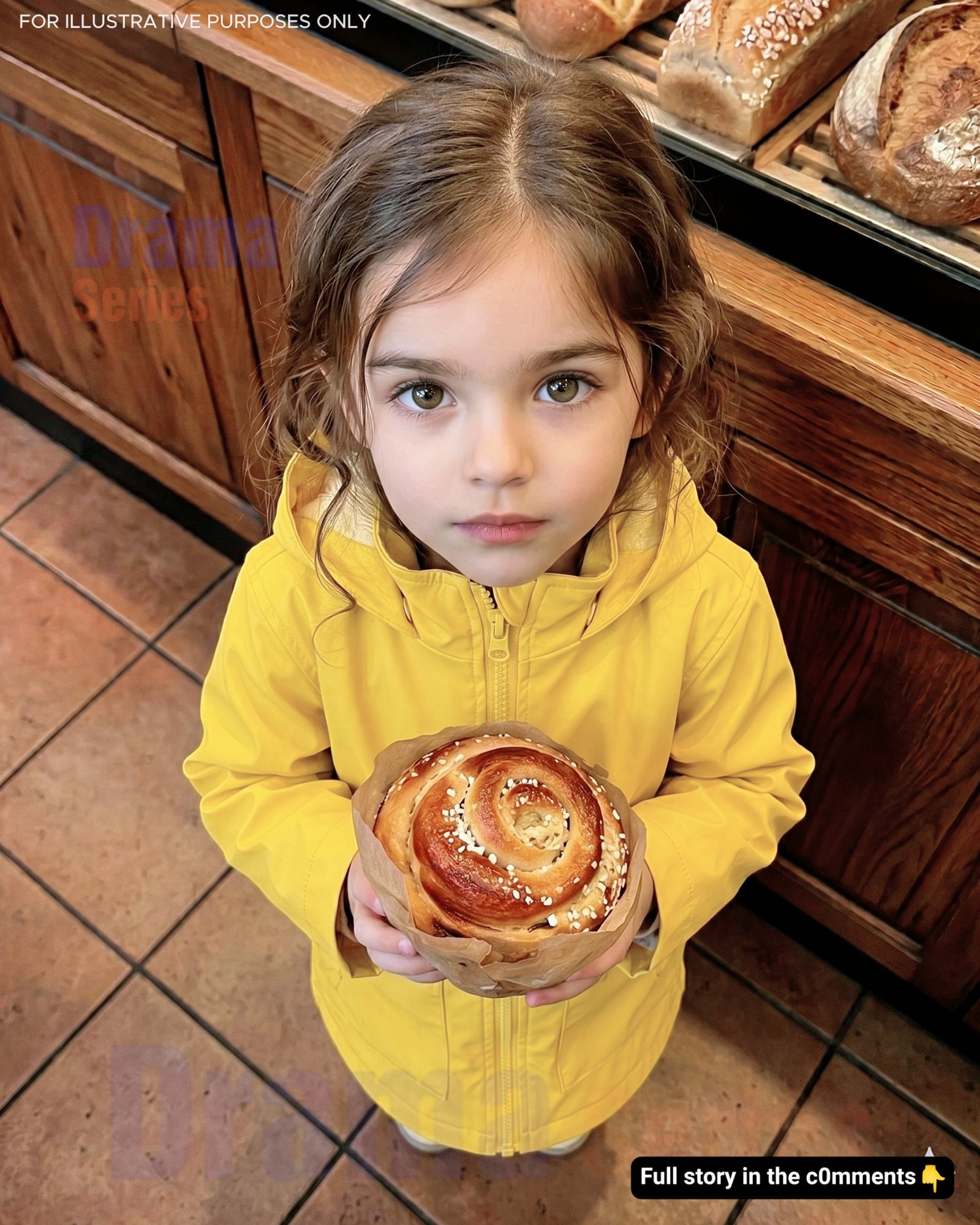
Then, three weeks ago, a little girl in a yellow raincoat walked into my bakery at exactly four o’clock.
She couldn’t have been more than nine. Her brown hair was tied in two messy braids, her backpack looked too heavy for her small shoulders, and her eyes—
Her eyes nearly made me drop the tray in my hands.
They were my son’s eyes.
Deep brown, bright, stubborn, and sad around the edges.
She walked straight to the counter, stood on her toes, and said, “Two cinnamon rolls, please.”
I smiled, though my chest had tightened. “Big appetite?”
“One is for me,” she said. “One is for my dad.”
I boxed them up carefully. “Your dad has good taste.”
She grinned. “He says nobody else makes them this good.”
For a moment, the bakery seemed to tilt.
I forced myself to breathe. “Does he?”
“Mhm. He said he used to eat them when he was a kid.”
My fingers froze on the ribbon.
I wanted to ask his name. I wanted to ask where he lived, whether he had brown hair, whether he had a scar above his eyebrow from falling off a bike at age seven.
Instead, I only said, “Tell your dad thank you.”
The little girl nodded, paid with crumpled bills and coins, and skipped out into the rain.
I told myself it meant nothing.
Lots of people liked cinnamon rolls. Lots of men had daughters. Lots of little girls had brown eyes.

But the next day, she came again.
Exactly four o’clock.
And the day after that.
And the day after that.
Always two cinnamon rolls. Always the yellow raincoat if it rained. Always that same careful smile, as if she had learned early not to take up too much space.
Soon, I learned her name was Lily.
She was nine years old. She loved spelling tests, hated mushrooms, and thought pigeons looked “suspicious.” She sat at the table by the window doing homework while I wiped counters and packed orders.
At first, she stayed only ten minutes.
Then twenty.
Then nearly an hour.
“Does your dad know you come here every day?” I asked one afternoon.
She nodded. “He gives me money. He says I can stop here before I go to Mrs. Bell’s apartment.”
“Mrs. Bell?”
“My neighbor. She watches me until Dad gets home.”
“And your mom?”
The question slipped out gently, but Lily’s pencil stopped moving.
“It’s just me and my dad,” she said quietly. “My mom left when I was little. I don’t remember her much.”
“I’m sorry, sweetheart.”
She shrugged, trying to look braver than she was. “It’s okay. Dad works a lot. He says everything he does is for me.”
Something in her voice cracked my heart.
From that day on, I began saving the softest cinnamon rolls for her.
I told myself it was kindness. Nothing more.
But deep down, I started waiting for her.
At 3:55, I would glance at the door.
At 4:00, she would appear, bringing with her the ghost of a life I had lost.
Then yesterday evening, everything changed.
A storm had rolled in hard, turning the street silver with rain. I was about to flip the sign to CLOSED when the door burst open.
Lily stumbled inside, soaked from head to toe, her yellow raincoat torn at the sleeve. Mud streaked her knees. Her cheeks were wet with tears.
“Lily!”
I rushed around the counter and caught her before she could fall.
“I fell off my bike,” she sobbed. “Some older boys were chasing me. They took my backpack and threw it in a puddle.”
Anger rose in me, sharp and hot, but I kept my voice calm.
“You’re safe now. Come here.”
I sat her in the chair behind the counter, cleaned the scrapes on her knees, wrapped a towel around her shoulders, and gave her warm milk with honey.
Then I handed her my phone.
“Call your dad, sweetheart. Tell him to come get you.”
Her hands shook as she dialed.
“Dad?” she whispered. “I’m at the bakery. I’m okay, but I fell… Please don’t be mad.”
My heart twisted at those words.
Please don’t be mad.
No child should have to say that when they were hurt.
Ten minutes later, the bakery door opened so hard the bell nearly snapped off.
A man rushed in, rain dripping from his dark coat.
He saw Lily first. Then her bruised knees.
Then he saw me.
The world stopped.
My son stood in my bakery.
Older. Thinner. Tired in a way that went deeper than lack of sleep.
But still my Daniel.
His eyes widened for half a second.
Then his face hardened.
“What did you do to my child, Mom?” he shouted.
The word Mom hit me harder than the accusation.
I rose slowly from behind the counter.
“And I’m happy to see you too, sweetheart.”
Lily looked between us, confused.
“Wait… what’s going on?”
Daniel stepped toward her. “Lily, get your things.”
“But Dad—”
“Now.”

His voice was firm, but I heard the fear beneath it.
I had heard that fear before.
Ten years ago.
The night he left.
“You don’t get to storm in here and accuse me,” I said. “She came in hurt and scared. I helped her.”
Daniel’s jaw tightened. “You always make yourself the hero.”
“And you always run before anyone can explain.”
His eyes flashed. “You think I ran? You told me I was ruining my life!”
I froze.
Lily sat very still.
The storm battered the windows.
Daniel’s voice broke despite his anger. “When I told you I was going to be a father, you didn’t ask if I was scared. You didn’t ask if I needed help. You said I was throwing everything away.”
Pain moved through me like an old wound reopening.
“I was scared too,” I whispered.
“You called me irresponsible.”
“I did.”
“You said I’d end up trapped.”
I closed my eyes.
“I said terrible things that night.”
His face changed slightly, but he said nothing.
So I kept going.
“I thought I was protecting you. You were twenty-two. You had dropped out of college. You were working two jobs. And when you told me a baby was coming, all I saw was how hard your life would become.”
“You didn’t see me,” he said quietly.
The words landed heavier than his shouting.
“No,” I admitted. “I didn’t. I saw my fear. I saw my plans for you disappearing. And instead of holding my son, I judged him.”
His mouth trembled, but he looked away.
“For years,” I continued, “I told myself you left because you were stubborn. Because you were angry. But the truth is, I gave you a reason to believe you weren’t welcome.”
Lily’s small voice broke the silence.
“Dad… she’s my grandma?”
Daniel looked at her.
The anger drained from him, leaving only exhaustion.
“Yes,” he said hoarsely. “She is.”
Lily’s eyes filled with tears. “You told me I didn’t have any grandparents.”
Daniel knelt in front of her. “I know. I’m sorry.”
“Why?”
He swallowed hard. “Because I was hurt. And because I didn’t know how to come back.”
That broke me.
Not his anger. Not his accusation.
That.
My son, nearly thirty-three years old, kneeling in my bakery, still sounding like the boy who had once needed his mother and found a locked door instead.
I walked over slowly and knelt beside them.
“Daniel,” I said, “I can’t change what I said ten years ago. But I have regretted it every day since.”
His eyes shone.
“I wanted to call,” he said. “So many times. When Lily was born. When her mother left. When I didn’t know how to make rent. When she got sick at three in the morning and I sat on the bathroom floor holding her, terrified.”
My hand flew to my mouth.
“But then I’d remember your face that night,” he whispered. “And I’d tell myself I didn’t need you.”
I reached for him, then stopped, afraid he would pull away.
“I should have come looking for you.”
“I should have let you.”
For a long moment, none of us moved.
Then Lily, still wrapped in my towel, looked at both of us and said, “This is very sad, but can we hug now?”
A laugh escaped me through my tears.
Daniel laughed too, broken and soft.
Then he leaned forward.
And for the first time in ten years, I held my son.
He was no longer the young man who had stormed out of my house. He was a father now, carrying burdens I hadn’t seen. But beneath all that, he was still my boy.
“I’m sorry,” I whispered into his coat.
“I’m sorry too,” he said.
Lily squeezed between us, wrapping one arm around each of our necks.
“I knew this bakery felt special,” she mumbled.
Daniel pulled back and looked at me. “She found it by accident. First day, she brought home those cinnamon rolls, and I knew. I should’ve told her not to go back.”
“But you didn’t,” I said.
His smile was faint. “No. I think part of me wanted her to.”
I wiped my cheeks. “Then come back tomorrow.”
He hesitated.
I added, “Both of you.”
Lily gasped. “Can we?”
Daniel looked at his daughter, then at me.
Something old and frozen softened in his face.
“Yeah,” he said quietly. “We can.”
The next afternoon, at exactly four o’clock, the bakery door opened.
This time, Lily came in holding Daniel’s hand.
I had already set three cinnamon rolls on the table by the window.
One for Lily.
One for Daniel.
And one for me.
Because some wounds do not heal in a single conversation.
Some families do not become whole again overnight.
But that day, as my granddaughter laughed with frosting on her nose and my son smiled at me for the first time in ten years, I understood something.
Love can be buried under pride, silence, and pain.
But sometimes, if grace walks in wearing a yellow raincoat and asking for two cinnamon rolls, love finds its way home.
Note: This story is a work of fiction inspired by real events. Names, characters, and details have been altered. Any resemblance is coincidental. The author and publisher disclaim accuracy, liability, and responsibility for interpretations or reliance. All images are for illustration purposes only.