
A Dress No One Noticed
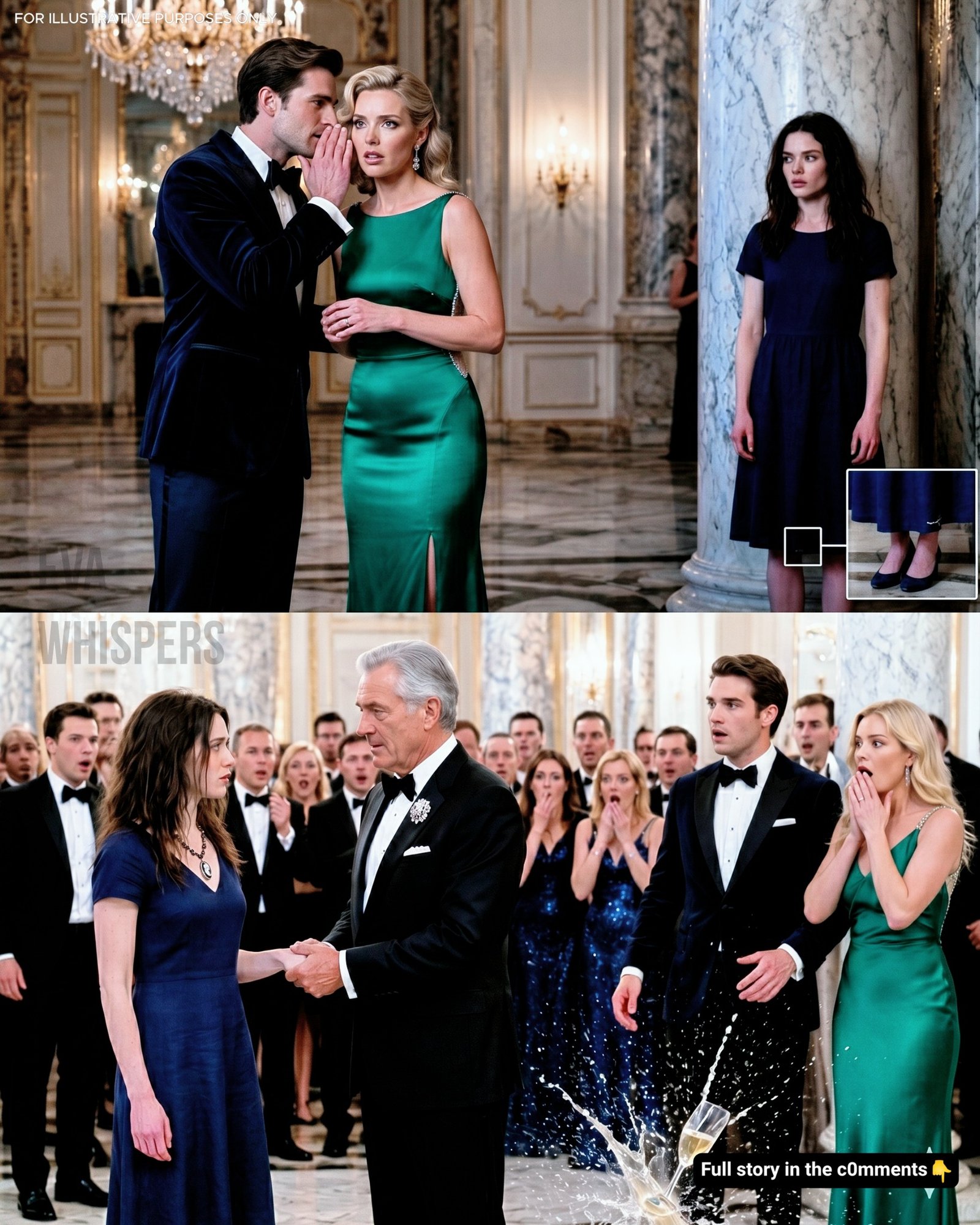
The night Daniel Whitmore told me to hide in the darkest corner of the ballroom, I was wearing the simplest dress in the room.
It was plain navy blue, with no designer tag, no expensive stitching, and no attempt to compete with the women glittering beneath the chandeliers. Near the hem was a tiny repair I had sewn myself that same afternoon at the kitchen table. The dress likely cost less than what most women at the gala had spent on a single pair of shoes.
But it was clean.
It was carefully ironed.
And to me, it meant something.
The dress reminded me of Rosa Bennett, the gentle widow from South Dallas who had raised me after no one else wanted the orphaned little girl found alone three decades earlier. Rosa sold tamales, sweet bread, and hot chocolate from a tiny food cart, yet somehow always made me feel loved.
Outside the historic Arlington Manor Hotel in downtown Dallas, Daniel tossed the keys of his black Aston Martin to the valet and gave me a look filled with embarrassment.
“Please, Emily,” he muttered, adjusting his gold Rolex. “Tonight matters. The board is here. Investors are here. Senators, CEOs… and my boss.”
“I know,” I said softly. “That’s why I came. I wanted to support you.”
Daniel gave a humorless laugh.
“You don’t get it. That dress…”
He lowered his voice.
“You look like you belong with the catering staff.”
The words hit me like a slap.
The Man He Used to Be
It was not the first time Daniel had made me feel small.
When we first met, I was working at a nonprofit health clinic in Oak Cliff, filing paperwork and helping patients who had nowhere else to go. Daniel arrived for a public donation event, charming, polished, and attentive. Back then, he told me he admired my honesty. He said wealthy women exhausted him and that he loved my simplicity.
I believed him.
But after the wedding, his admiration slowly turned into correction.
“Speak less at dinner.”
“Don’t bring up your childhood.”
“That accent makes people uncomfortable.”
And now, beneath the golden lights of the ballroom, he gave me the most humiliating order yet.
“Stay near the kitchen or the restrooms,” he whispered sharply. “Do not introduce yourself as my wife tonight. If anyone asks, say you work for the event.”
I froze.
Around my neck hung an old silver necklace shaped like half a sun. Whenever I felt ashamed or afraid, I touched it without thinking. Rosa had given it to me before she died.
“You were found after a terrible fire thirty years ago,” Rosa had once whispered from her hospital bed. “You had a scar near your collarbone… and this necklace in your tiny hand.”
That necklace and the scar were the only clues I had about where I came from.

The Ballroom Falls Silent
Inside the ballroom, Daniel became someone else entirely.
He smiled, shook hands, laughed loudly, and moved through the crowd like a man born to stand beside billionaires. I obeyed him quietly and stayed near the dessert table, pretending not to notice that my own husband refused to look at me.
Then, without warning, the entire ballroom fell silent.
Richard Kensington had arrived.
He was the seventy-two-year-old billionaire owner of Whitmore Corporation, a telecommunications titan whose approval could elevate a career or end it overnight. He entered with his older sister, Eleanor Kensington, beside him, while security guards followed a few steps behind.
Daniel nearly stumbled in his rush to greet him.
“Mr. Kensington,” he said breathlessly. “What an honor.”
Richard shook his hand without warmth.
“I was told you brought your wife tonight.”
Daniel’s posture stiffened.
“Yes, sir. She’s… somewhere nearby. She’s shy. Not used to this kind of world.”
With visible irritation, Daniel motioned me forward.
I walked toward them slowly, keeping my shoulders straight even though humiliation burned in my chest.
“Emily, this is Mr. Kensington,” Daniel said quickly. “Emily is… helping with the event.”
I extended my hand politely.
But Richard did not take it.
His eyes locked onto the necklace around my neck.
All the color drained from his face.
Beside him, Eleanor gasped and covered her mouth with both hands.
Daniel laughed nervously.
“Oh, don’t mind that old thing,” he said, grabbing my arm. “I keep telling her not to wear flea-market junk to formal events. Go back to the corner, Emily. You’re embarrassing me.”
No one in that room knew that Daniel had just made the worst mistake of his life.
Richard Kensington’s voice thundered through the ballroom.
“Take your hand off her. Now.”
Every conversation died instantly.
Daniel released me at once.
“Sir, I—”
Richard ignored him completely.
He stepped closer to me, his eyes shining with tears.
“That necklace,” he whispered. “Where did you get it?”
I swallowed hard.
“It belonged to the woman who raised me. She found me after a car fire thirty years ago near Fort Worth. I was sick, burned, and holding this necklace.”
Eleanor broke into sobs.
With trembling hands, she pulled a gold chain from beneath her blouse. Hanging from it was the other half of the same silver sun.
The two pieces matched perfectly.
Gasps spread across the ballroom.
Daniel forced out another nervous laugh.
“Sir, with all due respect, necklaces like that can be bought anywh—”
“Shut up,” Eleanor snapped.
She carefully turned over my necklace.
“There should be an inscription.”
Richard’s hands shook as I let him examine it.
The engraving was faded, but still visible:
E.K. — My light always returns.
Richard closed his eyes.
Then the most powerful man in the room dropped to his knees in front of the woman Daniel had told to hide.
“Elizabeth,” he choked out. “My daughter… my little Elizabeth.”

The Truth Comes Out
The ballroom erupted into stunned whispers.
I felt as if the floor had vanished beneath me. For thirty years, I had carried an empty space inside my life, a question no one could answer. Now the impossible was kneeling in front of me, crying.
Eleanor could barely speak.
“The accident…” she sobbed. “We were told no one survived. We buried an empty coffin. We mourned you for thirty years.”
Richard looked at me as if he feared I might disappear again.
“I searched for you for ten years. Investigators, police, hospitals… I never stopped hoping.”
Daniel’s face changed instantly.
The shame disappeared.
Greed took its place.
“Baby!” he said suddenly, reaching for my waist. “I always knew there was something special about you. Mr. Kensington, I swear, I treated her like a queen.”
I stepped away from him.
“Don’t touch me.”
Daniel blinked rapidly.
“Emily, sweetheart, emotions are high right now—”
“No,” I said coldly. “For the first time in five years, I see everything clearly.”
The room fell silent again.
“You told me an hour ago to hide near the bathrooms because you were ashamed of me. You mocked the woman who raised me. You treated my past like something dirty.”
Daniel’s face went pale.
“But now that I’m your boss’s daughter, suddenly I matter?”
The investors nearby exchanged looks of disgust.
“Emily, don’t do this here—”
“You never loved me,” I said. “You loved status.”
Richard slowly rose to his feet.
When he turned toward Daniel, his expression had turned to ice.
“You are fired, effective immediately,” he said quietly. “And if you have any sense left, you will leave my sight before I decide to ruin the rest of your life as well.”
Daniel looked as if he might collapse.
Walking Into the Light
That night, I walked out through the front entrance of the hotel beside my biological father.
Not hidden.
Not ashamed.
Not alone.
Months later, DNA tests confirmed the truth. Investigators eventually uncovered that the crash thirty years earlier had not been an accident. A business rival had sabotaged the vehicle, and in the chaos afterward, I had vanished unnoticed into the public hospital system.
Rosa Bennett had saved my life.
My divorce from Daniel took less than three weeks.
I did not ask for money.
I did not need revenge.
Daniel’s reputation destroyed itself. No major company in Texas wanted to hire the man who had publicly humiliated the long-lost heiress of the Kensington empire.
Six months later, I stood beside Richard at Rosa Bennett’s grave in South Dallas.
Richard gently placed white roses on the headstone.
“Thank you,” he whispered. “For loving my daughter when I could not.”
I wore the same navy-blue dress from the gala.
Around my neck, the silver sun necklace was whole again.

The Rosa Bennett Foundation
Weeks later, I launched the Rosa Bennett Foundation, an organization created to help women escape financial and emotional abuse.
At the grand opening, hundreds of guests and reporters filled the room. I wore no diamonds, no extravagant gown, and no symbol of inherited wealth.
Only the restored silver necklace.
When I stepped up to the microphone, the room became quiet.
“For years,” I said calmly, “someone tried to convince me that my worth depended on money, status, and where I came from.”
My voice remained steady.
“He told me to hide because he was embarrassed by my clothes and my roots. But I learned something important. Dignity is not inherited through a last name. It is not purchased with wealth. And it cannot be taken away by humiliation.”
Many people in the audience were crying.
I smiled softly.
“Sometimes life lets people break you in public so the world can witness how powerfully you rise.”
As I stepped down from the stage, a woman in worn clothes approached me with tears streaming down her face.
“Because of your story,” the woman whispered, “I finally found the courage to leave my husband.”
I hugged her tightly.
Because my story had not truly begun in the shadows of that ballroom.
It began the moment I stopped asking permission to stand in the light.