
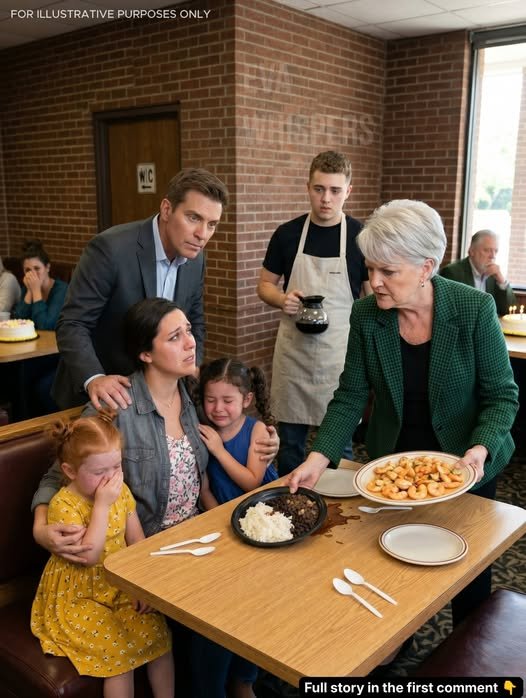
The restaurant smelled of butter, lemon, fried seafood, and bleach drifting from the hallway near the bathrooms—the exact spot where they had seated me and my two daughters.
Not at the main table with the cake and silver balloons.
Not near the window where Michael stood proudly beside his father, posing as if he had personally paid for the entire private celebration.
Instead, we were tucked away at a small table beside the bathroom door, where cold air brushed against our legs every time someone walked in or out.
My daughters noticed.
Olivia was seven, old enough to recognize humiliation even when nobody explained it. Megan was four, wearing a yellow dress covered with tiny white flowers because she insisted it made her look like sunshine.
The evening was supposed to celebrate my father-in-law David’s seventieth birthday. Michael wanted everyone to see him as the successful son—the man who could afford seafood platters, a private dining room, and a huge cake for forty guests.
The truth, however, was very different.
I had paid for all of it.
For years, Michael gave me a monthly allowance and acted as though he were being generous. Supposedly, it was meant to cover groceries, bills, school supplies, medicine, clothing, and everything else our daughters needed. It was never enough, and that was intentional. As long as I struggled, I had to keep asking.
Five years earlier, I quietly decided to change that.
Without telling Michael, I started a small catering business. I prepared office lunches, pasta trays, breakfast burritos, sandwich platters—anything that brought in extra income. Every dollar went into a separate account he knew nothing about.
I wasn’t plotting revenge.
I was building an escape route.
And then came the shrimp platter.
Every table in the room received one. As the waiter approached ours, Megan straightened excitedly in her chair.
“Mom, are those for us too?” Olivia asked softly.
“Yes,” I said with a smile.
Unfortunately, Jessica—my mother-in-law—heard me.
Before the waiter could place the platter on our table, she crossed the room, took it from his hands, and announced loudly, “Those girls don’t need shrimp. They already cost this family enough just by being born girls.”
The room fell silent.
Conversations stopped. Forks paused halfway to mouths.
Then Jessica placed a tray of cold rice, dry beans, and leftover chicken scraps in front of us, along with three plastic spoons.
“For you and your two little chickens,” she said.
Olivia slipped her hand into mine beneath the table.
“Mom,” she whispered, “why does Grandma call us chickens?”
That question hurt more than Jessica’s insult ever could.

A moment later, Michael appeared beside our table, already irritated.
“Don’t start, Emily,” he warned before I had said a single word.
I looked up calmly.
“I’m not starting anything.”
“Good,” he replied. “Tonight is about my father. You’re here to support me, not embarrass me.”
Then he glanced toward our daughters.
“My dad should be proud tonight, not reminded that his daughter-in-law only knows how to have girls.”
Something inside me went completely still.
Then Jessica slammed a bowl onto the table so hard that broth splashed across Megan’s yellow dress.
Megan burst into tears.
Nobody stopped Jessica.
Nobody defended my daughters.
So I did.
Carefully, I wiped Megan’s dress and took a photo of the stain. Then I checked the small recording device hidden beneath the tablecloth before dinner.
The red light was still blinking.
Recording.
Good.
Next, I opened the folder on my phone labeled “School Lunch Orders.”
Inside were years of receipts, invoices, bank records, payment confirmations, business registrations, and text messages. Every document told the same story.
The story Michael desperately wanted hidden.
Proof that I had paid for the party he was pretending to finance.
I stood up.
“Come on, girls.”
Michael grabbed my wrist.
“Don’t you dare make a scene.”
I lowered my eyes to his hand.
Slowly, he released me.
“The scene,” I said quietly, “is just getting started.”
Outside, I wrapped Megan in my cardigan and helped both girls into the rideshare I had already ordered.
Olivia looked worried.
“Are we in trouble?”
I turned around and smiled.
“No, baby. We’re done being punished for other people’s cruelty.”
Then I pressed Send.

Weeks earlier, Michael had asked me to prepare a birthday slideshow for the restaurant’s projector.
His exact words had been: “Handle this. Make me look good.”
So I did.
The first slide showed David smiling beside his birthday cake.
The second displayed the restaurant deposit receipt.
My name was highlighted.
The third slide showed the final payment.
Again, my name.
The fourth displayed Michael’s text messages bragging to friends about paying for everything.
The fifth showed the restaurant manager thanking me personally for organizing the event.
The sixth revealed Jessica asking me to buy her medication during the same week she had told relatives that I contributed nothing.
The seventh displayed my catering business registration.
No accusations.
No insults.
No yelling.
Just evidence.
One document after another.
By the time our rideshare reached the main road, my phone was exploding with calls.
Michael.
Jessica.
Relatives.
Family friends.
Everyone suddenly wanted to talk.
Later, my sister-in-law told me what happened after we left.
Jessica had collapsed into her chair, speechless.
Michael first tried laughing.
When that failed, he tried anger.
But anger looks very different when forty people have just watched the truth projected onto a wall.
Meanwhile, David sat quietly.
Then he looked at his son and asked a single question.
“Michael, what did you do?”
According to my sister-in-law, that question ended the party.
That night, I canceled our shared credit card, forwarded every document to myself and my accountant, and took the girls to my sister’s apartment.
Much later, after everyone had fallen asleep, Olivia crawled onto the couch beside me.
“Mom?”
“Yes?”
“Are we expensive?”
My heart broke.
I pulled both girls into my arms.
“No.”
I kissed Olivia’s forehead.
“You are precious.”
She frowned.
“What’s the difference?”
“Expensive means someone is counting,” I said softly. “Precious means the counting doesn’t matter.”
For the first time that day, she smiled.

The next morning, Michael arrived with a completely different attitude.
Conveniently, my sister was recording the conversation.
“Let’s not destroy the family over one bad night,” he said.
One bad night.
That was what he called ten years of insults.
Ten years of humiliation.
Ten years of silence whenever his mother attacked me or our daughters.
One bad night.
I told him he could contact me about the girls’ schedules, school matters, or expenses.
Nothing else.
Weeks turned into months.
I hired a lawyer.
I continued growing my catering business.
Order by order, client by client, the business expanded.
Eventually, I rented a small apartment with old carpet, thin walls, and a dishwasher that sounded like a tractor every time it ran.
It wasn’t perfect.
But it was peaceful.
One Saturday morning, Megan accidentally spilled an entire bowl of cereal across the kitchen floor.
The milk splashed everywhere.
She froze.
Then her eyes filled with tears.
“I’m sorry,” she whispered.
I knelt beside her.
Before I could say anything, she asked the question that shattered me.
“Nobody is mad?”
The fact that she expected anger over spilled cereal told me everything I needed to know about the life we had left behind.
I pulled her into a hug.
“Nobody is mad.”
She stared at me.
“Really?”
“Really.”
And in that moment, I knew we were finally safe.
Michael spent months trying to rewrite the story.
He told people I had embarrassed him.
He called me dramatic.
Ungrateful.
Vindictive.
But something fundamental had changed inside me.
I no longer confused endurance with love.
I no longer believed that keeping adults comfortable was more important than protecting children.
Most importantly, I stopped teaching my daughters to accept mistreatment simply to keep the peace.
The birthday party had been designed to prove Michael’s importance.
Instead, it revealed something far more valuable.
The truth.
The truth that receipts matter.
The truth that silence is not always weakness—sometimes it is preparation.
The truth that people who laugh at a child’s humiliation are not innocent simply because they stayed quiet.
And the truth that my daughters were never leftovers.
They were never burdens.
They were never too expensive.
They were the reason I finally stood up.
The reason I finally walked away.
And the reason I never sat at that table again