
Part 2
Nobody moved after Ryder said that.
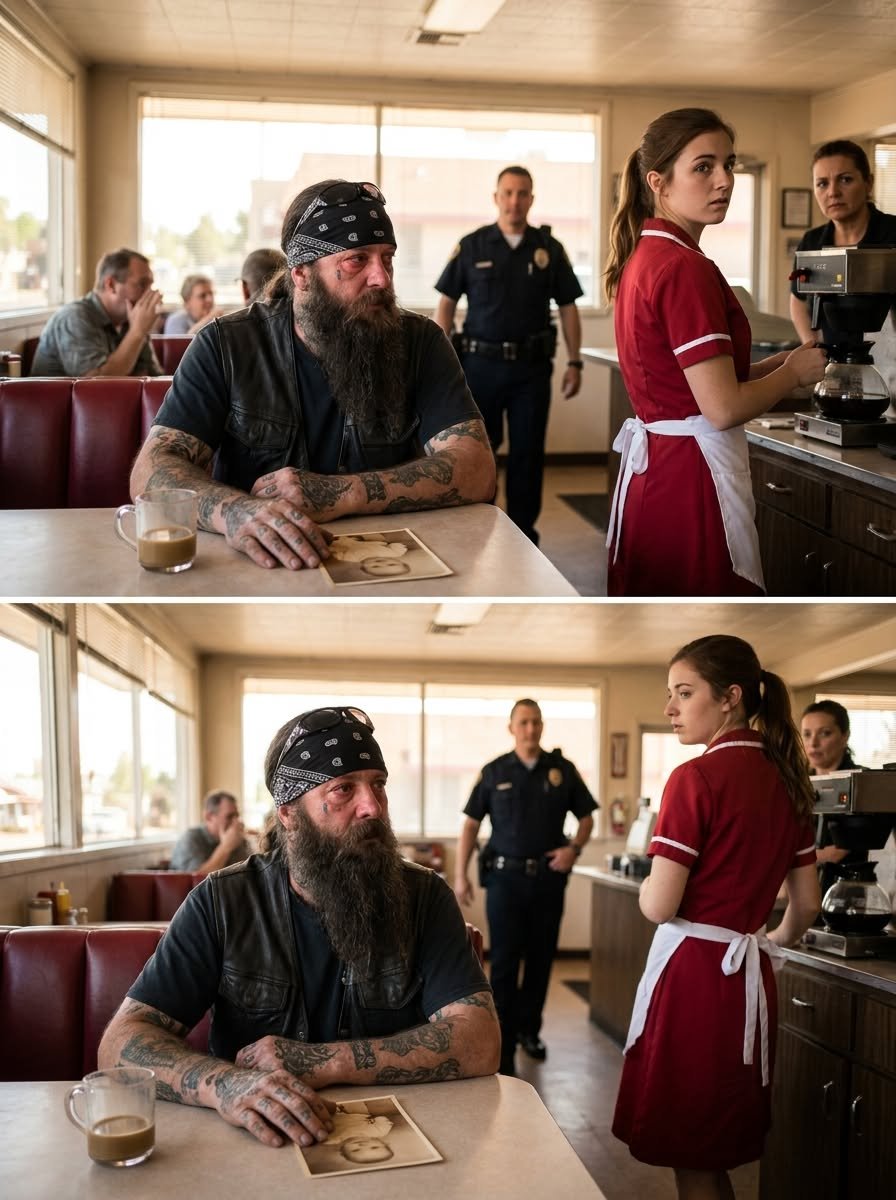
The diner had been full of sound all morning: forks against plates, the bell over the kitchen window, coffee pouring into thick white mugs, highway traffic humming beyond the glass, and customers pretending not to listen while listening to every word. But when that old baby photo hit the table, the whole room seemed to tighten around booth seven.
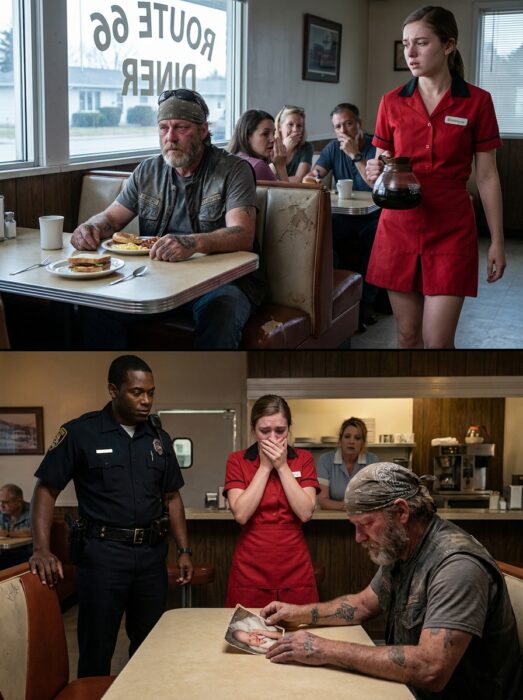
Officer Daniels looked at the picture first.
Then at Ryder.
Then at Emily.
Emily had stopped beside the counter with two plates still in her hands. One was meatloaf. One was a cheeseburger with extra pickles. The kitchen bell rang behind her, but she did not turn around. Her face had gone pale in a way I had seen only once before, when she got a phone call from her adoptive mother during a double shift and learned her grandmother had passed.
“Rachel,” she whispered, “what is that?”
I should have gone to her.
Instead, I stood frozen beside the office door, suddenly aware of every assumption I had made about the man in booth seven.
Officer Daniels picked up the photo carefully. He was a Black American man in his early forties, calm, broad-shouldered, with the kind of voice people trust when the room starts tipping. He studied the image without showing it to the crowd, then lowered it back to the table.
“Sir,” he said, “I need you to explain.”
Ryder nodded once, but the nod looked painful.
“My name is Jacob Hale,” he said. “I was married once. Her name was Melissa. We had a daughter. Emma Grace Hale.”
Emily’s fingers loosened around the plates.
One of them tilted. I took it from her before it fell.
Ryder did not look at her when he said the next part. I think he was afraid that if he looked too long, he would never finish.
“Melissa left when Emma was six months old. I came home from a ride and they were gone. Clothes gone. crib gone. Pictures gone. Phone disconnected. Her sister told me not to look, said Melissa was scared of my life, scared of the club, scared of what I might become.”
The old biker swallowed.
“She wasn’t wrong to be scared of some things.”
That line changed how I heard him.
He was not painting himself clean. He was not pretending he had been a perfect man betrayed by a cruel woman. His voice carried the weight of a past he would not decorate. Men like Ryder did not become soft by accident. They became soft after surviving the parts of themselves they could no longer defend.
He told Officer Daniels he had been twenty-five then, working nights in a garage, riding with a rough crowd, drinking too much, fighting too easily, and thinking love meant providing money while someone else carried the fear. By the time he understood what he had lost, there was no forwarding address, no family willing to talk, and no legal record clear enough for him to follow.
For years, he searched badly.
Then he searched sober.
That mattered.
He quit drinking at thirty-two because a private investigator told him no court, no agency, and no grown daughter would ever trust a man who smelled like whiskey and anger. He left the old club. He kept the bike, not the chaos. He worked at a repair shop in Nevada, saved cash in envelopes, paid for records, court searches, adoption traces, old hospital files, birth certificates, and every false lead that offered him one more chance to lose her again.
“Twenty-two years,” Officer Daniels said quietly.
Ryder nodded.
“I found out last month Melissa died in Oregon. Cancer. After that, one of her cousins finally answered me. Said the baby was adopted by a family named Carter after Melissa got sick the first time and couldn’t manage. Said the girl might be in Flagstaff. Might work in a diner.”
Emily’s hand went to her mouth.
“My name is Emily Carter,” she said.
Ryder closed his eyes.
“I know.”
The room breathed in around him.
He opened his eyes again, but he still did not look directly at her. His gaze stayed fixed on the table, on the baby photo, on the coffee mug he had not touched.
“I came in to see if you were okay,” he said. “That’s all. I told myself I’d drink one coffee, see your face, and leave.”
“Five hours?” Emily asked.
Her voice was not angry yet.
It was worse.
It was small.
Ryder’s jaw trembled, but he held it still.
“I’m not good at leaving you.”
No one whispered after that.
Even the trucker at the counter looked down at his plate.
Part 3
The false climax, the moment everyone thought would break the story open, came when Emily walked toward booth seven.
I almost stopped her.
Not because Ryder had done anything threatening by then, but because the room had become too exposed, and Emily was only twenty-two, holding a truth no one should receive in front of strangers eating lunch. But she moved before I could speak. Slow. Careful. Like she was approaching an injured animal, or maybe like she was the injured one and did not want anyone to notice how badly.
Ryder stood immediately.
The size of him filled the booth space. Leather creaked across his shoulders. His hands dropped open at his sides, fingers spread, showing her there was no demand in them. That detail broke something in me later. He looked like a man trying to make himself harmless in the only ways he knew how.
Emily stopped three feet from him.
“Don’t stand,” she said.
Ryder sat back down so quickly his knee hit the underside of the table and rattled the silverware.
“Sorry.”
She looked at the baby photo but did not touch it.
The picture was faded and bent at one corner. A baby girl sat in a yellow blanket, mouth open in a laughing expression too young to be controlled, one tiny fist gripping a man’s thumb. The man’s face was not in the photo, only his hand, tattooed even then, though the ink looked newer and darker. On the back, written in blue pen, were three words.
Emma. Six months.
Emily stared at it for so long I thought she might stop breathing.
“My birth name was Emma?” she asked.
Ryder nodded.
“Emma Grace.”
“Did my mom know?”
“Your adoptive mom?”
Emily nodded.
Ryder looked toward Officer Daniels, then back at the table.
“I don’t know. I didn’t contact her. I didn’t want to scare anybody. I didn’t want to show up at your house. I thought public was safer.”
That answer seemed to hit Emily strangely.
“You thought staring at me for five hours was safer?”
A few customers shifted.
Ryder accepted the blow without flinching.
“No,” he said. “I thought I’d be stronger than I was.”
Emily’s eyes filled.
“I thought you were some creep.”
“I know.”
“I was scared.”
That one hurt him. You could see it land.
His face did not collapse, but something behind it did. For five hours, he had tried not to disrupt her life, and in doing so, he had become exactly what he feared being: a source of fear. The irony sat on him like another leather vest, heavier than the one he wore.
“I’m sorry,” he said.
Not dramatic. Not defensive.
Just those two words, plain enough to be real.
Officer Daniels pulled a chair from a nearby table and sat at the end of the booth. That was when I knew he no longer saw Ryder as a threat, but as a situation that needed careful hands. He asked about documents. Ryder reached into the inside pocket of his cut and pulled out an envelope so worn it looked like he had carried it across half the country.
Inside were copies of a birth certificate, old photographs, a letter from the cousin, an adoption search summary, and a DNA test result from a registry Emily had apparently joined two years earlier after her adoptive father died. She had submitted her sample out of curiosity, then forgotten about it when no close match appeared.
Ryder had not forgotten.
He matched as a biological parent three weeks before entering the diner.
Emily sat down across from him then.
Not because everything was fixed.
Because her knees finally gave up pretending.
I brought water to the table. My hands shook when I set down the glasses.
“I’m sorry,” I whispered to Ryder.
He looked up at me for the first time since the police arrived.
“You did right,” he said.
That made it worse.
He was the one accused in front of a room full of people, yet he was comforting the person who had made the call.
Emily looked at him again.
“Why didn’t you just say it when I came to your table?”
Ryder rubbed one thumb over the edge of the photo.
“Because you smiled when you refilled my coffee.”
She blinked.
“And?”
“And I hadn’t seen that smile in twenty-two years,” he said. “I got selfish. I wanted five minutes where your life was still yours, and I was just some stranger lucky enough to see you okay.”
That was when Emily started crying.
Quietly, angrily, like she hated every tear for arriving before she had decided what to feel.
Part 4
The real twist came from Emily’s side of the story.
Until then, most of us thought the revelation was complete. Ryder was her biological father. He had searched for twenty-two years. He had finally found her, then sat frozen in a diner booth because love and guilt had tangled themselves too tightly to move.
But Emily had her own missing piece.
She wiped her face with the back of her hand, took a breath, and said, “My mom gave me something before she died.”
Ryder’s eyes lifted.
“Melissa?”
Emily nodded slowly, though the name seemed strange in her mouth.
“I didn’t know what it meant. I was twelve. She was sick, and I was angry because she kept coming in and out of my life like a relative, not a mother. The Carters were my parents by then. They were good to me.”
Ryder nodded quickly.
“Good.”
The speed of that word mattered. No jealousy. No claim. Just relief.
Emily continued. “Melissa gave me a small box. She said if a man with road tattoos ever came looking for me, I should know he wasn’t the monster she made him in her head.”
Ryder stopped breathing for a second.
At least it looked that way.
Emily looked toward me. “My purse is in the office.”
I went for it.
The whole diner waited while she opened the worn brown purse she carried to every shift and pulled out a key ring with too many keys, a lip balm, two receipts, and finally a small silver locket wrapped in tissue. Her fingers trembled as she placed it on the table beside the baby photo.
Ryder stared at the locket.
His face changed so completely that I knew it before he said it.
“That was mine.”
Emily opened it.
Inside was a tiny picture of a much younger Ryder, clean-shaven, holding a baby wrapped in yellow. He looked terrified and proud, the way new fathers often do when the future has not started taking things yet. Beside the photo was a folded strip of paper so old the creases had softened.
Emily unfolded it carefully.
The handwriting was faded, but readable.
Jacob, if she ever asks, tell her you loved her before you knew how to be safe.
Melissa.
Nobody in the diner knew what to do with that sentence.
Ryder covered his mouth with one hand and looked away, but not before we saw his eyes flood. He did not sob. He did not make a sound. He just bent over the table slightly, like the words had struck him in the chest.
Emily read the note twice.
Then she looked at him.
“Were you unsafe?”
That was the bravest question anyone asked that day.
Ryder lowered his hand.
“Yes.”
The honesty came without decoration.
Emily waited.
He looked at the locket, not at her, and continued. “Not to you. Never to you. But I was angry. I drank. I ran with men who thought fear was respect. I loved your mother, but I made her carry too much of my chaos. She left because she didn’t trust who I was becoming, and I hated her for that until I got sober enough to know she might have saved you.”
Emily’s face twisted.
“So she kept me from you?”
“She kept you from that version of me,” Ryder said. “I can hate the years and still understand the fear.”
That answer did something in the room.
It removed the easy villain.
People like easy villains because they tell us where to put our anger. Melissa was dead, Ryder was grieving, Emily was caught between two truths, and none of it fit neatly into the kind of story customers had been whispering when he was just a dangerous biker in booth seven.
Officer Daniels leaned back slightly.
The police call had become a family history.
Emily touched the locket.
“I used to wonder if this man ever looked for me.”
Ryder nodded, tears still standing in his eyes.
“Every state I could afford.”
“Why stop here?”
He looked around the diner, at the counter, the pie case, the chrome napkin holders, the window facing Route 66.
“Because the cousin said you worked here. And because when you came to the table, you asked if I needed more coffee like I was just another person.”
Emily laughed once through tears.
“That’s my job.”
“I know,” he said. “But for me, it was the first kind thing my daughter ever said to me.”
She broke then.
Not into his arms. Not yet. Real life rarely moves that fast.
She folded forward over the table, crying into both hands while Ryder sat across from her, every instinct in his body fighting to reach out and every bit of love in him refusing to take what had not been offered.
He waited.
For once, leaving was not the hard part.
Staying still was.
Part 5
The diner did not return to normal after that.
How could it?
The lunch rush had become a room full of witnesses, and every person there had to sit with the fact that they had turned a grieving father into a threat before they knew his name. Some paid quietly and left too much cash on the table. Some approached Emily, thought better of it, and walked away. The trucker who had muttered about Ryder earlier came to the register and asked me to cover booth seven’s bill.
I told him Ryder had only ordered coffee and toast.
He put down a twenty.
“Then cover the next one too.”
That was apology, diner style.
Officer Daniels stayed until Emily asked him to. He did not rush her. He did not force closure into a place where shock still needed space. He only told Ryder that sitting five hours and watching a young woman had scared people, no matter the reason, and Ryder accepted that without argument.
“I know,” Ryder said. “I won’t do it again.”
Emily looked up.
Something changed in her face when he said that. Maybe she heard the goodbye hidden inside it.
“You’re leaving?”
Ryder’s hand moved toward the baby photo, then stopped.
“I found you. That doesn’t mean I get you.”
That may have been the most fatherly thing he said all day.
Emily wiped her cheeks.
“I don’t know what I want.”
Ryder nodded.
“You don’t owe me knowing.”
“I might be angry tomorrow.”
“You get to be.”
“I might not call.”
“I know.”
“I might.”
His eyes lifted then.
Hope is dangerous when it enters an old wound. You could see him trying not to grab it too tightly.
“I’ll answer,” he said.
Emily looked at the locket again, then at the baby photo. “Can I keep this?”
Ryder pushed the photo toward her immediately.
“It was always yours.”
She touched it for the first time.
Her finger rested over the baby’s face, then over the tattooed thumb holding that tiny fist. She looked at his hands across the table, older now, scarred, ink faded, fingers thick from years of work and weather.
“I have your hands,” she said softly.
Ryder looked down at them as if seeing them for the first time.
“Sorry.”
She laughed.
It came out wet and broken, but it was real.
That tiny laugh loosened the air more than any speech could have. Ryder smiled for half a second, then lost it because emotion came too close behind.
Emily stood after a while and said she needed to finish her shift.
I told her she could go home.
She shook her head.
“No. I need to do something normal for ten minutes.”
So she did.
She refilled coffee. She brought checks. She forgot two orders and apologized three times to people who did not mind. Ryder remained in booth seven, but this time he kept his eyes on the table unless she spoke to him first.
At 3:05, Emily brought him a fresh cup of coffee.
She set it down carefully.
“Hot this time,” she said.
Ryder wrapped both hands around the mug.
“Thank you.”
She hesitated.
Then she took out a receipt slip and wrote her phone number on the back.
“This isn’t forgiveness,” she said.
Ryder stared at the number.
“No.”
“It’s not a promise.”
“I know.”
“It’s just a number.”
He nodded, but his voice had gone rough.
“Best thing I’ve had in twenty-two years.”
Emily walked back toward the kitchen before either of them could break again.
Ryder stayed five more minutes.
Exactly five.
Then he placed cash under the mug, folded the receipt with her number like something sacred, and stood. The room watched him again, but differently now. He put the baby photo’s empty envelope in his inside pocket, adjusted his leather cut, and walked toward the door.
At the threshold, he turned back once.
Emily was standing by the coffee station, holding the pot in both hands.
Neither of them waved.
Not yet.
But she did not look away.
Part 6
Ryder did not come back the next day.
Or the day after.
That surprised me, though it should not have. A man who had searched for twenty-two years knew something about waiting, and this time, waiting was the only respectful thing left for him to do. Emily worked her shifts. She smiled when customers required it. She cried once in the walk-in freezer, where diner workers go when life becomes too much and the onions cannot judge.
On the fourth day, she called him.
I know because she asked to use my office, even though her phone worked fine. She wanted a door. She wanted a place that did not smell like pancakes and overheard opinions. She sat in my chair with the baby photo on her lap, dialed the number from the card he had left, and stared at the wall while it rang.
He answered on the second ring.
I could hear only her side.
“Hi. It’s Emily.”
A pause.
“No, I’m okay.”
Another pause.
“No, you don’t have to talk. I just wanted to know if this number worked.”
Then her mouth trembled.
“Okay. Bye.”
She hung up and sat there for a long time.
After that, their relationship built itself in tiny, cautious pieces. A phone call once a week. Then twice. A coffee after her shift, not at booth seven but outside on the bench where the highway noise gave them somewhere to look when eye contact became too much. He told her about Melissa when she asked, but never cruelly. She told him about the Carters, her real parents in every daily sense, and he listened without competing against people who had done the raising he had missed.
That impressed me most.
He never tried to reclaim time by insulting the people who had filled it.
Three months later, Emily invited him to her twenty-third birthday dinner.
Not as Dad.
Not yet.
Just Jacob.
He arrived wearing a clean black shirt instead of his leather cut, which Emily noticed immediately.
“You didn’t have to dress harmless,” she said.
He looked embarrassed.
“I wasn’t sure.”
She touched his arm lightly.
“Just dress like you.”
The next time, he wore the cut.
Six months after booth seven, Emily rode on the back of his Harley for the first time. He drove like he was carrying glass. Helmet, jacket, gloves, the whole lecture. She rolled her eyes and told him she was twenty-three, not six months old.
He said, “I missed the middle. I’m overcorrecting.”
She laughed into the helmet.
That became their way.
Not perfect. Not healed. Not simple.
But alive.
Every year after that, on the anniversary of the day he found her, Ryder came to Miller’s Diner and sat in booth seven. For the first few years, Emily joined him before her shift. Later, when she moved to Phoenix for nursing school, she called him from wherever she was, and I put a cup of black coffee at the booth anyway.
He never stayed five hours again.
Usually twenty minutes.
Long enough to remember the man he had been that day. Long enough to honor the woman who had smiled at him before she knew who he was. Long enough to understand that love sometimes begins by not taking more than you are given.
Part 7
I still manage Miller’s Diner.
The counter has been replaced, the pie case finally died, and booth seven has a small scratch near the window where Ryder’s ring used to tap when he was nervous. Most customers never notice it. Emily does.
She is thirty now.
A nurse, just like she once swore she would never become because hospitals scared her. She says fear is sometimes a map. She has her father’s hands, her mother’s eyes, and a way of standing still during emergencies that reminds me of Ryder at that table, trying to survive hope without frightening it away.
She calls him Dad now.
Not every sentence.
Not performatively.
Just when it fits.
The first time she said it in the diner, Ryder spilled coffee on his jeans and pretended it was hot enough to explain his face. Emily let him have the lie.
Ryder is heavier now, beard mostly gray, shoulders still broad but slower under the leather cut. He still rides the black Road King into the lot when the weather allows, still parks by the same window, still folds his napkin with both hands before ordering.
But he does not look at Emily like a man afraid she will disappear.
He looks at her like a man still astonished she stayed.
Last month, I found an old photo tucked under the glass at booth seven. Emily must have placed it there. It was a new picture: Ryder and Emily standing beside his Harley, both squinting in Arizona sun, his tattooed hand resting carefully on her shoulder, her hand covering his.
On the back, she had written one line.
He found the table. I found the father.
That evening, Ryder came in, saw the photo, and sat down without a word.
Outside, Route 66 kept moving.
Inside, booth seven held.
Follow the page for more stories about the people we almost judge too quickly.