
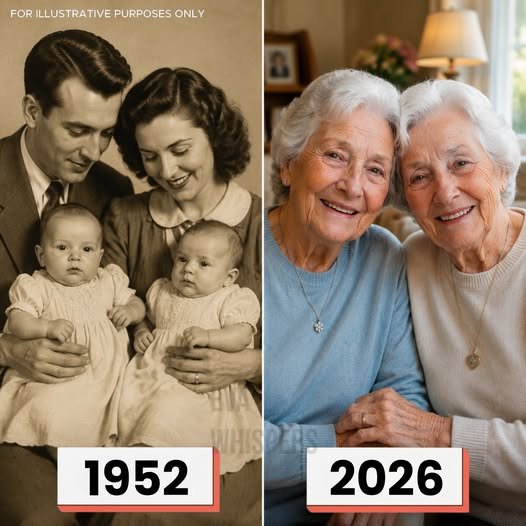
The woman staring back at me from my computer screen looked so much like my mother that I forgot how to breathe.
For one impossible second, I genuinely thought Facebook had malfunctioned and pulled up an old photograph from Mom’s profile. The resemblance was uncanny. The same eyes. The same smile. The same shape of the face.
Then I noticed the name.
Miranda.
And suddenly, a mystery that had haunted my family for more than seventy years no longer felt impossible to solve.
Growing up, Miranda had always felt less like a real person and more like a ghost woven into our family history.
Everyone knew she existed.
Nobody knew where she was.
My mother, Mary, rarely talked about her twin sister. It wasn’t because she didn’t care. If anything, she cared too much.
Whenever Miranda’s name came up, Mom’s expression would change in a way I didn’t understand as a child. Her smile would fade. Her eyes would drift somewhere far away.
The story never changed.
Their parents died when the girls were still young. Relatives stepped in and made decisions they believed were best. Mary remained in America. Miranda was sent to England.
The adults promised the sisters it would only be temporary.
They promised they would stay connected.
They promised they would see each other again soon.
None of those promises came true.
Months became years.
Years became decades.
The twin sisters grew up on opposite sides of the ocean.
They celebrated birthdays apart.
Graduated apart.
Married apart.
Raised children apart.
Became grandmothers apart.
Eventually, they became elderly women who had spent more than seven decades living separate lives.
Whenever I asked Mom about Miranda, she always gave short answers.
“I hope she’s happy.”
Or sometimes:
“I wonder if she ever thinks about me.”
Then she would quickly change the subject.
As a child, I assumed those answers meant she had moved on.
As an adult, I realized they meant exactly the opposite.
Some wounds never heal.
Some losses become so painful that you stop touching them altogether.
One evening, I was mindlessly scrolling through Facebook after dinner when a photograph stopped me cold.
I actually gasped.
The woman in the picture looked so much like my mother that I instinctively clicked on the image to see why Mom had been tagged.
She hadn’t.
The account belonged to someone else.
I stared at the name.
Miranda.
My pulse immediately sped up.
I clicked through the profile.
England.
Family photos.
Children.
Grandchildren.
Holiday pictures.
Garden photos.
An entire life.
A complete lifetime that existed across the ocean from ours.
The deeper I looked, the more unsettled I became.
The resemblance wasn’t merely physical.
Something about her expressions felt familiar.
The way she smiled.
The way she tilted her head.
The way she looked into the camera.
By the time I finished scrolling, my hands were shaking.
I grabbed my phone and called Mom.
She answered almost immediately.
“Everything okay?”
I swallowed.
“Mom…”

The hesitation in my voice instantly caught her attention.
“What is it?”
“Do you have a picture of Aunt Miranda?”
Silence.
A long silence.
Then she answered quietly.
“No.”
The response surprised me.
“You don’t?”
Her voice softened.
“No. I haven’t seen her face since we were children.”
The words hit me harder than I expected.
Seventy years.
Seventy years without seeing your own twin sister’s face.
I stared at the screen.
“Can you come over?”
An hour later, she was sitting beside me at my kitchen table.
I turned the laptop toward her.
For several seconds she didn’t react.
Then her hand flew to her mouth.
“Oh, my God…”
Tears instantly filled her eyes.
“She looks exactly like me.”
I nodded.
Neither of us dared say what we were both thinking.
Could it really be her?
Mom slowly reached toward the screen.
Her fingertips hovered just above the image without touching it.
For a brief moment, she no longer looked like a woman in her late seventies.
She looked like a little girl who had lost her best friend.
Finally, barely above a whisper, she said:
“I think that’s my sister.”
That night I sent a message.
I rewrote it over and over.
Nothing sounded right.
How do you introduce yourself to someone who might be family?
How do you explain seventy years of separation in a few sentences?
Eventually, I kept it simple.
I told her who I was.
I told her my mother’s name.
Then I pressed send.
For three agonizing days, nothing happened.
Mom pretended she wasn’t checking her phone every hour.
She was terrible at pretending.
Every time a notification sounded, her head snapped toward it.
Every evening she asked casually, “Anything yet?”
By the fourth day, I started wondering if we had made a mistake.
Then my phone buzzed.
I grabbed it instantly.
The message was short.
Very short.
But it changed everything.
“Your mother’s name isn’t Mary, is it?”
I didn’t even finish reading the rest.
I immediately called Mom.
She answered before the first ring completed.
“Well?”
“She replied.”
The silence that followed lasted several seconds.
Then:
“She did?”
I could hear both hope and terror in her voice.
I read the message aloud.
Before I finished, Mom was crying.
The days that followed felt surreal.
Questions flew back and forth between America and England.
Childhood memories.
Family stories.
Names.
Events.
Details.
Only the real sisters could possibly know them.
A dog named Rusty.
A ruined birthday cake.
A teacher they both adored.
Secret games they played.
Tiny memories buried beneath seventy years of life.
Every answer matched.
Every memory aligned.
Piece by piece, doubt vanished.
The impossible became undeniable.
After more than seventy years apart, the twins had found each other.
Then came the first video call.
Neither woman admitted she was nervous.
Neither woman needed to.
Mom changed sweaters three times.
Then she worried about her hair.
Then she worried about the lighting.
Then she worried about everything else.
When the phone finally rang, she froze.
“Answer it,” I said.
“I know.”
She didn’t move.
The phone rang again.
Finally, she pressed the button.
The screen went dark for a moment.
Then Miranda appeared.
Mom instantly covered her mouth.
On the screen, Miranda did exactly the same thing.
Neither spoke.
Neither blinked.
They simply stared.
The resemblance was breathtaking.
Not because they looked alike.
Because after seventy years, they still looked alike.
Different countries.
Different families.
Different experiences.
Different lives.
And yet somehow they remained reflections of one another.
Then Miranda laughed nervously.
Mom laughed too.
The same laugh.
The same rhythm.
The same little shake of their shoulders afterward.
I felt chills run through my body.
The conversation began slowly.
Then suddenly neither could stop talking.
Questions.
Stories.
Interruptions.
Memories.
Laughter.
Tears.

At one point, Miranda tilted her head and tucked a loose strand of hair behind her ear while listening.
The movement lasted less than a second.
But I had seen my mother do that exact gesture my entire life.
A few minutes later, Mom did it too.
Same motion.
Same expression.
Neither noticed.
I couldn’t stop staring.
Seventy years apart.
An ocean between them.
And somehow they still carried pieces of each other.
By the end of the call, both women were crying.
Neither wanted to hang up.
The next day they spoke again.
Then the day after that.
Within weeks, daily calls became routine.
Soon, they began discussing something they had dreamed about their entire lives.
Meeting in person.
A reunion.
For the first time in decades, they weren’t looking backward.
They were looking forward.
None of us knew how quickly that would change.
At first, planning seemed easy.
Miranda’s age and mobility issues made travel difficult, so Mom would fly to England.
We discussed flights.
Hotels.
Wheelchair assistance.
Travel insurance.
The sisters excitedly planned what they would do together.
Walk along the seaside.
Look through old photographs.
Share meals.
Talk face-to-face instead of through a screen.
For a while, happiness filled every conversation.
Then everything collapsed.
One afternoon, Mom called me from the hospital.
The second I heard her voice, my stomach dropped.
A serious medical issue had appeared without warning.
The following days became a blur of tests, specialists, waiting rooms, and terrifying conversations.
Eventually, doctors stabilized her condition.
But when we asked about England, their answer was immediate.
“No.”
The trip was too dangerous.
The reunion was canceled.
Telling Miranda was heartbreaking.
When the video call connected, Mom tried to remain positive.
She lasted less than thirty seconds.
By the time she explained the doctors’ decision, she was crying.
Miranda listened quietly.
Then she smiled sadly.
“We’ve already waited seventy years.”
Her voice cracked.
“I suppose we can wait a little longer.”
At the time, her words felt comforting.
Later, they felt terrifying.
Because suddenly a new fear entered all our lives.
What if they never got another chance?
The sisters continued speaking almost every day.
Birthdays happened through screens.
Christmas happened through screens.
Grandchildren met through screens.
Sometimes they laughed until they couldn’t breathe.
Other times they simply looked at one another.
Trying to reclaim lost decades through a tiny rectangle of glass.
Then, two years after reconnecting, everything changed again.
A cousin called.
She had been cleaning out the attic of a house that once belonged to Aunt Ruth—the woman who raised my mother after the twins were separated.
Most of what she found was unremarkable.
Old bills.
Photographs.
Paperwork.
Then she discovered a sealed carton.
Two names were written across the top.
Mary. Miranda.
Every hair on my arms stood up.
The box arrived two weeks later.
Mom opened it during a video call with Miranda.
Both sisters wanted to see the contents together.
At first, it seemed ordinary.
Photographs.
Cards.
Childhood keepsakes.
Then Mom lifted out a bundle tied with faded ribbon.
She frowned.
Miranda leaned closer.
“What is that?”
Mom didn’t answer.
Her eyes were fixed on the envelopes.
Then her expression changed.
Confusion.
Shock.
Disbelief.
Her hands started trembling.
“What?” Miranda asked.
Mom looked up.
“My name.”
The room went silent.
Written across the envelopes was Mary’s name.
Mom stared.
Then Miranda suddenly disappeared from the screen.
A moment later she returned carrying a box.
“I kept these,” she whispered.
“What are they?”
“Letters I wrote to you.”
The next hour shattered both women.
Dates matched.
Addresses matched.
Handwriting matched.
And a devastating truth slowly emerged.
The letters had never been delivered.
Not Miranda’s.
Not Mary’s.
After being separated, both girls had continued writing.
Both girls had waited for replies.
Both girls had hoped.
Both girls had cried.
And neither knew their letters had been intercepted.
For years they had reached for each other.
Someone had quietly hidden those attempts away.
The most heartbreaking part wasn’t reading the letters.
It was understanding what they meant.
For decades, Mom believed Miranda eventually stopped writing.
Miranda believed the same thing about Mom.
Neither sister ever realized the other had never stopped trying.
At one point, Miranda held an envelope in trembling hands.
She stared at it for a long time.
Then she looked at my mother.
“I thought you forgot me.”
Mom immediately shook her head.
Tears streamed down her face.
“So did I.”
Neither woman could continue.
Because they suddenly understood they had been mourning the same loss.
Separately.
For an entire lifetime.
The story they had carried for seventy years was wrong.
They had never abandoned each other.
They had been prevented from finding each other.
And those are very different things.
Weeks later, another discovery surfaced.
The same cousin found a journal belonging to Aunt Ruth.
Most of it contained ordinary entries.
Appointments.
Family gossip.
Shopping lists.
Then we found a passage that made the room go silent.
Aunt Ruth wrote that the girls were still exchanging letters.
Then she added one sentence.
A sentence none of us were prepared to read.
She worried maintaining contact would make separation harder.
She believed the girls would eventually build happier lives if they learned to let each other go.
She thought she was helping.
She was wrong.
Tragically, heartbreakingly wrong.
I looked at Mom expecting anger.
Instead, I saw grief.
Not grief for herself.
Grief for Miranda.
For the birthdays they missed.
The weddings they missed.
The births.
The holidays.
The ordinary afternoons sisters should share.

Someone had decided those moments didn’t matter.
Someone had decided two little girls could learn to live without each other.
And both women paid the price for seventy years.
The discovery should have brought closure.
Instead, it made the waiting even harder.
Because now they knew exactly what had been stolen.
And they still couldn’t be together.
Another year passed.
Then another.
Every health scare became terrifying.
Every doctor’s appointment felt significant.
Every missed call caused panic.
One afternoon Miranda missed a scheduled video chat.
Only twenty minutes passed before Mom started calling repeatedly.
When Miranda finally answered, both women were crying.
Neither admitted why.
Neither needed to.
We were all thinking the same thing.
What if time wins?
Then, almost four years after the canceled reunion, everything changed.
It began with another routine appointment.
Another round of scans.
More bloodwork.
More waiting.
When the doctor called, nobody expected good news.
I sat beside Mom as she answered.
For several seconds she listened silently.
Then her eyes widened.
“What?”
A pause.
Then:
“Are you sure?”
My heart began pounding.
She covered the phone and looked at me.
Hope radiated from her face.
Pure hope.
When the call ended, tears exploded from her eyes.
“What happened?”
She laughed and cried simultaneously.
“He cleared me.”
I blinked.
“What?”
“He cleared me.”
She was smiling.
Actually smiling.
“I can travel.”
For a second I couldn’t process the words.
Then I hugged her.
Years of disappointment suddenly cracked apart.
The impossible was possible again.
That night we called the family.
The next morning we searched flights.
By the end of the week, tickets were booked.
Then Mom had an idea.
A terrible idea.
A wonderful idea.
“We shouldn’t tell her.”
“What?”
“We should surprise her.”
I laughed.
“Mom, you’re seventy-eight.”
“Exactly.”
“That’s not an answer.”
“It is when you’re seventy-eight.”
The more we discussed it, the more perfect it sounded.
For four years Miranda believed the reunion could never happen.
Why not make it unforgettable?
So we kept the secret.
Every phone call became an exercise in self-control.
Weather.
Gardens.
Grandchildren.
Meanwhile, plane tickets sat hidden nearby.
The morning we left, neither of us slept.
Mom checked her passport five times before boarding.
During the flight she became quieter and quieter.
At one point she turned to me.
“What if she doesn’t recognize me?”
I smiled.
“Mom.”
She looked over.
“She’s recognized you for seventy years.”
Her eyes immediately filled with tears.
Neither of us spoke again.
By the time we reached Miranda’s village, my stomach was tied in knots.
The house looked exactly like it had during every video call.
Small brick walls.
Climbing roses.
The same front window.
Mom stared at the door.
“She’s really in there.”
I nodded.
“She’s really in there.”
I knocked.
Footsteps approached.
The door opened.
And there she was.
For a moment nobody moved.
Miranda looked at me.
Then at Mom.
Then back again.
Her expression froze.
Her mind seemed unable to process what her eyes were seeing.
Then her hand flew to her mouth.
The same gesture.
The same tilt of her head.
The same woman from the screen.
“Mary?”
The word emerged as barely a whisper.
Mom stared back.
“Miranda.”
Neither rushed forward immediately.
Both needed a few seconds to believe reality.
Then Miranda stepped forward.
Mom stepped forward too.
And suddenly they were in each other’s arms.
The years vanished.
The ocean vanished.
Seventy-four years of grief, hope, longing, and waiting collapsed into a single embrace.
They clung to each other desperately.
Sobbing.
Laughing.
Touching each other’s faces.
Pulling back only long enough to look again.
Neither seemed willing to let go.
Because both knew how much had already been taken from them.
I stepped quietly aside.
Neither noticed.
The world had narrowed to the space between them.
Eventually Miranda touched Mom’s cheek.
“You still do that.”
Mom blinked.
“Do what?”
“You still tilt your head when you’re listening.”
Mom laughed through tears.
“So do you.”
For one beautiful moment they sounded like little girls again.
Not elderly women.
Not strangers separated by continents.
Just sisters.
Later that evening, I sat quietly in the corner of Miranda’s living room and watched them talk.
Really talk.
Together.
Not through screens.
Not through oceans.
Not through decades of silence.
Together.
Mom reached over and squeezed Miranda’s hand.
Neither seemed willing to let go.
I thought about the letters hidden in the attic.
The journal.
The years they spent believing they had been forgotten.
The birthdays.
The weddings.
The grandchildren.
The ordinary moments that can never be replaced.
Time had stolen so much from them.
No reunion could ever return those lost decades.
No discovery could restore seventy years.
But as I watched them laughing side by side, one truth became impossible to ignore.
For most of their lives, each sister believed she had been reaching into silence.
Each believed the other had eventually stopped trying.
In the end, they discovered something far more heartbreaking—and far more beautiful.
Neither sister had ever let go.
Neither sister had ever stopped reaching.
The other had been reaching back the entire time.
They simply never knew it.