
A few days after my twins were born, my son hadn’t survived. That was the sentence I had carried inside me for ten years.
I was pregnant with a girl and a boy, and from the moment the doctor pointed to the screen and said, “There are two heartbeats,” my whole world changed. My husband, Daniel, cried right there in the examination room. I laughed through my own tears and squeezed his hand.
We named our daughter Susan and our son Clark before they were even born.
I bought two tiny blankets—one pale yellow, one soft blue. I placed them in the same drawer and imagined the day I would wrap both of my babies in them.
But labor started early.
Everything happened too fast.
There were bright lights, doctors shouting, Daniel’s terrified face above mine, and then darkness.
When I woke up, my body felt like it had been pulled apart and stitched back together. My throat was dry. My arms were empty.
Daniel was sitting beside me, holding our daughter.
“She’s perfect,” he whispered.
Susan was tiny, pink, and sleeping with one fist beside her cheek.
“And Clark?” I asked.
Daniel’s smile disappeared.
“He’s in intensive care,” he said carefully. “There were complications, but they’re doing everything they can.”
For three days, I lived between hope and fear.
My mother, Elaine, came to help. She fed me when I refused food. She brushed my hair when I didn’t have the strength to lift my arms. She whispered prayers under her breath while I stared at the hospital ceiling.
Then the doctor came in.
His face told me everything before his words did.
“I’m so sorry,” he said. “Clark was too weak. We did everything we could.”
I remember screaming.
Or maybe I didn’t scream at all.
Maybe the sound only happened inside me.
All I know is that a few days later, I left the hospital carrying only one child in my arms.
A Grief That Never Left
People told me time would help.
They said I was still young. They said I should focus on Susan. They said grief came in waves, and one day the waves would become smaller.
They meant well.
But none of them understood what it felt like to set two places in your heart and return home with one of them forever empty.
For months, I moved like a shadow through my own house.
Susan needed me, so I kept going. I changed her diapers. I rocked her to sleep. I kissed her tiny forehead and told myself she deserved a mother who was present, not a ghost.
Daniel tried his best too.
He grieved quietly. Sometimes I found him in the nursery at night, sitting beside Clark’s empty crib. He would run his hand along the little blue blanket and then wipe his eyes before he noticed me watching.
We never spoke much about the funeral.
My mother had arranged most of it because I could barely stand. I remembered flowers. A small white casket. Daniel’s hand shaking in mine.
Then life continued, as life cruelly does.
Susan grew into a bright, curious, kindhearted girl with dark curls and eyes the color of warm honey. Every birthday was a blessing, but also a reminder.
There should have been two cakes.
Two backpacks by the door.
Two voices calling, “Mom!”
Ten years passed.
I learned how to smile again.
But healing is not the same as forgetting.

The Boy at the Gate
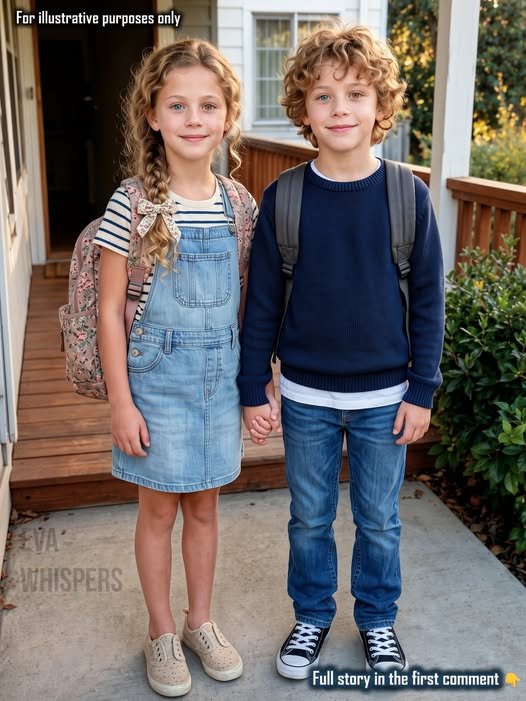
One Thursday afternoon, I was standing on the porch with a glass of lemonade in my hand when Susan came walking up the driveway with a boy beside her.
“Mom!” she called. “This is Noah. He just transferred to my class. Mrs. Benson paired us for the science project.”
The boy looked up at me.
The glass slipped from my hand and shattered on the porch.
For a moment, I could not breathe.
He had Susan’s eyes.
The same curls.
The same shape of face.
Even the same little dimple near his left cheek when he gave me a shy smile.
He looked exactly like my daughter.
No.
He looked like what Clark might have looked like if he had lived.
“Mom?” Susan rushed toward me. “Are you okay?”
“I’m fine,” I whispered, though my voice didn’t sound like mine. “I just dropped the glass.”
Noah stepped forward quickly. “I’m sorry, ma’am. Did I scare you?”
That nearly broke me.
His voice was gentle. Polite. Familiar in a way that made no sense.
“No,” I said, forcing a smile. “Of course not. Come inside. You two can work in the kitchen.”
I gave them cookies and notebooks. Susan chattered happily about their project on plant growth. Noah listened carefully and wrote down every idea she had.
I stood there pretending to wipe the counter while my heart pounded so hard I thought it might crack my ribs.
Finally, I excused myself and hurried to the guest room.
My mother was staying with us temporarily because her house was being renovated. She was folding laundry when I entered.
“Mom,” I whispered, shutting the door behind me. “There’s a boy here from Susan’s school. He looks exactly like her.”
My mother froze.
The towel slipped from her hands.
“His name is Noah,” I continued. “He has her eyes. Her curls. Mom, I know this sounds insane, but he looks like Clark.”
My mother went pale.
She sat slowly on the edge of the bed and pressed one hand to her chest.
Then she let out a long, tired sigh.
“Honey,” she said, her voice trembling, “sit down. It’s time for the truth to come out. But don’t tell Daniel anything yet. Promise me.”
The Truth My Mother Carried
I stared at her.
“What truth?”
Tears filled her eyes.
“I have lived with this for ten years,” she whispered. “And every day, I told myself I was protecting you. But maybe I was only too afraid to face what should have been faced long ago.”
My legs weakened. I sat down across from her.
“Mom, what are you talking about?”
She took my hands.
“Clark didn’t die that day.”
The room tilted.
I pulled my hands away as if she had burned me.
“No,” I said. “Don’t say that. Don’t you dare say that unless you know.”
“I know.”
“You were at the funeral!”
“I know,” she sobbed.
I stood up, shaking. “Then explain.”
My mother covered her face for a moment, then forced herself to look at me.
“The hospital made a terrible mistake. Clark was extremely weak, yes. He was transferred in the middle of the night to a children’s cardiac unit two hours away. You were unconscious after complications. Daniel had collapsed from exhaustion in the waiting area. I was the only family member awake when the paperwork came.”
I could barely hear her over the rushing in my ears.
“A nurse told me he had been transferred. Then a doctor came later, confused by the records, and said the baby had passed. I told him there had been a transfer, but he checked the wrong file. Everything was chaos. Two premature baby boys had similar names in the unit.”
“Why didn’t you tell us?” I whispered.
“I tried to find out. I called the transfer hospital. They said no baby under Clark’s name had arrived. I thought maybe the first nurse had been mistaken.”
My mother’s voice broke.
“Then, three days after the funeral, I received a call from a woman named Margaret Reed. She said she and her husband had been fostering a newborn boy from the hospital emergency program. The baby had no proper family information attached because of a paperwork error. She said one nurse had whispered to her that the child might belong to a mother who had been told he died.”
I gripped the back of a chair.
“She called you?”
“Yes. She said the baby was alive, but fragile. He needed months of special care. She wanted to return him if we could prove he was yours.”
“Then why didn’t you bring him back?”
My mother wept openly now.
“Because when I went to see him, the Reeds were there. They were kind people. They had lost their own child years before. They were caring for him day and night. He was attached to machines. He looked so small, so breakable.”
Her voice dropped to a whisper.
“And you were barely alive yourself. You weren’t eating. You weren’t sleeping. Your doctor had warned me that another shock could destroy you.”
“So you decided for me?” I said.
The pain in my voice made her flinch.
“No. I made the worst mistake of my life. I told myself I would wait until he was stronger. Then weeks became months. The Reeds filed for guardianship while the hospital investigation dragged on. By the time I realized how wrong it had become, they had moved away.”
“Did Daniel know?”
“No,” she said quickly. “Never. That is why I said not to tell him yet. Not because he doesn’t deserve to know, but because this will break him too. We need facts first.”
I stumbled back.
Facts.
My dead son might be alive, sitting in my kitchen, eating cookies with his twin sister.

Following the Thread
That evening, I barely spoke.
Daniel noticed, of course. He always noticed.
“Is something wrong?” he asked after Susan went to bed.
I looked at his tired, kind face and almost told him everything.
But my mother’s words stopped me.
Facts first.
The next morning, while Daniel was at work and Susan was at school, my mother and I went through the old box of hospital papers.
At the bottom was a folded note I had never seen.
Margaret Reed.
There was an old phone number, an address, and one sentence written in my mother’s handwriting:
Baby boy has honey-colored eyes.
I felt sick.
I searched the name. Margaret Reed had passed away two years earlier. Her husband, Thomas, had died before her. But there was another name attached to an old obituary.
Their grandson: Noah Reed.
Noah.
My hands shook as I printed everything I could find.
Noah lived with his aunt now. His parents—his adoptive parents—were gone. He had recently moved into our town because his aunt had taken a job nearby.
By the time Susan brought Noah over again for their project, I had barely slept.
I watched him more closely this time.
He thanked me for every glass of water.
He laughed when Susan teased him.
He touched the edge of the blue notebook on the table and said, “That’s my favorite color.”
Blue.
Clark’s color.
I nearly cried right there.
When he went home, Susan came to me with a puzzled smile.
“Mom, isn’t it weird?” she asked.
“What?”
“Noah and I both hate peas. We both tap our pencils when we think. And Mrs. Benson said we explain things the same way.”
She laughed.
“It’s like he’s my twin or something.”
I turned away before she could see my face.
The Test
I knew I could not keep it secret any longer.
That night, after Susan went to bed, I told Daniel everything.
At first, he didn’t move.
He sat at the kitchen table with his hands flat against the wood, staring at nothing.
Then he stood so suddenly the chair fell backward.
“Our son was alive?” he said.
“Daniel—”
“Our son was alive, and nobody told us?”
My mother stepped forward, crying. “I’m sorry.”
Daniel looked at her, and I saw ten years of grief turn into anger.
“You let us bury an empty casket?”
My mother covered her mouth and sobbed.
I touched Daniel’s arm. “We don’t know everything yet. But we can find out.”
He pulled away, not cruelly, but because he was shaking too badly.
For the first time in years, I saw the same broken man who had sat beside Clark’s empty crib.
The next day, we contacted Noah’s aunt, Linda.
I expected suspicion. Anger. Maybe denial.
Instead, Linda listened quietly, her face growing paler with every word.
“My sister Margaret always said Noah came to them through a miracle and a mistake,” she whispered. “She wanted to tell him more when he was older, but she got sick too fast.”
She agreed to a DNA test.
Those two weeks of waiting were the longest of my life.
I prayed.
I feared.
I hoped so hard it hurt.
Then the results came.
Noah was our son.
Clark.
Susan’s twin brother.

Telling the Children
I thought the truth would fix everything.
It didn’t.
Not at first.
Truth can heal, but it also opens wounds.
Daniel cried in the bathroom where he thought no one could hear him. My mother could barely look at us. I struggled with anger so deep it frightened me.
But then there was Noah.
Sweet, careful Noah, who had lost the only parents he remembered and was now being told that another family had loved him from the beginning.
We sat with him and Susan in the living room.
Linda was there too, holding Noah’s hand.
I told them gently. Slowly.
Susan stared at Noah.
Noah stared at Susan.
Then Susan whispered, “So you’re my brother?”
Noah’s eyes filled with tears.
“I guess,” he said. “Is that okay?”
Susan crossed the room and hugged him so fiercely he almost fell backward.
“I always wanted a brother,” she said.
That was when I broke.
I covered my face and cried for the baby I had mourned, the boy I had missed, and the miracle sitting in front of me.
Noah didn’t call me Mom right away.
I didn’t ask him to.
He had loved Margaret. She had been his mother in every way that mattered during the years I was kept from him. I would never steal that from him.
So we started slowly.
Weekend visits.
Family dinners.
Old photos.
New memories.
Sometimes he called me “Mrs. Harper.” Sometimes he called me “Susan’s mom.”
Then one afternoon, months later, he stood in the doorway holding the pale blue blanket I had kept in Clark’s drawer for ten years.
“Was this mine?” he asked.
I nodded, unable to speak.
He pressed it to his chest.
Then he whispered, “Mom?”
One word.
One small word.
But it gave back a piece of my heart I thought had been buried forever.
Coming Home
We did not erase the past.
We faced it.
The hospital issued a formal apology after an investigation. Records were corrected. The people responsible for the mistakes were no longer in positions where they could hurt another family. It did not undo the pain, but it gave our story a place to stand in the truth.
My mother asked for forgiveness, but she did not demand it.
For a long time, Daniel could not speak to her without anger. I understood. I felt it too.
But forgiveness, I learned, is not pretending something didn’t hurt.
It is choosing not to let that hurt destroy every good thing still left.
Slowly, painfully, we rebuilt.
Noah stayed close with Linda, because love does not shrink when a family grows. Eventually, he began spending more time with us, then holidays, then school breaks.
The first birthday we celebrated together, I baked two cakes.
One for Susan.
One for Noah.
When Daniel lit the candles, his hands trembled.
Susan leaned toward Noah and whispered, “We’re finally even.”
Noah laughed.
And I saw it then.
The life I thought had been stolen forever had found its way back—not perfectly, not easily, not without scars, but truly.
Ten years before, I had left the hospital carrying one child and an emptiness that nearly swallowed me.
Now, I stood in my kitchen watching my twins argue over who got the bigger slice of cake.
My son had not returned as a baby.
He had returned as a boy with gentle eyes, a careful heart, and a story of his own.
And when he smiled at me across the table, I finally understood something.
Some miracles do not arrive when we beg for them.
Some take the long road home.