
The Only Thing He Left Me
My father and I were always close.
After my mother passed away, I became more than his daughter. I became his morning coffee companion, his reminder to take his medicine, his passenger-seat navigator, and sometimes, the only person who could make him laugh when grief settled too heavily in the house.
For years, it was mostly the two of us.
Then, when I was already grown, he remarried.
His new wife, Marianne, was polite enough, though never warm. Along with her came her son, Jeffrey—my stepbrother. Jeffrey was charming when he wanted something and distant when he didn’t. We were never close, but for my father’s sake, I tried to keep peace.
Dad wanted a family.
So I smiled at holiday dinners. I remembered Jeffrey’s birthday. I helped Marianne when she needed errands done. I told myself that love sometimes meant making room for people who never quite made room for you.
But as my father’s health began to fail, the idea of family became very uneven.
Jeffrey lived in another state and always had an excuse.
Work was busy.
Flights were expensive.
He would come next month.
Then next month became next season, and next season became “soon.”
Meanwhile, I was the one driving Dad to doctor’s appointments. I was the one sitting beside him in waiting rooms, holding his hand when the nurse called his name. I picked up prescriptions, cooked soft meals when he struggled to eat, cleaned the kitchen, folded blankets, and listened to the same old stories because I knew one day I would miss hearing them.
And I do.
I miss them every single day.
When my father passed away, I wasn’t thinking about money. I was thinking about the empty chair by the window. The untouched mug in the cupboard. The old sweater still hanging on the back of his bedroom door.
I believed grief was already heavy enough.
Then came the reading of the will.

Jeffrey’s Smile
We sat in a polished office with tall bookshelves and cold leather chairs.
Marianne sat beside Jeffrey, dressed in black, her hands folded neatly in her lap. Jeffrey leaned back like a man waiting to receive good news.
I sat alone.
The lawyer began reading.
My father’s house went to Marianne.
His savings were divided between Marianne and Jeffrey.
His investments, furniture, car, and personal valuables were also left to them.
I kept waiting for my name.
Surely there was something.
Not because I felt entitled to wealth, but because I had been his daughter. His closest family. His caregiver. His last hand to hold.
Finally, the lawyer cleared his throat and said, “To my daughter, Clara, I leave my antique wall clock.”
That was it.
An old clock.
The one that had hung in the hallway for as long as I could remember.
For a moment, I couldn’t breathe.
Jeffrey’s mouth twitched. Then he smiled.
“Well,” he said, loud enough for everyone to hear, “I guess Dad knew exactly how much you deserved.”
The words landed like a slap.
I looked down at my hands, refusing to cry in front of him.
The lawyer gave Jeffrey a warning look, but Jeffrey only shrugged, still smiling as if he had won a contest I didn’t even know we were playing.
Marianne said nothing.
I signed the papers I was told to sign. I took the old clock when it was delivered to me later that afternoon. Then I carried it into my small apartment and placed it against the wall.
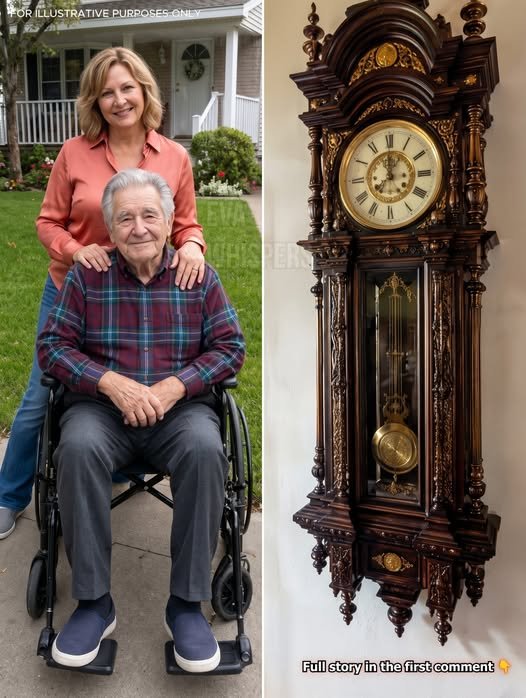
It looked too grand for my quiet living room—dark wood, brass face, carved edges, and hands that had stopped at 7:12.
I stared at it for a long time.
Why, Dad?
That was the question repeating in my head.
Why would you leave me only this?
The Words I Remembered
That evening, I made tea I didn’t drink and sat across from the clock as if it might explain itself.
The more I looked at it, the more memories came back.
When I was little, I used to ask Dad why he loved that old clock so much.
He would smile in that mysterious way of his and say, “One day, this clock will answer every question you never thought to ask.”
I always thought he was joking.
Sometimes he would wind it carefully and tell me, “Some things are not valuable because of what people can see. They’re valuable because of what they protect.”
At the time, I thought he meant memories.
Now, sitting alone in my apartment, I wasn’t sure.
The clock was dusty from years of hanging in the hallway. I found an old cloth and began cleaning it gently. The wood was smoother than I remembered. Along the side, beneath a line of carved leaves, I noticed something strange.
A tiny groove.
It was so small I almost missed it.
I ran my finger over it.
The groove didn’t look like a crack. It looked deliberate.
My heart began to pound.
I tried pressing it, sliding it, even turning the clock around to inspect the back, but nothing happened.
That night, I barely slept.
The next morning, I searched for someone who repaired antique clocks and found a small shop downtown called Harlan’s Timepieces.
The bell above the door rang when I entered.
An elderly man with silver hair looked up from a workbench covered in tiny tools.
“Can I help you?” he asked.
“I hope so,” I said. “This clock belonged to my father. I think there may be something unusual about it.”
He studied the clock for one quiet moment. Then his expression changed.
“Where did you get this?”
“It was my father’s,” I said. “He left it to me.”
The old clockmaker touched the carved wood with surprising gentleness.
“I haven’t seen one like this in years.”

The Hidden Compartment
His name was Mr. Harlan, and he moved with the patience of someone who had spent his life listening to time.
He placed the clock on a padded table and examined every inch of it. He checked the hinges, the frame, the face, and finally the carved leaves along the side.
For several minutes, he said nothing.
Then he reached for a small tool, pressed it into a spot I never would have noticed, and pushed.
A soft click filled the room.
A narrow compartment slid open from the side of the wooden frame.
I covered my mouth.
Inside was a folded envelope, yellowed with age but sealed carefully.
My name was written on the front.
Clara.
My father’s handwriting.
My knees nearly gave out.
Mr. Harlan stepped back.
“I’ll give you privacy,” he said softly.
But I could barely open the envelope. My hands trembled too much.
Inside was a letter, a small brass key, a photograph of my mother holding me as a baby, and a set of documents wrapped in a thin blue ribbon.
I unfolded the letter first.
My dearest Clara,
If you are reading this, then I am gone, and the clock has finally done what I always promised it would do.
I know you may be hurt. I know the will may have made you feel forgotten. But my darling girl, you were never forgotten. Not for one moment.
I had to make choices that looked strange from the outside. I did it to protect what mattered most.
Your mother and I bought something before she passed. We always intended it for you. It was never part of my public estate, and I made sure it never would be.
The key will lead you to the rest.
And Clara, remember this: inheritance is not always what is announced in a lawyer’s office. Sometimes it is hidden safely inside love, waiting for the right hands to find it.
By then, tears were slipping down my cheeks.
Mr. Harlan quietly handed me a tissue.
The documents under the ribbon included an address, a bank letter, and a copy of a recorded deed.
The property listed was not my father’s current house.
It was a small cottage near Lake Briar.
My mother’s favorite place.
I remembered it vaguely from childhood—the porch swing, the wildflowers, the sound of water against the dock. After Mom died, Dad stopped taking me there. I had assumed he sold it.
But he hadn’t.
According to the deed, the cottage had been transferred into a trust years earlier.
And I was the sole beneficiary.
The Place My Mother Loved
That afternoon, I drove to the address with the brass key clutched in my hand.
The road curved through pine trees and opened into a quiet lakeside neighborhood. At the end of a gravel lane stood the cottage.
It was smaller than I remembered but more beautiful.
White paint. Blue shutters. A porch wrapped in sunlight.
The key fit the lock perfectly.
When I stepped inside, dust floated in the air like tiny stars.
The cottage had been preserved, not abandoned.
There were sheets over the furniture, boxes stacked neatly against the wall, and a fireplace with a framed photo resting on the mantel.
It was a picture of my mother, my father, and me.
I was three years old, sitting on Dad’s shoulders, laughing with my whole face.
Beside the photo was another envelope.
This one said: For the day you come home.
I opened it with shaking hands.
Dad had written more.
He explained that after marrying Marianne, he had tried to keep peace in the family, but he soon realized that Jeffrey cared more about what he could gain than about building any real bond. Dad didn’t want his final days filled with arguments, suspicion, or legal battles.
So he made a decision.
He left the visible estate to Marianne and Jeffrey, knowing they would focus only on what was in front of them.
But the things tied to my mother—her cottage, her keepsakes, and the private savings they had built together—he protected separately.
The bank letter explained that a safe deposit box had been opened in my name. The trust documents had been handled years earlier, properly and legally. Nothing in that hidden compartment changed the will.
It simply revealed what already belonged to me.
I sat on the old sofa and cried harder than I had cried since the funeral.
Not because of the money.
Because my father had known.
He had known I might feel abandoned. He had known Jeffrey might mock me. He had known the clock would be the one thing no one else wanted.
And that was exactly why it was safe.

The Safe Deposit Box
The next morning, I went to the bank.
The manager reviewed the documents carefully, checked my identification, and led me to a private room.
Inside the safe deposit box were my mother’s jewelry, several family photographs, a bundle of letters she had written to me before she passed, and a bank account statement connected to the trust.
The amount stunned me.
It was not billionaire wealth. It was not the kind of fortune people write headlines about.
But it was enough to change my life.
Enough to pay off my debts.
Enough to repair the cottage.
Enough to give me breathing room after years of working, caregiving, and quietly putting my own needs last.
At the bottom of the box was one final note from Dad.
Clara,
You gave me your time when time was the only thing I had left. No amount of money could repay that.
This is not payment. Love is not a transaction.
This is simply what your mother and I always wanted you to have: a place to breathe, a place to remember, and a future that belongs to you.
Do not let bitterness move into the rooms we saved for peace.
Live well. That will be enough.
I pressed the letter to my chest.
For the first time since the will reading, I felt the sharp ache inside me soften.
Dad had not betrayed me.
He had protected me.
In the quietest, cleverest, most loving way he knew how.
When Jeffrey Found Out
Of course, Jeffrey found out.
People like Jeffrey always do.
A few weeks later, after the trust paperwork was finalized and the cottage was officially in my name, I received a call from him.
His voice was no longer amused.
“So,” he said, skipping any greeting, “you found something in that clock.”
I looked out at the cottage porch, where fresh flowers now sat in a clay pot.
“Yes,” I said calmly.
“What exactly did you find?”
“Something Dad wanted me to have.”
He laughed once, but it sounded forced. “You mean something he hid from the rest of us.”
“No,” I said. “Something he protected.”
There was a pause.
Then Jeffrey said, “That cottage should have been part of the estate.”
“It wasn’t,” I replied. “The trust was created years ago. The bank confirmed everything. The deed was recorded properly.”
His silence told me he had already spoken to someone and heard the same answer.
“You think you’re so special, don’t you?” he muttered.
I closed my eyes.
A month earlier, those words might have broken me. But now I was standing in a home filled with my parents’ love. His bitterness felt small from there.
“No, Jeffrey,” I said. “I think Dad knew us both very well.”
He didn’t answer.
I continued gently, “You received what you wanted. I received what he wanted me to understand.”
Then I ended the call.
My hands were shaking afterward, but not from fear.
From release.
For years, I had carried the burden of keeping peace with people who mistook kindness for weakness. But that day, I realized peace did not always mean staying silent. Sometimes peace meant closing the door softly and not opening it again to cruelty.

Restoring More Than a Cottage
I spent the next several months restoring the cottage.
I painted the shutters the same blue my mother had loved. I repaired the porch swing. I cleaned the windows until the lake shone through them like a painting.
Mr. Harlan repaired the clock, too.
When he returned it to me, polished and ticking again, he refused to take full payment.
“Your father came to my shop once,” he told me.
I stared at him. “He did?”
Mr. Harlan nodded. “About two years ago. He asked me if the hidden compartment still worked. Said one day his daughter would bring it in.”
My throat tightened.
“What else did he say?”
The old clockmaker smiled gently.
“He said, ‘She’ll be hurting when she comes. Please be kind to her.’”
That broke me in the sweetest way.
Even near the end, Dad had been thinking of me.
I hung the clock in the cottage hallway, exactly where morning light could touch its face.
Every hour, when it chimed, it felt less like a sound and more like a heartbeat returning to the house.
I began spending weekends there. Then longer stretches. Eventually, I moved in.
I planted lavender near the porch. I framed my mother’s letters. I turned the back room into a small studio where I could write, paint, and finally breathe without rushing to the next appointment, the next pharmacy, the next emergency.
For so long, my life had revolved around caring for someone else.
Now, because of my father’s final gift, I was learning to care for myself.
What the Clock Really Held
People sometimes ask if I ever confronted Marianne.
I didn’t.
She sent one short message months later, saying she hoped I was “satisfied.” I never replied.
Not because I had nothing to say, but because I had nothing to prove.
The truth had already spoken.
It spoke through a hidden compartment.
Through a recorded deed.
Through my mother’s letters.
Through my father’s careful planning.
And through an old clock that everyone else saw as worthless.
Jeffrey had laughed because he believed value was always obvious. He saw houses, savings, accounts, and investments. He saw numbers on paper and thought he had won.
But my father understood something deeper.
He knew the most precious things are often overlooked by the greedy because they do not shine loudly enough.
That old wall clock was not just an antique.
It was a map.
A message.
A final embrace.
It led me back to my mother’s love, my father’s wisdom, and a home I thought had been lost forever.
The day Jeffrey smiled in that lawyer’s office, I thought I had been erased from my father’s story.
But I was wrong.
My father had written me into the part no one else knew how to read.
The Last Chime
One evening, nearly a year after Dad passed, I sat on the porch swing and watched the sun sink over Lake Briar.
The windows behind me were open, and inside the hallway, the antique clock began to chime.
One.
Two.
Three.
Each note floated through the cottage like a memory.
I thought about Dad sitting by the window during his final months, smiling whenever I asked about that clock.
“One day,” he had said, “this clock will answer every question you never thought to ask.”
And it had.
It answered the question of whether he remembered me.
He did.
It answered whether love could survive misunderstanding.
It could.
It answered whether quiet loyalty mattered, even when no one else seemed to notice.
It mattered more than I ever knew.
I looked toward the lake, holding one of my mother’s letters in my lap, and whispered, “Thank you, Dad.”
For the first time in a long time, grief did not feel like an ending.
It felt like a doorway.
And beyond it was the life my parents had saved for me, ticking patiently inside an old wooden clock, waiting for me to come home