
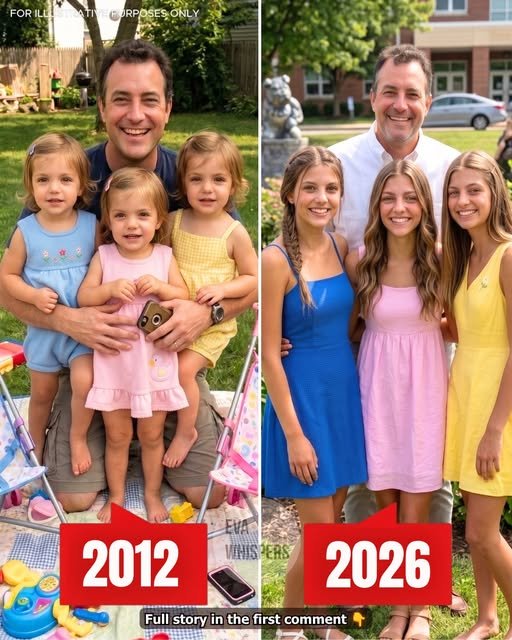
raised my three daughters alone after my wife, Sarah, passed away. But on their sixteenth birthday, one of them said, “Dad, Mom didn’t leave the way you thought.”
The kitchen light hummed softly above me, spreading a pale glow over the counter, where pink frosting, crumbs, and paper plates still cluttered the surface. Midnight had already come and gone, and after hours of laughter, music, and celebration, the house was finally quiet.
My triplets had just turned sixteen.
I stood at the sink, running a sponge along the rim of a glass, and felt the familiar ache rise in my chest. I wished Sarah could have been there to see them. I wished she could have watched the little girls she left behind grow into the young women they had become.
Fourteen years.
That was how long I had been doing this alone.
Fourteen Years of Being Dad
For fourteen years, I worked double shifts at the plant so I could afford three sets of braces, school supplies, birthday gifts, and everything else three growing girls needed. I learned things I never expected to learn. When Maya and her sisters were five, I taught myself how to do French braids from a YouTube video, pausing and replaying it until my fingers finally understood what my heart already knew: my daughters needed me to be both strong and gentle.
There were nights I came home so exhausted that my bones felt heavy. But I never resented a second of it.
Whenever the girls asked about their mother, I told them what the police told me. Sarah had been caught in a freak storm. The road was wet. She lost control of the car.
I gave them the exact words the officer had given me because, after losing Sarah, the truth felt like the only thing I had left to offer them.
Our triplets were only two years old when Sarah died.
The Hidden Lockbox
I never let the girls see how much grief I carried. I hid it upstairs, where they could not hear me break. In the attic, tucked beneath old tax returns, there was a rusted metal lockbox filled with the pieces of Sarah I could not bring myself to throw away.
Inside it were the locket she wore on our wedding day, a dried corsage, and the ultrasound photo where the technician had circled three tiny hearts.
I never opened that box in front of the girls.
That night, after the birthday celebration ended, I lifted an empty juice glass toward the ceiling and whispered into the quiet kitchen, “To 16,”
Then I swallowed hard and added, “You would’ve cried tonight seeing the young women they’ve become, Sarah. Nora actually sang.”
For a moment, the only sound was the hum of the kitchen light.
Then the floorboards above me groaned.

Maya Comes Downstairs
I heard footsteps on the stairs and turned toward the doorway, expecting one of the girls to sneak down for leftover cake.
But what I saw stopped me cold.
Maya stood in the archway, holding my hidden lockbox tightly against her chest. The brass latch was gone, snapped clean off. Jagged scratches ran down the front of the steel, as if someone had pried it open with a screwdriver.
In her other hand, she held a sealed white envelope.
She walked to the kitchen island, placed the lockbox down, and slid the envelope toward me. Her eyes were red, swollen with tears, and filled with something I did not yet understand.
“This came in the mail today, Dad,” she whispered. “I took it out before you got home. After everyone went to bed, I went up to the attic looking for anything else she wrote.”
My mouth went dry.
“Maya, that isn’t possible,” I said.
She looked at me as if she were begging me not to lie, even though she was terrified of the answer.
“Dad, Mom didn’t leave the way you thought, did she?”
The Letter
I knew the handwriting before I even picked up the envelope.
For a moment, I could not breathe.
I tried to explain what I knew. I told Maya about the police report, the wrecked car, and the memorial. I repeated the story I had believed for fourteen years. But Maya kept urging me to open the envelope.
When I could not move, frozen by shock, she tore it open herself.
Then she unfolded the letter and read the first line aloud.
“My girls, I don’t know if your father will let you see this, but you deserve to know I’m alive.”
The kitchen seemed to tilt beneath me.
Maya continued reading.
“I was sick after you were born. I convinced myself you were better off without me. I was a coward, and I’m sorry. That night in the storm, I purposely pushed the car over the embankment. I left my items on the seat and walked out through the trees. I promised myself I’d wait until you were old enough to decide for yourselves. Sixteen felt like that age. If you want to meet me, the address is on the envelope.”
When Maya lowered the page, Ellie and Nora were standing in the hallway.
They had heard enough.
I could not lie to them anymore.
The nicknames in the letter were real. The specific detail about the ultrasound was real. Sarah was alive.
And everything I thought I knew had just fallen apart.
The Six-Hour Drive
Before sunrise, I left the house and drove six hours to the address on the envelope.
Every mile felt unreal. I kept seeing Sarah’s handwriting in my mind. I kept hearing Maya’s voice reading those impossible words. I kept thinking about the storm, the wrecked car, the memorial, and the fourteen years I had spent grieving a woman who had walked away.
When I reached the address, I stood at the door with my hand trembling.
Sarah opened it.
She looked tired, older, and worn by something I could not name.
But she did not look surprised.
“You came,” Sarah said.
I stared at her, trying to understand how the woman I had buried in my heart was standing in front of me.
“You wrote to them,” I replied.

Rachel’s Secret
Sarah looked down before answering.
“Rachel called me yesterday,” she explained.
My sister.
Rachel had known the truth for six years.
For six years, she had carried the secret that Sarah was alive, and she had kept it from me because she feared I would fall apart.
I felt anger rise in me, but beneath it was something even heavier: grief for all the years I had lived inside a lie.
Sarah confessed that after the triplets were born, she had struggled with postpartum depression. She said she had convinced herself that she would ruin the children if she stayed. She believed leaving them was the only way to protect them, even though what she had done shattered all of us.
I begged her to come home with me and face the girls.
But she refused.
“Not until they say they want me to. I won’t take the choice away from them a second time.”
Telling the Girls Everything
I drove home with the truth sitting beside me like a weight I could not escape.
When I returned, I confronted Rachel about her six-year deception. There were tears, anger, and explanations that did not erase the damage. She had thought she was protecting me, but the truth had belonged to all of us.
Then I sat the girls down.
No more softened stories. No more repeating what the police had told me. No more hiding behind the version of Sarah’s death I had believed for fourteen years.
I told them everything.
When I finished, the room was silent.
Then I asked the only question that mattered.
“What do you want to do?”
Maya answered first.
“We’ll meet her. Together,” Maya said.
Ellie reached for my hand. “You’re still our dad. That doesn’t change.”
Nora was quiet. “I’ll come. But I’m not calling her ‘Mom.’”
What the Truth Gave Us
Months later, I stood at the sink washing dishes while laughter spilled from the kitchen table.
The girls were on a video call with Sarah.
Their relationship with her was complicated, fragile, and still unfolding. But it was theirs to decide now.
I had started therapy. My relationship with Rachel was slowly healing, though trust would take time to rebuild.
For years, the lie about Sarah’s death had felt like a shield. I had believed it protected my daughters. I had believed it protected me.
But standing there in the kitchen, listening to my daughters laugh at the table, I finally understood something painful and necessary.
The truth could hurt.
But in the end, the truth was better.