
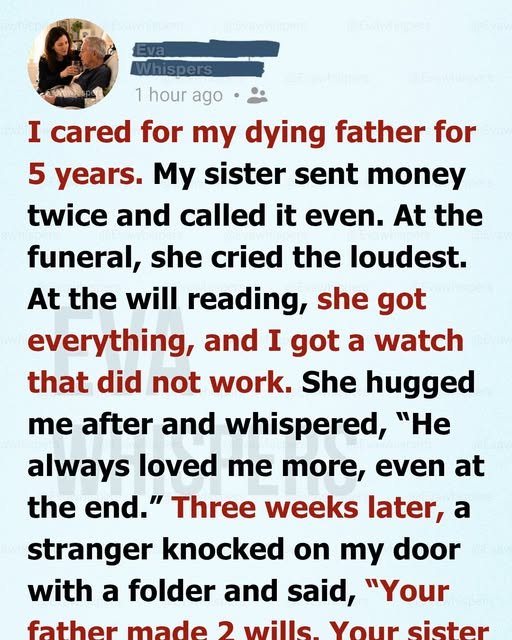
Five Years at Home
When my father first got sick, everyone said the same thing.
“Family will come together.”
I believed them.
I was thirty-two then, living in a small apartment I loved, working a job that had taken me years to earn. I had plants on my windowsill, weekend plans with friends, and a life that felt like it was finally becoming my own.
Then Dad’s diagnosis came.
At first, it was supposed to be manageable. A few doctor visits. A few lifestyle changes. A few hard months. But hard months turned into hard years, and before I fully understood what was happening, I had packed up my apartment, moved back into my childhood bedroom, and become the person who remembered every pill, every appointment, every warning sign, and every look in his eyes when he was too afraid to say he was scared.
My older sister, Vanessa, lived two states away.
She sent money twice.
The first time, she wrote, “For Dad’s care. Wish I could do more.”
The second time, almost a year later, she added, “You’re so strong. I don’t know how you do it.”
After that, she seemed to decide those two payments had settled her share of love, duty, and sacrifice.
Meanwhile, I learned how to lift Dad from his chair when his legs weakened. I learned which soup he could swallow on bad days and which music calmed him when pain made him angry. I learned how to forgive sharp words from a frightened man who hated needing help.
Some nights, after finally getting him to sleep, I would sit alone in the kitchen with the lights off and cry quietly into my hands.
Still, when Dad called my name, I always went.
The Loudest Tears
The last week of his life was strangely peaceful.
He slept more. Talked less. But when he was awake, he watched me with an expression I could not quite read.
One evening, he reached for my hand.
“Clara,” he whispered.
“I’m here, Dad.”
His fingers felt thin and cold around mine. “You gave up too much.”
I shook my head. “Don’t say that.”
“But you did.”
“I did what I wanted to do.”
His eyes filled with tears. “You did what love does.”
Those were some of the last clear words he ever said to me.
When he passed, the house became too quiet. For five years, every sound had belonged to him—the creak of his chair, the beep of his medical machine, the soft call of my name from the bedroom.
Now there was nothing.
At the funeral, Vanessa arrived in a black dress, holding a tissue before she had even stepped out of the car. She collapsed against relatives, cried into shoulders, and told everyone how impossible it was to lose “her daddy.”
People comforted her.
They told her she had been such a loving daughter.
I stood near the casket, too tired to correct anyone.
Grief had hollowed me out. I had no strength left for performance.

A week later, we gathered in a lawyer’s office downtown.
The lawyer was young, polished, and distant. He read the will in a voice that made our family sound like a business arrangement.
The house went to Vanessa.
Dad’s savings went to Vanessa.
The car went to Vanessa.
The furniture, the jewelry from my mother, and nearly every possession of value went to Vanessa.
And me?
I received Dad’s old wristwatch.
A silver watch with a cracked face and hands that had stopped moving years ago.
For a moment, I thought I had misunderstood.
The lawyer slid a small box toward me. “Your father specifically left this to you.”
Vanessa covered her mouth, pretending to be surprised, but I saw the tiny smile she tried to hide.
After the reading, she hugged me tightly in the hallway.
Anyone watching would have thought she was comforting me.
But her mouth brushed my ear, and she whispered, “He always loved me more, even at the end.”
I froze.
Then she pulled away, wiped her eyes, and said loudly, “We’ll get through this together.”
I said nothing.
Not because I agreed.
Because I was too empty to form words.
Three Weeks of Silence
For three weeks, I stayed in the house that no longer belonged to me.
Vanessa said she was “giving me time” before putting it on the market, as though I should be grateful.
I packed slowly.
Dad’s shirts. His books. His medicine bottles. The mug he used every morning. Every object felt heavier than it should have.
I kept the watch on the kitchen table.
Every morning, I looked at it and wondered why Dad had left me something broken.
Part of me felt ashamed for caring. Love was not supposed to be measured in money or property.
But it was not really about the inheritance.
It was about the message.
After five years of giving everything I had, the will seemed to say that Vanessa had mattered more simply because she had always expected more.
One rainy afternoon, I was sealing a box of Dad’s old photographs when someone knocked on the door.
When I opened it, an older man stood on the porch in a dark coat, holding a leather folder under one arm.
“Clara Bennett?” he asked.
“Yes.”
“My name is Harold Whitman. I was your father’s attorney.”
I frowned. “We already had the will reading.”
He nodded slowly. “Yes. With another lawyer.”
Something in his voice made my heart begin to pound.
“May I come in?”

The Second Will
We sat at the kitchen table, the broken watch between us.
Mr. Whitman looked at it and smiled sadly.
“He wanted you to have that first,” he said.
“Why?”
“Because he said you would understand broken things better than anyone.”
My throat tightened.
Then he opened the folder.
“Your father made two wills,” he said. “Your sister knew about both.”
The room seemed to tilt.
He continued carefully, “For the past two years, Vanessa had been visiting another lawyer, trying to persuade your father to change the first will. She told him you were only caring for him because you expected money. She said she had sacrificed from a distance. Your father listened, but he did not believe her.”
I could barely breathe.
Mr. Whitman slid a document across the table.
“The second will was made six weeks before he died, after your sister’s last visit.”
My hands trembled as I touched the paper.
“It leaves Vanessa the house,” he said. “That was intentional. Your father knew she wanted it most.”
I swallowed hard. “And me?”
His eyes softened.
“It leaves you everything else. The accounts, the land he bought in 1987, and the investment portfolio he never told either of you about.”
I stared at him.
“What investment portfolio?”
“A very successful one.”
The rain tapped against the windows. The stopped watch sat between us like a secret finally ready to speak.
Mr. Whitman leaned back.
“Your father told me to wait three weeks before coming to you. He said he wanted to see what kind of person Vanessa would be at the end.” His voice grew gentler. “He said he already knew what kind of person you were.”
That was when I broke.
Not because of the money.
Because my father had seen me.
All those quiet nights. All those tired mornings. All the times I thought no one noticed how much I was carrying.
He had noticed.
What the Watch Meant
Inside the box, beneath the watch, Mr. Whitman showed me a folded note I had missed.
It was written in Dad’s shaky handwriting.
My dear Clara,
This watch stopped the year your mother died. I never fixed it because it reminded me that time can break, but love does not.
You gave me your time when I had so little left.
No amount of money can repay that. But I hope what I leave behind gives you back some of the life you put on hold for me.
Do not let bitterness inherit your heart.
Live, sweetheart.
That will be my final gift.
Love,
Dad
I pressed the letter to my chest and cried harder than I had cried at the funeral.
For the first time in weeks, the house did not feel empty.
It felt like Dad was still there, reminding me who I was.

The Final Choice
When Vanessa found out, she called me screaming.
She said I had manipulated him. She said I had tricked a dying man. She said the money should have been hers because she had “a real life” while I had “chosen to stay behind.”
For once, I did not shrink.
I listened until she ran out of breath.
Then I said, “Vanessa, Dad left you the house because he knew that was what you wanted. He left me the rest because he knew what I gave. I’m not going to apologize for being loved fairly.”
She threatened court.
She threatened family drama.
She threatened to ruin my name.
But the documents were clear, witnessed, and legal. More importantly, my conscience was clear.
I did not fight her with cruelty. I did not expose every ugly thing she had whispered. I simply let the truth stand on its own.
In the end, Vanessa sold the house.
I used part of my inheritance to buy a small place of my own with wide windows, a garden, and enough sunlight for new plants.
I returned to work slowly. I traveled once, just because I could. I donated to the hospice nurses who had helped us during Dad’s final months.
And I repaired the watch.
The jeweler warned me the crack on the face would still show.
I told him to leave it.
Now it ticks softly on my wrist every day, not perfect, but moving.
Just like me.
Sometimes people look at it and say, “Beautiful watch.”
And I smile.
They see silver and glass.
I see five years of love.
I see my father’s final lesson.
Time given with love is never wasted.
And the truth, no matter how quietly buried, always finds its way home.