
The Garden We Built for Lily
For six years, my son Patrick and I planted sunflowers behind my parents’ old farmhouse.
Not because we loved gardening.
Not because we were good at it.
But because every golden bloom reminded us of the little girl we had lost.
Her name was Lily.
She was Patrick’s twin sister, born only minutes before him, but somehow always acting like she had arrived in the world first for a reason. Lily was bold, bright, and fearless. Patrick was quieter, gentler, the kind of child who looked both ways twice and reached for his sister’s hand before crossing a room full of strangers.
When Lily laughed, Patrick laughed.
When Patrick cried, Lily’s face crumpled too.
They were two separate children, but their hearts seemed stitched together by some invisible thread.
Then, when they were six years old, that thread was torn in a way none of us knew how to survive.
The Day Everything Changed
It happened one summer afternoon at my parents’ farmhouse.
The twins had been begging to take some stale bread down to the pond behind the back pasture to feed the ducks. It was something they had done before. The pond wasn’t far. The day was warm. The grass was high. Nothing about that moment felt dangerous.
So I said yes.
Only Patrick came back.
He stumbled toward the house soaked to his knees, mud streaked across his legs, his little face twisted in terror. He was screaming so hard I couldn’t understand him at first.
Then I heard Lily’s name.
And the world dropped out from under me.
I ran after him toward the pond, my heart pounding so loudly I could barely hear my own voice calling for her. Near the water, we found trampled reeds, cloudy ripples, and half a sack of bread abandoned by the bank.
But we did not find Lily.
Deputies searched until dark. Neighbors came with flashlights. My cousin Vince, who lived nearby, stayed outside nearly the whole night, calling her name until his voice went hoarse.
After heavy rain, that pond often drained into a narrow runoff channel hidden beyond the reeds, then toward a culvert beneath the road. The officers believed Lily must have slipped, been pulled past the deeper edge, and carried farther than anyone could reach in time.
They called it a terrible accident.
Patrick called it his fault.
A Brother’s Guilt
The truth, as Patrick remembered it, was simple and unbearable.
A duck had gotten tangled near the reeds. Lily wanted to help. Patrick had been holding her hand, just like he always did.
Then the bread sack started blowing toward the water.
He let go for one second.
One second.
By the time he turned back, Lily had stepped forward. The muddy bank gave way beneath her feet, and she was gone.
From that day on, Patrick woke up screaming.
“I shouldn’t have let go of her hand,” he would sob.
No matter how many times I told him he was only a child, no matter how many times I reminded him that none of it was his fault, the words never reached the place inside him where the guilt lived.
We tried therapy. We tried routines. We tried speaking about Lily gently, then openly, then not at all for a while.
But grief has its own language.
And Patrick’s grief spoke in one sentence:
“I let go.”

The Sunflower Tradition
On what would have been Lily’s seventh birthday, Patrick came to me holding a small packet of sunflower seeds.
“They were her favorite,” he whispered. “We should still celebrate her.”
So we planted them.
The first patch was uneven, messy, and far from perfect. Some flowers leaned too far to one side. Some never bloomed at all. But when the first yellow face opened toward the sky, Patrick stood in front of it with tears in his eyes.
After that, it became our tradition.
Every spring, we turned the soil together. Every summer, Patrick sat among the sunflowers and talked to Lily as if she were sitting right beside him.
When he made the baseball team, he told the flowers first.
When he lost his first tooth after she was gone, he whispered the news into the garden.
When he was sad, angry, proud, or afraid, he went there.
And I let him.
Because for years, that small patch of sunflowers was the only place where Patrick’s grief seemed to breathe instead of choke him.
The Morning of the White Box
Last Saturday marked six years since the day we lost Lily.
Patrick woke before sunrise and asked if we could bring fresh lemonade out to the garden before the heat settled in. I remember thinking how grown he looked standing in the kitchen, tall and thin, his hair sticking up in the back like it had when he was little.
We stepped outside together.
Then Patrick stopped.
At first, I didn’t understand what I was seeing.
The garden looked wrong.
Too flat.
Too empty.
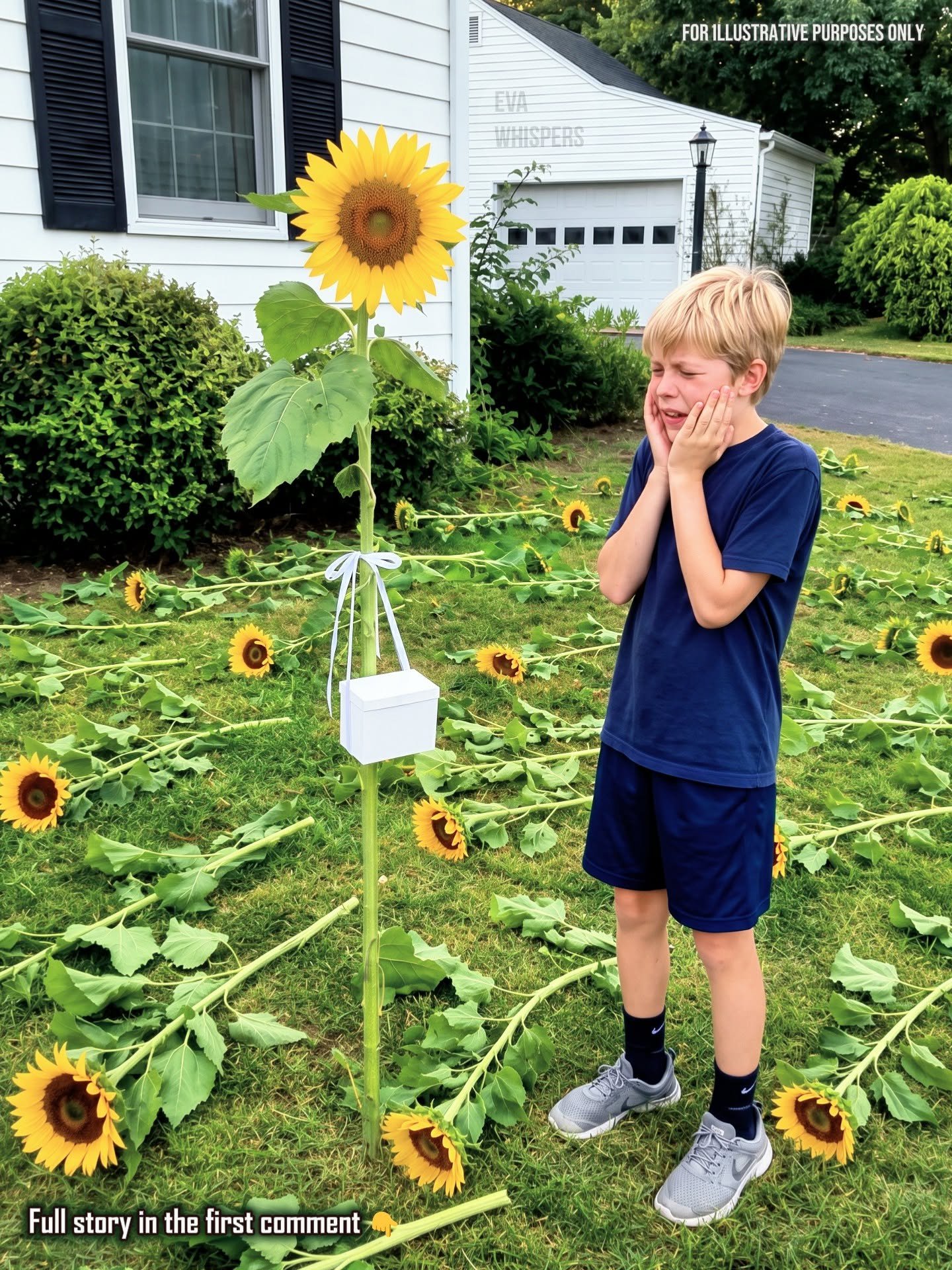
Every sunflower had been cut down.
Every single one.
All except one tall stalk standing in the center of the patch.
It swayed gently in the morning air, alone among the broken stems.
Hanging from it by a white ribbon was a small white box.
Patrick’s voice came out barely above a whisper.
“Mom…”
My hands trembled as I untied the ribbon. I opened the box slowly, already afraid of whatever was inside.
Then my knees nearly gave way.
Inside was a photograph.
A girl stood beside a roadside sunflower field, wearing a sleeveless yellow dress, sunlight on her bare collarbone, her face turned slightly toward the camera.
For one impossible second, my heart stopped.
Because I thought I was looking at Lily.
Older.
Taller.
Alive.
Patrick snatched the photograph from my hands.
He stared at it without blinking.
“Mom,” he whispered. “That’s her.”
The Note That Reopened Everything
I should have stopped.
I should have studied the picture more carefully.
But grief does not wait for reason.
Hope can be even more dangerous than pain, because it enters quietly and makes you believe the impossible is finally being returned to you.
Behind the photograph was a folded note.
The message was short.
“She is alive. Bring $40,000 if you want the truth.”
Below it was a phone number.
And two words:
“Call now.”
Patrick was already dialing before I could think clearly.
I didn’t stop him.
A man answered on the second ring. His voice was calm, low, and careful, as though he had rehearsed every word. He said he knew what had happened to Lily. He said if we wanted the truth, we needed to bring forty thousand dollars in cash to the Pine Crest Motel the following afternoon.
Patrick’s hand shook around the phone.
“Is she okay?” he asked.
There was a pause.
Then the man said, “She’s alive.”
That was all Patrick needed to hear.
He broke down in the ruined garden, clutching the photograph to his chest as if it were a doorway back to his sister.
And I cried too.
Because for one brief, foolish, beautiful moment, I wanted to believe him.
A House Full of Hope and Fear
Patrick carried the photograph everywhere.
To the kitchen.
To the hallway.
To the porch steps.
He held it like it might disappear if he set it down.
“What if someone found her?” he kept saying. “What if someone took care of her all this time? What if she didn’t know who she was? What if she’s been trying to come home?”
I listened.
Not because I believed every word.
But because I wanted to.
I wanted to live inside that possibility for just one hour.
I didn’t even tell my parents at first. I wanted to protect that fragile little spark before anyone could blow it out.
But it lasted less than twenty minutes.
My mother walked in from the yard, saw Patrick holding the photograph, and went completely still.
“Oh my God,” she whispered.
My father came behind her. He looked at the picture for a long time without saying anything.
By noon, the four of us were sitting around the kitchen table with the photograph in the center like it was evidence, a miracle, and a wound all at once.
Patrick refused to let anyone doubt.
“What if she couldn’t get back?” he demanded. “What if she only found out later? What if someone has been keeping her from us?”
My mother cried softly, touching the edge of the photograph with one trembling finger.
My father finally said, “It does look like her.”
And that was enough.
By evening, we had built an entire story around one picture and one cruel note.
We weren’t foolish people.
We were grieving people.
And sometimes grief makes hope look like proof.

The Missing Mark
That night, I barely slept.
Patrick didn’t sleep at all.
Around two in the morning, I found him sitting at the kitchen table, the photograph beneath the yellow light.
“I keep trying to remember,” he said quietly, “if her left eyebrow always lifted like that when she was thinking.”
“Patrick…”
“What if she’s been waiting for us?”
The way he said it broke something in me.
Because I realized then that if this turned out to be a lie, it would not simply disappoint him.
It would make him lose Lily all over again.
The next morning, we looked at the photograph in the cold daylight.
This time, my mother noticed it first.
“Where is Lily’s birthmark?”
The room went silent.
I took the picture from Patrick and looked closer.
Lily had a small crescent-shaped birthmark near her collarbone.
The girl in the photograph did not.
Patrick saw my face change.
“What?” he asked.
I didn’t answer fast enough.
“What, Mom?”
I turned the photograph toward him and pointed.
For a second, he only stared.
Then he shook his head.
“No. Maybe it’s the angle.”
“It isn’t.”
“Maybe makeup covered it.”
“Patrick…”
“Maybe the picture was edited.”
His voice rose with each excuse. I knew he wasn’t arguing with me. He was fighting the truth before it could reach him.
Then his eyes moved from my face to my mother’s, then to my father’s.
And he understood.
He folded inward, covering his mouth with both hands.
I had watched my son grieve Lily once.
I did not know if he could survive grieving her again.
Calling Detective Harris
I called Detective Harris.
Six years earlier, he had been one of the deputies searching the pond. Over time, he had become a sergeant, but he still remembered Lily. He came to the farmhouse within the hour.
I showed him everything.
The cut sunflowers.
The white box.
The note.
The photograph.
The open back gate.
Harris crouched near the broken stems and studied the ground. The flowers had been cut cleanly with shears. Tire tracks marked the damp soil near the old gate.
That gate led straight to the sunflower patch.
Only family and a few old neighbors even knew it was there.
Someone had not stumbled onto our grief by accident.
Someone had studied it.
Someone had chosen the one wound in our family that had never healed.
Harris asked me to call the number again, this time from his phone with the line blocked. He told me to keep the man talking.
So I did.
The same low, calm voice answered.
He repeated the demand for forty thousand dollars. He repeated the motel location. He repeated the promise that Lily was alive.
Then, in the background, I heard a bell above a door.
A woman called out, “Order for Ray.”
When the man hung up, Harris looked at me.
“Ray’s Diner,” he said.
There was only one near the Pine Crest Motel.
The Girl in the Photograph
Harris didn’t like involving Patrick, but he understood why my son needed answers. He agreed Patrick could ride along as far as the diner, as long as he stayed in the car unless told otherwise.
Patrick sat in the back seat, the photograph turned face down on his knee.
He could no longer bear to look at it.
But he couldn’t let it go either.
At the diner, Harris showed the waitress the picture and said we were looking for a relative.
The waitress glanced at it and nodded.
“That’s Emily,” she said. “She helps over at Miller’s produce stand sometimes. Lives with her grandmother in Dalton Ridge.”
Patrick closed his eyes.
It was not Lily.
Her name was Emily.
And somehow, hearing that made the lie both clearer and crueler.
We drove to Dalton Ridge. Emily’s grandmother opened the door, saw the photograph, and immediately tried to close it again. Harris showed his badge, and after a tense moment, she let us inside.
The truth came out quickly.
A man had taken Emily’s photograph the week before. He told her grandmother it was for a local sunflower festival flyer.
He had asked Emily to stand near the flowers.
To hold one.
To look sad.
Then the grandmother said his name.
Vince.
The Name We Knew
My breath caught.
Vince.
My cousin.
He had been seventeen when Lily disappeared. Old enough to remember the search. Old enough to hear adults whispering. Old enough to know Patrick blamed himself.
He had spent that terrible night near the pond with the rest of us.
He knew about Lily.
He knew about the sunflowers.
He knew about the strip of farmland we had sold the year before.
And apparently, he knew enough about our grief to think he could turn it into money.
Emily sat beside her grandmother, twisting her hands in her lap. She looked frightened and ashamed, though she had done nothing wrong.
She told us Vince had mud on his shoes when he took the photo.
She remembered a white ribbon sticking out of his pocket.
That was when I stopped feeling only heartbroken.
I became angry.
Not loud angry.
Not reckless angry.
The kind of anger that goes cold and steady because it knows exactly where it needs to go.
The Motel Meeting
Harris arranged the meeting at the Pine Crest Motel.
Before I got out of the cruiser, he made me repeat the plan twice.
Do not improvise.
Do not follow Vince anywhere.
Do not hand over the envelope unless Harris gave the signal.
The envelope in my hand was stuffed with cut paper, not money.
A wire was hidden beneath my shirt.
My legs shook as I walked toward the vending machines where Vince was waiting in a cap pulled low over his face.
He started talking before I said a word.
He told me Lily had survived.
He told me a woman had taken her in.
He told me she remembered the farmhouse porch.
He said she still talked about Patrick, though she called him Pat now.
I let him talk.
I let him build the lie higher and higher until there was nowhere left for him to hide.
Then I said, “Our farmhouse didn’t have a porch until four years after Lily disappeared.”
His mouth twitched.
I took one step closer.
“And Lily never called her brother Pat.”
Vince’s face tightened.
“She called him Patch.”
For the first time, his confidence slipped.
Then I said, “I found Emily.”
The color drained from his face.
He tried to laugh, but it sounded thin and broken.
I had the photograph.
I had Emily’s grandmother.
I had the ribbon.
I had the tire tracks.
I had his lies recorded.
And now, so did Detective Harris.
When Harris stepped out, Vince bolted toward the back stairwell.
He made it three steps before another deputy caught him.

The Truth We Had to Face
By evening, Vince was in custody.
Later, Harris told us Vince had never known anything more about Lily than the rest of the town did.
There was no hidden survivor.
No secret family.
No girl waiting to come home.
He had remembered Patrick’s guilt. He had heard about the land sale. He had guessed we might have access to money.
And he had decided our grief made us easy.
The sunflowers.
The white ribbon.
Emily’s photograph.
The small white box.
All of it had been theater.
Cruel, calculated theater.
When I returned home, Patrick was sitting beside the ruined garden.
For a long time, neither of us spoke.
Then he said, “So she wasn’t Lily.”
I sat down beside him.
“No,” I said softly. “She wasn’t.”
He nodded once, staring at the broken stems.
I waited for him to cry.
I waited for him to fall apart.
Instead, after a long silence, he said, “We need to fix what he messed up.”
Planting Again
The next morning, Emily and her grandmother came to the farmhouse.
Emily apologized again and again, even though none of this was her fault. She had been used too.
Patrick listened quietly.
Then he said, “You didn’t hurt us. He did.”
I saw Emily’s shoulders loosen with relief.
Together, we cleared the broken stems from the garden. My father brought fresh soil. My mother brought lemonade, though no one drank much at first.
Then we opened a new packet of sunflower seeds.
This time, Patrick planted them in straight, careful rows.
Emily pressed the last seed into the ground herself.
“For Lily,” she whispered.
Patrick nodded.
“For Lily.”
Then he tied a fresh white ribbon around a small wooden marker and wrote:
“For Lily. Still loved. Still ours.”
When he stood, he did not reach for my hand the way he used to after hard moments.
He stood on his own.
And for the first time in six years, I saw something in my son that looked different from grief.
Not forgetting.
Not moving on.
Something gentler than that.
Healing.
What the Sunflowers Taught Us
The garden was not the same after that.
How could it be?
Someone had tried to turn our love for Lily into a weapon. Someone had tried to use Patrick’s guilt against him. Someone had cut down the one place where my son still felt close to his sister.
But as the weeks passed, tiny green shoots began pushing through the soil again.
Fragile at first.
Then stronger.
Patrick checked them every morning.
He no longer spoke to them with the same desperate ache in his voice. He still told Lily things, but slowly, his words changed.
He no longer said, “I’m sorry I let go.”
Instead, one evening, I heard him whisper, “I miss you. I love you. I hope you know that.”
And I stood by the kitchen window with tears in my eyes, because that was the first time he had spoken to Lily without punishing himself.
By late summer, the sunflowers bloomed again.
They were not perfect.
Some leaned.
Some grew taller than others.
One opened later than the rest.
But they stood.
And so did Patrick.
That was when I finally understood something.
Love does not disappear just because someone tries to destroy the place where you keep it.
Grief can be cut down.
Hope can be tricked.
Memories can be disturbed.
But real love has roots deeper than cruelty can reach.
And every year, when the sunflowers turn their faces toward the light, I remember Lily.
I remember the little girl who loved yellow dresses, muddy shoes, and feeding ducks.
I remember the brother who loved her so much that he carried guilt no child should ever carry.
And I remember the morning he planted again.
Not because he had forgotten her.
But because he had finally begun to forgive himself.