
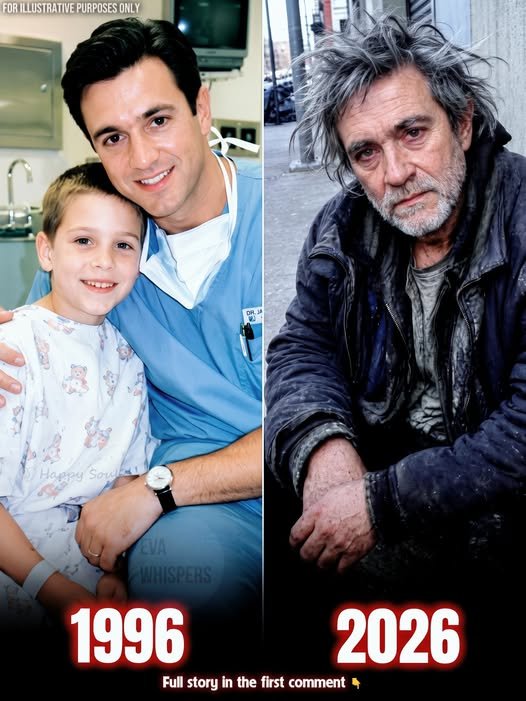
The Man on the Bench
Thirty years ago, a doctor refused to let me die.
Yesterday, I found him sleeping on a piece of cardboard outside the hospital where he had saved my life.
At first, I didn’t recognize him.
The freezing rain had darkened his thin gray coat, and his shoulders were hunched against the wind. A battered canvas bag rested beside his feet. His shoes were cracked, his beard was uneven, and his hands trembled as he held a paper cup between them.
People hurried past him without looking.
Doctors in white coats rushed through the revolving doors. Nurses finishing their shifts pulled scarves over their faces. Visitors stepped around the puddles, staring at their phones.
No one stopped.
I almost didn’t either.
I was already late for an important business meeting inside the hospital. My company had spent months preparing for it. If everything went well, the hospital would become the largest client we had ever signed.
But something about the elderly man made me slow down.
Maybe it was the way he stared at the building.
He wasn’t watching the people. He was looking up at the hospital windows as though they belonged to another life.
I reached into my coat pocket and found a few bills.
“Sir,” I said gently.
He looked up.
I held out the money, but he raised one hand.
“No, son.”
His voice was weak, but his words were firm.
“I worked in this hospital my entire life. I don’t need handouts—even if they chewed me up and spit me out.”
My heart seemed to stop.
That voice.
I had heard it only a few times in old recordings, but my mother had repeated his words so often that they had become part of my childhood.
I moved closer.
Beneath the rain, the exhaustion, and the years, I saw the sharp jawline. The deep-set blue eyes. The small scar beside his left eyebrow.
It couldn’t be.
“Dr. Bennett?” I whispered.
He studied me without recognition.
“Yes?”
For a moment, I was eight years old again.
I was lying beneath blinding lights while machines screamed around me. My mother was crying in a hospital hallway, and everyone believed I would be dead before morning.
Everyone except him.
The Night My Heart Stopped
I remember almost nothing from the night I nearly died.
Most of what I know came from my mother, who told me the story every year on my birthday.
I had been sick for several weeks. At first, everyone thought it was a stubborn flu. I was tired, pale, and constantly out of breath. Then one evening, while helping my father carry groceries into the house, I collapsed on the kitchen floor.
By the time the ambulance arrived, my pulse was dangerously weak.
At the hospital, doctors discovered a severe problem with my heart that had gone undetected since birth. The condition had suddenly worsened, and without immediate surgery, I had almost no chance of surviving the night.
The surgeon on call was Dr. Samuel Bennett.
He was forty-seven years old then, known for taking the cases other surgeons considered impossible.
He took one look at my scans and said, “We operate now.”
Another doctor quietly warned him, “The boy won’t survive the night.”
My mother heard every word.
She told me Dr. Bennett removed his glasses, wiped them on the sleeve of his scrubs, and answered without raising his voice.
“Then I’ll give him every minute I have.”
The surgery lasted eleven hours.
For most of that time, my mother sat in the waiting room holding my father’s hand. He kept telling her to have faith, but she could feel his fingers trembling.
At one point during the operation, my heart stopped.
The surgical team fought to bring me back. Dr. Bennett refused to leave the table, even when another surgeon offered to take over so he could rest.
He stayed.
Minute after minute.
Hour after hour.
Shortly after sunrise, the operating-room doors finally opened.
Dr. Bennett walked into the waiting room with bloodshot eyes and deep marks across his face from his surgical mask.
My mother stood so quickly that her chair fell backward.
Dr. Bennett caught her by the shoulders.
“Your son is alive,” he said.
My mother broke down in his arms.
I spent several weeks in the hospital and many months recovering at home. Dr. Bennett checked on me whenever he could, but I was too young and too weak to understand what he had done.
By the time I returned for a follow-up appointment the following year, he had transferred to another medical center.
I never saw him again.
But I never forgot his face.

Thirty Borrowed Years
My recovery was slow.
For a while, I couldn’t run, climb stairs, or play outside for more than a few minutes. I hated watching other children race across the playground while I sat on a bench.
My mother always seemed to know when I was feeling sorry for myself.
She would sit beside me, place her hand over my heart, and say, “This heart fought for you. Dr. Bennett fought for you. Don’t waste what they gave you.”
As I grew older, those words shaped every major decision I made.
I studied engineering because I wanted to understand the machines that had kept me alive. After college, I began designing monitoring equipment that helped doctors detect dangerous changes in a patient’s heart rhythm.
My first device was built in the garage of a rented house.
My mother helped me label boxes. My father, who had no idea what any of the equipment did, drove deliveries across three states because I couldn’t afford a shipping company.
The business nearly failed twice.
But eventually, one hospital agreed to test our system. Then another hospital called. Then another.
By the time I turned thirty-eight, the company employed more than two hundred people.
I married a patient, funny woman named Laura. We had two children, both healthy. On every birthday, my mother called at exactly 6:12 in the morning—the time Dr. Bennett had walked into the waiting room.
“Another year,” she would say.
“Another year,” I would answer.
Then she would add the same sentence.
“That doctor gave us thirty more years.”
I always planned to find him.
But life kept moving.
There was another product launch. Another business trip. Another family emergency. I searched his name a few times, but the results were outdated. Eventually, I convinced myself that I would have plenty of time.
Standing in the freezing rain, looking into Dr. Bennett’s tired eyes, I realized how close I had come to being too late.
He Didn’t Recognize Me
Dr. Bennett pulled his coat tighter around his body.
“Do I know you?” he asked.
“My name is Michael Carter.”
He shook his head apologetically.
“I’m sorry.”
“I was a patient here thirty years ago.”
He gave a sad smile.
“I treated thousands of patients.”
“I was eight years old. My heart stopped during surgery.”
The smile disappeared.
I continued, my voice shaking.
“You operated for eleven hours. Another doctor said I wouldn’t survive the night.”
Dr. Bennett’s eyes searched my face.
I could almost see the memory returning piece by piece.
“My mother’s name was Diane Carter,” I said. “My father was Robert.”
His lips parted.
“The little boy with the congenital defect,” he whispered.
I nodded.
“You told my mother, ‘Your son is alive.’”
For several seconds, neither of us spoke.
The rain struck the metal roof above the bench.
Dr. Bennett looked at my face, then at my chest, as though he could see the scar beneath my shirt.
“You lived,” he said.
“I lived.”
His eyes filled with tears, but he quickly turned away.
“I’m glad,” he said quietly. “That’s all a surgeon ever hopes for.”
I wanted to ask a hundred questions.
What had happened to him?
Why was he outside?
Where was his family?
How could a man who had spent his life saving people end up sleeping in the rain a few yards from the operating rooms where he had once been respected?
But I was already late for my meeting, and Dr. Bennett had started gathering his belongings.
“Please wait here,” I said. “I’ll be back.”
He gave a weary laugh.
“People always say that.”
“I mean it.”
He lifted his canvas bag onto his shoulder.
“So do they.”
Then he walked away.

A Meeting I Couldn’t Concentrate On
Inside the hospital, twelve executives were waiting for me.
There were presentations, contracts, financial projections, and technical demonstrations. My team had worked too hard for me to abandon the meeting, so I forced myself to continue.
But every time someone mentioned patient care, I pictured Dr. Bennett outside in his wet coat.
The hospital’s chief administrator, Rebecca Sloan, noticed that I was distracted.
During a break, she approached me.
“Is something wrong?”
“Did a Dr. Samuel Bennett work here?”
Her expression changed.
“Yes. He was a cardiac surgeon for decades. He also trained half the senior physicians in this building.”
“What happened to him?”
Rebecca hesitated.
“The hospital went through a merger several years ago. Dr. Bennett strongly opposed the closure of a community cardiac clinic. There was a dispute with the previous administration, and his contract wasn’t renewed.”
“So they fired him?”
“I wasn’t here then,” she said carefully. “But from what I understand, it was complicated.”
It usually was.
That word—complicated—was often used when people wanted to avoid saying that something cruel had happened.
“Do you know where he lives?”
“I assumed he had retired.”
“He’s sleeping outside.”
Rebecca went pale.
She immediately called the hospital’s social-services department, but no one there had recently worked with him.
The meeting continued, but before leaving, I made one request.
“I need twenty-four hours before signing the contract.”
My business partner stared at me.
“Michael, this agreement is worth millions.”
“I know.”
“Then why delay it?”
“Because I need to understand what kind of hospital we’re partnering with.”
What Had Happened to Dr. Bennett
I returned early the next morning.
Dr. Bennett wasn’t on the bench.
I searched the nearby streets, the bus station, and two shelters. Finally, a security guard told me he had seen an elderly man enter a twenty-four-hour diner three blocks away.
I found Dr. Bennett sitting in a back booth with a cup of coffee.
There was no food in front of him.
I slid into the opposite seat.
“You came back,” he said.
“I told you I would.”
A waitress approached, and I ordered breakfast for both of us. Dr. Bennett tried to protest, but I stopped him.
“This isn’t a handout. It’s breakfast with an old friend.”
“We met for less than five minutes yesterday.”
“You spent eleven hours saving my life. I think that qualifies.”
For the first time, he smiled.
As we ate, he told me what had happened.
After leaving the hospital, Dr. Bennett had continued working at a small cardiac clinic that served families who couldn’t afford private care. When a corporate merger threatened to close the clinic, he protested.
He wrote letters, attended board meetings, and spoke publicly about patients who would lose access to treatment.
The clinic closed anyway.
His contract was not renewed.
By then, his wife, Claire, had developed dementia. Dr. Bennett spent most of his savings on caregivers, medications, and modifications to their home so she could remain with him.
“I promised her she wouldn’t die in a place where she was afraid,” he said.
Claire lived for six more years.
After she died, Dr. Bennett discovered that their debts were greater than he had realized. He sold the house, intending to move into a small apartment, but grief made even simple tasks feel impossible.
He missed deadlines. He stopped opening mail. He lost contact with former colleagues.
A man who had once made life-or-death decisions in seconds could no longer decide what to eat for dinner.
“I kept thinking I would recover,” he said. “I told myself I only needed a few weeks.”
The weeks became months.
Then his temporary housing ended. His identification documents were stolen along with his suitcase. Without proper identification, he struggled to access benefits and long-term senior housing.
He had spent the previous four months moving between shelters, bus stations, and the hospital entrance.
“Why the hospital?” I asked.
He looked down at his hands.
“Because it was the last place where I knew who I was.”
That answer broke something inside me.

The Words I Had Carried for Thirty Years
When breakfast was finished, I moved to the seat beside him.
“Dr. Bennett, look at me.”
He did.
I leaned closer and said the words I had carried for thirty years.
“You once told my mother that you would give me every minute you had.”
His eyes began to shine.
“You gave me eleven hours that night,” I continued. “Because of those eleven hours, I had thirty years. I graduated from college. I built a company. I married the woman I love. I became a father.”
His chin trembled.
“My children exist because you refused to give up on me.”
A tear rolled down his cheek.
I took his hand.
“You told my mother, ‘Your son is alive.’ I’ve waited my whole life to tell you this: I am alive, Dr. Bennett. I am here because of you.”
He covered his face.
His shoulders shook as thirty years of grief, exhaustion, and loneliness finally came pouring out.
People in nearby booths turned toward us, but I didn’t care.
When he lowered his hands, I finished what I needed to say.
“Now it’s my turn to give you every minute I have.”
He immediately shook his head.
“I can’t take your money.”
“I’m not offering you money.”
“Then what are you offering?”
“A way forward.”
Not Charity—A Second Career
My company didn’t only manufacture monitoring equipment. We employed physicians as clinical advisers to review designs, train engineers, and help us understand what doctors needed in real emergencies.
Dr. Bennett had more than forty years of experience.
He couldn’t return to surgery, and I wasn’t asking him to. But his knowledge still mattered.
“I want you to work with us,” I said.
He stared at me.
“You haven’t seen me practice.”
“I’ve seen your work.”
“That was thirty years ago.”
“And I’ve spent thirty years benefiting from it.”
He looked away.
“I don’t even own a clean shirt.”
“We can solve that.”
“I have no home.”
“We can solve that too.”
“I’m old.”
“You’re experienced.”
His mouth twitched as though he was trying not to smile.
I explained that the position would begin as a three-month consulting role. He would review our cardiac-monitoring systems, speak with engineers, and help train employees using real medical cases.
The job came with a salary, health insurance, and temporary corporate housing.
Dr. Bennett remained silent for a long time.
Finally, he said, “What if I’m not useful anymore?”
It was the question of a man who had lost more than his house.
He had lost his sense of purpose.
“Then tell me honestly what you think of our newest system,” I said.
I opened my laptop and showed him the monitoring program we had presented to the hospital.
Within minutes, his posture changed.
He leaned closer to the screen.
“Go back,” he said.
I returned to the previous display.
“There,” he said, pointing. “Your alert threshold is based on adult recovery patterns.”
“It can be adjusted for children.”
“Yes, but the default setting may delay an alert in pediatric patients with surgical scarring. Most nurses will trust the default.”
I stared at him.
Our engineers had spent eighteen months developing the system, yet none of us had noticed the risk.
Dr. Bennett studied the data again.
“It may never cause a problem,” he said. “But in cardiac care, ‘may never’ isn’t good enough.”
I closed the laptop.
“When can you start?”
This time, he laughed.
It was quiet and rusty, as though he hadn’t used the sound in years.
The Hospital Had a Choice
That afternoon, Dr. Bennett returned to the hospital with me.
He wore new clothes, but I had not tried to transform him into someone he wasn’t. He still had his gray beard and worn canvas bag.
Rebecca Sloan met us in the conference room.
Several older doctors recognized him immediately.
One surgeon crossed the room and embraced him.
“You trained me,” she said, fighting tears. “We thought you had moved away.”
Dr. Bennett seemed overwhelmed by the attention.
Rebecca apologized for what had happened under the previous administration. She didn’t pretend that one apology could erase years of neglect, but she promised a full review of how retired and former staff members were supported.
I made my position clear.
My company would sign the contract, but part of our partnership would fund a new assistance program for hospital employees and retirees facing medical, housing, or financial emergencies.
The hospital agreed to match our contribution.
Dr. Bennett would help design the program.
Not because he was helpless.
Because he understood better than anyone how easily a respected person could disappear when pride, grief, and bureaucracy collided.
Before we left, Rebecca handed him a temporary identification badge.
It read:
DR. SAMUEL BENNETT
CLINICAL ADVISER
He stared at it for so long that I wondered if he was going to refuse.
Instead, he carefully clipped it to his coat.

My Mother’s Final Thank-You
That evening, I took Dr. Bennett to the furnished apartment my company kept for visiting specialists.
It wasn’t a mansion. It was a comfortable one-bedroom place with a warm bed, a stocked kitchen, and windows overlooking a small park.
He stood in the doorway without moving.
“This is too much,” he whispered.
“It’s temporary,” I said. “Your first paycheck can cover your own place.”
He nodded, grateful that I had allowed him to keep his dignity.
Then I called my mother.
She answered on the second ring.
“Michael? Is everything all right?”
“Mom, there’s someone here who wants to see you.”
I turned the phone toward Dr. Bennett.
For a moment, my mother simply stared at the screen.
Then she lifted one hand to her mouth.
“Dr. Bennett?”
His eyes filled again.
“Hello, Mrs. Carter.”
She began to cry.
“I prayed for you for thirty years,” she said. “Every night, I thanked God for your hands.”
Dr. Bennett sat down heavily.
“Your son told me about his life.”
“You gave him that life.”
“No,” Dr. Bennett said. “I only helped him keep it.”
My mother shook her head.
“You stayed when everyone else believed there was no hope. A mother never forgets the person who stayed.”
They spoke for nearly an hour.
Before hanging up, my mother smiled through her tears.
“Take care of him, Michael.”
“I will.”
Dr. Bennett looked at me.
“You already have,” he said.
The First Night of His New Life
Before I left, I placed a key on the kitchen counter.
Dr. Bennett picked it up and turned it over in his hand.
Such a small object.
But to him, it meant a locked door, a warm room, and the right to decide when the lights went off.
It meant safety.
It meant home.
At the doorway, he called my name.
“Michael?”
I turned around.
“That night, thirty years ago, I was afraid.”
I had never imagined him saying that.
“You looked fearless,” I replied.
“Surgeons learn how to hide fear. But your heart stopped, and for a moment, I thought we had lost you.”
He paused.
“I kept thinking about your mother sitting outside. I knew I couldn’t walk into that waiting room without doing everything possible.”
“You did.”
He nodded.
“And yesterday, you could have walked past me.”
“I almost did.”
“But you didn’t.”
I smiled.
“I had a good teacher.”
Six Months Later
When I first wrote down the beginning of this story, I had found Dr. Bennett only the day before.
Six months have passed since then.
He now lives in his own apartment.
He works three days a week as our senior clinical adviser and refuses to let anyone call him an honorary employee.
“Honorary people don’t attend seven-thirty meetings,” he says.
The pediatric alert problem he discovered was corrected before our system entered wider use. That change may protect thousands of young patients in the years ahead.
He also helped launch the Bennett Support Program, which provides confidential assistance to hospital employees and retirees facing difficult circumstances.
The program has already helped a former nurse avoid eviction and connected a widowed custodian with affordable medical care.
Dr. Bennett says he doesn’t deserve to have the program named after him.
Everyone else disagrees.
Last month, my mother visited our office.
When she saw him, she didn’t say a word. She simply wrapped her arms around him and held on.
Thirty years earlier, he had walked out of an operating room and told her that her son was alive.
Now her son had brought him back from the edge of being forgotten.
People sometimes ask me why I did so much for a man I barely knew.
The answer is simple.
Dr. Bennett didn’t know what kind of person I would become when he fought for me.
He didn’t know whether I would be successful, whether I would have a family, or whether I would ever remember his name.
I was simply a frightened eight-year-old boy whose heart had stopped.
That was enough for him.
He gave me every minute he had—not because I had earned those minutes, but because my life had value.
Thirty years later, I finally had the chance to return the gift.
We often imagine that changing someone’s life requires wealth, power, or a perfect plan.
Sometimes it begins with something much smaller.
You stop walking.
You look closely.
You recognize the person everyone else has stopped seeing.
And you say:
“I remember what you did for me.”
Dr. Bennett gave me thirty more years.
But when I found him on that bench, I realized those years had never belonged only to me.
They had been entrusted to me.
And perhaps the best way to honor the person who saved your life is to use that life to save someone else.