
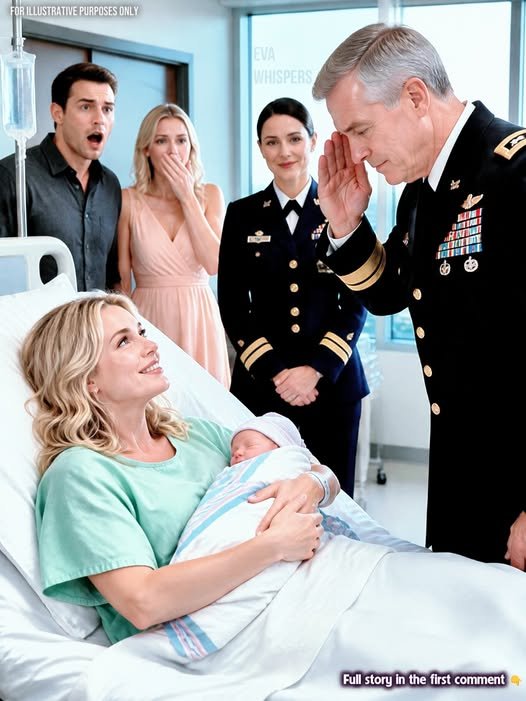
The night my husband threw me out of our home, I was in labor, frightened, and barely able to stand. He watched me leave with an overnight bag dragging across the floor and told me not to come back. By the following afternoon, he was in my hospital room with another woman at his side, flashing a ring and smiling as though he had finally defeated me.
Then a three-star general stepped through the door, saluted my bed, and addressed me by the title my husband never knew I held.
Mark thought that was the worst surprise waiting for him.
He was wrong.
The rank I had kept secret was only one piece of the life he had never bothered to understand. The other was a twenty-million-dollar inheritance locked inside a family trust – and evidence that he had already begun trying to reach it.
Part 1: The Night My Marriage Ended
My name is Anna Whitmore. For years, I believed strength meant carrying pain quietly so the people you loved would not have to feel its weight. It took one terrible night for me to understand that silence can protect a marriage only when both people are protecting it.
Several months earlier, my grandfather, William Hart, had died after a short illness. He had raised me during long stretches of my childhood and had been the steadiest person in my life. He was stern in public, unexpectedly gentle in private, and far wealthier than anyone outside his attorneys seemed to know.
After the funeral, Dana Monroe, the attorney managing his estate, told me he had left a family trust in my name. Its estimated value was twenty million dollars. The transfer was complicated, tied to old companies, and subject to a strict confidentiality period. Until the legal review was complete, I was not permitted to discuss the amount or the trust documents with anyone.
Anyone included my husband.
I did not hide the inheritance because I wanted to deceive Mark. I kept quiet because the attorneys and the military legal office handling my financial disclosures required it. My own work added another layer of secrecy. Mark believed I held a routine administrative position for the Department of Defense. In reality, I was an Army colonel on a restricted command assignment, with responsibilities I could not explain outside secure channels.
When we first married, Mark had seemed proud of my discipline. He said my calmness made him feel safe. But during the final months of my pregnancy, the quality he once admired became something he resented.
He began missing appointments. He stopped answering calls. He came home late with explanations that never quite matched the hour.
“The office is a mess,” he would say.
“I need space.”
“Not everything can revolve around the baby, Anna.”
I told myself he was overwhelmed. I told myself we were both tired. I told myself that marriage sometimes passed through seasons in which love looked less like tenderness and more like endurance.
So I endured.
The evening everything broke, I was standing at the kitchen counter when a contraction tightened across my abdomen so sharply that my knees nearly gave way. I gripped the edge of the counter and waited for the pain to ease.
“Mark,” I said, trying to keep my voice level. “The contractions are close now. The doctor said I need to go in.”
He sat at the dining table with his phone turned face down beside him. He did not stand. He did not ask how long the pain had lasted. He did not even look worried.
“Call a car,” he said.
I thought I had misheard him.
“I need you to drive me.”
His jaw tightened. “I said call a car.”
Another contraction came. I bent forward, breathing through it, and heard his chair scrape against the floor. For one hopeful second, I thought he was coming to help me.
Instead, he walked to the hall closet, pulled out my hospital bag, and dropped it near the front door.
“What are you doing?” I whispered.
“Ending this,” he said. “I am tired of carrying someone who contributes nothing. You are dead weight, Anna.”
The words were so cruel that my mind refused to accept them at first. I stared at the man I had loved, searching his face for a flicker of shame, hesitation, anything that might prove this was anger speaking rather than truth.
There was nothing.
“I am having your baby,” I said.
“And I am done being trapped by it.”
He opened the front door.
My hands were shaking too badly to lift the bag. I could not bend without pain. Still, he stood there as though my weakness offended him.
I called Mrs. Rivera, our neighbor across the street. She was seventy-two, barely five feet tall, and arrived in less than four minutes wearing slippers and a cardigan over her nightgown.
“Oh, sweetheart,” she breathed when she saw me.
She took one look at Mark and did not ask for an explanation. She put one arm around my waist, lifted the hospital bag with the other, and guided me toward her car.
As we crossed the threshold, I glanced back.
Mark leaned against the wall with his arms folded.
“Do not come back,” he said.
The door closed behind me before I reached the sidewalk.
That sound stayed with me through every red light, every contraction, and every frightened breath on the way to the hospital. It was not merely the closing of a door. It was the end of the future I had spent years trying to save.
Part 2: The Woman Wearing My Place
The military medical center admitted me immediately. Nurses moved around me with quiet efficiency, checking the baby’s heartbeat, timing contractions, and asking questions I struggled to answer through the pain.
Was my husband on the way?
Did I want them to call anyone?
Was there a support person they could contact?
I kept looking at my phone as though concern might appear if I stared hard enough.
No calls came.
No messages.
Mark never asked whether I had arrived safely. He never asked whether our child was in distress. He never asked if I was afraid.
Grace was born just after sunrise.
The delivery was exhausting, but the moment the nurse placed my daughter against my chest, the room seemed to grow still. Her fingers opened and closed against my skin. Her face was red, wrinkled, and perfect. I cried with relief, grief, love, and a loneliness so deep it felt almost physical.
I had imagined Mark beside me for that moment. Instead, a nurse held my hand.
The next afternoon, while I was drifting between sleep and wakefulness, the door opened without warning.
Mark walked in wearing a dark jacket I had never seen before. He looked rested. Composed. Almost pleased with himself.
Beside him stood a blonde woman in a lavender dress. A diamond ring glittered on her left hand.
She was beautiful in the careful, polished way of someone who had prepared for an entrance. Her hair was smooth, her makeup flawless, and her smile carried the confidence of a person who believed the scene already belonged to her.
Mark did not look at the bassinet.
He looked at me.
“I wanted you to hear it directly,” he said. “I have moved on.”
The woman raised her hand slightly, making certain I saw the ring.
“Some relationships simply reach their natural end,” she said. “It is better to accept that with dignity.”
My body was still weak from labor. Every movement hurt. Yet the humiliation cut more sharply than anything physical. They had not come to discuss our daughter or repair what Mark had destroyed. They had come to stage a victory.
Then the woman turned her face toward the light, and recognition struck me.
Captain Elise Warren.
My executive officer.
She had joined my command three months earlier. At work she was precise, restrained, and careful never to overstep. I had considered her competent. I had also sensed something guarded in her, though I had never found a reason to question her loyalty.
Now she stood beside my husband wearing a false smile and a ring meant to wound me.
Before I could speak, someone knocked once and entered.
Every nurse in the room straightened.
Lieutenant General Samuel Hayes stepped through the doorway in full uniform. He was a three-star officer, my mentor, and one of the most respected commanders in the service.
Mark frowned, annoyed by the interruption.
Elise stopped breathing.
General Hayes crossed the room, came to attention beside my bed, and raised his hand in salute.
“Colonel Anna Whitmore,” he said, his voice carrying through the sudden silence. “Headquarters directed me to deliver your promotion orders personally and confirm your appointment to the new classified command.”
He placed a sealed envelope in my hands.
The blood drained from Mark’s face.
“Colonel?” he said faintly.
Elise’s posture snapped into military attention.
“Sir,” she said.
General Hayes turned toward her with a look so cold it changed the temperature of the room.
“Captain Warren,” he said, “step away from Colonel Whitmore’s civilian visitor.”
Mark stared at Elise.
“Captain?” he repeated.
In less than a minute, the performance they had built collapsed. Mark had arrived believing he was revealing my insignificance. Instead, he discovered that the wife he had dismissed as useless held authority neither he nor the woman beside him could ignore.

Part 3: The First Boundary
General Hayes asked the nurses whether I was stable, then faced Mark.
“Mr. Whitmore, this is a restricted medical wing. Your access was granted because you are Colonel Whitmore’s spouse. She has requested rest. You will leave now.”
Mark looked at me as though I had betrayed him by allowing other people to see him clearly.
“Anna, tell him this is ridiculous.”
That sentence revealed more than he intended. Even after abandoning me, even after bringing another woman to my bedside, he still expected me to protect him from consequences.
For years, I had translated his impatience into stress, his selfishness into confusion, and his absence into ambition. I had softened every hard edge until I no longer recognized the shape of my own life.
Then Grace stirred in the bassinet.
I looked at my daughter and felt a line form inside me – quiet, permanent, and stronger than fear.
“I want him removed,” I said.
Mark’s expression changed.
“Anna.”
“Now.”
Two military police officers were waiting in the corridor. Mark glanced from them to General Hayes, then to Elise, searching for someone who might restore the control he had lost.
“You cannot do this to me,” he said.
General Hayes did not raise his voice.
“She can.”
At the doorway, Mark finally looked toward the bassinet.
There was no tenderness in his eyes. Only alarm.
“Is the baby even mine?” he asked.
The question silenced the room.
I rested one hand beside Grace’s small body and looked directly at him.
“She is a child,” I said. “Not an argument, not a bargaining chip, and not evidence for your pride.”
The officers escorted him out.
Only after the door closed did my body begin to tremble. A nurse moved beside me and helped me breathe slowly. I covered my mouth as tears came, afraid my crying would wake Grace.
I wept for the marriage I had defended long after Mark stopped deserving my defense. I wept for the version of myself who had mistaken patience for love. Most of all, I wept because part of me had still hoped he would walk into that room, see our daughter, and remember the man he had promised to be.
General Hayes waited until my breathing steadied.
“Anna,” he said softly.
He rarely used my first name. Hearing it from him, without rank or formality, nearly undid me again.
“I am sorry,” he said.
“This is not your fault, sir.”
“No. But I do not believe any of this happened by accident.”
His gaze shifted toward Elise.
She stood near the window, pale and rigid, the ring still shining on her hand.
“Captain Warren will remain available for questioning,” he said.
“Questioning about what?” I asked.
Elise looked down.
General Hayes did not answer immediately, and that pause frightened me more than any quick explanation could.
Part 4: Grace and the First Truth
A nurse lifted my daughter from the bassinet and placed her in my arms. The warmth of her body steadied me in a way nothing else could.
“Have you chosen a name?” the nurse asked.
Mark and I had argued about names for months. He wanted something fashionable and impressive. I wanted Grace, after my grandmother, who had taught me that dignity was often quiet.
Mark had called it old-fashioned.
Mark was no longer in the room.
“Grace Eleanor Whitmore,” I said.
General Hayes gave a small approving nod.
“A strong name.”
Elise turned toward the window, but not before I saw emotion cross her face.
“Was the ring real?” I asked her.
She flinched.
“No.”
I stared at her.
“Then why wear it?”
Her composure cracked around the edges.
“Mark said you would never understand the marriage was over unless you believed he had chosen someone else. He said he needed to make you face reality.”
For a moment, the cruelty was so childish that I could not absorb it. Then anger moved through me, slow and hot.
“I was in labor,” I said.
Her eyes filled with tears.
“I did not know he had forced you out of the house.”
“But you knew I had delivered a baby, and you still came here wearing it.”
Elise closed her eyes.
“Yes.”
Honesty did not make the answer kinder.
General Hayes stepped closer.
“The promotion and command appointment are genuine,” he told me. “But I came personally because an internal review uncovered possible unauthorized access connected to your previous assignment.”
I held Grace more tightly.
“What kind of access?”
“Personnel information. Home records. Medical scheduling. Leave status. Spousal data. And identifiers connected to your financial disclosure.”
The trust.
The room seemed to tilt.
“Are you saying someone found the inheritance?”
“We are saying someone tried,” he replied.
I looked at Elise.
She remained motionless, but guilt has a posture of its own.
General Hayes continued. “Captain Warren’s credentials appear in access logs for files outside the normal scope of her duties.”
Elise shook her head quickly.
“I did not download trust documents. I never saw the full amount.”
“Then what did you see?” I asked.
Her voice dropped.
“Months ago, I overheard part of a legal call. I understood there was an inheritance. I should have reported what I heard and removed myself from anything involving your personal information. I did not.”
“How did Mark enter this?”
She swallowed.
“He contacted me first.”
That answer hurt in a different way.
“He knew you worked with me?”
“He found my name through a public event roster. He said you had become secretive and that he was worried you were hiding debt or planning to leave him. At first I told him to talk to you. Then he kept calling.”
“And you kept answering.”
She nodded.
“He said you made him feel invisible. He said you never trusted him with your real life.”
I almost laughed. Mark had complained that my silence shut him out, yet he had never asked what carrying that silence cost me.
“Did you tell him about the inheritance?”
“I confirmed that one existed. I did not know the amount.”
“But he knows it is twenty million dollars,” I said.
Elise looked genuinely startled.
“I never told him that number.”
General Hayes and I exchanged a glance.
There was another source.
Or another betrayal.

Part 5: What Mark Wanted
The next two days passed in fragments. Doctors checked my recovery. Nurses taught me how to feed Grace and swaddle her without trapping her tiny hands. Mrs. Rivera brought soup, clean clothes, and a knitted blanket she claimed was imperfect even though it was beautiful.
When she held Grace, her eyes shone.
“This little girl arrived at exactly the right time,” she said.
“The right time for what?”
“For you to remember what courage is.”
I thought courage was supposed to feel powerful. Mine felt like exhaustion. It felt like signing forms with shaking fingers. It felt like staring at my phone while Mark left message after message.
His tone changed with every voicemail.
“Anna, please call me. I made a mistake.”
“You humiliated me in front of those officers.”
“We need to discuss custody.”
“You cannot keep my daughter from me.”
Then came the message that revealed what fear and apology had failed to hide.
“Did you really inherit twenty million dollars?”
I played that recording twice, then forwarded it to Dana Monroe.
Dana arrived that afternoon carrying a leather folder and the steady expression of someone who had watched money expose people many times before.
“The trust transfer cleared final review this morning,” she told me. “The assets are legally yours. The structure, timing, and separate-property provisions prevent Mark from claiming ownership.”
Relief came, but it was incomplete.
“Could he have used my identity?” I asked.
Dana’s expression sharpened.
“We found several inquiries. None were completed, but they were not harmless. Someone explored real-estate financing, a private investment account, and an application connected to a limited liability company.”
“Under my name?”
“Using information associated with you.”
My stomach tightened.
“Was Mark involved?”
“His email appears in one communication thread. Another name appears as well.”
She paused.
“Margaret Whitmore.”
Mark’s mother.
Margaret was a retired school administrator who dressed for brunch as though photographers might be waiting. She spoke softly, smiled politely, and delivered insults with such elegance that people sometimes thanked her before realizing what she had said.
She had never approved of my career. She called me distant, secretive, and overly independent. But disapproval was not the same as financial interference.
My phone buzzed while Dana was still in the room.
A message from Margaret appeared.
“Anna, dear, Mark says there has been a misunderstanding. A child needs both parents. Let us behave like adults before attorneys make this unpleasant.”
A second message followed.
“Family resources should remain within the family. Your grandfather would not want outsiders influencing your decisions.”
The word outsiders stood out.
She meant my attorneys. Perhaps she meant the military. Perhaps, in her mind, she even meant me – the woman whose inheritance she had already begun discussing as though it belonged to the Whitmores.
I took screenshots, sent them to Dana, and blocked Margaret’s number.
That evening, General Hayes returned without staff. He carried a small stuffed bear wearing miniature dress blues and placed it awkwardly beside Grace’s bassinet.
“I was told newborns appreciate these,” he said.
For the first time in days, I laughed.
Then his expression turned serious.
“We have a preliminary finding. Captain Warren admitted to inappropriate communication with Mark. She shared impressions and limited personal details, though not the trust documents themselves. She will face disciplinary review.”
“And the other access?”
“It came through a civilian contractor portal connected to family-readiness services. Mark briefly volunteered with a spouse-support committee last year. His credentials were used to view dependent records and contact information.”
A memory surfaced: Mark asking whether military email addresses followed predictable patterns, Mark joking that our security questions were probably easier than our classified files, Mark borrowing my laptop and returning it with the browser history cleared.
At the time, none of it had seemed important.
Now each memory felt like a fingerprint.
“What was he trying to do?” I asked.
General Hayes glanced at Grace before answering.
“We believe he was positioning himself before the transfer became final.”
Positioning.
The word sounded bloodless. It did not describe a husband gathering pieces of his wife’s identity while resenting her for the secrets he planned to exploit.
Part 6: The Voice Behind the Apology
Late that night, I listened to Mark’s newest voicemail.
His voice was low and careful, the voice he used when he wanted to sound wounded instead of responsible.
“Anna, I know I handled things badly. I was frightened. You kept so much from me that I felt as though I did not exist in my own marriage. Elise meant nothing. The ring was a stupid idea. I only wanted proof that you still cared.”
For a few seconds, he almost sounded like the man I remembered.
Then the real purpose emerged.
“My mother thinks we should resolve this privately. I do not want custody to become ugly. I do not want lawyers taking what should belong to our daughter.”
Not what belonged to me.
What should belong to our daughter.
He had always been skilled at placing his desire inside the language of duty.
Before the message ended, his tone changed again.
“And be careful who you trust. You do not know everything your grandfather did. There are things about that money people have hidden from you.”
The recording stopped.
I replayed the last sentence.
My grandfather had been generous, but he had also been private. He paid tuition anonymously, settled medical debts without taking credit, and remembered every birthday in our family. Yet there were parts of his life he kept sealed behind a locked study door. Phone calls ended when people entered. Old storage boxes remained untouched. Certain names were never discussed.
Mark had found the one uncertainty strong enough to reach through my anger.
The following morning, Dana arrived with a cream-colored envelope.
“This was released when the trust became final,” she said. “Your grandfather wrote it six years ago. The instructions allowed us to give it to you only if someone close to you attempted to interfere with the transfer.”
My hands went cold.
“He expected this?”
“He prepared for the possibility.”
The letter was written on William Hart’s personal stationery.
My dear Anna,
If you are reading this, then someone has probably mistaken your trust for an opportunity. I am sorry that my caution could not spare you the pain that brought you to this letter.
Money does not create character. It removes excuses. Some people will see you. Others will see access. The danger is that both may speak in the language of love.
I stopped because the words blurred. Dana waited while I wiped my eyes and continued.
The trust contains more than wealth. It carries obligations attached to decisions I made long ago. There is a ledger. There are people who are owed protection, explanations, and, in some cases, apologies.
If anyone urges you to act quickly, sign privately, or surrender judgment merely because they call themselves family, stop. Ask Dana for the gray file.
I lowered the letter.
“What gray file?”
Dana did not answer.
That frightened me.
I read the final paragraph.
One warning above all others: if a man named Whitmore approaches the trust, do not assume his presence is accidental.
I stared at the surname.
Whitmore.
My husband’s name.

Part 7: The Photograph
Dana sat beside the window, her folder closed on her lap.
“Why would my grandfather write that?” I asked.
“I hoped you might know,” she said.
“I have never heard him mention Mark’s family.”
“Did Mark tell you much about his father?”
“Only that he died when Mark was young. Margaret said they had little contact with the rest of the family.”
Dana opened the folder again.
“Your grandfather’s business archives from the late 1980s include the name Thomas Whitmore.”
My pulse quickened.
“That was Mark’s father.”
“Yes.”
She placed a photocopied record on the table. William Hart and Thomas Whitmore had both been connected to a company that closed more than three decades earlier. The papers did not explain why the business ended, only that several assets had been transferred, disputes settled, and records sealed.
The room felt smaller with every page.
“Are you suggesting Mark married me because of my grandfather?”
“I am not suggesting anything yet. I am saying coincidence is no longer the safest assumption.”
My mind resisted the idea.
Mark and I had met at a charity dinner in Washington. He spilled coffee near my dress, apologized with such sincerity that I laughed, and spent the rest of the evening asking questions about my work. He had made me feel seen during a period when most people either feared my ambition or dismissed what I could not explain.
Had that meeting been arranged?
Had he known my name before I knew his?
Had every attentive question been a search?
No, I thought. I would have noticed.
But I had not noticed the affair. I had not noticed the financial inquiries. I had not noticed how thoroughly resentment had replaced love.
Dana removed an old photograph from a protective sleeve.
Four young men stood in front of a brick warehouse. One was unmistakably my grandfather – tall, broad-shouldered, and serious even in youth.
Beside him stood a man with sandy hair and a crooked half-smile.
The expression was familiar.
Mark smiled the same way when he believed he had already won.
I turned the photograph over. Four names were written in fading blue ink.
William Hart.
Thomas Whitmore.
Robert Vale.
Martin Sullivan.
My daughter shifted against me, and I realized I had been holding my breath.
“There is one more detail,” Dana said.
She pointed to the date.
The photograph had been taken thirty-four years earlier.
The year Mark was born.
Part 8: The Name at the Door
I looked from the photograph to Grace, then back to my grandfather’s warning.
If a man named Whitmore approaches the trust, do not assume his presence is accidental.
The sentence no longer sounded like the caution of an overly suspicious old man. It sounded like a message sent across time by someone who knew a secret was coming for me.
A quiet knock interrupted us.
Dana gathered the documents quickly, sliding the photograph beneath the gray folder.
A nurse opened the door halfway.
“Colonel Whitmore,” she said, uncertain, “there is a gentleman here asking to see you.”
My first thought was Mark.
My second was Margaret.
But the nurse looked at the card in her hand as though the name meant nothing to her.
“He says his name is Robert Vale.”
The third name on the photograph.
Dana went completely pale.
In the hallway, an elderly man’s shadow stretched across the floor. He stood motionless on the other side of the door, waiting.
Grace curled one tiny hand around my finger.
Whatever truth had begun with my grandfather’s death had now reached my hospital room.
I held my daughter closer.
“Let him in,” I said.
The door began to open.