
Part One: The Perfect Birthday
Throwing my husband a surprise party for his fortieth birthday had sounded like a wonderful idea when I first planned it.
By the afternoon of the party, I was seriously questioning that decision.
Our backyard was packed with relatives, neighbors, coworkers, and what felt like every child within a ten-mile radius. Music played from speakers near the patio. Children raced across the lawn while their parents shouted halfhearted warnings. Someone was always asking where to put another tray of food, whether the dip contained dairy, or where I kept the extra napkins.
And at the center of everything stood my husband, Brad.
Forty looked unfairly good on him.
He was laughing with a group of friends beside the grill, one hand wrapped around a drink. His dark hair was slightly tousled, and the corners of his eyes crinkled whenever he smiled.
For a moment, I forgot the chaos around me.
Even after twelve years of marriage, there were still times when I would look at Brad and feel quietly amazed that we had built a life together. We had a home, a beautiful four-year-old son, and years of shared memories.
I genuinely believed I was lucky.
Looking back, I suppose that was what hurt most.
I had been standing near the patio door, holding napkins in one hand and checking a message on my phone with the other, when a small figure darted between my legs.
My son, Will, disappeared beneath one of the tables with a cake pop clutched in his sticky fist.
“Will,” I called after him. “Please don’t throw that.”
“I’m not throwing it!” he shouted from beneath the tablecloth.
His immediate denial told me he had either already thrown one or was considering it.
Before I could investigate, someone approached carrying two bags of drinks.
“Marla, where should these go?”
“The side table,” I answered. “No, sorry—the other side table.”
I hurried across the patio, rearranged the drinks, replaced an empty bowl of chips, and found a clean cup for my mother-in-law.
For several hours, I moved through the party with a smile fixed firmly on my face, proud that I had managed to organize everything while privately promising myself never to host an event this large again.
Then Ellie appeared beside me.
She rested one hand lightly on my arm.
“You’re doing too much,” she said.
Ellie had been my best friend since we were eight years old. She had sat beside me in elementary school, helped me survive high school, stood next to me on my wedding day, and held Will at the hospital when he was only a few hours old.
She was not related to me by blood, but I had always considered her family.
“I always do too much,” I replied with a tired laugh. “You know me.”
“I should’ve come earlier. I could’ve helped more before everyone arrived.”
“You’ve already done plenty.”
She smiled, and for a brief moment, gratitude warmed my chest.
I was happy she was there.
A few feet away, Brad glanced toward us. Ellie said something I couldn’t hear, and he laughed.
At the time, their easy familiarity seemed perfectly natural.
Why wouldn’t it?
She was my closest friend.
He was my husband.
I trusted them both completely.
A loud shriek came from beneath one of the tables. Seconds later, Will crawled out with two other children following behind him.
His knees were covered in grass stains. Chocolate was smeared near his mouth, and his hands looked as though he had been digging in the garden.
“Oh, Will,” I groaned. “Come here.”
He immediately began backing away.
“Mommy, no. We’re playing.”
“You can play again after we cut the cake. Right now, you need clean hands.”
He giggled as I caught him by the wrist and guided him toward the house.
Nothing about that moment felt important.
Nothing warned me that my entire marriage was about to unravel because of something my four-year-old had noticed.

Part Two: What Will Saw
I lifted Will onto a chair beside the kitchen sink and turned on the faucet.
He squirmed as I scrubbed the dirt and melted chocolate from his fingers.
“Hold still,” I told him.
He was smiling at me with a strange, secretive expression.
“What’s so funny?”
His cheeks were pink from running, and damp curls clung to his forehead.
“Aunt Ellie has Daddy,” he announced.
I stopped washing his hands.
“What did you say?”
“Aunt Ellie has Daddy.”
At first, I assumed he was talking about a photograph. Perhaps Ellie had shown him a picture on her phone. Maybe Brad had left his sunglasses, keys, or wallet with her.
Children said confusing things all the time.
“What do you mean she has Daddy?” I asked carefully.
“I saw him.”
“Where?”
“On Aunt Ellie.”
A chill moved through me, although I didn’t yet understand why.
I turned off the water and wrapped his hands in a towel.
“Where did you see him?”
Will pulled his hands away and jumped down from the chair.
“Come. I’ll show you.”
He grabbed two of my fingers and tugged me toward the patio.
Most unsettling things children say eventually turn out to have innocent explanations.
This wasn’t one of those times.
The noise of the party washed over us as we stepped outside. Brad was still near the grill. Ellie stood several yards away, leaning against the back of a chair while speaking to one of our neighbors.
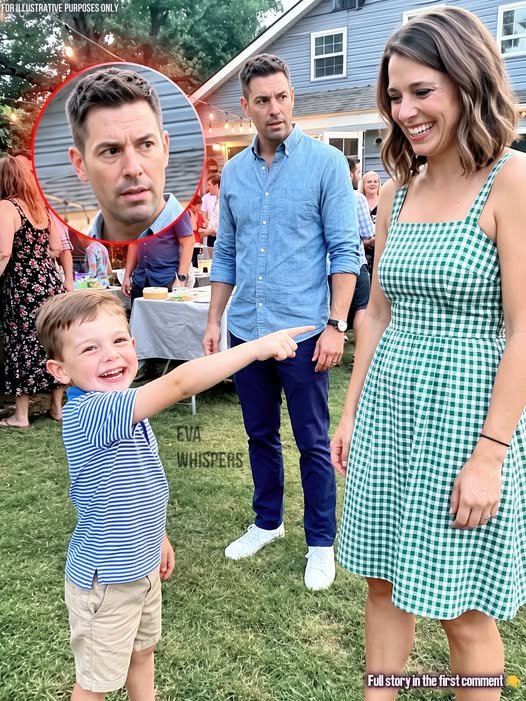
Will raised his arm and pointed directly at her.
“There,” he said loudly. “Daddy’s there.”
Ellie looked over and laughed.
I laughed too, although my voice sounded unnatural to my own ears.
“You’re being silly, sweetheart.”
But Will didn’t smile.
His small face tightened with frustration because I wasn’t understanding him.
He kept pointing.
Only then did I realize he wasn’t pointing at Ellie’s face.
He was pointing at her waist.
Ellie leaned forward to pick up her drink. As she moved, the side of her blouse lifted slightly.
For less than a second, I saw several thin black lines on the skin near her ribs.
An eye.
The bridge of a nose.
The corner of a mouth.
It was part of a tattoo—a portrait of someone’s face.
My smile remained in place, but inside me, something shifted.
The sounds of the party seemed to fade. I could still see people talking and laughing, but their voices felt far away, as if I were suddenly watching everything from underwater.
“Okay, honey,” I said to Will. “Go sit at the table. We’ll have cake soon.”
“But—”
“Go on. You can play afterward.”
Satisfied that cake was coming, he ran toward the children’s table.
I stood still for another moment, staring at Ellie.
The glimpse had been too quick. I couldn’t be certain of what I had seen.
But Will had recognized it.
And my son knew his father’s face better than almost anyone.
I forced myself to walk toward her.
“Ellie,” I said as casually as I could manage. “Could you help me with something inside?”
“Of course.”
She placed her drink on the table and followed me into the kitchen.
The sliding door closed behind us, dulling the party noise.
“What do you need?” she asked. “Is it time to bring out the cake?”
My thoughts were racing.
I needed to see the rest of that tattoo.
I couldn’t simply demand that she lift her shirt. If I was wrong, I would look suspicious and irrational. If I was right, I had no idea what would happen next.
I glanced around the kitchen, searching for an excuse.
Then I noticed a storage box on the shelf above the refrigerator.
“Could you get that down for me?” I asked.
She looked at the shelf. “That one?”
“Yes. I strained my back getting everything ready, and I don’t want to make it worse.”
Her expression filled with concern.
“When did that happen?”
“This morning. It’s nothing serious.”
Ellie stepped closer to the refrigerator and reached upward.
She rose onto her toes, stretching both arms over her head.
Her blouse lifted.
And my world stopped.

Part Three: The Face Beneath Her Shirt
The tattoo was a delicate black-ink portrait, detailed enough that there could be no mistake.
The dimpled smile.
The almond-shaped eyes.
The strong jaw.
The slightly curved nose I had kissed countless times.
It was Brad.
My husband’s face was permanently inked onto my best friend’s body.
For a moment, I couldn’t breathe.
It wasn’t a small symbol or a set of initials that could be explained away. It was an intimate, carefully drawn portrait placed along her ribs, hidden beneath her clothes.
A secret she carried everywhere.
A secret meant for someone to see.
I stared at it, unable to look away.
From outside, the guests suddenly cheered.
“Bring out the cake!” someone shouted.
Ellie pulled the box down and turned toward me. Her shirt fell back into place.
She smiled as though nothing had happened.
“Here you go.”
Then Brad called from the patio.
“Babe? Everything okay in there?”
His voice was warm and familiar.
The same voice that had whispered promises at our wedding.
The same voice that had read bedtime stories to our son.
The same voice that had told me not to worry whenever he came home late.
I closed my eyes.
Memories I had dismissed began rising one after another.
Brad forgetting our anniversary but remembering Ellie’s birthday.
Ellie canceling plans with me at the last minute.
Brad spending more evenings at “work.”
The private jokes between them that I didn’t understand.
The way they occasionally went silent when I entered a room.
Each moment had seemed too small to challenge on its own. I had explained everything away because trusting them was easier than considering the alternative.
Marriage was complicated, I had told myself.
People became busy.
Friends drifted in and out.
Husbands forgot things.
I had stepped carefully around every crack because I loved Brad, because Ellie was family, and because I believed loyalty meant giving the people you loved the benefit of the doubt.
Now I realized they had depended on that loyalty.
They had used my trust as a place to hide.
Will’s words echoed in my mind.
Aunt Ellie has Daddy.
He had said it happily, believing he had discovered something amusing.
My son had recognized the truth before I did.
“Marla?” Ellie asked. “Are you all right?”
I opened my eyes.
At that moment, I understood that I had two choices.
I could pull Ellie aside, quietly demand an explanation, and allow her and Brad to control the story.
Or I could stop protecting two people who had shown no concern for protecting me.
“The cake,” I said. “Could you carry it outside?”
“Sure.”
She opened the refrigerator and carefully lifted Brad’s birthday cake.
I followed one step behind her.
When we returned to the patio, she placed the cake in the center of the table.
Brad smiled at her.
She smiled back.
It was quick, almost invisible.
But now that I knew what I was looking for, the intimacy between them was unmistakable.
My stomach twisted.
The guests began gathering around the table. Phones were raised. Children squeezed toward the front. Brad stood behind the cake, grinning as everyone started singing.
I looked at the candles, the carefully piped frosting, and the words I had chosen that morning:
HAPPY 40TH, BRAD.
I had spent days preparing a celebration for a man who had been betraying me with the woman I trusted most.
When the song ended, Brad laughed and lifted his hands.
“No speeches,” he joked.
The guests chuckled.
“Actually,” I said, “I’d like to say something.”
The conversations faded.
Brad looked at me with an indulgent smile.
“All right,” he said. “I suppose I can allow my wife to praise me on my birthday.”
More laughter followed.
He had no idea what was coming.
I looked at him.
Then I looked at Ellie.
And for the first time all day, I felt completely calm.

Part Four: The Birthday Toast
“I’ve spent the entire day trying to make this celebration perfect for you,” I began.
Brad’s mother pressed a hand to her chest, already expecting a sentimental speech.
“I arranged the food, decorated the yard, invited everyone you care about, and made sure every detail was exactly right.”
Brad smiled proudly.
“So,” I continued, “before we cut the cake, I think it’s reasonable to ask for one small favor.”
His smile weakened slightly.
“What favor?”
I turned toward Ellie.
“Would you show everyone your tattoo?”
The color vanished from her face.
Her hand immediately moved to the side of her body.
Brad frowned.
“What are you talking about?”
“I’m talking about Ellie’s tattoo.”
Several guests looked at one another in confusion.
“Why would anyone need to see that?” Brad asked.
“Because it’s an extraordinary portrait of you.”
Silence fell across the yard.
Brad’s mouth opened, but no words came out.
He looked at Ellie.
She stared at the ground.
That single exchange told me everything I still needed to know.
A murmur spread through the crowd.
“Did she say it’s Brad’s face?”
“What is going on?”
Ellie’s lips trembled.
“Marla,” she whispered.
“My four-year-old noticed it before I did,” I said. “He pointed at Ellie and told me his daddy was there.”
Brad’s eyes darted toward our son.
Will was sitting at the children’s table, swinging his legs beneath the chair and waiting patiently for cake.
I looked back at my husband.
“I can’t help wondering what else our son may have noticed that I didn’t.”
Brad’s expression changed.
Fear became anger.
“How dare you suggest we did anything in front of him?”
His mother gasped.
I tilted my head.
“So you admit there was something to hide.”
Brad froze.
Ellie closed her eyes.
“My husband and my best friend,” I said, my voice shaking for the first time. “The two people I trusted more than anyone.”
No one moved.
Even the children seemed to sense that something terrible had happened. Their laughter faded, and several of them turned toward their parents.
Ellie finally looked at me.
“I was going to tell you.”
The words struck me as almost absurd.
“When?” I asked. “After he left me? After you moved in together? Were you waiting until you got pregnant, or until the divorce papers arrived?”
“It isn’t like that,” Brad snapped.
“Then explain it.”
He said nothing.
“Go ahead,” I challenged. “Tell everyone what it is like.”
His lips parted, but he couldn’t form an answer. He glanced around the yard, searching for an escape.
As I looked at him, I saw every version of the man I had loved.
The young man who used to send me ridiculous jokes during my workday.
The husband who kissed me in supermarket aisles.
The man who held my hand while I gave birth to our son.
The father who built blanket forts in the living room.
But I also saw the man who stopped calling when he would be late.
The man who treated my forgiveness as permission.
The man who knew I would overlook the cracks because I wanted our family to remain whole.
He had counted on my love to keep me blind.
Brad lowered his voice.
“Can we please discuss this somewhere private?”
I looked around the backyard.
“At the birthday party I organized for you? In front of the people who have watched me love both of you for years?”
“Marla,” his father muttered, “lower your voice.”
I turned toward him.
“No.”
Brad’s face hardened.
“You’re embarrassing yourself.”
Several people gasped.
My sister stared at him in disbelief.
Something inside me became still.
“No, Brad,” I said. “The embarrassment belongs entirely to you.”
I lifted the cake from the table.
“The party is over.”
No one protested.
No one moved toward the food or asked whether they should stay.
I looked directly at Brad.
“You’ll need to find somewhere else to sleep tonight. You are not coming home with me.”
Then I turned away from him.
I had no interest in hearing another excuse.

Part Five: The Truth That Set Us Free
Will was still waiting at the children’s table.
He looked up at me with bright, trusting eyes.
“Cake now?”
For one painful second, I couldn’t answer.
His knees were dirty. His curls were damp from playing in the sun. His small hands rested eagerly on the edge of the table.
He had no idea that our family had just changed forever.
He didn’t understand betrayal, divorce, or the complicated grief of discovering that the people you trusted had been lying to you.
He only knew that there was a birthday cake in front of him and that his mother had promised he could have some.
Part of me wanted to gather him into my arms and hold him until the world became safe again.
Instead, I swallowed the ache in my throat.
“We’re going inside,” I told him gently.
“What about the cake?”
“Later, sweetheart.”
He climbed down from the chair and slipped his hand into mine.
Behind us, the party erupted into noise.
People began asking questions. Brad called my name. Someone was crying. Someone else demanded an explanation from Ellie.
Brad’s mother repeated his name as though saying it often enough might transform what had happened into a misunderstanding.
I didn’t turn around.
Will and I entered the kitchen together.
I closed the sliding door and shut out the voices.
Tomorrow, I would deal with the consequences.
Tomorrow, there would be questions, phone calls, explanations, lawyers, and painful decisions.
But in that moment, my son needed me more than I needed answers.
I crouched in front of him and brushed the hair from his forehead.
“You didn’t do anything wrong,” I said.
He frowned.
“I know.”
Of course he didn’t understand why I was saying it.
Perhaps I was saying it for myself.
That night, Brad did not come home.
The next morning, the story had already reached everyone who mattered. Some people called to check on me. Others offered advice I hadn’t requested. A few tried to explain that marriage was complicated and suggested that I avoid making permanent decisions while I was angry.
But I wasn’t merely angry.
I was finished.
The divorce was not dramatic.
There were no public battles or endless screaming matches. Brad and I sat in quiet offices while lawyers discussed property, schedules, and custody arrangements.
Will remained at the center of every decision.
Whatever Brad had done to me, he was still our son’s father. I refused to use Will as a weapon or force him to carry the weight of adult mistakes.
Ellie sent me one message.
It was long, apologetic, and filled with explanations about loneliness, confusion, and feelings she had supposedly never intended to develop.
I deleted it without responding.
Some betrayals do not require a conversation.
A week later, I heard that she had left town.
I never asked where she went.
The house felt strange after Brad moved out.
The silence seemed larger at first. His shoes were gone from the hallway. His coffee mug no longer sat beside mine in the sink. Half the closet was suddenly empty.
For several nights, I lay awake listening to the quiet and wondering how many moments in my marriage had been real.
Grief arrived in unexpected ways.
It came when I found one of Brad’s old shirts behind the washing machine.
It came when Will asked why Daddy wasn’t eating dinner with us.
It came when I reached for my phone to text Ellie before remembering that she was no longer the person I had believed her to be.
But beneath the grief, something else slowly appeared.
Relief.
For the first time in years, I no longer had to explain away Brad’s absences. I didn’t have to wonder whether Ellie was avoiding me. I didn’t have to ignore the uneasy feeling that something in my life was slightly wrong.
The truth had devastated me.
But it had also released me.
One evening, several weeks after the party, Will and I sat on the living room floor building a tower from wooden blocks.
He carefully placed one block at the top, then clapped when the tower remained standing.
“Look, Mommy!”
“I see it.”
He leaned against me, completely pleased with himself.
As I wrapped an arm around him, I understood something I had been too frightened to admit before.
Our home was smaller now.
Quieter.
Different.
But for the first time in a long while, it felt honest.
It belonged to me and to the little boy who had pointed at the truth while everyone else was trying to hide it.
Will had believed he was only showing me a familiar face.
Instead, he had shown me the life I needed to leave behind.
And although the truth broke my heart, it also gave me the courage to begin again.