
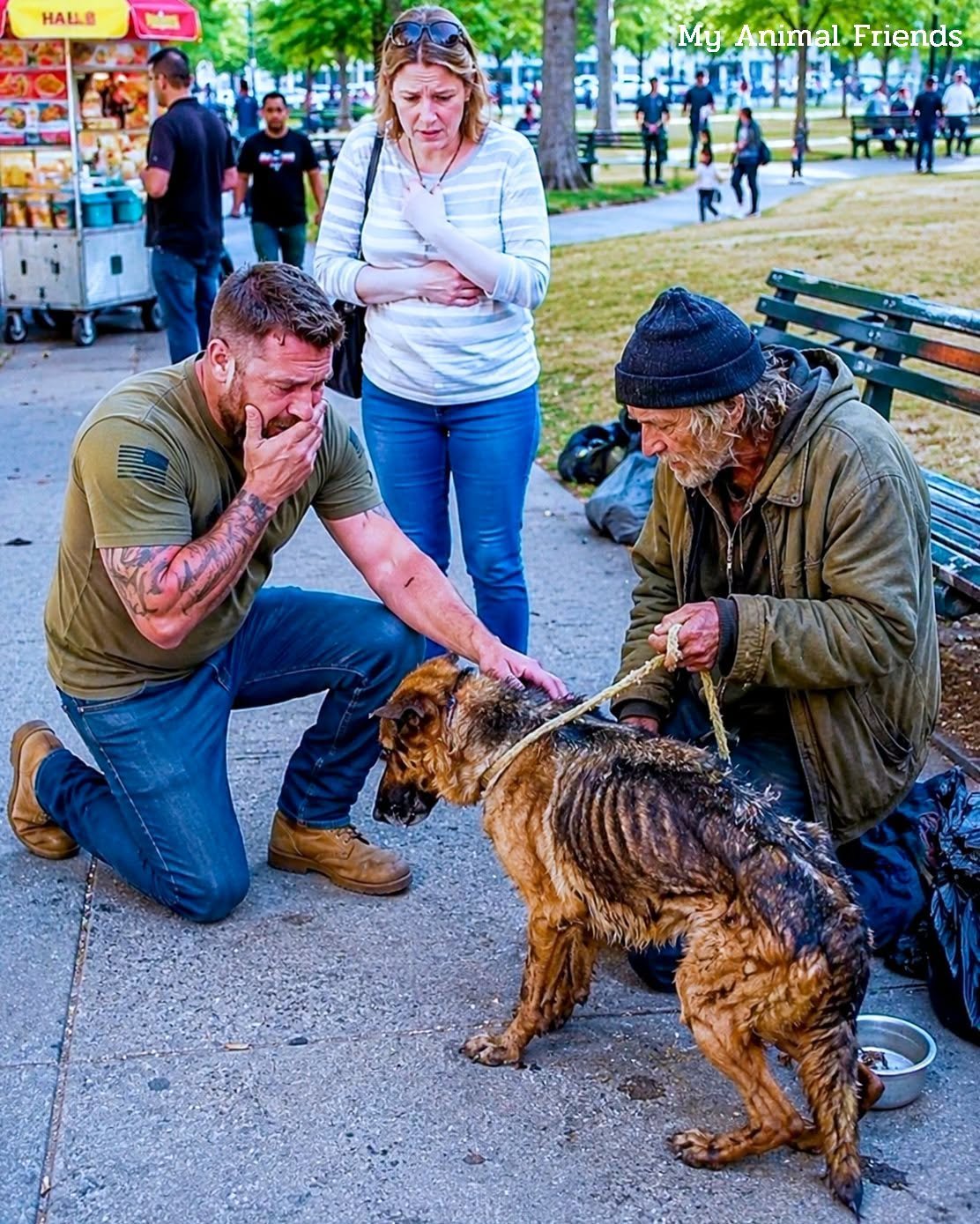
The first time I saw Rocky again, he was lying under the far end of a park bench like he had been trying to disappear from the heat.
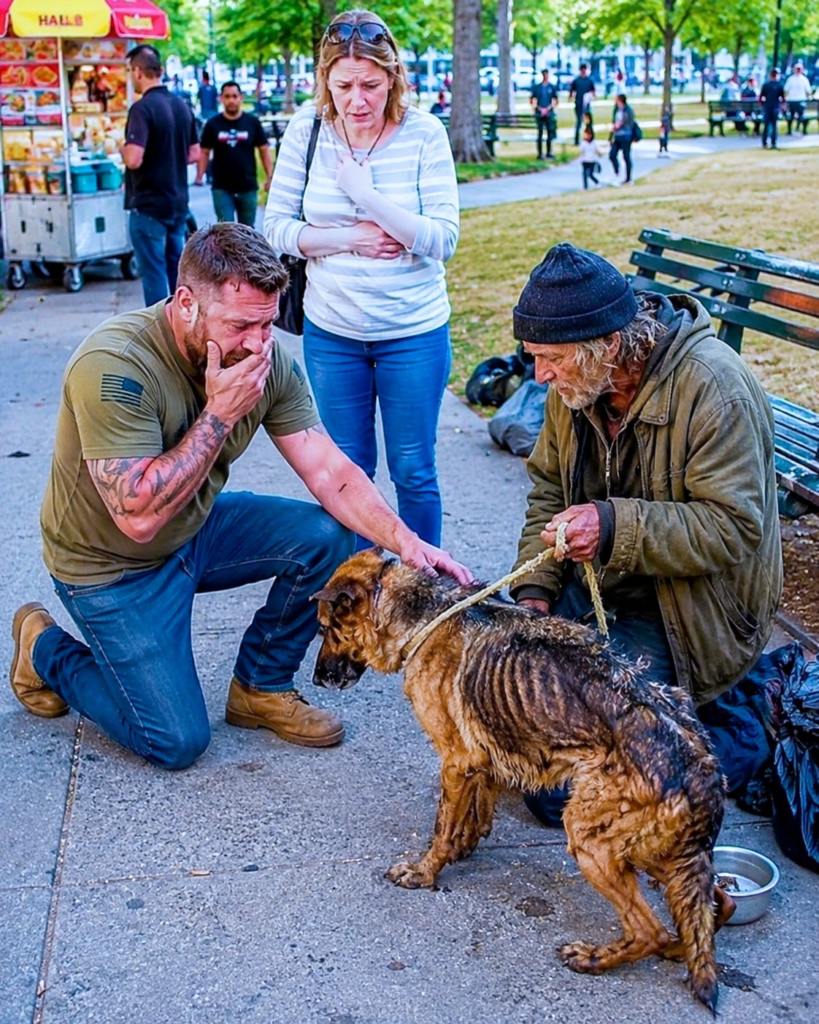
I had gone to Riverside Park because my therapist told me to walk somewhere with noise, somewhere I could remember I was home, but the crowd blurred the moment I saw the amber eyes watching me from the dust. He was half the size he used to be, all ribs and matted fur, with a frayed rope tied to a collar so worn the leather had cracked white at the edges.
I said his name before I meant to. “Rocky Bennett.”
The dog lifted his head one inch, and his tail tapped the dirt twice, weak but certain. My knees went out from under me so fast that a woman pushing a stroller stopped in the path, and for a second I was back in a village overseas, hearing him growl through smoke while he dragged me behind a wall I never would have reached alone.
An old man on the bench tightened his hand around the rope and stepped between us. His name was Earl, and he looked like a man who had already lost too many arguments with the world.
“Don’t grab him,” he said, rough as gravel. “He doesn’t trust uniforms anymore.”
That sentence hit harder than any accusation. I was still in my pressed service shirt from a memorial event, and Rocky had flinched at the flash of the brass on my sleeve. I lowered my hands and told Earl the truth as plainly as I could: Rocky had been my partner, my shield, and the reason my mother got a son back instead of a folded flag.
Earl did not soften at first. He told me he had found Rocky limping behind a bus depot in the rain three months earlier, too weak to bark and too proud to beg. He had fed him canned soup, cleaned the wound on his flank, and kept him alive with more kindness than money. Then he pointed at the scar under Rocky’s fur and asked how a family loses a dog carrying a mark like that.
I had no good answer, and that made the shame worse. The Army had retired Rocky after the blast, and I had signed every petition I could to adopt him. A private contractor had sent me a form letter saying he was placed in lifetime care, medically monitored, and unavailable for transfer.
Earl stared at me for a long time after I said that. Then his hand moved to Rocky’s collar, and he pulled a grimy metal tag from beneath the fur. The tag had a number, a faded bar code, and the name Northbridge Canine Services stamped across it. I knew that name because it was printed on the letter that had told me to stop asking.
I wrapped Rocky in the blanket from my truck and carried him like he weighed nothing, which was the worst part. Earl followed us all the way to the animal clinic and stood in the doorway while the vet read the microchip. When she said Rocky had been marked “placed and stable” six weeks after Earl found him starving, Earl whispered one word I cannot forget:
“Paid.”
By morning, I had copies of the chip record, the tag number, and the retirement letter spread across my kitchen table. Rocky slept beside my chair with his paws twitching, trapped somewhere between the park and the battlefield. I kept one hand on his back and called every number on the old paperwork until a clerk finally forgot to hang up fast enough.
She told me there was a care ledger. She told me contractors submitted monthly proof of food, shelter, and veterinary support for retired working dogs. Then her voice dropped so low I almost missed it.
“Sergeant Hayes, if your dog was in a park, somebody kept billing for a ghost.”
That was when the anger stopped being loud and became useful. I did not post a rant, and I did not drive to Northbridge looking for a fight. I made copies, called a veterans’ advocate named Sarah Coleman, and asked Earl to write down the day he found Rocky, the bus depot, the rain, and the soup cans he had bought when a paid system had left a hero hungry.
Two days later, Sarah called me back with a hearing date and a warning. Northbridge had lawyers, clean suits, and a habit of making old soldiers look confused. She told me to bring the dog only if he was strong enough, and to bring the paperwork either way.
I looked down at Rocky, who had raised his head at the sound of my voice, and I knew the room was finally going to see what their forms had tried to bury.
The morning of the hearing, Earl arrived in his good shirt with Rocky’s old rope folded in a grocery bag. He said the rope was ugly, but ugly things sometimes tell the truth better than polished speeches. Sarah slid a stamped care ledger into a blue folder and told me not to open it until the director denied knowing Rocky’s name.
Then the hearing room doors opened, and the man from Northbridge walked in smiling.
(I know you’re curious about the next part, so please be patient and read on in the comments below. Thank you for your understanding of the inconvenience. please leave a ‘YES’ comment below and give us a “Like ” to get full story)
Part 2
The director introduced himself like he was doing the room a favor. He wore a navy suit, a silver watch, and the calm expression of someone who had never sat on a kitchen floor beside a dog too hungry to sleep.
Rocky was not in the room yet; the vet had asked me to keep him in the quiet hallway until the crowd settled, so Earl sat beside the door with one hand on that folded rope.
Sarah began with the records, but the director smiled through the first page. He said Northbridge handled hundreds of retired dogs, that clerical errors happened, and that emotional testimony could not replace documentation.
Then he looked straight at me and said, “Sergeant, sit down before you embarrass yourself.”
I stayed standing. Earl shifted in his chair, and the rope crackled inside the grocery bag like dry leaves.
That was when Sarah asked one simple question: if Rocky had been safe in lifetime care, why had his microchip been scanned at a public clinic after three months on the street?
The director’s smile thinned. He asked for a recess, but the committee chair refused.
Sarah nodded toward the hallway, and the vet came in with Rocky walking slowly beside her, ribs still visible under a clean harness. Every whisper in the room died at once.
Then Earl stood up, opened the grocery bag, and laid the frayed rope on the witness table. The director stared at it like it had crawled out of a grave.
Sarah leaned toward me and whispered, “Now.”
Part 3
The sound that followed was not a roar or a gasp. It was the absolute, suffocating silence of a room where a terrible secret had just been stripped of its armor.
“That piece of frayed nylon,” Sarah said, her voice cutting through the quiet like a surgical blade, “was purchased at a hardware store three miles from the Greyhound terminal in Newark. It cost four dollars and twelve cents. It was tied around this dog’s neck by Earl Vance because Northbridge Canine Services—a contractor receiving eight hundred and fifty dollars a month from taxpayers for Rocky’s ‘lifetime veterinary and residential shelter’—had abandoned him in an alley to starve.”
The director, whose name plate read Arthur Pendelton, didn’t look at the rope. He looked at the legal pad in front of his lead attorney. His knuckles were pale against the mahogany desk. “This is an emotional stunt,” Pendelton said, though the effortless polish in his voice had begun to flake. “We oversee thousands of canine placements. A single dog slipping through the administrative grid due to a sub-contractor’s breach of protocol—”
“A sub-contractor?” I interrupted.
I didn’t mean to speak. I hadn’t planned to. But Rocky had shifted in the aisle. Feeling the tension in the room, he had crept forward until his snout rested gently on the toe of my worn combat boot. The cold of his nose seeped through the leather.
“Sergeant Hayes, please,” the committee chairman cautioned gently, but his eyes were fixed on the dog’s exposed ribcage. “Let your counsel speak.”
“No, sir,” I said, stepping forward. I felt Earl’s hand briefly touch the back of my belt—a silent, steadying weight. “With respect, Mr. Chairman, I want Mr. Pendelton to look at this dog and say the word ‘protocol’ again.”
Pendelton kept his eyes dead ahead. “We are running a professional logistics network, Sergeant. Mistakes happen in logistics.”
“Logistics,” I repeated, the word tasting like copper on my tongue. “In the Helmand Province, when a bomb went off under our lead Humvee, Rocky didn’t treat me like logistics. He had sharp shrapnel embedded in his flank—the very scar you marked as ‘healed’ in your fraudulent filing three months ago. He dragged me eighty yards through burning diesel and small-arms fire while his own blood pooled in the dirt. He didn’t ask for a voucher. He didn’t submit a invoice. He just stayed until the medevac arrived.”
I pointed down at the floor, where Rocky lay motionless, his golden eyes fixed entirely on me, ignoring the room full of suits, ignoring the cameras, ignoring everything except the man he had saved.
“You took a hero,” I said, my voice dropping until it was barely a whisper, yet carrying to every corner of the gallery, “and you turned him into a line item on a ghost ledger so you could buy that silver watch.”
Pendelton’s lawyer whispered furiously in his ear, trying to shield him, but the damage was done. Sarah slid three thick binders across the table toward the panel.
“Those are the microchip logs, Mr. Chairman,” Sarah stated calmly. “Not just for Rocky, but for thirty-two other retired military and working dogs assigned to Northbridge facilities across three states over the last two years. Every single one was billed monthly as ‘active care.’ Twelve of them were found in shelters. Four were dead in animal control facilities. The rest… are missing.”
A collective sharp intake of breath echoed through the gallery. Pendelton finally looked down, his face drained of color as the committee chairman picked up the top folder, his expression darkening with every page he turned.
Part 4
The hearing adjourned twenty minutes later, not with a quiet dismissal, but with the committee chairman issuing a formal order for federal auditors to seize Northbridge’s digital servers before the sun set.
We didn’t wait around for the reporters who gathered outside the double glass doors. Earl, Sarah, and I walked Rocky out through the service exit at the back of the building, where the noise of the city felt muffled by the concrete walls.
The sun was high and brutal, bouncing off the asphalt of the parking lot. Rocky walked slowly, his gait uneven, but he kept his shoulder pressed against my calf. Every few steps, he would lean heavily into me, checking to make sure I was still there—a habit from our months on patrol together, when visibility was low and trust was the only thing keeping us breathing.
Earl stopped beside my old pickup truck. He held the empty grocery bag in his hands, folding it over and over until it was no larger than a wallet.
“He’s yours now, son,” Earl said softly, looking down at his boots. “The lawyer lady says the emergency custody papers are signed. Nobody’s coming to take him back.”
I looked at the old man. His hands were calloused, stained with the engine grease of a life spent doing hard, unthanked labor. “Earl,” I said, “come home with us. Just for dinner. My mother made enough stew to feed a battalion, and she wants to meet the man who kept my brother alive.”
Earl gave a small, sad smile, shaking his head. “I got a room at the boarding house near the depot. It ain’t much, but it’s quiet. Besides… Rocky’s a soldier dog. He belongs with a soldier.”
“He survived because of a man who bought him soup when he had nothing,” I insisted, reaching out to grasp Earl’s forearm. “You’re part of this family now, Earl. Like it or not.”
For the first time since I met him under that park bench, the old man’s shoulders dropped. The gravelly, hardened armor he carried around his chest seemed to crack. He looked at Rocky, who leaned over and rested his heavy chin on Earl’s shoe, let out a long, shuddering sigh, and closed his eyes in the warm afternoon air.
“Soup,” Earl muttered, clearing his throat roughly to hide the tremble in his voice. “The damn dog wouldn’t even eat the fancy stuff. Only chicken noodle.”
“Then we’re having chicken noodle,” I said.
Three weeks later, the news broke wide. Northbridge Canine Services was stripped of its government contracts, and federal indictments were handed down for mail fraud, grand larceny, and animal cruelty. Pendelton’s slick smile was replaced by a grim scowl on the front page of every major newspaper as he was led away in handcuffs.
Because of Earl’s rope and Sarah’s blue folder, the state legislature drafted “Rocky’s Law”—requiring independent, real-time microchip verification for every retired working animal funded by public dollars.
The system that had left a hero hungry was finally being dismantled, brick by brick.
Part 5
Autumn came to the city with a crisp, cool wind that swept the fallen leaves across Riverside Park.
I walked the same paved path my therapist had sent me to months ago, but the world didn’t feel blurred anymore. The noise of children playing, the hum of traffic from the avenue, the bark of dogs across the green—it didn’t feel like a threat or a chaotic fog. It felt like life returning to its proper place.
Beside me, Rocky trotted with a new, steady rhythm. His ribs were no longer visible beneath a thick, shiny coat of golden fur. He wore a soft leather harness with no brass, no heavy buckles, and no institutional tags.
We stopped near the far end of the green, beside the old park bench where I had found him dying in the dirt.
Earl was already sitting there, wearing a new coat I’d bought him for his birthday and reading the morning paper. When he saw us approaching, he reached into his pocket and pulled out a small rubber ball, tossing it weakly across the grass.
Rocky didn’t sprint after it—his joints were too old and carrying too many combat memories for high speeds—but he trotted over, picked it up gently in his jaws, and brought it back, dropping it directly into Earl’s lap before slumping down across my boots.
I sat down on the bench beside Earl, watching the river reflect the pale orange rays of the setting sun.
“Therapist says I only need to see her once a month now,” I said quietly, leaning back against the wooden slats.
Earl adjusted his cap, his eyes watching the water. “What’d you tell her?”
“I told her I found my home,” I said. “It just took two broken old men and a half-starved dog to show me where it was.”
Rocky let out a deep, contented breath beneath our feet, his tail tapping the grass once, twice—weak no longer, but entirely certain. I reached down, burying my fingers into the soft fur behind his ears, feeling the steady, rhythmic beat of his heart against my palm.
The smoke was gone. The battlefield was far away. For the first time in three years, all of us were finally home.