
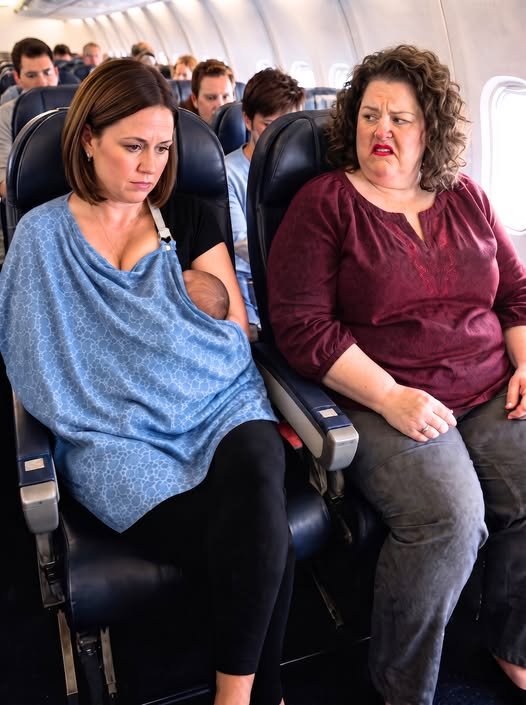
Part 1: The Scream at 30,000 Feet
The woman’s scream cut through the airplane cabin so sharply that conversations stopped mid-sentence.
Heads turned.
A flight attendant hurried down the aisle.
The woman who had spent the last twenty minutes criticizing me was now standing beside her seat, staring at the tablet in my eight-year-old daughter’s hands.
Her face had gone completely pale.
“Turn that off!” she shouted.
My daughter Louise didn’t flinch.
She simply looked up at the woman and asked, in the calmest voice I had ever heard:
“Which one is the real you?”
The woman grabbed her purse and rushed toward the back of the plane.
Around us, passengers whispered and exchanged confused looks.
I sat one row away with my five-month-old son against my chest, wondering what on earth Louise had shown her.
Only minutes earlier, that woman had told me to lock myself in the airplane bathroom if I wanted to feed my hungry baby.
She had called me shameless.
She had questioned what kind of mother I was.
What she didn’t know was that a month earlier, I had buried my husband.
What she didn’t know was that I was using every ounce of strength I had just to keep my children fed, dressed, and moving forward.
And she certainly didn’t know that the quiet little girl sitting beside her had learned something important from her father:
Sometimes kindness means offering comfort.
But sometimes kindness means holding up a mirror.
Part 2: The First Flight Without Him
My husband, Daniel, had been gone for thirty-two days.
I knew the exact number because every morning I woke up and counted another day I had somehow survived without him.
He had died suddenly from an undiagnosed heart condition.
One moment he had been standing in our kitchen, making pancakes shaped like animals for Louise. The next day, I had been sitting in a hospital room, holding his hand while a doctor explained that they had done everything they could.
Daniel was thirty-six.
I was thirty-four.
Our son, Noah, had been only four months old.
Louise had asked me three times whether the doctors were sure her father couldn’t come home.
The first time, I tried to explain.
The second time, I held her.
The third time, I broke down beside her on the hospital floor.
The weeks that followed passed in fragments.
There were flowers on our porch, casseroles in our freezer, sympathy cards on the dining table, and Daniel’s shoes still sitting beside the front door.
People kept telling me to call if I needed anything.
But I didn’t know what to ask for.
Could someone come over and explain to Noah why his father’s voice had disappeared?
Could someone teach me how to sleep in a bed that suddenly felt twice as large?
Could someone tell Louise why good people sometimes left before they were finished loving us?
My mother called every day from Seattle.
“Come stay with me,” she kept saying. “You don’t have to be strong every minute. Let me take care of you for a while.”
At first, I refused.
The idea of packing bags, taking two children through an airport, and sitting on a six-hour flight seemed impossible.
Then one night, I found Louise sitting on the floor of Daniel’s closet, hugging one of his sweaters.
She wasn’t crying.
That frightened me more than tears would have.
“Would you like to visit Grandma?” I asked.
Louise pressed her face against the sweater.
“Can we come back afterward?”
“Of course.”
“Will Dad’s things still be here?”
“Yes.”
She thought for a moment, then nodded.
So I booked three tickets.
Unfortunately, the flight was nearly full. There were no three seats together, and there weren’t even two seats beside each other.
The gate agent managed to place Louise in the row directly behind me. She would be in an aisle seat, close enough for me to see her.
“I’ll be okay,” she assured me.
She had been saying that a lot since Daniel died.
It was one of the many ways my eight-year-old daughter had started sounding far older than she should.
I settled into my window seat with Noah in my arms.
The woman beside me was dressed in a cream blazer, dark slacks, and expensive-looking shoes. She appeared to be in her late fifties. Her silver-blond hair was styled perfectly, and a leather tote bag rested beneath the seat in front of her.
Printed across the side of the bag were the words:
DR. CELESTE WARREN — RAISING KIND HUMANS
I assumed it was the name of a conference or a book.
Before takeoff, she spoke loudly on her phone.
“Yes, I’ll be there in time for the keynote,” she said. “The whole point of the talk is that children repeat what adults model for them.”
I looked down at Noah and smiled faintly.
Daniel had often said something similar.
Children might not always listen to adults, but they were always watching them.
The woman ended her call and glanced at the baby in my arms.
Her expression tightened immediately.
“If your baby starts screaming,” she said, “I’m not going to listen to it for six hours. I’m warning you.”
For a second, I thought she was joking.
Then I saw the hard look in her eyes.
“I’ll do my best to keep him comfortable,” I said.
She rolled her eyes and turned toward the aisle.
Behind us, Louise leaned forward between the seats.
“He’s usually a good traveler,” she said politely. “My dad said babies cry because crying is the only language they know.”
The woman didn’t respond.
I turned around and gave Louise a reassuring smile.
“Sit back, sweetheart. We’re about to take off.”
She nodded, but her eyes remained fixed on the woman beside me.

Part 3: A Hungry Baby and an Angry Stranger
For the first two hours, Noah slept peacefully.
I held him against my chest while the clouds passed below us like fields of white cotton.
Everyone around me seemed to be reading, sleeping, or watching movies.
I tried closing my eyes, but grief had made sleep difficult.
Whenever I began drifting off, I heard Daniel’s laugh.
I saw him standing beside Noah’s crib, whispering that our son had inherited my nose and his stubbornness.
I remembered the last ordinary morning we had shared—the kind of morning I had once taken for granted.
Daniel had kissed the top of my head and asked if we needed anything from the grocery store.
Milk, I had told him.
He had never come home.
I opened my eyes before the memory could pull me under.
A few minutes later, Noah stirred.
He made a soft whimpering sound.
I rocked him gently and placed his pacifier in his mouth. He sucked on it briefly, then pushed it away and began to cry.
The woman beside me stiffened.
“You said he was a good traveler.”
“He is,” I whispered. “He’s probably hungry.”
I bounced him carefully, hoping he might settle.
His cries grew louder.
I could feel nearby passengers glancing toward us. Most looked sympathetic, but after everything I had been through, even harmless attention felt overwhelming.
I offered Noah the pacifier again.
He turned his head toward me, rooting against my shirt.
There was no question about what he needed.
I pulled a nursing cover from the diaper bag and draped it securely over my shoulder. I was fully covered, and there was nothing visible to anyone around me.
As soon as Noah began feeding, his cries stopped.
His tiny body relaxed.
I let out a breath I hadn’t realized I was holding.
Then the woman beside me sighed dramatically.
“Oh, great.”
I looked at her.
She stared at the nursing cover as though I had placed something offensive between us.
“I paid for this seat,” she said loudly, “not only to listen to someone else’s baby scream, but also to watch you feed him.”
Several passengers turned toward us.
My cheeks burned.
“I’m covered,” I said quietly. “He was hungry. He’ll be finished soon.”
“How shameless.”
The word struck me harder than it should have.
Maybe it was because I hadn’t slept properly in weeks.
Maybe it was because grief had stripped away the protective layer I once carried between myself and the world.
Or maybe it was because I had spent the last month feeling like I was failing everyone.
I hadn’t been able to save my husband.
I couldn’t stop my daughter from missing him.
I couldn’t explain why my son would grow up knowing his father only through photographs and stories.
Now this stranger was telling me I was failing at motherhood too.
“I’m sorry you’re uncomfortable,” I said. “But my son has to eat.”
“People with babies like that should stay home.”
My throat tightened.
She continued before I could respond.
“What kind of mother brings an infant onto a six-hour flight when she can’t even calm him down?”
I looked toward the window.
I didn’t want her to see the tears gathering in my eyes.
I didn’t want Louise to see them either.
“I’m doing the best I can,” I whispered.
“Well, your best is disturbing everyone around you.”
Noah continued feeding, unaware of the cruelty being aimed at his mother.
The woman leaned closer.
“If you insist on doing that, go lock yourself in the toilet and feed him there. Why should I have to look at this shameful display?”
Behind us, I heard a seat belt click.
Then Louise appeared beside our row.
Her face was pale, but her shoulders were straight.
“Mom,” she said, “why don’t you take my seat?”
“Louise, it’s okay.”
“No. You’ll have more room in the aisle, and I can sit here.”
The woman looked almost relieved.
“Yes. Let the girl sit here. Perhaps she knows how to behave in public.”
I saw something change in Louise’s expression.
It wasn’t anger exactly.
It was determination.
Daniel used to get the same look whenever he saw someone being treated unfairly.
“Please, Mom,” Louise said. “Sit with Noah behind me.”
I hesitated, but I was exhausted and close to tears. I carefully gathered the diaper bag while keeping Noah beneath the nursing cover.
Louise slid into my window seat.
I moved into hers, directly behind her.
Before sitting down, I placed a hand on her shoulder.
“Don’t argue with her.”
“I won’t,” Louise promised.
Technically, she kept that promise.
Part 4: Which One Is the Real You?
From the row behind, I could see only the top of Louise’s head.
For about a minute, nothing happened.
Then I heard the woman speak.
“Do you always interfere in adult conversations?”
“No,” Louise answered. “Only when someone makes my mom cry.”
“I did not make your mother cry.”
“You almost did.”
The woman gave an irritated laugh.
“Your mother needs to learn that the world doesn’t revolve around her children.”
Louise was silent.
I leaned forward.
“Louise, put your headphones on.”
“I’m just opening my tablet.”
I heard the familiar sound of the device unlocking.
A few seconds passed.
Then Louise asked, “Are you Dr. Celeste Warren?”
The woman’s voice changed slightly.
“Yes.”
“The woman who wrote Raising Kind Humans?”
“Yes,” she replied. “Have you read it?”
“No. But my teacher showed our class one of your videos.”
The woman’s tone softened with pride.
“Well, then you already know I teach parents how important it is to model appropriate behavior.”
“I remember.”
Louise tapped the screen.
A woman’s voice began playing from the tablet.
I recognized it immediately as the passenger beside her.
“Children learn empathy not from lectures,” the recorded voice said, “but from watching how we treat people when we are tired, inconvenienced, or uncomfortable.”
There was a pause.
The woman shifted in her seat.
“That’s enough,” she said.
But Louise didn’t turn it off.
The video continued.
“A child who sees an adult humiliate someone weaker learns that cruelty is acceptable. A child who sees an adult offer patience learns that compassion is strength.”
“Turn it off,” the woman said more sharply.
Louise stopped the video.
For a second, there was silence.
Then she said, “I remembered your face from the video. Your name is on your bag, so I searched for it.”
“That doesn’t give you the right to lecture me.”
“I’m not lecturing you.”
I heard another tap.
This time, the woman’s own voice came from the tablet—but the words were the ones she had spoken to me only minutes earlier.
“People with babies like that should stay home.”
My stomach dropped.
Louise had recorded part of the confrontation.
The recording continued.
“What kind of mother are you if you feed your child in public and can’t even calm him down on your own?”
“Turn that off!” the woman shouted.
Passengers began looking toward us.
But Louise remained calm.
She held up the screen, where the woman could apparently see two paused videos side by side.
One showed Dr. Celeste Warren standing on a stage beneath the words RAISING KIND HUMANS.
The other showed her sitting on the airplane, insulting a grieving mother with a baby in her arms.
“Which one is the real you?” Louise asked.
That was when the woman screamed.
She stood so quickly that her knee struck the seat in front of her.
“Turn it off right now!”
Louise lowered the tablet.
“I wasn’t going to post it.”
The woman grabbed her purse.
“Delete it!”
“You should apologize to my mom first.”
“I will not be threatened by a child!”
“I’m not threatening you,” Louise said. “I just wanted you to hear how you sounded.”
The woman stared at her.
Then she looked around and realized nearly half the cabin was watching.
Her face turned pale.
She pushed past Louise, stepped into the aisle, and hurried toward the back of the plane.
A flight attendant followed her.
For several seconds, the cabin remained unusually quiet.
Then an older man across the aisle looked at Louise and said, “Your father taught you to be brave, didn’t he?”
Louise looked down at her tablet.
“Yes,” she said softly. “He did.”

Part 5: What Louise Hadn’t Told Her
I quickly moved back into the seat beside Louise.
Noah had finished feeding and was asleep against my chest.
“What were you thinking?” I whispered.
“I didn’t post anything.”
“You recorded her.”
“I know.”
“Louise—”
“She asked what kind of mother you are.”
My daughter’s voice trembled for the first time.
“She doesn’t know anything about you.”
“I don’t care what she thinks.”
“Yes, you do. You were crying.”
“I’m tired, sweetheart.”
“You’re always tired now.”
Her words silenced me.
Louise stared at her hands.
“She doesn’t know that you get up with Noah every night. She doesn’t know you still pack my lunch even when you forget to eat breakfast. She doesn’t know you sleep with Dad’s sweatshirt because the bedroom is too quiet.”
My eyes filled with tears.
“Louise…”
“She doesn’t know that Dad died.”
The last word cracked in her throat.
I wrapped my free arm around her.
“No, she doesn’t.”
“She looked at you like you were a bad mom.”
“I know.”
“You’re not.”
“I know that too.”
But the truth was, sometimes I didn’t.
Grief had made me doubt everything.
Daniel had been the parent who made ordinary life feel manageable. He remembered permission slips, invented bedtime stories, and knew exactly how to make Louise laugh when she was upset.
Without him, I felt as though I were building our lives each morning from broken pieces.
Louise wiped her eyes.
“Dad said you were the strongest person he knew.”
“He said the same thing about you.”
“No, he didn’t.”
“He did.”
“When?”
“The night Noah was born. You were sitting beside the hospital bed, holding him. Your dad said, ‘Look at her. She’s eight years old, and she already has more courage than most adults.’”
Louise leaned against me.
“I don’t feel brave.”
“Brave people usually don’t.”
For several minutes, we sat together in silence.
The woman’s seat remained empty.
Eventually, the flight attendant returned. Her name tag read MAYA.
She crouched beside us.
“Is everyone all right?”
“Yes,” I said. “I’m sorry about the disturbance.”
“You don’t need to apologize. Feeding your baby at your seat is permitted. You were not doing anything wrong.”
Louise glanced toward the back of the plane.
“Is that lady okay?”
“She’s upset.”
“Because I recorded her?”
“Partly.”
Louise lowered her eyes.
“I’ll delete it.”
Maya’s expression softened.
“That decision is between you and your mother. But I think it would be wise not to share it publicly.”
“I wasn’t going to.”
“I believe you.”
The flight attendant stood.
“Dr. Warren has requested another seat. We found one farther back, so you and your daughter may sit together for the remainder of the flight.”
Relief washed over me.
“Thank you.”
Maya started to leave, then paused.
“She also asked whether she could speak with you later.”
I looked at Louise.
My daughter gave a small shrug.
“Later,” I said. “When everyone is calmer.”
Part 6: The Woman Behind the Perfect Words
About an hour before landing, Dr. Warren returned.
She no longer looked polished and confident.
Her blazer was folded over one arm, and several strands of hair had come loose around her face.
She stopped beside our row.
“May I speak with you?”
I nodded cautiously.
She looked at Louise first.
“I owe both of you an apology.”
Louise watched her without speaking.
Dr. Warren took a breath.
“What I said to your mother was cruel. There is no excuse for it.”
She turned toward me.
“You were caring for your child. You were discreet, patient, and far more polite to me than I deserved.”
“Why did you say those things?” Louise asked.
“Louise,” I cautioned.
“No,” Dr. Warren said. “She deserves an answer.”
The woman rested one hand on the empty seat across the aisle.
“My daughter had a baby six weeks ago,” she explained. “She has been struggling. She called me this morning crying because she feels she isn’t a good mother. I’m flying to Seattle because she finally agreed to let me help.”
I waited.
Dr. Warren looked ashamed.
“Instead of facing how frightened and helpless I felt, I became angry. Then I saw your mother calmly doing the very thing my daughter has been struggling to do, and something ugly came out of me.”
“That still wasn’t Mom’s fault,” Louise said.
“No. It wasn’t.”
“You teach people to be kind.”
“I do.”
“But you weren’t.”
“No,” the woman admitted. “I wasn’t.”
Her honesty seemed to surprise Louise.
Dr. Warren glanced at the tablet.
“When I saw those two videos beside each other, I felt as if I were looking at two different people.”
“Which one is real?” Louise asked again.
The woman’s eyes filled with tears.
“Both of them, I suppose. One is the person I want to be. The other is the person I became when I stopped paying attention to my own behavior.”
She looked at me.
“I have spent years telling audiences that character is revealed when we are inconvenienced. Then the moment I was inconvenienced, I failed my own test.”
I didn’t know what to say.
Part of me wanted to tell her that everything was fine.
Women are often taught to make other people comfortable, even after being hurt.
But everything wasn’t fine.
Her words had wounded me.
More importantly, Louise had heard them.
So I told the truth.
“You made one of the hardest days of my life harder.”
Dr. Warren nodded.
“I understand.”
“My husband died last month.”
Her hand flew to her mouth.
“I’m so sorry.”
“We’re flying to stay with my mother because I’m trying to keep our family together. I didn’t bring my children on this plane to inconvenience you. I brought them because we needed help.”
Tears spilled down her face.
“I had no idea.”
“No, you didn’t. That’s the point. We rarely know what someone else is carrying.”
She lowered her head.
“You’re right.”
“I don’t expect strangers to know my story,” I continued. “But I do expect basic decency, even when they don’t.”
Dr. Warren looked at Louise.
“Your mother is right.”
“I know,” Louise said.
For the first time that day, I almost laughed.
Dr. Warren managed a small, embarrassed smile.
“Would you delete the recording?” she asked.
Louise looked at me.
I nodded.
My daughter opened the tablet, found the video, and pressed delete.
Then she opened the recently deleted folder and removed it from there too.
Dr. Warren watched her.
“You could have embarrassed me in front of thousands of people.”
“I didn’t want thousands of people to see it,” Louise said. “I wanted you to see it.”
The woman closed her eyes briefly.
“I did.”

Part 7: An Apology Without Excuses
Before returning to her new seat, Dr. Warren surprised us.
“My keynote tomorrow is about raising compassionate children,” she said. “I don’t think I can give the speech I prepared.”
“Why not?” Louise asked.
“Because it’s too easy to stand on a stage and tell other people what kindness looks like. Tomorrow, I think I need to tell them what failure looks like.”
I studied her carefully.
“You don’t have to mention us.”
“I won’t. Not without your permission.”
“I would prefer that you didn’t identify us.”
“Of course.”
She turned to Louise.
“But may I tell people that a child once asked me which version of myself was real?”
Louise thought about it.
“Only if you tell them you apologized.”
“I will.”
“And that Mom wasn’t doing anything wrong.”
“I’ll make that very clear.”
“And don’t call me brave.”
“Why not?”
“Because people say that when a kid has to do something a grown-up should have done.”
Dr. Warren’s eyes widened.
So did mine.
Once again, Louise had said something that sounded far beyond her years.
The woman nodded slowly.
“That may be the most important part of the story.”
She thanked us and returned to her new seat.
As the plane began its descent, Louise rested her head on my shoulder.
“Are you mad at me?” she asked.
“A little.”
She nodded as if she had expected that.
“But I’m proud of you too.”
“Can you be both?”
“Parents are often both.”
She smiled faintly.
“Dad would have laughed.”
“He would have tried not to.”
“He was bad at trying not to laugh.”
“He really was.”
For the first time since Daniel’s funeral, talking about him didn’t feel like falling into a hole.
It hurt.
But the hurt was mixed with warmth.
I could almost hear him telling Louise that she had done well, then gently reminding her not to record people without permission.
Daniel had believed in courage, but he had also believed in mercy.
I hoped we had honored both.
Part 8: What Happened After We Landed
My mother was waiting near baggage claim.
The moment she saw us, she hurried forward and wrapped her arms around Louise, Noah, and me all at once.
For a few seconds, I let myself stop being the person holding everyone else together.
I became someone’s daughter again.
I cried into my mother’s shoulder while she whispered, “You’re home. You’re safe. I’ve got you.”
A few feet away, Dr. Warren stood with a small suitcase.
A younger woman holding a newborn rushed toward her.
Dr. Warren’s daughter looked exhausted.
Her hair was pulled into a loose bun, and dark circles shadowed her eyes. When she saw her mother, her face crumpled.
“I’m sorry,” the young woman said. “I know you’re busy.”
Dr. Warren dropped her suitcase and embraced her.
“Never apologize for needing me.”
The words made me look up.
Dr. Warren caught my eye over her daughter’s shoulder.
She didn’t smile.
Neither did I.
But we exchanged a small nod.
Sometimes forgiveness isn’t a dramatic declaration.
Sometimes it is simply acknowledging that a person has begun walking in a better direction.
A week later, while staying at my mother’s house, I received an email.
It was from Dr. Celeste Warren.
She wrote that she had changed her keynote.
Instead of giving polished advice, she had told the audience about a moment when she had failed to practice the compassion she taught.
She didn’t mention our names, Daniel’s death, or any identifying details.
She told them about a tired mother feeding a hungry baby on a plane.
She told them about a child who had shown her two versions of herself.
Then she had asked the entire audience:
“Who are we when there is no stage, no applause, and no reward for being kind?”
At the end of the email, she wrote:
Your daughter did not ruin my reputation. She may have saved my character.
I am deeply sorry for the pain I caused you.
I hope the days ahead bring gentleness to your family.
Attached was a photograph of a handwritten page from her revised speech.
One sentence had been underlined:
Children do not need perfect adults. They need adults who are willing to admit when they are wrong, repair the harm they caused, and choose better the next time.
I showed the message to Louise.
“Do you forgive her?” she asked.
“I think so.”
“Even though she was mean?”
“Forgiveness doesn’t mean pretending she wasn’t mean. It means accepting that she understood the harm and tried to repair it.”
Louise considered that.
“Dad would forgive her.”
“He probably would.”
“He always gave people another chance.”
“Yes. But he also believed people had to earn that chance.”
Louise nodded.
Then she took the tablet from me and typed a reply.
She showed it to me before sending it.
Dear Dr. Warren,
Thank you for apologizing. My mom is a good mom. Please remember that when you see another mother having a hard day.
Also, your daughter is probably a good mom too. Tell her babies cry because crying is the only language they know.
From,
Louise
I read the message twice.
Then I pressed send.
Part 9: The Kind of Mother I Am
We stayed with my mother for six weeks.
During that time, I slept more than three hours in a row for the first time since Daniel died.
My mother held Noah while I took showers.
She packed Louise’s lunches.
She sat beside me after the children went to bed and let me talk about Daniel until there were no words left.
Healing didn’t happen all at once.
There was no morning when I woke up and suddenly felt whole.
There were still moments when I reached for my phone to call Daniel.
There were still nights when Louise crawled into my bed because she had dreamed that she had forgotten the sound of his voice.
There were still days when grief felt like an ocean and I had no idea how to keep swimming.
But slowly, we learned.
We learned that talking about Daniel didn’t make us sadder. It reminded us how deeply we had been loved.
We learned that asking for help wasn’t weakness.
We learned that laughter could live in the same house as grief.
Most importantly, I learned to stop measuring motherhood by whether my children ever cried, struggled, or felt afraid.
A good mother cannot prevent every painful moment.
She cannot control every stranger’s judgment.
She cannot always keep her own heart from breaking.
Sometimes a good mother is simply the woman who gets on the plane even when she is terrified.
She is the woman who feeds her baby when he is hungry.
She is the woman who allows her daughter to defend her, then teaches that daughter the difference between courage and revenge.
She is the woman who keeps moving forward even when every step feels impossible.
Months later, Louise brought home an assignment from school.
Her class had been asked to write about someone who had taught them an important lesson.
I assumed she would write about Daniel.
Instead, she wrote about the airplane.
Her final paragraph said:
My dad taught me that kindness is important, but he also taught me that kindness does not mean staying quiet when someone is being hurt. I learned that people can say mean things and still choose to become better. My mom says we should not decide someone’s whole life by their worst moment, especially if they are sorry and change. I think being brave means telling the truth without becoming cruel.
I sat at the kitchen table and cried.
Louise came in and found me holding the paper.
“Why are you crying?” she asked.
“Because your dad would be so proud of you.”
She looked down at her assignment.
“Do you think he knows?”
I reached for her hand.
“I don’t know exactly what happens after people leave us,” I said. “But I know the love they gave us doesn’t disappear. It shows up in the things we do.”
Louise squeezed my fingers.
“So when I stood up for you…”
“That was part of your dad’s love showing up.”
“And when we forgave Dr. Warren?”
“That was part of it too.”
Noah began crying from his crib in the next room.
Louise smiled.
“He’s using his only language.”
“Yes, he is.”
I lifted him into my arms and began feeding him near the living room window, where the afternoon sun warmed his tiny face.
I didn’t cover myself.
I didn’t apologize.
I simply held my son and gave him what he needed.
Louise sat beside me, reading her school assignment aloud while Noah’s small hand curled around my finger.
For the first time in months, I didn’t feel like a frightened widow trying to survive without her husband.
I felt like myself.
Not the old version of myself.
Not the woman I had been before grief entered our home.
I was someone new—wounded, imperfect, and still standing.
I finally knew exactly what kind of mother I was.
I was the kind who kept loving.
The kind who kept learning.
And the kind who would never again apologize for caring for her children.