
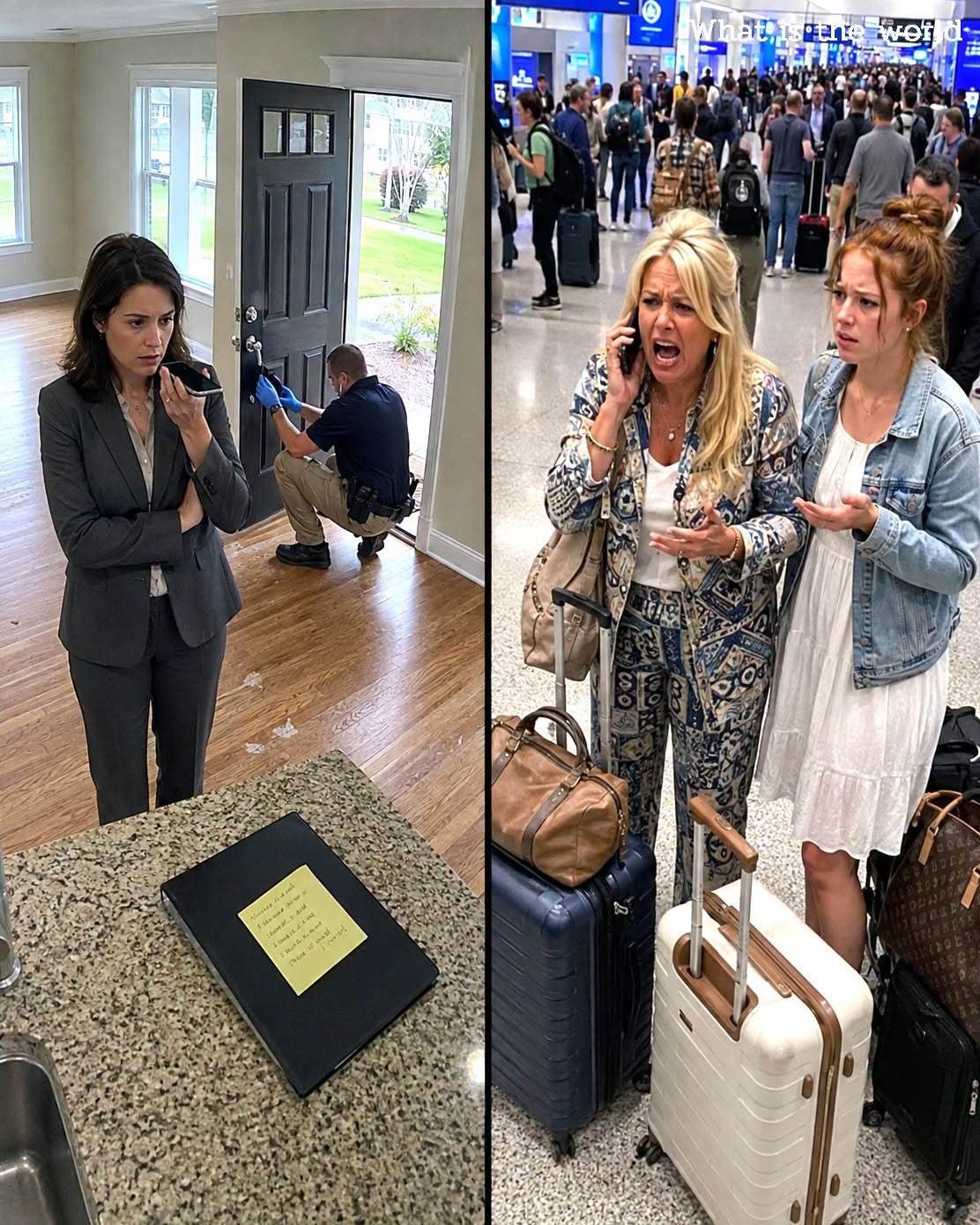
I tapped the speaker icon and placed my phone on the bare kitchen counter.
“Avery!” my mother shouted.
Her voice was sharp with the outrage of someone who had expected obedience and received consequences instead.
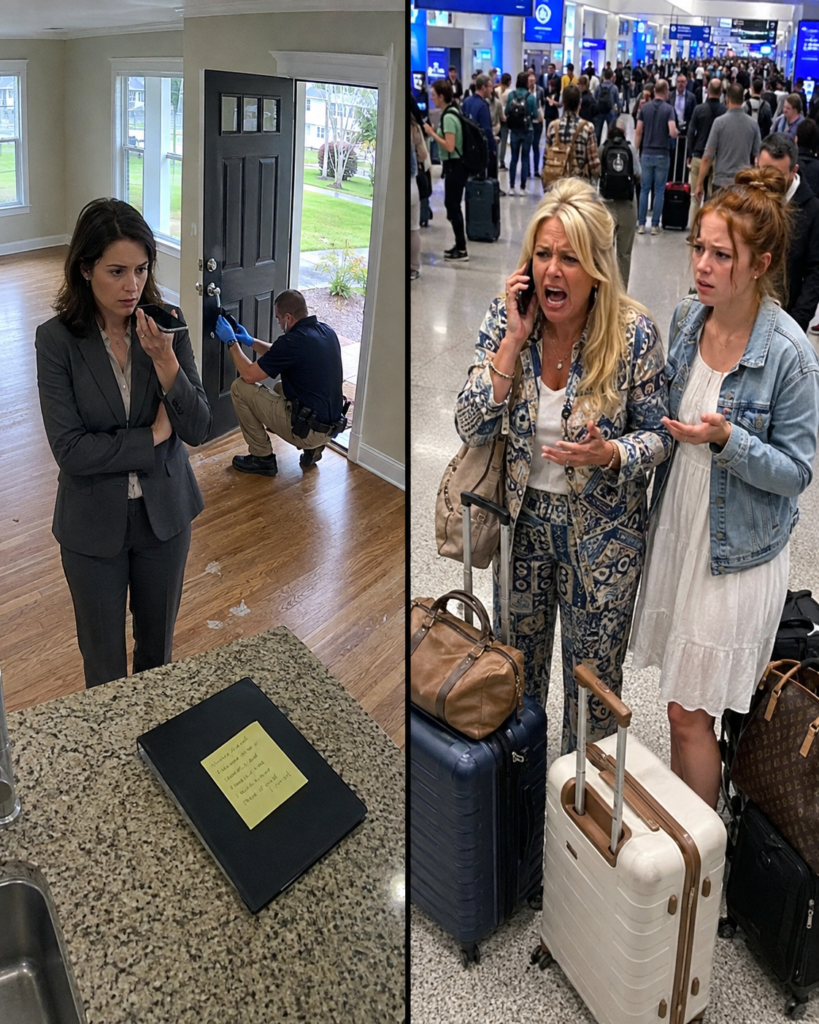
Airport announcements crackled behind her, followed by the rolling thunder of suitcase wheels.
“What did you do to our accounts?”
Naomi Ward, the bank’s fraud investigator, remained silent on my second phone.
She had already told me the call was being recorded with my consent.
I stared at the yellow note my mother had left behind.
Don’t bother calling.
We are finally choosing happiness.
“I didn’t do anything to your accounts,” I said.
“Why are you calling me?”
“Our cards are frozen.
The hotel says the reservation payment failed.
Brittany’s debit card won’t work, and the airline won’t let us charge the upgrade.
Call the bank and tell them to release the money.”
“The money you took from me?”
My mother lowered her voice, as though a softer tone might transform theft into a misunderstanding.
“It’s family money.
You have more than you need, and Brittany deserves a chance to enjoy her life.
Stop being dramatic and give me your security code.”
Across the kitchen, the police officer photographing the damaged lock paused and looked toward me.
I kept my hands flat against the counter.
“How did you transfer it?”
“With the authorization you signed.”
“What authorization?”
“The power of attorney.
Don’t play stupid, Avery.
I submitted the paperwork, the bank approved it, and the money appeared in our account.
That means it was legal.”
Naomi sent a message to my screen.
Keep her talking.
I asked, “Who witnessed me sign it?”
My mother went quiet for half a second.
Then she laughed.
“Elaine did.
She remembers.
And if you try to claim otherwise, I’ll tell the police you gave us the furniture and staged the burglary because you regretted helping your own family.”
Brittany’s voice rose in the background.
“Ask her about the jewelry.
The airline employee said police might search our bags.”
“Be quiet,” my mother snapped.
A file arrived from Naomi.
I opened it and saw a document titled Durable General Power of Attorney.
My name appeared throughout the pages.
The signature at the bottom resembled mine closely enough to fool someone who had never watched me write it.
The witness and notary section carried the name Elaine Marsh.
Elaine had been my mother’s closest friend for nearly thirty years.
She had attended every birthday party I could remember.
When my father died, she sat beside me through the funeral and held my hand as the casket was lowered.
Nine days earlier, just before my business trip, she had hugged me in my driveway and wished me a safe flight.
The seal beside her name looked official.
The date said I had signed the document while I was already in Denver for work.
My mother was still demanding an answer.
“Avery, are you listening? Call the bank now.
Tell them the transfer was authorized.”
Naomi typed another message.
Ask whether Elaine watched you sign.
“Did Elaine see me sign the document?” I asked.
“Of course she did.”
“In person?”
“Yes.”
“You’re certain?”
My mother’s irritation sharpened.
“She sat across from you at her dining-room table.
Brittany was there too.
You explained that you wanted us to have access to the money.
We all heard you.”
The officer beside me wrote something in his notebook.
I had spent the date printed on that document presenting quarterly results to forty-seven people in a Denver conference room.
My employer’s travel records, hotel key logs, building security footage, and presentation recording could prove it.
My mother did not know that yet.
“Why did you empty my house?” I asked.
“We didn’t empty it.
We took what belonged to the family.”
“You took my furniture.”
“You can buy more.”
“You took Dad’s watch.”
That stopped her.
My father’s watch was not valuable compared with the missing money.
It had a scratched steel case and a worn leather strap, but he had worn it every day until the final week of his life.
My mother knew exactly what it meant to me.
“You never wear it,” she said.
“I kept it in my jewelry box.”
“Then it was being wasted.”
Behind her, Brittany muttered that they needed to leave before security returned.
My mother rushed on.
“Fix the accounts within ten minutes, or I swear I’ll make sure everyone knows what kind of daughter you are.”
Then she disconnected.
For several seconds, the only sound in my kitchen was the faint hum of the refrigerator they had been unable to carry away.
Naomi spoke first.
“We have what we need from that call.
Do not contact either of them again unless law enforcement advises it.”
I looked at Elaine’s name on the forged document.
“What happened to the transfer?”
“The receiving account displayed a provisional credit,” Naomi explained.
“Your mother appears to have mistaken that for completed settlement.
The transaction entered secondary review because the amount was unusual, the destination account was newly opened, and you had placed a fraud warning on your profile three months ago.”
That warning had been my response to Brittany’s careless comment at dinner.
After she mentioned the exact amount of my savings, I met with my banker and reviewed every document connected to my accounts.
Years earlier, during a medical procedure, I had granted my mother limited authority to handle two bills if I was temporarily incapacitated.
That authority had expired, but the bank still had an archived copy.
At my request, the bank recorded a formal revocation of any past or claimed authority, added a verbal password, and required direct confirmation for transfers above a set threshold.
My mother knew none of that.
“The power of attorney they submitted was built from your old limited authorization,” Naomi continued.
“Several pages were replaced.
The document number does not match the notary date, and your revocation was already on file.
Once the review team saw those inconsistencies, we froze the receiving account and all internal accounts linked to the attempted movement of funds.”
“So the money never left?”
“It never cleared final settlement.
It will remain restricted while the investigation is completed, but the full amount is contained.”
For the first time since landing, I allowed myself to breathe fully.
The $500,000 represented fifteen years of work, cautious investing, canceled vacations, and weekends spent building a career while my mother mocked me for being boring.
She had not merely tried to take money.
She had tried to erase the future I had built with it.
But she had celebrated too early.
Detective Leah Morgan arrived shortly after midnight.
She walked through each room without rushing, documenting the missing objects and studying the scratches around the front lock.
“They probably used a key first,” she said.
“When that failed, someone tried to force the cylinder.”
I told her Brittany had once kept a spare key while I recovered from surgery.
I had changed the main lock afterward, but I could not know whether she had copied an older key or found another point of entry.
Then I remembered the garage sensor.
My mother and sister knew about the visible doorbell camera.
They had ripped it from the wall and taken the storage hub from my office.
They did not know that the detached garage had a separate cloud-connected camera aimed toward the side entrance.
I opened the security application.
The footage showed a rented moving truck arriving two days after I left for Denver.
Brittany stepped from the passenger side wearing my red winter coat.
My mother emerged from the driver’s side holding a clipboard.
A locksmith arrived twelve minutes later.
The video had no sound, but it clearly showed my mother presenting a paper to him and pointing toward the house.
After examining the side door, he replaced the cylinder and let them inside.
Over the next five hours, four movers carried out furniture, boxes, electronics, artwork, and rolled rugs.
My mother stood on the porch directing them.
At one point, Brittany noticed the garage camera.
She looked directly into it.
Then she smiled and waved.
Detective Morgan watched the clip twice.
“That wave is going to be difficult to explain,” she said.
The moving truck’s company name was visible on its side.
By morning, the owner had provided an invoice, payment record, and delivery address.
Brittany had paid with a card linked to the newly opened bank account.
She had signed the invoice herself.
Most of my belongings had been taken to a storage facility twenty miles away.
Several larger pieces had already been delivered to a consignment shop, where my mother had represented herself as the owner.
Detective Morgan obtained an order preventing the shop and storage facility from releasing or selling anything until ownership could be established.
My photographs, receipts, serial numbers, and insurance inventory did the rest.
While the police worked on the property theft, the bank’s investigators examined the forged authorization.
Elaine Marsh initially insisted that she had watched me sign it.
She repeated my mother’s story almost word for word: I had supposedly invited Diane and Brittany to her dining room, announced that I wanted to share my savings, and signed the document willingly.
Then Naomi showed Elaine my flight record.
On the date of the supposed signing, I had boarded a plane to Denver at 6:10 that morning.
My hotel records showed that I entered my room shortly after noon.
That evening, a recording placed me onstage during a business presentation more than nine hundred miles from Elaine’s dining-room table.
Elaine changed her story.
She admitted my mother had brought her the document already signed.
Diane claimed I was traveling and had asked her to complete the notarization as a favor.
Elaine knew she was not permitted to notarize a signature she had not witnessed, but my mother pressured her.
According to Elaine’s later statement, Diane said, “It’s only paperwork.
Avery wants us taken care of, but she’s too controlling to make anything simple.”
Elaine stamped it.
She had not known the document would be used to seize half a million dollars, but she had knowingly certified something false.
Her notary commission was suspended, and she became part of the investigation.
My mother’s response was not remorse.
It was escalation.
She left fourteen voicemails in two days.
In some, she cried.
In others, she threatened to sue me, contact my employer, and tell every relative that I had stranded her in Hawaii.
One message lasted nearly four minutes.
“I raised you,” she said.
“Every dollar you have exists because I kept you alive.
Brittany has struggled while you hoarded money.
You owe this family.
You owe me.”
I saved every recording and forwarded them to Detective Morgan.
Meanwhile, Honolulu authorities located my mother and sister after Detective Morgan alerted them that stolen jewelry might be in their luggage.
They were not arrested at the hotel on the strength of a phone call alone.
Investigators first compared the jewelry descriptions and serial numbers from my report with photographs provided by hotel security.
When my mother and Brittany attempted to fly home, officers met them at the airport.
Inside their luggage, police found my jewelry box, my father’s watch, two bracelets listed on my insurance inventory, and envelopes containing cash from the sale of smaller household items.
My mother claimed everything had been gifted to her.
Brittany claimed she knew nothing about the money or the furniture.
Then investigators showed her the moving-company invoice bearing her signature and the camera footage of her waving as my possessions were carried away.
Her story changed immediately.
She said the entire plan had been my mother’s idea.
According to Brittany, Diane had spent months insisting that my savings belonged to the family.
She described the money as compensation for all the sacrifices she had made as a parent.
She told Brittany that the old authorization gave her legal control and that I would complain but never involve the police because I was too concerned about appearances.
Brittany admitted opening the joint account, helping prepare the altered document, hiring the movers, and packing my valuables into their luggage.
She also admitted sending my mother a screenshot when the $500,000 appeared as a provisional balance.
That screenshot triggered the Hawaii celebration.
They booked expensive flights, reserved a resort suite, and wrote the email before the bank completed its review.
By the time they arrived at the airport, the fraud team had already stopped the transfer.
The first major hearing took place several weeks later.
It concerned the frozen funds, possession of the recovered property, and temporary restrictions preventing my mother and sister from selling additional assets while the criminal investigation continued.
My mother entered the courtroom dressed in pale blue and carrying herself as though she were attending church.
She smiled at relatives in the gallery and shook her head sadly whenever my name was mentioned.
Brittany sat beside her attorney and avoided looking at me.
My mother’s lawyer argued that the dispute was a private family disagreement.
He said I had previously expressed a desire to help my mother and that the transfer could have resulted from confusion over an old authorization.
Then the bank’s attorney presented the timeline.
First came my written revocation, filed three months before the transfer.
Next came the alert requiring my direct verbal approval for any large withdrawal.
Then came the forged power of attorney, submitted from an internet address linked to my mother’s home.
The metadata showed that the document had been assembled two days before my trip.
Pages from the old limited authorization had been scanned and combined with newly created pages granting broad financial control.
Finally, the attorney played part of the recorded phone call.
My mother’s voice filled the courtroom.
“With the authorization you signed.
Don’t play stupid, Avery.”
Then my question: “Did Elaine see me sign it?”
My mother’s answer followed, clear and confident.
“She sat across from you at her dining-room table.
Brittany was there too.”
The bank’s attorney placed my Denver travel records on the screen.
The room went silent.
My mother’s expression did not collapse dramatically.
It changed in smaller ways.
Her jaw tightened.
Her shoulders lowered.
Her eyes moved toward Elaine, who sat behind the attorneys waiting to testify.
Elaine began to cry before she was sworn in.
She admitted she had not witnessed my signature.
The judge read her corrected affidavit, reviewed the bank records, and ordered that the disputed funds remain protected for return to my account once the bank completed its process.
The court also barred my mother and sister from selling, transferring, or concealing any property connected to the case.
When the judge mentioned the moving-truck footage, my mother finally turned to look at me.
There was no apology in her face.
Only disbelief that I had prepared.
The criminal cases took months to resolve.
Brittany agreed to cooperate with prosecutors.
She returned the remaining property in her possession, provided messages showing how the plan had been organized, and admitted her role in the forged transfer and removal of my belongings.
Her cooperation reduced her sentence, but it did not erase the consequences.
She received a felony conviction, supervised probation after a period of confinement, mandatory restitution, and a court order prohibiting contact with me.
Elaine surrendered her notary commission, paid penalties, and entered an agreement requiring community service and cooperation with the prosecution.
She wrote me a long apology.
I read it once.
I did not answer.
My mother refused every early agreement because each one required her to admit that the money and property were mine.
She continued claiming she had been entitled to both.
Eventually, faced with the bank records, the altered document, the recorded call, the moving-company evidence, the storage-unit inventory, and Brittany’s testimony, she pleaded guilty to multiple charges involving fraud, identity theft, and felony theft.
At sentencing, she told the court she had only been trying to create fairness between her daughters.
The judge replied that fairness did not require forged documents, secret transfers, locksmiths, moving trucks, or an email mocking the victim.
My mother received a custodial sentence followed by supervision and restitution obligations.
The court also extended the no-contact order.
The bank restored the full $500,000 after completing its investigation.
Because the transfer had been stopped before final settlement, none of the principal was lost.
Most of my furniture was recovered from the storage unit and consignment shop.
Insurance covered several damaged or missing pieces.
The stolen jewelry returned from Hawaii in sealed evidence packaging.
My father’s watch came back last.
When Detective Morgan handed it to me, the leather strap was bent from being packed beneath heavier objects.
The hands had stopped at 3:17.
I took it to a repair shop and had the mechanism cleaned, but I asked them not to replace the scratched case or worn strap.
Some things should not be made to look untouched.
For several months, I lived among boxes while the house was repaired.
I replaced the damaged doors, installed new locks, and repainted the rooms.
I did not try to recreate every detail my mother had taken.
I chose different chairs.
A different rug.
New photographs for the hallway.
The sticky note stayed sealed in the evidence bag until the case ended.
Afterward, I considered keeping it as a reminder, but I realized I did not need my mother’s handwriting to remember what had happened.
I shredded it.
The final object I returned to the house was my father’s watch.
I placed it inside a small glass case on the restored entry table, where I could see it every time I came home.
My mother had believed family gave her unlimited access—to my money, my possessions, my future, and even my silence.
She was wrong.
Family had never been the problem.
The problem was believing that love could exist without boundaries, or that keeping the peace required surrendering the keys.
The first evening after the final court hearing, I sat alone in my rebuilt living room.
The house was quiet, but it no longer felt hollow.
My phone did not ring.
No demands arrived.
No threats appeared.
No one told me what I owed them.
For the first time in years, being alone did not feel like abandonment.
It felt like ownership.