
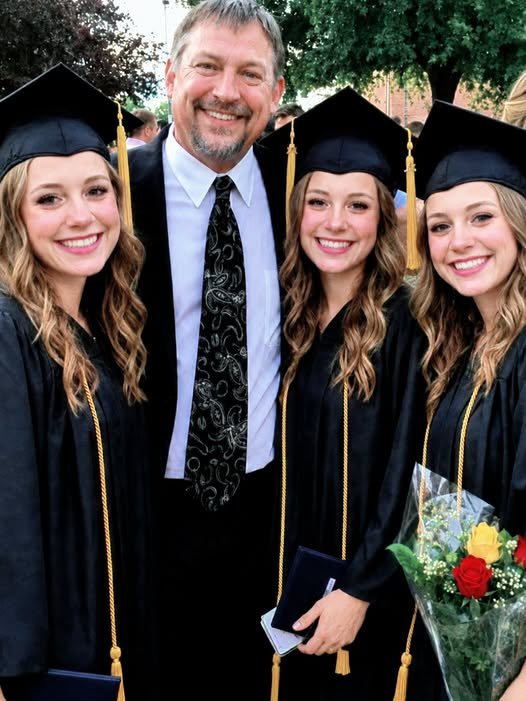
Twenty-two years ago, my brother left his six-month-old triplet daughters at my doorstep with three car seats, one diaper bag, and a handwritten note. I raised them as my own. At their college graduation, they returned to the stage one final time—and what they shared left me completely overwhelmed.
PART 1
The girls were only six months old when they arrived.
Three little babies.
Three car seats.
One diaper bag.
And one note scribbled across the back of a gas-station receipt.
I’m sorry, Noah.
I can’t do this.
That was all my brother Daniel left me.
Their mother, Leah, had passed away eleven days earlier after a sudden illness. Daniel had tried to manage on his own for less than two weeks. Then, sometime before sunrise on a cold October morning, he carried his daughters up the narrow stairs to my apartment, placed them outside my door, knocked once, and disappeared.
I didn’t see his car pull away.
I didn’t even know he had been there until Ava started crying.
I was twenty-seven years old. I was single, living in a cramped one-bedroom apartment above Parker’s Hardware in the small Ohio town where Daniel and I had grown up. I had $312 in my bank account, a refrigerator containing mustard, eggs, and half a meatloaf, and absolutely no idea how to care for one baby—much less three.
For several minutes, I simply stood in the hallway in my work socks, staring at them.
One baby was crying. One was kicking both feet against the blanket. The smallest one, June, watched me with solemn gray eyes as if she were waiting to see what kind of man I would turn out to be.
My neighbor, Mrs. Alvarez, opened her door across the hall. She took in the car seats, the diaper bag, and my terrified face.
“Noah,” she whispered, “please tell me those babies are only visiting.”
I handed her the note.
She read it twice, then looked at me with tears in her eyes.
“You can’t raise triplets by yourself.”
She wasn’t being cruel. She was seventy years old, had raised four children, and understood exactly what three infants would require. She was probably right.
I knew I had to call the authorities. I knew there would be social workers, paperwork, home inspections, and questions I couldn’t answer. I knew the girls might be placed with people who had bigger houses, more money, and actual experience.
Then June reached through the straps of her car seat and curled her tiny hand around my finger.
That settled one thing in my heart, even if it settled nothing legally.
Whatever came next, I would not let those girls face it alone.
Mrs. Alvarez showed me how to warm a bottle while I called the county’s child services office. A caseworker named Denise Coleman arrived before noon. She examined the babies, checked the apartment, took Daniel’s note, and asked me a long list of questions.
Did I have a criminal record? No.
Did I use drugs? No.
Did I have reliable employment? Yes, though my paycheck wasn’t impressive.
Did I understand what I was volunteering for?
I looked at three babies who had managed to dirty every outfit in the diaper bag before lunchtime.
“Not even a little,” I admitted. “But I want to learn.”
Denise’s expression softened.
Emergency kinship placement was approved for seventy-two hours. Then it became two weeks. Then thirty days. Every extension brought another inspection, another form, and another chance that someone might decide I wasn’t enough.
My apartment didn’t have room for three cribs. Mr. Parker, who owned the hardware store, cleared out an unused office downstairs and helped me move into a small rental house his sister owned. Mrs. Alvarez organized a collection at her church. People brought baby clothes, a changing table, cans of formula, and three used cribs that did not match.
I learned very quickly that pride was a luxury I could no longer afford.
If someone offered diapers, I said thank you.
If someone offered an hour of babysitting, I said thank you twice.
If someone offered advice, I listened—even when three people gave me three completely different answers.

PART 2
The first months passed in a blur of bottles, laundry, and exhaustion. I put colored dots on everything because I kept mixing up their belongings: red for Ava, blue for Claire, and yellow for June.
Ava was loud and determined to be held. Claire smiled at anyone who leaned over her crib. June studied every new face before deciding whether that person deserved her attention.
Some nights, I sat on the kitchen floor at two in the morning with a baby against my shoulder and wondered whether love would be enough. It could not pay the heating bill or tell me whether a fever was dangerous. But it made me ask for help, attend parenting classes, trade my old pickup for a dented minivan, and get up every time one of them cried.
Daniel never called.
The police tried to locate him. Denise checked every address we had. I called old friends, former coworkers, and distant relatives. For months, I jumped whenever the phone rang after dark. Part of me was angry enough to shout at him. Another part hoped he would come home ready to be their father.
He did neither.
After almost three years of temporary hearings and uncertainty, a judge approved my adoption petition.
I remember sitting in the courtroom with the girls in matching yellow dresses Mrs. Alvarez had sewn. Ava swung her feet beneath the chair. Claire whispered questions during every quiet moment. June stared at the judge as seriously as if she planned to review his decision herself.
“Mr. Harper,” the judge said, “do you understand that adoption creates a permanent legal responsibility?”
“Yes, Your Honor.”
“And you accept that responsibility for all three children?”
I looked at my girls.
“I already have,” I said.
The judge smiled.
That afternoon, I took them to a diner and ordered one piece of chocolate pie with four forks. It was all I could afford after paying the last legal fee.
It remains the best celebration of my life.
In the beginning, I was Uncle Noah.
I never asked them to call me anything else. I kept pictures of Leah in the living room and told them stories about the mother who had loved them fiercely during the short time she had with them. I wanted them to know that becoming my daughters did not require erasing where they came from.
Somewhere along the journey, however, I became Dad.
The first time it happened, Claire was four. She fell from the bottom rung of a playground ladder and scraped her knee. I ran toward her, expecting to hear “Uncle Noah.”
Instead, she threw both arms around my neck and cried, “Daddy!”
The word hit me so hard I nearly sat down in the mulch.
That evening, Ava tried it too, mostly because Claire had. June waited another two weeks. She never copied anyone until she was certain the idea was her own.
One night, as I tucked her into bed, she touched my cheek and said, “Good night, Dad.”
Then she rolled over as if nothing important had happened.
I stood in the hallway afterward and cried into a clean dish towel because it was the closest thing I could grab.
PART 3
For the next eighteen years, I did the ordinary work of raising children.
I packed school lunches, often putting the wrong sandwich in the wrong bag. I ruined dinners and called them experiments. I learned to braid hair from a library book, though my braids always leaned strangely to one side.
I worked extra shifts at the hardware store and repaired lawn mowers in our garage on weekends. I stayed awake through fevers, applauded too loudly at school plays, and once built three solar-system models because the girls all remembered the same assignment on the same Sunday night.
I attended parent-teacher conferences carrying a notebook divided into three sections. Teachers often started by saying, “The girls look so much alike,” and ended by admitting they could not have been more different.
Ava felt everything deeply. She cried over injured birds, sad movies, and other people’s bad days. By middle school, she was the student sitting beside the new girl at lunch.
Claire could make anyone laugh. She sang while washing dishes, danced in grocery-store aisles, and turned every family story into a performance.
June was quiet, observant, and stubborn in a way that would either make her a judge or the most difficult person ever called for jury duty. If she believed something was unfair, she could argue for an hour and come back the next morning with written notes.
They shared a birthday and a face, but never a personality.
There were hard years too.
When they were eight, a classmate asked why they did not have a mother. Ava came home crying. Claire announced that she had told the boy to mind his own business. June wanted a precise definition of abandonment.
I sat with them at the kitchen table and told them the truth in words children could carry.
Their mother had died. Their biological father had been overwhelmed by grief and responsibility, and he had left. I did not call Daniel a monster, though there were nights when I had thought much worse. I told them his decision was about his inability to stay, not their worthiness of being loved.
“Did he not want us?” Ava asked.
“I can’t tell you what was in his heart,” I said. “I can only tell you what he did. And I can tell you that I wanted you. I still do. Every day.”
June studied me across the table.
“Even when Claire put a sock in the toilet?”
“Even then.”
“A whole sock?” Claire asked, offended. “It was a doll sweater.”
That ended the serious conversation because all four of us started laughing.
When the girls were sixteen, Denise—who had stayed in touch long after the adoption—called me with news. Daniel had passed away in another state after years of moving from place to place. There would be no reunion and no final explanation.
I told the girls together.
They reacted differently, as they always did. Ava cried for the father she had never known. Claire became very quiet. June asked to be alone and then spent the evening looking through the small box of family photographs I had saved.
Their grief was complicated. They did not miss memories of Daniel; they mourned the possibility that someday he might have explained himself.
I could not give them that answer.
All I could do was sit nearby while they learned to live without it.
The teenage years tested all four of us.
For a while, apparently, everything about me was embarrassing—my old minivan, my work boots, my jokes, and especially the way I waved both arms when I spotted them at school events.
Once, Claire asked me to drop her off a block away from a dance.
“Why?” I asked. “Is the front entrance broken?”
“Dad, please.”
I understood two years later when, without asking, she invited me inside to take pictures before prom.
There were arguments over curfews, grades, messy bedrooms, and one disastrous haircut June gave herself after watching an online tutorial. There were also late-night talks at the kitchen counter, Saturday pancakes shaped like unrecognizable animals, and four names written in wet cement beside the garage.
I missed vacations. I declined invitations to weddings when I could not afford travel or childcare. I never built another family somewhere else—not because anyone forced me to sacrifice my life, and not because I considered myself noble.
The truth was simpler.
Those girls were already my family.

PART 4
By the time college applications arrived, I had saved what I could, but it was not enough for three tuition bills. The girls applied for grants, worked summers, and chose the same affordable in-state school: Lakeview State University. I worried they were afraid to separate, but June insisted they could build three different lives at the same school—and survive on the same instant noodles.
Ava studied social work. Claire entered the nursing program. June chose public policy and spent so much time arguing with professors that one of them recruited her as a research assistant.
Their campus was only two hours from home, but the house felt impossibly quiet. For the first month, I still bought four bananas at the grocery store. Letting children grow is a strange kind of success: you teach them to walk away with confidence, then stand in the doorway wondering why the room is so still.
During their senior year, they began asking unusual questions.
Ava wanted to know the name of the caseworker who had approved the first emergency placement. Claire asked how much three cans of formula had cost in 2004. June wanted copies of the adoption records.
I assumed they were putting together one of their school projects. They had recently created a campus volunteer program connecting students with local grandparents, aunts, uncles, and siblings who were unexpectedly raising children. They called it One More Chair because, as Ava explained, “Every family should be able to pull up one more chair when a child needs a place to belong.”
The program offered babysitting hours, rides to appointments, donated supplies, and help finding county resources. What began as a class assignment had already assisted thirty-seven local families.
I was proud, but I did not realize how personal their final presentation would become.
Three weeks before graduation, I gave June the key to the fireproof box in my closet. Their original birth certificates and adoption papers were inside, and she needed copies for an application.
I had forgotten that Daniel’s note was there too.
I had asked the county to return it after the adoption. I kept it not because I wanted the girls to see it, but because throwing it away felt like destroying part of the truth. For twenty-two years, it remained folded between the court order and their mother’s death certificate.
The girls found more than the note.
They found my first household budget, written on a yellow legal pad. The numbers did not come close to working. Rent. Heat. Formula. Diapers. Day care. Underneath the total, in my twenty-seven-year-old handwriting, I had written three words and underlined them twice:
Keep girls together.
They found the receipt from the three mismatched cribs. They found the adoption-day diner bill. They found every school picture and the handmade Father’s Day cards I could never bring myself to discard.
They put everything back exactly as they had found it.
And they said nothing to me.
Graduation morning arrived bright and windy.
I wore the only suit I owned, the same navy one I had worn to three high school graduations four years earlier. It fit a little tighter around the middle. My beard had gone mostly gray, my right knee complained about every staircase, and my camera was so old that Claire had once asked whether it used film.
But I carried more pride than I knew how to contain.
I arrived ninety minutes early and took a seat in Section C, Row 8. Mr. Parker sat beside me. He had retired years earlier but insisted on coming because, as he put it, he had been there when the “three-baby emergency” began.
One by one, my daughters crossed the stage.
Ava cried before the dean finished announcing her name.
Claire accepted her diploma, found me in the crowd, and waved with both arms—the same embarrassing wave she had once begged me never to use.
June wore the serious expression she had carried since childhood, but I saw her chin tremble when she looked toward us.
I took blurry photographs of all three.
PART 5
When the final student sat down, the audience began gathering purses and folding programs. I assumed the ceremony was over.
Then Dean Holloway returned to the microphone.
“Before we conclude,” she said, “we have one final presentation from this year’s recipients of the Lakeview Community Impact Award.”
The girls walked back onto the stage side by side.
My first thought was that they had forgotten something.
Then June picked up the microphone.
“Our father couldn’t be here today,” she said softly.
A deep silence settled across the room.
My chest tightened. I knew she meant Daniel.
Ava reached inside her graduation gown and pulled out an old, folded piece of paper.
Even from Row 8, I recognized it.
Claire covered her mouth, already crying.
June looked straight at me.
“Three weeks ago, we found what he left behind.”
She unfolded the gas receipt and began to read.
“I’m sorry, Noah. I can’t do this.”
Before she could finish, my knees gave way beneath me.
Mr. Parker caught my elbow and guided me back into my chair. Around us, people turned, trying to understand why the gray-bearded man with the cheap camera could no longer stand.
June waited until I looked at her again.
“Twenty-two years ago,” she continued, “one man wrote that he couldn’t do it. Another man opened his door and did it anyway.”
Ava stepped toward the microphone.
“He did it when he had three hundred and twelve dollars, one bedroom, and no idea how to change a diaper.”
Laughter moved gently through the crowd.
“He did it through three babies with fevers, three first days of school, three sets of braces, three learner’s permits, and more school projects than any one parent should ever have to survive.”
Claire took her turn.
“He tells people he raised us. That isn’t the whole truth. He protected our connection to the mother we lost. He never taught us to hate the father who left. He taught us that another person’s failure to stay does not make you unworthy of love.”
I covered my face.
For years, I had wondered whether I had said the right things. I had worried that every answer I could not give had left another small crack in their hearts. Hearing Claire speak, I realized they had understood more than I knew.
June held up the yellow legal pad they had found in the box.
“This was our dad’s first budget,” she said. “It is the worst budget I have ever seen.”
The audience laughed again.
“The numbers were impossible. But at the bottom he wrote, ‘Keep girls together.’ Those were the first instructions he gave himself as our father. He followed them for twenty-two years.”
Behind them, the large screen changed.
There I was at twenty-seven, asleep upright on a couch with Ava on my chest and Claire tucked against my side while June glared at the camera from a baby seat.
The next photograph showed three crooked braids on the girls’ first day of kindergarten.
Then came Halloween costumes I had sewn badly, birthday cakes that leaned, science fairs, scraped knees, school dances, and a picture of four hands pressed into the cement beside our garage.
The final image was not a photograph.
It was the logo for One More Chair.
Ava explained that the university and a local family foundation had agreed to continue the program after the girls graduated. It would provide practical support to relatives who suddenly found themselves raising children—people standing at their own doorways, frightened and unprepared, with no idea what to do next.
Then Claire announced that the program’s annual emergency assistance grant would carry a new name.
The Noah Harper Open Door Grant.
“Dad,” she said, her voice breaking, “you once believed you had to do everything alone. We created this so the next Noah won’t have to.”
By then, I was crying too hard to care who saw me.
Dean Holloway invited me to the stage.

PART 6
The walk from Section C felt longer than the previous twenty-two years. Mr. Parker came with me as far as the aisle, then squeezed my shoulder and let me go.
My knee hurt. My vision blurred. The audience rose, row by row, but all I could see were my three girls waiting beneath the university seal.
Ava reached me first and wrapped both arms around my neck.
Claire joined us from the other side.
June tried to maintain her serious expression for about two seconds before collapsing into the hug.
For a moment, we stood exactly as we had so many times in our little kitchen—four people holding one another up.
The dean handed me a framed copy of the grant announcement and asked whether I wanted to say something.
I had not prepared a speech. I could barely remember my own name.
I looked at the note still resting in June’s hand.
For years, I had thought that scrap of paper marked the moment my brother destroyed a family. Standing on that stage, I understood that it also marked the moment another family began.
I leaned toward the microphone.
“People have sometimes told me I gave up my life for these girls,” I said. “They’re wrong. I didn’t give up a life. Ava, Claire, and June became my life—and they gave me more than I ever could have given them.”
I turned to my daughters.
“That old note says, ‘I can’t do this.’ But the truth is, I couldn’t have done any of it without you. We raised one another.”
June finally began to cry.
The crowd stood again, but the applause sounded far away.
After the ceremony, we took pictures beneath an oak tree outside the auditorium. Ava insisted on checking every photograph. Claire made the dean laugh. June carefully refolded the gas receipt and placed it in my hand.
“Do you want to keep it?” she asked.
I looked down at the words that had once frightened me more than anything in the world.
“I think it belongs with the program now,” I said. “Not as a story about someone leaving. As a reminder of what can happen when someone stays.”
That evening, we returned to our house in Maplewood. Mrs. Alvarez’s children brought her from the assisted-living center, and Mr. Parker carried in enough food for half the town. Denise came with her husband and cried the moment she saw the girls in their graduation gowns.
At some point, Ava disappeared into the kitchen and returned with a chocolate pie.
She placed it in the middle of the table with four forks.
“For adoption day,” she said.
We ate directly from the pie plate, just as we had nineteen years earlier.
Later, after everyone left, I stood alone in the quiet living room. Three framed diplomas rested against the wall. Three graduation gowns hung over chairs. On the coffee table lay the announcement for a program that would carry our family’s story into homes we might never see.
I thought about the morning Daniel knocked on my door.
For a long time, I believed the most important moment was June wrapping her hand around my finger. I believed that was when I chose them.
But raising children taught me that family is not created by one grand decision.
It is created by thousands of small ones.
It is getting up at two in the morning.
It is learning three different ways to listen.
It is saying no when no is needed, apologizing when you are wrong, and showing up again the next day.
It is making room at the table even when the numbers do not work.
It is staying.
My brother left me three car seats, one diaper bag, and a note saying he could not do it.
Twenty-two years later, my daughters gave me three diplomas to frame, an open door for other families, and a truth I would carry for the rest of my life.
I had never raised those girls alone.
They had been holding on to me from the very beginning.