
Part 1 — The Room That Stayed Ready
Three weeks after I buried my newborn son, his nursery still looked as though he might arrive at any moment.
Morning light slipped through the blinds and stretched across the pale rug. Tiny clothes sat folded in perfect stacks on the changing table. Packages of diapers remained sealed beneath it. A stuffed giraffe leaned against the side of the crib.
And the crib itself had never been slept in.
I stood in the doorway, gripping the frame with one hand.
Some mornings I couldn’t bring myself to enter.
Other mornings I couldn’t make myself leave.
His name was Noah.
For months, I had imagined carrying him into that room. I pictured late-night feedings in the rocking chair, sleepy mornings, tiny socks disappearing in the laundry, and Thomas complaining jokingly about how one baby could somehow require so much equipment.
We had prepared for everything.
Everything except coming home without him.
Thomas had been struggling too, although grief had changed us in opposite ways.
I wanted to remain close to every reminder of Noah.
Thomas wanted every reminder gone.
A week earlier, I had walked into our bedroom and found an open suitcase on the bed.
He was folding shirts into it.
For several seconds I just stared.
“You’re leaving?”
Thomas stopped, but he didn’t turn around immediately.
“I can’t do this anymore, Kate.”
“Do what?”
“Live here.”
His voice sounded exhausted rather than angry.
He finally looked at me.
“Every time I walk down that hallway, I see that nursery door. Every time I see it, I think about him.”
“He was your son.”
“I know.”
“Then how can you walk away?”
His jaw tightened.
“Because he was my son.”
The answer knocked the air out of me.
Thomas dragged a hand across his face.
“I asked you weeks ago if we could put the nursery away.”
“And I told you I’m not ready.”
“When will you be ready?”
“I don’t know.”
“That’s the problem.”
He looked toward the hallway.
“We built an entire room for a baby who’s never going to use it, and now we’re both pretending that leaving everything untouched somehow keeps us close to him.”
“I’m not pretending anything.”
“Then what are you doing?”
“Surviving.”
The word came out sharper than I’d intended.
Thomas sighed.
“Kate, this house is swallowing us.”
“No. You’re choosing to leave.”
“Maybe because I don’t know how else to breathe here.”
I wrapped my arms around myself.
“Do you think I know how?”
His expression softened for only a moment.
Then he closed the suitcase.
“I called someone about putting the house on the market.”
My head snapped up.
“You did what?”
“We can’t keep living like this.”
“I’m not selling Noah’s home.”
“It’s our home.”
“Then why are you abandoning it?”
Thomas picked up the suitcase.
“I’ll come back next week for the rest of my things.”
“You can’t make this decision for me!”
He paused at the bedroom door but never turned around.
Then he walked out.
A moment later, the front door closed.
Not dramatically.
Not loudly.
Just one quiet click.
Somehow that made it worse.
I went straight to Noah’s nursery.
For the first time that day, I stepped inside.
I sat on the carpet beside the crib and rested my forehead against its wooden railing.
“I’m sorry,” I whispered.
My voice disappeared into the room.
“I would’ve given anything to bring you home.”
Above me, the little mobile slowly turned in the air from the heating vent.
That evening, I ate crackers over the kitchen sink because cooking felt pointless.
My mother called three times.
I ignored every call.
I left the television dark.
When I finally went upstairs, I slept on Thomas’s side of the bed because mine still carried too many memories of pregnancy—of lying awake with my hands over my stomach, feeling Noah move beneath them.
But sleep never came.
Neither did tears.
Grief had moved beyond crying.
It had become silence.

Part 2 — The Mother Outside the Grocery Store
A few days later, I visited the cemetery.
Afterward, I couldn’t bring myself to drive directly home.
The house felt too quiet.
So I took the long way through town, passing restaurants, pharmacies, and a crowded shopping center.
That’s when I noticed her.
A young woman was sitting outside a grocery store near the curb.
Beside her rested a handwritten cardboard sign.
I couldn’t read all the words from the road, but I understood enough.
She needed help.
A tiny baby slept against her chest in an old carrier. One of its straps looked frayed near the buckle.
I drove past.
Then stopped.
For reasons I couldn’t explain, I pulled into the parking lot and parked several rows away.
I stayed inside my car.
And watched.
People entered the store carrying reusable bags and shopping lists.
People came out pushing carts overflowing with groceries.
Some glanced at the young mother.
Most didn’t.
She never approached anyone.
She simply sat there, occasionally adjusting the blanket around the baby.
At one point, she kissed the top of his head.
Something inside me cracked.
I thought about Noah’s closet.
His stroller.
His blankets.
His untouched clothes.
All those things had been purchased with love.
Now they were trapped inside a room I could barely enter.
I drove away.
Halfway home, I already knew what I was going to do.
The knowledge terrified me.
When I reached the house, I walked past the nursery several times.
On the seventh pass, I stopped.
My hand rested on the doorknob.
“This isn’t giving him away,” I whispered to myself.
But part of me felt exactly as though it were.
I opened the door.
The familiar scent of baby detergent still lingered faintly in the room.
I walked to the rocking chair and placed my hands on its back.
“You’re not coming home, sweetheart.”
My throat tightened.
I stared at the empty crib.
“I’ve been keeping everything ready because I didn’t know what else to do.”
Tears finally gathered in my eyes.
“But there was another baby today.”
I swallowed.
“He needs these things.”
For several seconds, I couldn’t continue.
Then I whispered, “Maybe your things can take care of him the way I wanted them to take care of you.”
That was enough.
I started packing.
The unopened diapers went first.
Then blankets.
Bottles.
Several packages of onesies.
The stroller Thomas and I had once assembled in the hallway just to practice folding it correctly.
I kept two things.
The knitted hat my mother had made.
And the little dinosaur outfit Noah had worn in the hospital.
Everything else went into my car.
My hands shook the entire time.
But strangely, with every bag I carried outside, the room felt a little less suffocating.
Not emptier.
Different.
As though the love inside it had finally been allowed to move.
Part 3 — Elena and Mateo
I returned to the grocery store.
The woman was still there.
She looked surprised when my car stopped beside her.
I lowered the window.
“Hi.”
Her expression became cautious.
“Hi.”
“I saw you earlier.”
She nodded but said nothing.
“I brought some baby things.”
Her eyes narrowed slightly.
“I don’t have money.”
“I don’t want money.”
I got out and opened my trunk.
She approached slowly with the baby still against her chest.
When she saw what I’d brought, she froze.
Bags filled the trunk.
The boxed stroller barely fit behind them.
She stared at everything, then looked at me.
“I can’t take all this.”
“Yes, you can.”
“No, I mean… this is too much.”
“Please.”
Something in my voice must have reached her.
She stopped arguing.
“My name is Kate,” I said.
“I’m Elena.”
Her baby stirred.
I looked at him.
“What’s his name?”
“Mateo.”
She smiled when she said it, and that smile told me everything I needed to know about how deeply she loved him.
“He’s beautiful.”
“Thank you.”
Silence stretched between us.
Then Elena glanced into the trunk again.
“Why are you doing this?”
I knew the question would come.
I still wasn’t prepared for it.
“My son was supposed to use these.”
Her face changed immediately.
I looked down at the pavement.
“His name was Noah.”
Elena didn’t interrupt.
“He didn’t get to come home from the hospital.”
The words hurt.
But saying them to a stranger felt strangely easier than saying them to people who knew me.
Maybe because she didn’t have memories of pregnant Kate.
She didn’t know the nursery plans or the baby shower or how Thomas used to talk to my stomach every evening.
She only knew the woman standing in front of her.
“I’ve kept all of this in his room,” I continued. “I thought I needed it there.”
My voice trembled.
“But today I saw you holding Mateo, and I realized these things could either stay in a room collecting dust or they could help a child.”
Elena covered her mouth.
“I’m so sorry.”
I nodded.
She looked toward Mateo.
Then back at me.
“Are you sure?”
“No.”
That surprised her.
I gave a small, broken laugh.
“I’m not sure about anything anymore.”
A tear rolled down my cheek.
“But I know I want you to have them.”
Elena’s eyes filled.
She carefully lowered Mateo’s carrier beside her and then covered her face with both hands.
Her shoulders began trembling.
She didn’t make a sound.
I understood that kind of crying.
Eventually, she lowered her hands.
“I keep promising him I’ll make things better,” she said. “Every night. I tell him this isn’t forever.”
“You don’t need everything figured out tonight.”
She looked at me.
“You’re here. You’re holding him. You’re trying. That matters.”
She wiped her cheek.
“Why did you choose me?”
“I don’t think I did.”
“What do you mean?”
“I think I just needed somewhere for all this love to go.”
Neither of us spoke for a moment.
Then Elena reached for my hand.
Her fingers closed around mine.
It was such a simple gesture.
But for the first time since Noah died, I didn’t feel like someone was looking at me as though I might shatter.
Elena simply stood there with me.
Two mothers.
Two completely different lives.
Both trying to make it through one more day.
We unloaded everything together.
She ran her fingertips across each little blanket as though it were precious.
When I pulled out the stroller, Elena laughed and cried at the same time.
“You don’t understand,” she said. “I’ve been carrying Mateo everywhere because I couldn’t afford one.”
“Then Noah’s stroller finally has somewhere to go.”
She looked at me carefully.
“I’ll tell him.”
“Tell him what?”
“About Noah.”
My breath caught.
Elena placed her hand on the stroller box.
“When Mateo is old enough, I’ll tell him another little boy gave him his first stroller.”
I turned away for a second because I couldn’t speak.
Finally, I whispered, “I’d like that.”
I drove home with an empty car.
For weeks, emptiness had frightened me.
But that evening, it felt different.
I cooked dinner.
Real dinner.
I sat at the kitchen table and ate the whole plate.
Later, I turned on the television and actually watched part of a show.
And sometime after midnight, curled beneath a blanket on the couch, I fell asleep.
For the first time since Noah died, I slept until morning.
I didn’t know that while I slept, something extraordinary was happening outside my house.

Part 4 — The Strollers
The doorbell woke me shortly after sunrise.
I opened my eyes, confused.
The blanket was twisted around my legs.
For one peaceful second, I forgot everything.
Then memory returned.
Noah.
Thomas.
The empty nursery.
The bell rang again.
I stood and walked toward the door.
I expected a package delivery or perhaps my mother arriving unannounced after days of unanswered phone calls.
I opened it.
Nobody was standing there.
Then I looked toward the yard.
My hand tightened around the doorknob.
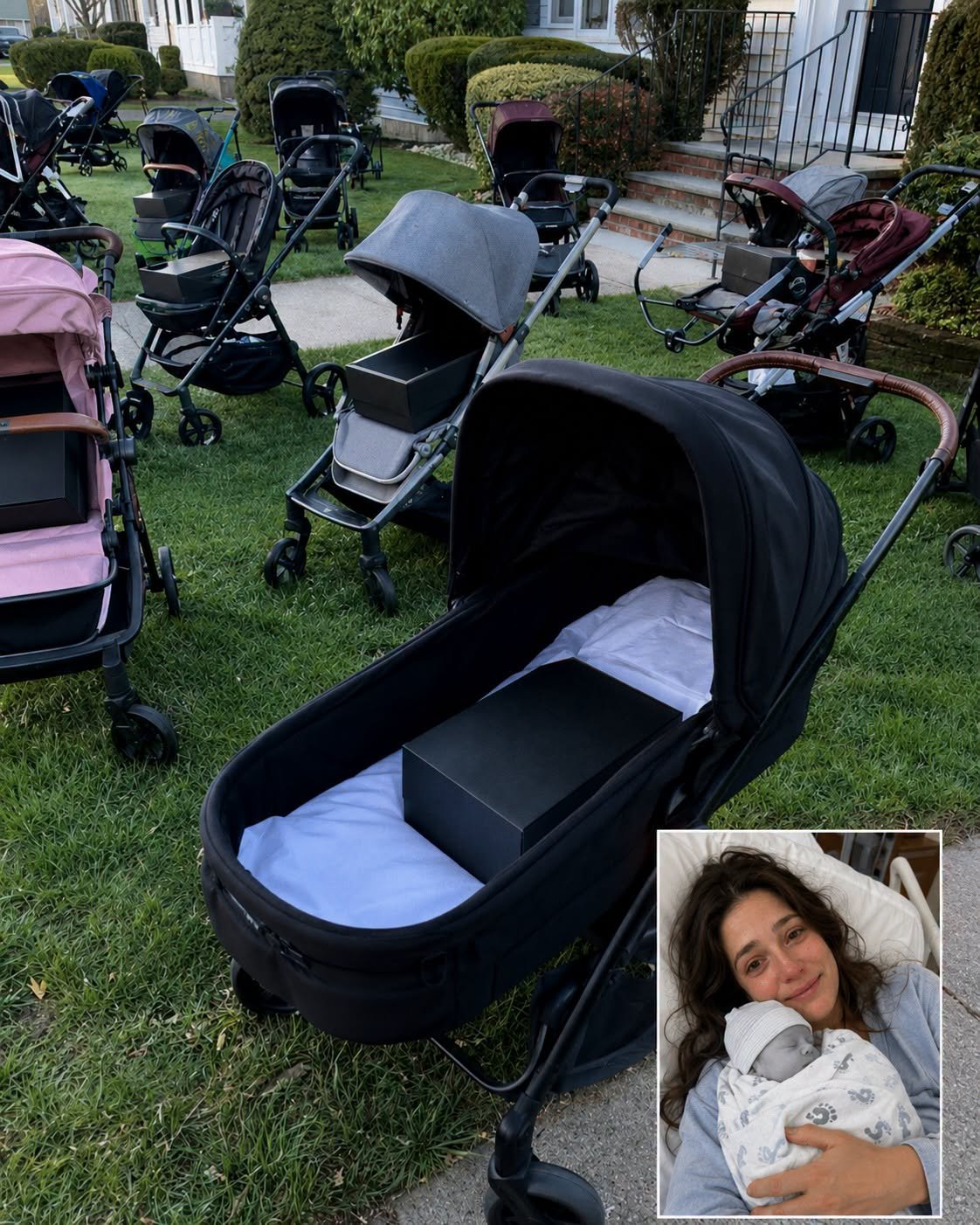
There were strollers everywhere.
For a moment, my brain refused to understand what I was seeing.
Blue strollers.
Gray strollers.
Pink ones.
Green ones.
Old-fashioned ones.
New ones.
Some looked barely used.
Others had faded fabric and worn wheels.
They stretched across the lawn in uneven rows, shining with morning dew.
Dozens of them.
I stepped onto the porch.
“What in the world…?”
No trucks.
No people.
No explanation.
Just strollers.
My heart began beating faster.
I walked slowly down the porch steps.
Then I noticed something else.
Each stroller contained a box.
Most were wrapped simply.
One held a folded blanket on top.
Another had a little stuffed elephant tied to the handle.
Near the center of the yard stood a larger black stroller with its canopy raised.
Inside was a box with an envelope resting on top.
My name was written across it.
Kate.
That frightened me enough that I stepped backward.
My hip bumped another stroller and it rolled slightly.
I grabbed the handle before it tipped.
That’s when I noticed the box inside.
I stared at it.
Then opened it.
Inside were a folded baby blanket, tiny socks, and a pacifier still inside its packaging.
Underneath them lay a handwritten note.
I unfolded it.
The letter was from a mother named Rachel.
She wrote about her daughter, Emma, who had lived for less than a day.
For years, Rachel had kept Emma’s things stored away because opening the boxes hurt too much.
Then someone told her that love didn’t have to disappear simply because the person it had been meant for was gone.
Love, the letter said, could be passed forward.
My knees weakened.
I sat down in the grass.
After several minutes, I opened the next stroller.
Another box.
Another letter.
This one came from parents who had lost a son named Owen before they ever brought him home.
The next came from parents who had once prepared for twins.
Another was from a mother who said she hadn’t opened her daughter’s closet in years.
Every stroller carried a story.
Every box had belonged to a family that understood exactly what Noah’s nursery meant to me.
By the sixth letter, I couldn’t read clearly through my tears.
But something had changed.
When I first opened the door, the strollers had looked strange.
Almost frightening.
Now they looked completely different.
They were evidence.
Evidence that I hadn’t been the only mother unable to close a nursery door.
That I wasn’t the only parent who had kept tiny clothes long after they could no longer be worn.
That grief wasn’t a private country where I was destined to live alone.
All around me were reminders of children who had been deeply loved.
And somehow that love had found its way to my lawn.
Part 5 — The People Behind the Gifts
A car door closed behind me.
I turned.
Several neighbors were standing along the sidewalk.
More cars began pulling over.
A woman in her sixties walked toward me.
“Kate?”
I wiped my face.
“Yes?”
“My name is Linda.”
She pointed to a blue stroller.
“That one is mine.”
I looked from her to the stroller.
“It belonged to my grandson,” she explained. “We kept it after we lost him. My daughter couldn’t bear to give it away.”
Another woman stepped forward.
“The pink stroller was my daughter’s.”
A man placed one hand on a green stroller.
“This belonged to my little boy.”
One by one, people came forward.
Some were couples.
Some came alone.
A few were grandparents.
Each pointed to a stroller.
Each spoke a child’s name.
And gradually I understood.
These weren’t strangers leaving random objects in my yard.
They were families.
Families carrying the same kind of love I had carried into Noah’s nursery.
I looked at Linda.
“How did you know about me?”
She smiled gently.
“Elena.”
My eyes widened.
“Elena?”
“She came to the community resource center yesterday.”
Linda folded her hands.
“She told one of the volunteers about a woman who had stopped at a grocery store and given her everything from her baby’s nursery.”
I felt my face grow warm.
“I wasn’t trying to start anything.”
“We know.”
Linda smiled.
“That’s why it mattered.”
She gestured around us.
“A number of us belong to a support group for families who’ve lost babies. When I heard what you’d done, I told the group.”
Her eyes traveled across the lawn.
“Apparently everyone had the same thought.”
I looked at the boxes.
“What thought?”
“That maybe it was time.”
She touched the handle of her stroller.
“For years I’ve told myself I was saving this because it meant something.”
Her voice softened.
“But yesterday I realized it could mean something in a different way.”
I looked around at the crowd.
“So all these things are for…?”
“Families who need them.”
My hand went to my mouth.
Linda continued.
“Some parents aren’t ready to let anything go. That’s okay. Nobody should be rushed.”
She looked at me.
“But others are ready and don’t know what to do with the things they’ve kept.”
She pointed toward the strollers.
“You gave us an answer.”
I shook my head.
“No. I only helped one person.”
“Exactly.”
Linda’s smile widened.
“One person is where these things usually begin.”
Then another car pulled up.
I recognized it immediately.
Thomas.
My stomach tightened.
He climbed out holding a manila folder.
When he saw the yard, he stopped.
His eyes moved from stroller to stroller.
Then toward the crowd.
Finally, he looked at me.
“What happened here?”
Before I could answer, Linda said quietly, “Something started.”
Thomas looked confused.
“I don’t understand.”
I almost laughed.
A week earlier, his words would have broken me.
Now I simply looked across the yard.
“No,” I said softly. “You probably don’t.”
His eyes met mine.
“I came because of the house paperwork.”
I looked at the folder.
The realtor.
The sale.
The life Thomas had already decided needed to disappear.
Then I looked back at Noah’s nursery window.
“I know.”
“Kate, we still need to talk.”
“We will.”
His expression changed.
Maybe he had expected anger.
Maybe tears.
Maybe the woman he’d left sitting beside an empty crib.
But that woman no longer felt quite as alone.
Thomas glanced around again.
“What are you going to do with all these?”
I ran my fingers across the handle of the nearest stroller.
“Give them away.”
“All of them?”
“Eventually.”
“To who?”
“To people who need them.”
He stared at me.
I looked toward the house.
“You told me this place was empty.”
Thomas didn’t respond.
I swallowed.
“I don’t think it is anymore.”
For several seconds, neither of us spoke.
Then someone called my name.
I turned.
The black stroller still waited near the center of the lawn.

Part 6 — Noah’s Strollers
Until then, I had avoided opening it.
Now the fear was gone.
I walked across the grass while everyone watched quietly.
The black envelope still rested on top.
I removed it and opened the box beneath it.
There were no clothes inside.
No bottles.
No blankets.
Only a small wooden plaque.
I lifted it carefully.
Two words had been carved into the wood.
NOAH’S STROLLERS
I stopped breathing.
Below the name was a simple message:
When one family is ready to pass something on, another family should never have to begin with nothing.
My vision blurred.
I lowered myself onto the edge of the porch steps with the plaque resting across my knees.
Inside the envelope was another letter.
It explained that the community wanted to turn what had happened into something permanent.
Every stroller on my lawn would be cleaned, checked, and passed along with the donated supplies to a family struggling to care for a baby.
Parents who were ready to donate their children’s unused things could contribute whenever they wished.
No pressure.
No deadlines.
No expectations.
Only an open door.
The project needed a name.
They had chosen Noah’s.
I read the letter twice.
Then a third time.
Behind me, I heard people quietly talking.
Some were crying.
Others were sharing stories.
One neighbor had already offered space in her garage for temporary storage.
Someone else worked for a local nonprofit and offered to help organize donations.
A father volunteered his truck.
A woman who owned a laundromat offered to wash donated blankets and baby clothes for free.
Something that had begun with one stroller was already becoming larger than any of us had planned.
I looked toward Thomas.
He stood apart from the group, the folder still beneath his arm.
His face was unreadable.
For once, I didn’t need to understand what he was thinking.
I didn’t even know what would happen between us.
Maybe our marriage could be repaired.
Maybe too much had happened.
Maybe the house would someday be sold.
Maybe I would stay.
Those answers could wait.
That morning wasn’t about Thomas.
It wasn’t even entirely about me.
It was about what remained after love had nowhere obvious to go.
For weeks, I had believed Noah’s life had been measured only by what we had lost.
The empty crib.
The clothes he never wore.
The stroller that never carried him down our street.
The future that disappeared before it had properly begun.
But standing there, surrounded by strangers who knew my grief without needing it explained, I finally saw another way to measure his life.
A mother named Elena wouldn’t have to carry Mateo everywhere because she now had a stroller.
Another baby would sleep beneath one of Noah’s blankets.
Another family would receive diapers when money was tight.
And soon dozens more families would receive the things sitting across my lawn.
Noah would never take a first step.
But somehow, because of him, other families might have an easier beginning.
I stood and carried the plaque inside.
For the first time in three weeks, I walked into Noah’s nursery without stopping in the doorway.
The room looked different.
The shelves were emptier.
The changing table was bare.
Sunlight poured across the rug.
For weeks, I’d thought removing his belongings would erase him.
Instead, I finally understood that the objects had never been Noah.
Noah was the love I’d poured into choosing them.
And love could leave a room without disappearing.
I placed the wooden plaque on the shelf beside his knitted hat and dinosaur outfit.
Then I opened the blinds completely.
Outside, people were pushing strollers across the lawn, sorting boxes and making plans.
I heard laughter.
Not careless laughter.
Not the kind that forgot what had happened.
It was the fragile laughter of people discovering they were allowed to feel something besides sorrow.
I placed one hand on the edge of the crib.
Three weeks earlier, I’d stood in that room and apologized because I couldn’t bring my son home.
Now dozens of strollers waited outside carrying his name.
I closed my eyes.
For the first time, speaking to him didn’t feel like speaking only to emptiness.
“You know what, baby?” I whispered.
Tears slipped down my cheeks, but I was smiling.
“I spent all this time waiting for you to come home.”
I looked through the nursery window at the families gathered below.
Then I touched Noah’s name on the plaque.
“I think you finally did.”