
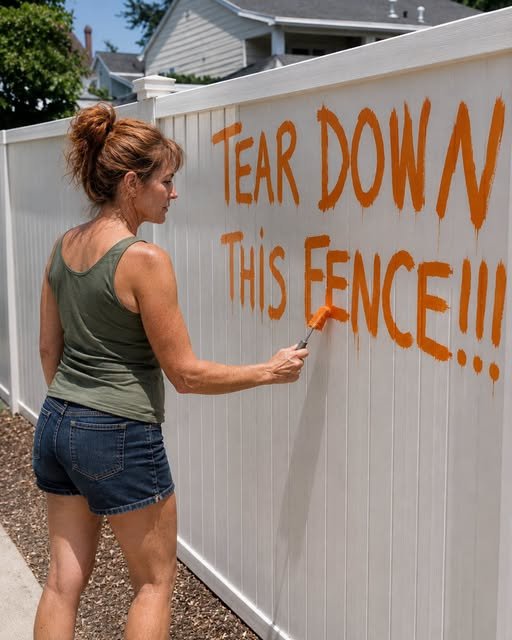
Some people will go to extraordinary lengths to prove that you are the problem, even when you have never done anything to them. My new neighbor was so determined to find fault with me that she brought the city into a disagreement that did not need to exist. She believed the inspection would embarrass me. She never imagined it would force her to face a truth about herself.
PART ONE: THE STREET BEFORE CLAIRE
I had lived in my small house for nearly five years, and I loved the quiet rhythm of the street. It was not glamorous, but it felt safe. People waved while walking their dogs, brought one another’s packages inside during vacations, and traded cookies over the fences in December. Most of us knew when to offer help and when to leave each other alone. Nobody went searching for reasons to make a neighbor’s day harder.
That peace began to thin the afternoon a moving truck stopped across from my driveway. The woman supervising the move had carefully styled blonde hair, enormous sunglasses, and a clipboard held against her chest. She directed the movers with quick gestures, correcting the placement of every box as though the entire operation depended on her approval.
I was watering the flowers on my porch when I gave her a friendly wave. She glanced in my direction, then looked away without returning it. I told myself she was busy or tired. I had no reason, at that point, to assume anything worse.
Three days later, I learned how quickly a small comment can change the feeling of a place. I was rolling my trash cans back toward the garage after collection when I heard someone clear her throat behind me.
I turned and found the new neighbor standing with her arms folded, staring at the cans instead of at me.
“Hi,” I said.
“Those should not be left where everyone can see them,” she replied. “They make the whole street look untidy.”
I looked at the cans, then at the neighboring driveways. Every home on the block kept its containers beside the garage until the end of the day. Still, I kept my voice calm.
“I usually put them away after dinner.”
She gave a small shrug. “Some people care about the appearance of their property more than others.”
Then she crossed the street and left me standing beside two perfectly ordinary trash cans. I was offended, but the absurdity of the exchange made me laugh. Surely no one could build a lasting feud out of something so harmless.
I was wrong about that.
A few days later, Claire – that was her name – knocked on my door. I had been sitting beneath the porch awning with a book while the wind chimes my grandmother had given me moved in the breeze. Their soft notes always carried me back to her farmhouse, to peach pies cooling on the counter and afternoons when she reminded me that a home should contain at least one thing that made you smile.
“Those chimes are too loud,” Claire said after introducing herself.
I glanced at them. The air had gone still, and they were completely silent. “They only make noise when the wind moves them.”
She sighed. “I prefer peace and quiet.”
I nearly pointed out the contradiction, but I could already sense that correcting her would only prolong the conversation. I told her I would keep it in mind. She nodded once and walked away.
After that, I began seeing her everywhere. She watched while I trimmed the hedges, watched while I washed my car, and watched from her driveway whenever I sat outside with coffee. At first, I tried to ignore it. Then the feeling of being observed followed me into my own yard.
One Saturday, as I planted flowers beneath the front window, Claire stopped beside the fence that had been there since long before I bought the house.
“That fence looks a little too tall,” she said.
I brushed soil from my gloves. “It has been here for years, but thank you for mentioning it.”
She rolled her eyes, muttered something I could not make out, and walked away. I watched her go, then returned to my flowers. I hoped the matter would end there. But some people do not let a disagreement disappear when they can turn it into a mission.
PART TWO: THE NOTICE
The following Monday was exhausting. By the time I reached home, I wanted nothing more than a hot shower and the leftovers waiting in my refrigerator. Instead, I found a bright orange notice fastened to my mailbox.
My hands went cold as I pulled it free. I read the page once, then again, hoping the words would change. They did not. A formal complaint had been filed with the city claiming that my fence stood two inches above the permitted height. An inspector would be coming to measure it.
I looked across the street. Claire’s curtains shifted, just slightly. Someone was watching me, and I did not need to guess who had made the report.
Anger rose first. I had never threatened her, insulted her, or interfered with her property. I had welcomed her when she moved in and answered each of her complaints with more patience than she had shown me. Yet she had apparently decided that my existence was a problem that needed to be corrected.
I carried the notice inside and covered the dining table with paperwork: the survey from the day I bought the house, the old inspection report, the property disclosure forms, and the permit records the previous owner had left behind. Every document suggested that the fence had been installed legally and had stood in the same place for years.
Even with the evidence spread in front of me, I slept badly. Official letters have a way of making ordinary people feel guilty before anyone has proved they did anything wrong. I kept imagining the cost of replacing the fence, the disruption, and the humiliation of having the entire street watch me take it apart.
The next morning, Claire stood in her driveway with a coffee mug. When she saw me, satisfaction warmed her smile.
“Rules are rules,” she called. “Maybe next time you will think before breaking them.”
I did not answer. Arguing with someone who had already written the ending in her head would not help me. I went inside, but her words followed me through the day.
At work, I reread the notice between tasks. What if the fence had been altered before I purchased the property? What if the regulations had changed? What if I really was about to lose thousands of dollars over a problem I had never known existed? The uncertainty was more exhausting than the complaint itself.
My friend Jenna noticed that I barely touched my lunch. When I told her what happened, she stared at me in disbelief.
“Someone reported your fence?” she asked.
“Apparently.”
Jenna shook her head. “Some people need better hobbies. Keep every document, and photograph the fence before the inspector arrives.”
That evening, I followed her advice. I photographed every post, panel, gate, and corner. While I was working, Emily from down the block stopped to ask why I was measuring and taking pictures.
When I explained, she frowned toward Claire’s house. “That fence has been there for as long as I can remember. No one has ever complained about it.”
Her support eased some of the pressure in my chest. It also made me realize that the dispute was no longer invisible. Claire had tried to make it a private accusation, but the city notice had turned it into something the whole street could see.
I kept telling myself that facts would settle the matter. Still, as Thursday approached, I felt as though I were waiting for a judgment.

PART THREE: THE MEASUREMENT
At a few minutes before nine on Thursday morning, a white city truck pulled up in front of my house. A tall man stepped out carrying a measuring wheel, a clipboard, and a small case of tools. He introduced himself as Greg and spoke with the calm courtesy of someone who had seen many neighborhood disputes.
“Good morning, Mia. We will try to make this quick.”
“I appreciate that,” I said, though my voice sounded tighter than I wanted.
Before Greg reached the fence, Claire’s front door opened. She emerged with another cup of coffee, as though she had taken the day off specifically to witness my defeat. She leaned against her mailbox with her arms crossed and wore the same confident expression she had shown me all week.
Greg measured one section, recorded the result, and moved to the next. Claire watched every motion. After a few minutes, she called across the yard.
“Well? Is it over the limit?”
Greg did not look up. He checked each panel, gate, and corner, then compared his measurements with the city’s records. Claire asked again. He continued working. Her impatience became so obvious that Emily stepped onto her porch, and Howard paused beside his mailbox to watch.
I stood quietly near the gate, trying not to let my fear show. I had prepared myself for an argument, but there was nothing to argue about. Either the fence was legal or it was not. All I could do was wait for the number.
At last, Greg closed his notebook and turned to me.
“Everything here is compliant,” he said. “There is no violation. In fact, the fence is two inches below the maximum height.”
For one suspended second, I could not move. Then relief passed through me so quickly that my knees weakened. I had been carrying the fear of that notice for days, and suddenly there was nowhere for it to go.
Across the street, Claire’s smile vanished. The confident woman with the coffee and folded arms seemed to disappear, leaving someone startled and unprepared beneath her perfectly arranged exterior.
I expected Greg to pack up and leave. Instead, he glanced toward Claire’s property.
“There is one other thing I would like to check,” he said. “I noticed something near the shared boundary while I was confirming the fence line.”
Claire straightened. “My property was not the subject of the complaint.”
“I understand,” Greg replied. “But an inspection can reveal a separate issue, especially when the properties share a boundary.”
The color drained from Claire’s face. She tried to laugh, but the sound was thin and uncertain. After a long pause, she stepped aside and told him he could look.
I followed several paces behind. Claire glanced at me sharply.
“You do not need to come.”
“Mia can remain,” Greg said. “If the boundary has been crossed, it could affect her property as well.”
For the first time, Claire had no reply. She pressed her lips together and watched Greg walk toward the front corner of her yard.
PART FOUR: THE LINE SHE HAD CROSSED
Claire’s front yard had been newly landscaped. The flower beds curved in graceful shapes, bordered by pale decorative stones. Fresh shrubs filled the spaces beneath the windows, and a new irrigation line disappeared beneath the soil. I had admired the work when it was installed. It looked expensive, polished, and carefully planned.
Now Greg crouched beside the shrubs and studied several metal survey markers set into the ground. He compared them with the parcel diagram on his clipboard, then measured from the sidewalk to the first marker. After that, he measured toward the stone border.
“What exactly are you checking?” Claire asked.
“The recorded property line and the survey markers.”
“And?”
“They do not match the edge of your landscaping.”
Claire forced a smile. “I hired professionals.”
“I am sure you did,” Greg said. “That does not change where the legal boundary is.”
He continued measuring until he reached the stone border. Then he stood and pointed toward a marker near the edge of the lawn.
“The property line runs here,” he said. He pointed again, nearly three feet away. “The border is here.”
Claire’s expression hardened. “That is impossible. Those markers must be wrong.”
Greg checked the diagram again. “The markers match the city’s parcel map and the original subdivision survey.”
He walked the edge of the flower bed, making notes as he went. His voice stayed measured, but each sentence landed with greater force.
“The stone border, several shrubs, and part of the irrigation line extend into the city easement. At the widest point, the improvements reach about thirty inches beyond your legal boundary. A portion also crosses onto Mia’s lot.”
Claire stared at him as though he had accused her of stealing the house itself. Then she turned toward me.
“Your yard is not part of mine.”
“I did not know anything about this,” I said.
“That is convenient.”
I looked at the survey in Greg’s hand and then at the flower bed. The border seemed so permanent that my eyes refused to accept the space between the marker and the stones. We pass over invisible boundaries every day without noticing them. Sometimes the only thing that reveals them is a line on a piece of paper.
Claire’s voice rose. She insisted that the contractor must have measured incorrectly. She accused someone of moving the markers and finally suggested that I might have done it myself.
“You moved them,” she said.
I let out a short, disbelieving laugh. “You think I dug up survey markers that have been fixed in the ground for years?”
“You could have.”
Greg turned toward her, and the warmth left his expression.
“Unsupported accusations will not change the measurements, Claire. Please stop.”
By then, more neighbors had come outside. Howard stood by his mailbox. Emily had stopped watering her roses. Lila, who had been walking down the block, paused at the edge of the sidewalk. They had all heard Claire criticize my fence. Now they were watching the same complaint expose a problem in her own yard.
Greg explained that the city would issue a corrective notice. The stone border, landscaping, and irrigation installed beyond the legal boundary would have to be removed or moved. Claire would have thirty days to comply, with appeal instructions included in the paperwork.
Claire’s eyes widened. “Removed?”
“Yes.”
“But I just paid for all of this.”
“I understand. You should contact the contractor and review the appeal process.”
She looked down at the flower beds, and the anger drained out of her face. What remained was panic. Her eyes filled before she could turn away. She stood beside the carefully arranged yard, clutching the notice in both hands while tears gathered and slipped down her cheeks.
The sight did not make me feel victorious. It made the entire morning feel heavier. I had wanted the truth to be known, not to watch another person break down in front of the neighbors.
“You must be happy,” Claire whispered.
“No,” I answered. “I never wanted this. I wanted a neighbor, not an enemy.”
She lowered her eyes. Greg gave her the paperwork, repeated the deadline, and returned to his truck. The neighbors slowly went back inside, leaving Claire alone with the notice and the consequences of the complaint she had filed.

PART FIVE: WHAT THE STREET SAW
The repairs began the next week. Contractors arrived almost every morning, and the work continued for nearly a month. The pale stone border disappeared first. Then the shrubs were dug up and replanted within the proper line. Finally, the irrigation system was adjusted so that every part of it stayed on Claire’s property.
Everyone saw it happen. The neighbors who had watched her point at my fence now watched her yard being taken apart and rebuilt. Yet no one mocked her. No one stood in the street to celebrate. They did not need to. The quiet facts were enough.
My own fence remained exactly where it had always been. It was not too high. It had not threatened anyone. The city had measured it, recorded the result, and moved on. The problem Claire had been determined to find in my yard had never been there.
For a while, I felt guilty about the relief I carried. I did not regret proving that I had done nothing wrong, but I disliked the way the dispute had changed the atmosphere around us. A street that once felt like a shared home had begun to feel like a courtroom, with every driveway turned into a witness stand.
Claire kept to herself during the construction. When we happened to see each other, she looked away. I did not chase her for an apology. An apology demanded too soon is often only another form of pressure, and I had no desire to force her into saying words she did not mean.
Then, one afternoon, I was carrying groceries from my car when I saw her walking across the street. She stopped several feet away, leaving enough space between us to show that she understood I might not want her close.
“I owe you an apology,” she said.
I waited. She looked embarrassed, but not performatively embarrassed. There was no coffee mug, no folded arms, and no audience she could impress. Just a tired woman standing in front of me with the truth she had been avoiding.
“I spent so much time searching your property for something wrong that I never checked my own,” she continued. “I was so determined to make everything around me look perfect that I turned you into a problem instead of treating you like a person. I am sorry.”
The apology was not dramatic. She did not try to explain away the complaint or blame the contractor. She simply admitted what she had done and allowed the silence afterward to remain uncomfortable.
I thought about the first time she had criticized my trash cans, the way she had dismissed my grandmother’s wind chimes, and the uneasy feeling of being watched in my own yard. The hurt had been real. So was the possibility that the conflict did not have to last forever.
“I accept your apology,” I said.
A small, unsteady smile touched her face. “Thank you.”
It was not a complete repair, but it was a beginning. Some damage disappears quickly once it is acknowledged. Other damage leaves a faint outline, a reminder of how easily pride can turn a neighbor into an opponent.
PART SIX: A DIFFERENT KIND OF NEIGHBOR
After that conversation, the street slowly found its old rhythm again. Claire stopped watching my house. The complaints ended. When we passed outside, we began with small acknowledgments – a wave, a comment about the weather, a question about which flowers were doing well in the heat.
We never became close friends, and I did not expect us to. Trust is not rebuilt by one conversation. But we were no longer enemies, and that was more than enough. Peace does not always arrive with a dramatic gesture. Sometimes it begins when two people decide not to keep adding new injuries to old ones.
The corrected flower beds looked different from the road. They were smaller, less elaborate, and entirely within the proper boundary. Claire seemed disappointed at first, but she took better care of them than before. Perhaps it was easier to love a space once she stopped trying to make it impress everyone else.
My fence remained untouched. So did the porch, the trash cans, and my grandmother’s wind chimes. On breezy afternoons, the chimes still sang above the front steps. Claire never complained about them again.
Whenever I heard their gentle notes, I thought about the invisible lines that shape our lives. There are lines on surveys, lines between properties, and lines that tell us where one person’s responsibility ends and another’s begins. Crossing one without noticing can cause real damage.
But there are also lines we draw inside ourselves – lines between pride and humility, suspicion and trust, punishment and understanding. Those boundaries are harder to measure. No city inspector can mark them on a map. We have to recognize them on our own.
Claire had spent weeks measuring my life from across the street. In the end, the inspection revealed that the person who had crossed the line was not me. Still, the lesson was not that she deserved to suffer. The deeper lesson was that none of us is so careful, so polished, or so certain that we can stop examining our own choices.
I still think about that orange notice sometimes. It reminded me how frightening it can be to be accused, especially when the accusation comes from someone who seems determined to misunderstand you. It also reminded me that truth does not need to shout. Given time, it can stand quietly beside the evidence and let the facts speak.
And whenever the wind moves through the chimes, I remember my grandmother’s advice: every home should have something that makes people smile. Mine has a porch, a fence that is two inches below the limit, and the soft sound of forgiveness carried through the air.