
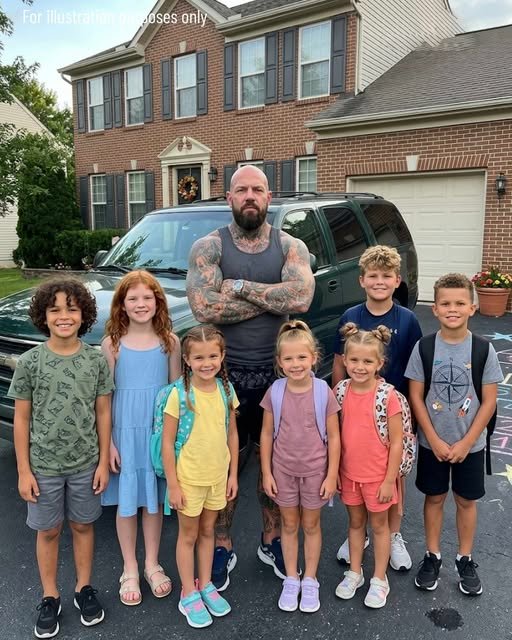
When my husband and I signed the lease, we thought we’d hit the jackpot — the rent was suspiciously low for such a quiet street.
We found out why on day one.
“Well… you’re BRAVE,” our neighbor whispered while we unloaded boxes, eyeing the fence between our yards. “Renting next to THEM is definitely a decision.”
Another neighbor brought cookies and cut to the chase.
“Nobody told you? The man next door is raising SEVEN kids. Alone.”
That evening, we saw it for ourselves.
A tall, stoic man stepped onto his back porch and blew a silver whistle.
Seven children — from a teenager down to a little boy who looked barely old enough for kindergarten — lined up on the grass. Perfect formation. Tallest to smallest.
No laughing. No pushing. Dead silence.
He walked the line with a clipboard, inspecting their shoes, checking their hands, then marking boxes beside a massive wooden chore wheel.
I stood at my kitchen window with a dish towel in my hands and forgot I was holding it.
It went on for weeks. Every morning at 5:00 a.m. — yard work, buckets, rakes, that whistle.
He never hugged them.
I never once saw him smile.
I started keeping notes on my phone. Dates. Times. Just in case.
My husband said, “Maybe that’s just how he runs things.”
I said, “Kids don’t line up like soldiers because they WANT to.”
Yesterday, I made the decision.
I typed in the CPS number while walking the trash out to the bin by our shared fence.
Thumb over the button.
And then, from the other side of the slats, came a heavy THUMP.
Then a child’s frantic whisper.
“Quick — before Dad sees. You KNOW what he’ll do.”
I put my eye to the gap in the fence.
A small boy was sitting on the ground beside an overturned wooden crate.
His knee was scraped and bleeding.
Two of his older siblings crouched around him. The teenage girl held a first-aid kit while her brother nervously watched the back door.
“Hold still, Jamie,” she whispered.
“It hurts.”
“I know. Just don’t let Dad see yet.”
The boy beside her looked toward the porch.
“He’ll stop everything again.”
My stomach tightened.
Stop everything?
What did that mean?
Punishment?
More chores?
I moved my thumb closer to the call button.
Then the back door opened.
Merritt stepped outside.
That was the father’s name. I had finally learned it from the mailbox.
The children froze.
“What happened?”
Nobody answered.
His eyes went immediately to Jamie’s knee.
“Talia?”
The oldest girl stood.
“He fell. We were cleaning the shed.”
“And you were hiding it?”
“We didn’t want you to cancel today.”
Merritt stared at her.
For a moment, I was certain I was about to witness the thing I had feared for weeks.
Instead, he set his clipboard on the ground.
Then he knelt.
“Come here, buddy.”
Jamie limped toward him.
Merritt lifted the boy onto his knee and examined the scrape.
“You never hide an injury from me.”
Jamie sniffled.
“But we need to practice.”
“We can practice tomorrow.”
The little boy shook his head.
“You said we’re running out of time.”
Merritt’s hand stopped.
Even through the fence, I saw the expression on his face change.
“We’re okay,” he said softly.
Jamie looked up at him.
“You’re not.”
Nobody spoke after that.
Neither did I.
I slowly lowered my phone.
For the first time, I wondered whether I had misunderstood something.
But I still didn’t know what.
The strange routine had begun the morning after we moved in.
At exactly five, Merritt blew that silver whistle.
Seven children came outside.
He checked that everyone was dressed properly, then spun the chore wheel.
Laundry.
Breakfast.
Garden.
Bathroom.
Trash.
Chicken coop.
Repairs.
The jobs rotated constantly.
At first, I assumed he simply believed in discipline.
Then I started noticing other things.
One afternoon, Talia sat at the patio table while Merritt placed utility bills in front of her.
He pointed to the numbers.
She wrote something in a notebook.
Another child practiced sewing a button onto a shirt.
Two younger ones learned how to prepare eggs without burning them.
A twelve-year-old stood beside the fuse box while Merritt showed him how to reset a breaker.
These weren’t ordinary chores anymore.
They were lessons.
The whole neighborhood had an opinion about it.
“That poor oldest girl is basically their mother,” someone said.
“He runs that house like a military camp,” another neighbor told me.
The mail carrier had been the only person who didn’t criticize him.
“I’ve never heard Merritt scream at those children,” he said when I asked.
“Then why does everyone think he’s so terrible?”
The man shrugged.
“Because nobody likes what they don’t understand.”
I remembered that sentence later.
At the time, I ignored it.
The thing that finally pushed me toward CPS happened several days before Jamie fell.
I had my kitchen window open while making dinner when I heard Merritt’s voice next door.
“Again.”
Then a girl spoke.
“My name is Sadie Cade. I’m eleven years old. My address is 42 Maple Ridge Drive.”
“Again.”
She repeated it.
Then Merritt asked another question.
“What do you say if I’m on the floor and I don’t answer you?”
There was a pause.
“My dad is unconscious. There are seven children in the house. Please send an ambulance.”
“Again.”
She repeated it.
He made every child old enough to speak practice.
Even Jamie.
“My daddy isn’t waking up,” the little boy said carefully. “We need help.”
That night, I told my husband.
He stopped eating.
“That’s… strange.”
“Strange? He’s teaching kindergarteners what to say when they find him unconscious.”
“Maybe he has a medical problem.”
“Then why is the whole neighborhood acting like they know nothing?”
Neither of us had an answer.
Two mornings later, an ambulance pulled into Merritt’s driveway.
Talia walked outside carrying a thick blue folder.
She handed it directly to the paramedic.
Merritt sat on the porch while they examined him.
He looked pale, but after twenty minutes, the ambulance left without him.
The next morning, the whistle sounded again.
That was when I decided someone needed to look into the situation.
And then Jamie fell.
Three days after I watched Merritt hold him, I finally learned the truth.
It was just after noon when I heard something hit the patio next door.
This time, the sound was much heavier than a wooden crate.
Then someone yelled,
“RED PLAN!”
I ran outside.
Through the fence, I saw Merritt lying on the ground.
The change in his children was instant.
Talia dropped beside him.
One brother pulled out a phone.
Another ran to unlock the gate.
A younger girl disappeared inside and returned carrying that blue folder.
Jamie and the two youngest children stood together near the fence.
They were frightened.
But they knew exactly where to go.
Nobody screamed.
Nobody froze.
Talia leaned near her father’s face.
“He’s breathing.”
Her brother repeated the information to the emergency operator.
The gate opened before the ambulance even arrived.
I hurried into their yard.
“Tell me what I can do.”
Talia pointed toward the little ones.
“Stay with them, please.”
There was no panic in her voice.
That frightened me almost as much as Merritt lying unconscious.
The ambulance arrived within minutes.
While the paramedics worked, one of them glanced toward Talia.
“Medication list?”
She opened the folder to the correct page.
“Medical history?”
Another page.
“Insurance?”
She already had the card in her hand.
The paramedic stared at her.
“You’ve done this before.”
Talia nodded.
As they lifted Merritt onto the stretcher, the folder slipped from her hands.
Papers scattered across the driveway.
I bent to help collect them.
One page landed faceup near my foot.
I picked it up.
Then I saw the words.
Stage IV pancreatic cancer.
Diagnosed eight months ago.
For a moment, I forgot to breathe.
There were chemotherapy dates.
Medication lists.
Emergency plans.
Notes from doctors.
I looked toward Merritt on the stretcher.
Then at the seven children.
Talia saw what I was holding.
Her shoulders dropped.
“So you know.”
“All those mornings…” I whispered.
She nodded.
“He isn’t training us because he wants everything perfect.”
Her voice trembled for the first time.
“He’s training us because he doesn’t know how much longer he’ll be here.”
I looked at Jamie.
The little boy was crying silently.
Talia wiped her own eyes.
“Dad says none of us should wake up one morning and suddenly realize we don’t know how to do anything without him.”
Every ugly thought I had entertained about Merritt came rushing back.
The notes on my phone.
The CPS number.
All the times I had stared through the window and decided I understood a family I had never spoken to.
Merritt came home two days later.
He looked exhausted.
That afternoon, Talia knocked on our door.
“Dad wants to see you.”
I expected an uncomfortable conversation.
Instead, Merritt pointed to the chair across from him.
“I hear you almost called CPS.”
I felt my face burn.
“I’m sorry.”
He gave a tired smile.
“Honestly? If I watched my family from your window, I might have wondered too.”
That somehow made me feel worse.
I glanced around their living room.
Family photographs covered one wall.
In most of them, Merritt was smiling.
There was one of him sitting on a hospital bed holding a newborn.
Another showed all seven children piled around him on a couch.
And in the center was a photograph of a woman with bright eyes and curly brown hair.
“My wife,” Merritt said.
“She died four years ago.”
“I’m sorry.”
He nodded.
“I thought raising seven kids alone was the hardest thing life could hand me.”
He glanced toward the medical folder.
“Then I got sick.”
His doctors had told him treatment might slow the disease.
Nobody promised him years.
The first night after hearing the diagnosis, Merritt sat at the kitchen table and made a list.
Who knew how to cook?
Who knew where the insurance cards were?
Who knew the doctor’s number?
Who could handle a fever?
Who knew how to pay a bill?
Who could help Jamie if he woke from a nightmare?
The answers terrified him.
Mostly, they were:
Dad.
“I realized almost everything in their lives ended with me,” he said.
“And I couldn’t allow that.”
So the training started.
The whistle made sure every child knew how to follow the same routine.
The chore wheel made them learn every job instead of only their favorite ones.
The emergency drills meant none of them would freeze if Merritt collapsed.
He pulled a small black notebook from beside his chair.
Every page listed something he was trying to teach before he ran out of time.
Talia cooks dinner without help.
Passed.
Owen resets breaker safely.
Passed.
Sadie calls emergency services.
Passed.
Jamie remembers address.
Passed.
Near the bottom of Jamie’s page, there was another note.
Asked who will tuck him in when I’m gone.
I didn’t know what to say.
I closed the book.
Merritt stared toward the window.
“I can teach them how to survive.”
His voice became rough.
“I can’t teach them how to stop being children when they lose their father.”
“You shouldn’t have to do all of this alone.”
He laughed quietly.
“I’m not the one who has to learn to live alone.”
That stayed with me.
Over the next few days, my husband and I began talking to neighbors.
Not gossiping.
Helping.
A retired electrician started teaching the teenagers simple repairs.
A former nurse helped organize medication and emergency information.
A woman who had worked in banking offered to teach Talia budgeting so the sixteen-year-old wouldn’t feel she had to become the parent overnight.
Someone brought dinner on Wednesdays.
Someone else helped with homework.
My husband fixed their broken shed door.
I started taking Jamie and his little sister into my garden after school.
At first, Merritt hated accepting help.
Then one afternoon, he watched three of his children riding bicycles with neighborhood kids instead of doing chores.
“You’re ruining my schedule,” he told me.
“I can send them back.”
He watched Jamie laughing.
“No.”
He smiled.
“Give them another half hour.”
As winter approached, Merritt became weaker.
The whistle started sounding later.
Sometimes Talia blew it.
Sometimes nobody did.
One Saturday morning, I looked through the window at seven-thirty and saw Merritt asleep on the porch beneath a blanket.
Jamie was curled beside him.
Three other children were still in pajamas.
Nobody was cleaning anything.
It was the least organized I had ever seen that house.
And somehow, it looked healthier than ever.
Merritt passed away on a Sunday morning several weeks later.
Talia called our house before sunrise.
By the time I arrived, other neighbors were already coming through the door.
Nobody had to ask them.
They simply came.
The children were able to remain together under temporary guardianship while relatives and local services worked out a longer plan.
That had been one of Merritt’s biggest fears.
He had done everything possible to keep his seven children from being separated.
After the funeral, we gathered back at their house.
Jamie stood beside his father’s empty chair.
“Who blows the whistle now?”
His voice cracked.
Talia looked toward Merritt’s jacket hanging beside the door.
She reached into the pocket.
The silver whistle was still there.
She held it for a moment.
Then she blew one short note.
Every brother and sister turned toward her.
Nobody lined up.
Nobody grabbed a rake.
Instead, one child began setting the table.
Another poured drinks.
Someone checked the soup.
Jamie carried the napkins.
The movements were so familiar that they barely needed words.
Then Jamie stopped.
He looked around at all of us standing in the kitchen.
“Are you staying for dinner?”
Talia glanced at me.
I pulled out a chair.
“Of course.”
Others did the same.
Soon the table was crowded with seven children and nearly as many neighbors.
That night, I finally deleted the notes I had kept on my phone.
For weeks, I had believed the whistle meant fear.
I thought those children moved quickly because they were afraid of their father.
I had been watching from the wrong side of the fence.
Merritt wasn’t trying to raise children who could live without love.
He was a dying father trying to make sure that when his voice was no longer there to tell them what to do, his seven children would still know how to take care of themselves — and, more importantly, how to take care of one another.