
Part One — The Cake I Made at 1:47 in the Morning
Some things can be destroyed in a single second, even when they took an entire week of sacrifice to create.
I learned that on my son’s seventh birthday.
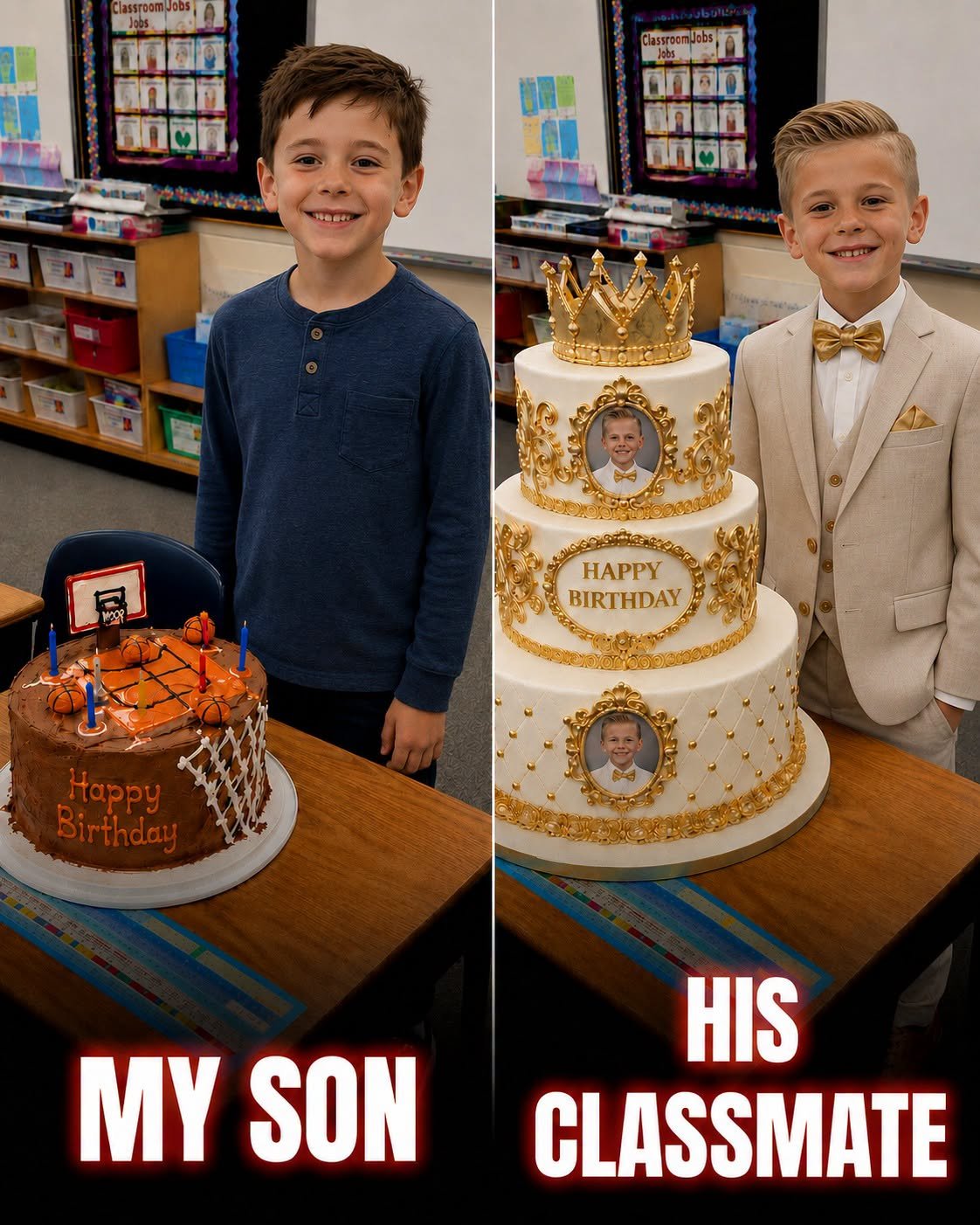
At 1:47 a.m., I finally stepped away from the kitchen table and looked at the cake I had made for Caleb. It was supposed to be a basketball, or at least a cake inspired by one. The orange frosting was uneven, the dome leaned slightly to the left, and the tiny fondant basketballs I had rolled by hand looked as if they had survived a strong wind.
One of them was tilted so badly that I had to prop it up with a toothpick.
My hands were sticky. My back ached. There was frosting in my hair, and I was too tired to care.
Still, I smiled.
It was not perfect, but it was finished.
I sat down at the table and stared at it until my eyes began to burn. Money had been painfully tight since my divorce. I picked up extra shifts whenever I could, counted every dollar twice, and still found myself moving bills around in my head before falling asleep.
Caleb had asked for a basketball cake from the expensive bakery near the mall. He had seen one in the window and talked about it for days—the tall orange cake, the smooth black lines, the little sugar basketballs arranged around the top.
I wanted to buy it for him.
More than anything, I wanted to give him the kind of birthday he would never have to compare with anyone else’s.
But the price was more than I could spare, so I had smiled and said, “How about Mom makes you one?”
Ordering one simply was not an option.
Caleb had hesitated before nodding. That tiny pause had followed me all week. I knew he loved me, but I also knew he was old enough to notice what other children had and what we did not.
So I had practiced frosting after work. I had watched videos during my lunch break. I had ruined one batch of icing, then another. I had carefully shaped each little basketball while Caleb slept in the next room.
Now, alone in the quiet kitchen, I pressed my palms against my face.
“It counts,” I whispered. “It counts because I made it.”
The words sounded brave in the empty room.
I was not sure I believed them yet.
Caleb shared his birthday with a boy in his class named Mason. Their teacher, Ms. Stevenson, had suggested holding one celebration for both boys so neither child would feel left out. At first, I thought it was a sweet idea.
Then I remembered Mason’s mother.
Vanessa and I had spoken only a few times during pickup, but she had a way of making every conversation feel like a competition. She wore heels in the school parking lot and spoke about private tutors, travel basketball teams, and expensive camps as if she were reading from a list of achievements.
“He’s already reading two grades ahead,” she had told me once, adjusting her sunglasses. “I just believe in investing in them, you know?”
I had nodded and said something polite about Caleb enjoying second grade.
She had smiled at me the way some people smile at a stray dog—kind enough to look generous, but distant enough to make sure they never had to get close.
As I covered my cake with a cardboard box, I imagined the one Vanessa would bring. Something towering. Something polished. Something that would make mine look like a child had made it.
That thought hurt because, technically, a child had not made it.
I had.
I set my alarm for six, turned off the kitchen light, and went to bed. I did not really sleep. I closed my eyes and waited for morning.
Part Two — “It’s Exactly What I Wanted”
Small footsteps padded into the kitchen just after sunrise.
I was pouring coffee when Caleb appeared in his dinosaur pajamas. His hair stood straight up, and he blinked sleepily at the cardboard box on the counter.
“Is that it?” my son asked.
I put down the coffee pot and tried to sound confident. “That’s it, buddy. You want to see?”
He nodded so quickly that his hair bounced.
I lifted the box.
For one terrible second, Caleb said nothing. My stomach tightened. I prepared myself to apologize—to explain that the frosting had been difficult and that maybe next year we could save enough for the bakery cake.
Then he wrapped both arms around my waist.
“It’s exactly what I wanted, Mom!”
I closed my eyes and held him. His hair smelled like children’s shampoo, and his small heart beat rapidly against my ribs.
“You really like it?” I asked.
“It’s the best cake ever!”
I laughed, though my eyes filled with tears. I kissed the top of his head and held him a little longer than usual.
He ran off to get dressed, already talking about showing his friends the cake. I remained beside the counter, looking at the lopsided orange dome.
Caleb’s joy had made it beautiful.
But as the morning moved closer to the school celebration, fear began creeping back in. I could picture Vanessa walking through the classroom with some perfect creation that would make everyone stop and stare. I imagined Caleb looking from her cake to mine and wondering why his mother could not give him something better.
I hated that I was already bracing him for disappointment when the only thing he had done wrong was be born into a family that had to count its money.
At school, Caleb bounced beside me as I carried the cake in its box. I held it carefully against my hip, protecting every crooked basketball and every uneven line of frosting.
The classroom smelled of juice boxes, dry-erase markers, and construction paper. Colorful birthday drawings covered one wall. A paper banner reading “HAPPY BIRTHDAY” hung above the celebration table.
Vanessa swept through the doorway as if she were arriving at a gala instead of a second-grade classroom. In her hands was an enormous three-tier cake covered in gold fondant. Each layer featured an edible photograph of Mason.
Mason in a soccer uniform.
Mason in a tuxedo.
Mason holding a trophy I did not recognize.
The cake was so tall that Vanessa had to tilt it slightly to get through the doorway.
Caleb looked up at it, then down at the box against my hip.
His excitement flickered.
“Mom, put it in the middle,” he said quickly. “Put it in the middle.”
I found a clear space by the window and lowered the box onto the table. The little basketballs had shifted during the car ride, but they were still standing.
“There we go, buddy,” I said. “Looks pretty good, right?”
“It looks awesome!”
I was still smiling when Vanessa’s eyes landed on our cake.

Part Three — Two Cakes, One Table
Vanessa stared at my cake for several seconds.
“Oh.”
She tilted her head as if she were studying a stain on an expensive rug.
“You’re putting THAT next to Mason’s?”
Caleb’s hand tightened around the hem of my sweater.
I straightened slowly. “It’s my son’s birthday too, Vanessa. The teacher wanted a shared celebration, remember?”
Her smile became thin at the edges.
“Right. Of course. I just thought, well, we could’ve coordinated.”
“We did,” I answered, keeping my voice calm. “I brought a cake. You brought a cake.”
She gave a small laugh that never reached her eyes and turned toward the napkin dispenser.
I looked down at Caleb. He was watching Vanessa the way children watch a large dog they are not sure they can trust.
I bent close to him.
“Hey,” I whispered. “Your cake is the coolest one in this room. Trust me.”
He nodded, but his eyes kept drifting toward the gold tower.
I could not blame him. It was beautiful. Every surface was smooth. Every photograph was perfectly centered. Even the candles looked expensive.
For a moment, I felt embarrassed by my own honesty. I wanted to hide the cake’s uneven side, the little basketball with the crooked line, and the patch of frosting I had repaired with the back of a spoon.
Then Caleb leaned closer to it and smiled.
That was enough to make me keep my shoulders straight.
The other children began arriving. Coats were hung on hooks. Backpacks were dropped beneath desks. Voices filled the room.
I expected the children to gather around Vanessa’s cake first. I really did. Shiny things usually win, especially when you are seven.
But a little girl with braids stopped in front of my cake.
“Wait, is that a basketball?” she asked. “Are those little basketballs?”
Another child hurried over. “How did you do the lines on them?”
“My mom made it,” Caleb announced.
His whole chest lifted with pride.
“She stayed up until almost half the night making it for me. She had to redo the frosting twice!”
“Your mom made it?”
“By hand?”
“That’s so cool!”
I stood behind Caleb with my hands folded in front of me, blinking hard. He began giving his classmates a tour of the cake, pointing out every detail as though he had helped design it.
“See, this one is a little smooshed because it fell off,” he explained, “but my mom just stuck it back on.”
The children laughed.
Not at him.
With him.
The sound loosened something inside my chest.
I glanced toward Vanessa.
She stood beside her three-tier cake with one hand resting on the table. Her expression had changed. She was watching the children crowd around the homemade cake, fascinated by the tiny details and the fact that someone had stayed awake to make them.
Her jaw tightened.
The children had seen expensive cakes before. They had probably seen better ones at restaurants and parties. But Caleb’s cake held their attention because it told a story. A mother had made it for her son. A tired mother. A determined mother. A mother who had refused to let an empty wallet decide how much love her child would receive.
Vanessa seemed to understand that, and she did not like it.
Part Four — The Boy Beside the Coat Hooks
That was when I noticed Mason.
He stood near the coat hooks, away from the crowd. He was not looking at his mother’s cake. He was looking at Caleb’s.
His head was tilted, and his mouth rested in a small uncertain line that was halfway between a frown and a smile.
It was not envy.
That was what struck me.
Mason did not look jealous. He looked moved.
He watched Caleb explain the crooked basketballs. He watched the other children ask questions. He watched Caleb answer every one of them as proudly as a tour guide showing visitors a famous landmark.
Vanessa noticed where her son was looking.
Her hand slid away from the table.
“Mason, sweetheart, come stand by your cake for a picture,” she called.
“In a minute, Mom.”
“Now, please.”
Her voice was still pleasant, but something hard had appeared beneath it.
Mason did not move.
Caleb tugged at my sleeve and whispered something that made both of us laugh. I smiled down at him, but I could feel tension gathering in the room.
I had seen that expression on adults before—the expression of someone who believed a moment belonged to them and could not tolerate watching it move elsewhere.
Ms. Stevenson clapped her hands.
“All right, everyone, gather around. It’s time for candles!”
Vanessa began moving before the teacher had finished speaking. She walked toward the celebration table with a bright, practiced smile.
“Let me make some room,” she announced.
I stepped slightly aside, still standing close to Caleb.
Vanessa reached across the table. Her long sleeve swept forward in a wide arc.
The next moment seemed to stretch.
Her arm brushed the edge of Caleb’s plate.
The cake tipped.
It wobbled once.
Then it slid off the table.
It struck the tile with a wet, awful sound.
Orange frosting splattered across the floor. The tiny basketballs I had rolled by hand bounced beneath the desks like bright marbles.
“Oh my goodness! What a horrible accident!” Vanessa cried, pressing a manicured hand to her mouth.
I felt every muscle in my body go still.
She had not stumbled. She had not reached blindly. She had looked directly at the cake before sweeping her arm across it.
Every parent standing near the table had seen it.
So had Mason.
Caleb’s face crumpled. His lower lip trembled, and he stared at the ruined orange puddle as if he were trying to understand how something so happy could disappear so quickly.
I dropped to my knees beside him.
“Buddy,” I whispered. “Hey. Look at me.”
He would not look up.
Vanessa was already recovering. She waved toward her gold cake as though the floor were not covered in the thing my son had been excited to share.
“Well, at least there’s still a proper cake for everyone. Come on, kids, gather around Mason!”
She guided the children toward her son with the efficiency of someone directing traffic.
Then she lit the gold candles one by one.
I wrapped my arm around Caleb’s shoulders.
“It’s okay,” I murmured. “It’s just a cake. We’ll make another one.”
But it was not just a cake.
It was the fourteen dollars I had set aside for three weeks. It was the sleep I had traded for every crooked decoration. It was the one thing that year I had managed to give Caleb exactly as he had asked for it.
And Vanessa had swept it onto the floor as if it were something dirty.
The old feeling rose in my chest—the hot, choking helplessness I remembered from my marriage, the feeling of being made small while everyone watched and no one spoke.
I swallowed it.
I had to remain steady. Caleb needed me more than I needed an apology.
Vanessa lifted her phone and angled it toward her son.
“Everyone ready? Let’s sing!”
The children began singing.
Their voices were thin and polite. I mouthed the words while rubbing slow circles across Caleb’s back.
Mason stood in front of his cake, but he was not smiling.
He was looking at Caleb.

Part Five — Mason Would Not Blow Out the Candles
“Make a wish, sweetheart,” Vanessa cooed, holding her phone high.
Mason did not move.
“Mason, honey, blow them out.”
He did not lean forward. He did not puff out his cheeks. His small hands hung at his sides, and his head lowered quietly.
Vanessa’s smile flickered before tightening again.
“Mason. Everyone’s waiting.”
I looked up from Caleb.
Something about the way Mason stood made me pause. He was not shy. He was not confused. He was deciding something.
“Mason,” Vanessa said again, her voice dropping lower. “Blow out your candles.”
Instead of obeying, Mason stepped away from the table.
A ripple moved through the parents. One father coughed. Ms. Stevenson tilted her head and watched carefully.
Vanessa lowered her phone.
“Sweetheart, what’s wrong? Are you feeling shy? Do you want Mommy to help you?”
Mason shook his head.
Then he walked to the coat hooks along the back wall.
He unzipped his small navy backpack, the one with the astronaut patch, and began searching through it.
Vanessa gave a strained laugh.
“Kids, right? He’s probably looking for a birthday hat he made.”
But her eyes were sharp. She was tracking Mason with the same intensity she had used to watch the homemade cake.
Mason pulled out a folded piece of paper. The edges were wrinkled, as if he had carried it around for several days.
He walked back through the suddenly quiet classroom. He passed his mother, stopped in front of Caleb and me, and turned to face Vanessa.
“Mason, honey, everyone’s still waiting on you,” she said.
He looked straight at her and held out the paper.
Vanessa took it slowly. Her smile remained on her face, but it had become stiff and fragile.
From where I stood beside Caleb, I could see the crayon drawing.
Two stick figures.
One had tears on its face. The other was labeled “Caleb” and held out half a sandwich.
Vanessa stared at it.
“Mason, what is this? Is it some sort of trash you found?” she asked. Her voice was thinner now.
“Last week I forgot my lunch,” Mason said.
His voice was quiet, but the classroom had become so still that every word carried.
“Nobody noticed, but Caleb did. He gave me half of his sandwich. And told me not to feel bad.”
Vanessa’s mouth opened. No sound came out.
Mason looked at Caleb.
“He’s my friend, Mom.”
Then he glanced at the smashed orange frosting on the floor.
“And I made that card for him to thank him on our birthday. But you knocked his cake down on purpose. I saw you.”
The silence that followed was not angry. It was heavier than anger.
It was the silence of a room full of people who had witnessed the truth and could no longer pretend they had not.
Vanessa’s face lost its color.
“Sweetheart, that was an accident. I would never…”
Mason’s eyes filled with tears, but he did not look away.
“I don’t want to blow out the candles by myself.”
For the first time that morning, Vanessa looked less concerned about her image than about the small boy standing in front of her.
She looked at the card again. Then she looked at Mason.
Ms. Stevenson stepped forward gently.
“How about you and Caleb share the candles, Mason?” she suggested. “It is both of your birthdays.”
Mason nodded immediately and reached for Caleb’s hand.
“Come blow them out with me!”
Caleb looked at me. His eyes were still wet, but the fear in them had softened.
I squeezed his shoulder.
“Go ahead, buddy.”
He took Mason’s hand.
Vanessa stood behind them, holding the little crayon card while the other parents looked everywhere except at her.
Part Six — The Birthday That Belonged to Both Boys
Ms. Stevenson moved the gold cake closer to the boys. The candles burned in a bright line across the top.
Mason leaned forward first. Caleb leaned beside him.
Together, they blew.
The flames disappeared in a single breath.
The children cheered, and the tension in the room finally broke. Ms. Stevenson began cutting the cake while the children crowded around the table. Someone handed Caleb a napkin. Another child picked up one of the little fondant basketballs from the floor and brought it to me as if it were a precious object.
“This one survived,” the girl with the braids said.
I thanked her and placed it carefully in my palm.
Caleb and Mason stayed side by side. They talked about basketball, sandwiches, and which part of the cake they wanted. Mason kept glancing toward his mother, but he did not let go of Caleb’s hand until the first slice was served.
The celebration turned out better than I expected.
Not because the cake on the floor was forgotten, but because it no longer had the power to define the day.
Vanessa’s cake was large enough for everyone to have seconds and thirds. It was beautiful, and I could admit that without feeling small. But when the children talked about the birthday later, they did not talk about the gold fondant or the edible photographs.
They talked about the tiny basketballs.
They talked about the cake being homemade.
They talked about Mason and Caleb blowing out the candles together.
Before I left, Ms. Stevenson placed a slice of cake in a napkin for Caleb. Mason’s mother remained near the table, still holding the crayon card.
For a moment, our eyes met.
I expected another excuse. Maybe a cold explanation. Maybe a complaint about how the children had misunderstood what happened.
Instead, Vanessa looked down at the drawing.
She did not apologize. Not then.
But she looked uncomfortable in a way that had nothing to do with the other parents and everything to do with her son’s disappointment.
Mason had not exposed her to humiliate her. He had spoken because he loved his friend and could not accept seeing him treated unfairly.
That was the consequence Vanessa had never anticipated.
She could dismiss my feelings. She could call my cake childish. She could pretend the fall had been an accident.
But she could not argue with the truth spoken by her own child.

Part Seven — What Caleb Remembered on the Drive Home
On the drive home, Caleb held his slice of cake in his lap, wrapped carefully in a napkin.
For several minutes, he watched the road in silence.
Then he said, “Mason’s actually really nice, Mom.”
I glanced at him in the rearview mirror. “Yes, he is.”
“He’s also into basketball.”
“I know he is, buddy.”
Caleb considered this.
“I’m glad he got to have birthday cake with me.”
My hands tightened around the steering wheel, and I felt my eyes sting.
He was seven years old. He had watched someone destroy the gift he was proud of. He had seen his mother try to pretend it did not matter. Yet the thing he remembered most was that Mason had been kind.
That was my son.
He had shared half of his sandwich with a hungry classmate without telling anyone. He had never expected praise for it. He had simply seen someone in need and made room for him.
And now Mason had done the same for him—not with food, but with courage.
I had spent years believing my efforts did not count because they did not sparkle. I had compared our small apartment, our thrift-store furniture, and our homemade cakes to the polished lives of people who had more money.
But Caleb had taught me something that afternoon.
Love did not become less valuable because it was made in a small kitchen.
Kindness did not need a professional finish.
And a child could recognize sincerity faster than most adults ever would.
At a red light, Caleb lifted his slice of cake.
“Can I save this for later?”
“Of course.”
“Maybe I can bring some for Mason tomorrow.”
I smiled. “I think he would like that.”
Caleb leaned back in his seat, satisfied.
The rest of the drive passed quietly. The afternoon sun came through the windshield, turning the crumbs on his napkin golden.
For the first time since the cake hit the floor, I allowed myself to breathe all the way down to my lungs.
Part Eight — The Cake We Baked Again
That evening, Caleb placed the surviving fondant basketball on a small plate beside his bed. He said it was a birthday souvenir.
Before falling asleep, he asked whether we could make another basketball cake the following year.
“Next year,” I told him, “we bake again. And I’m not apologizing for the messy frosting.”
He giggled.
The next morning, Mason sat beside Caleb during breakfast at school. Caleb gave him a small piece of cake, and Mason showed him the card he had drawn again. The orange crayon had smeared slightly at the corner, but Mason had added two more figures beside the first ones.
This time, the drawing showed two boys standing together beneath a crooked birthday banner.
One was labeled “Caleb.”
The other was labeled “Mason.”
They were both smiling.
I kept thinking about that picture long after I left the classroom.
Vanessa had believed attention could be purchased. She thought the tallest cake would make her son’s birthday the most important one in the room. When my homemade cake began attracting the children, she tried to take that moment away.
But she had forgotten something simple.
Children do not measure love by price tags.
They notice who stays awake to make something by hand. They notice who shares a sandwich. They notice who stands beside a friend when everyone else is watching.
The cake Vanessa knocked to the floor was imperfect. It leaned to one side, the frosting was uneven, and half the decorations were never eaten.
But it had already done what I made it to do.
It had made my son feel loved.
And when it fell, it revealed something even more important: the kindness Caleb had shown Mason had taken root in another child’s heart.
That was the part Vanessa could never smash.
So I stopped comparing our life to hers. I stopped apologizing for what we could not afford. And I stopped believing that love needed to look impressive before it could be enough.
Sometimes the most meaningful gifts are lopsided, homemade, and made after midnight by someone who is exhausted but refuses to give up.
Sometimes the smallest act—a shared sandwich, a folded card, a hand reaching for a friend—can speak louder than all the gold in the world.
And sometimes, the truth does not arrive through an angry adult or a dramatic confrontation.
Sometimes it comes from a child holding a crayon drawing in both hands and saying, simply, “He’s my friend, Mom.”