
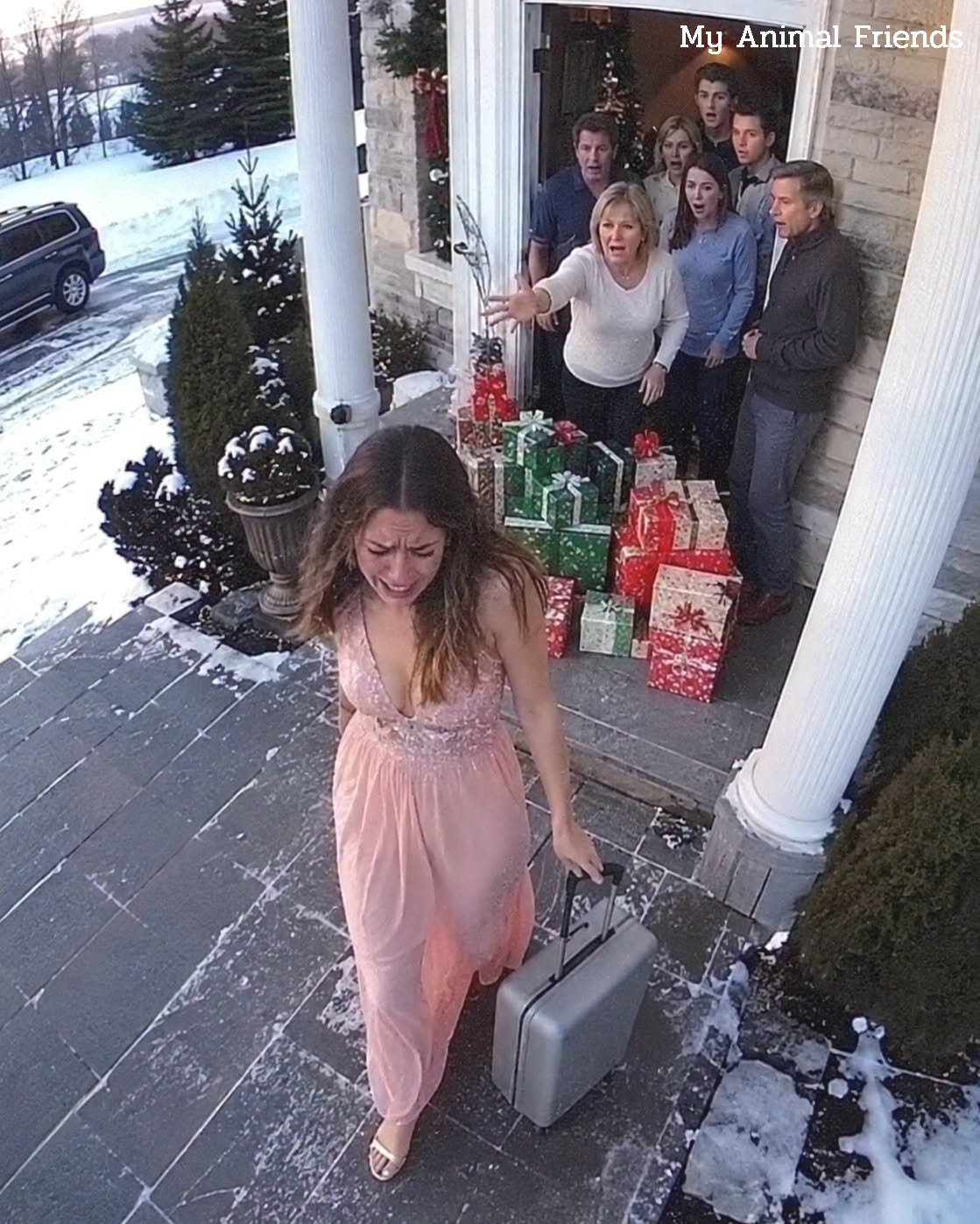
PART 2
The second car was not one my parents recognized.
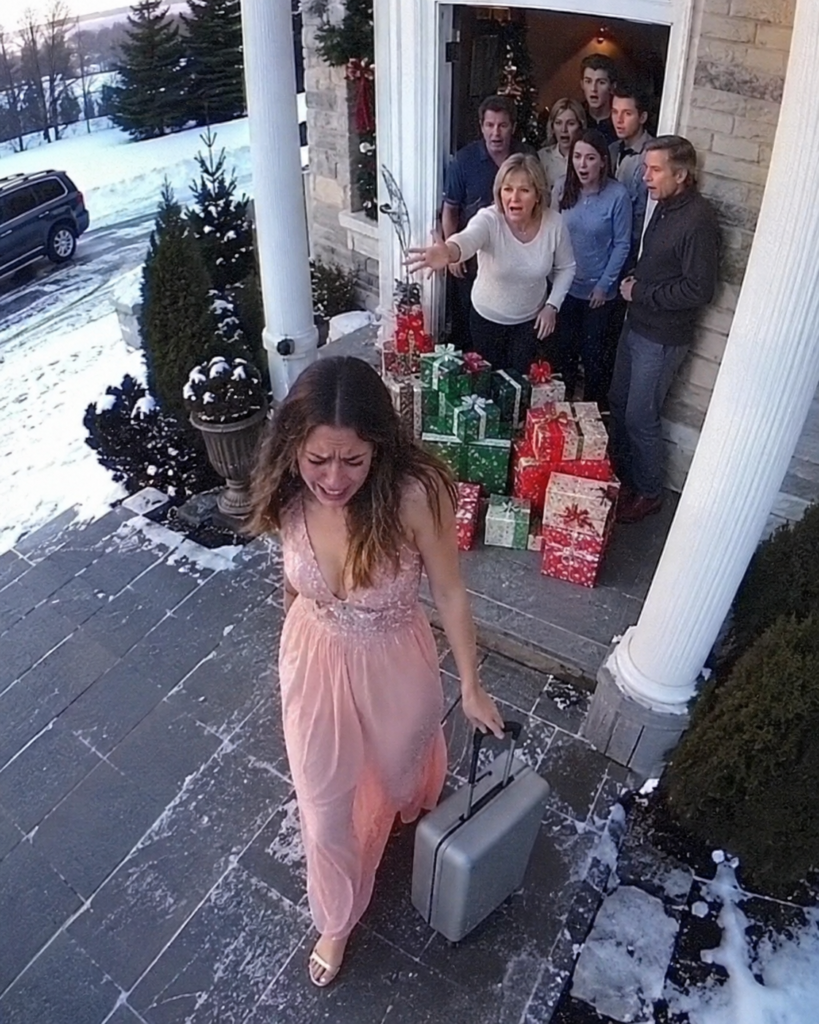
It was black, low, and spotless, the kind of car that looked too quiet for a neighborhood like theirs, where every arrival usually announced itself with squealing brakes, barking dogs, or someone’s loud holiday leftovers clattering in the trunk. It rolled to a stop behind the courier’s van, and for one long second, everyone inside my parents’ house simply stared through the narrow glass beside the front door.
My mother still held the certified envelope against her chest.
My father stood frozen with the documents in one hand and my handwritten note in the other.
Brent, who had spent the previous night laughing every time my children lowered their heads in embarrassment, suddenly looked like a man who had discovered the joke had been written about him.
The driver’s door opened first.
A woman stepped out in a navy coat, silver-haired, elegant, carrying a leather folder under one arm. My father recognized her before she even reached the porch.
“No,” he whispered.
That single word did more to frighten my mother than the legal documents had.
“Arthur?” she said.
But he did not answer.
The woman climbed the porch steps with calm, careful movements. She did not look angry. She did not look pleased. She looked like someone who had waited a very long time to knock on that door, and now that the day had come, she had no reason to hurry.
Behind her, the passenger door opened.
An older man stepped out.
He was tall but slightly bent at the shoulders, with a cane in one hand and a gray scarf tucked neatly beneath his coat. His face was thinner than it had been in the old photographs I had seen hidden in my father’s office years earlier, but the sharp eyes were the same.
Thomas Reed.
The man my father had cursed for half my life.
The man he blamed for the collapse of Reed & Whitaker Construction.
The man he said had stolen from him, betrayed him, and vanished with the money that should have kept our family comfortable forever.
The man I had been raised to hate.
My father’s lips parted, but no sound came out.
Thomas looked at him through the glass.
Then he raised one hand, not in greeting, but as if reminding my father that ghosts eventually learned how to knock.
My mother stepped back.
Brent moved first, rushing to the door with the careless confidence of a man who still believed anger could solve everything.
“What the hell is this?” he snapped, pulling the door open.
The silver-haired woman gave him a polite glance. “Good morning. I’m Evelyn March, attorney for Northstar Holdings and legal representative for Mr. Thomas Reed in matters related to the Whitaker family estate.”
Brent blinked.
The words did not land all at once.
My father understood them immediately.
“No,” he said again, louder this time. “You have no right to come here.”
Thomas Reed’s mouth curved slightly, but it was not a smile. “You told everyone I ran away, Arthur. I thought it was time I arrived properly.”
My mother pressed one hand to the wall.
And that was when my phone rang.
I was not at the house when any of this began. I was in a small hotel room six miles away, sitting beside my children while they slept under stiff white blankets, their faces soft and exhausted from crying. We had left my parents’ New Year’s Eve dinner just before midnight, after Brent told my son Lucas that “some kids needed to learn early that the world doesn’t hand out prizes to everyone.”
Lucas had only asked why his cousins got gift bags and he did not.
My daughter Emma, who was twelve and old enough to understand cruelty even when adults dressed it up as honesty, had stared down at her empty plate until her cheeks turned red.
My mother had not defended them.
My father had pretended not to hear.
Brent had laughed.
And I had finally stood up.
There are moments when a person does not become stronger. They simply become finished.
I gathered my children’s coats, thanked my parents for dinner, and walked out while my mother called after me that I was being dramatic. Brent had shouted that I would come crawling back when I remembered family was all I had.
He was wrong.
Family was not all I had.
For years, they had mistaken my silence for weakness because it benefited them to do so. They did not know about the holding company. They did not know about the mortgage. They did not know I had spent nearly a decade paying property taxes, covering emergency repairs, and quietly stopping foreclosure notices before my parents ever saw them.
They lived in that house because I had allowed it.
And the night they humiliated my children beneath its roof, something inside me locked into place.
When my phone rang, I saw Evelyn March’s name on the screen.
“Claire,” she said when I answered, her voice low and steady. “The documents have been delivered. Mr. Reed and I are at the property.”
I glanced at Emma and Lucas. Lucas shifted in his sleep, one hand curled around the stuffed dinosaur he pretended he was too old to need.
“Are they calm?” I asked.
There was a pause.
“No.”
I almost laughed, but it came out as a breath.
“Is Thomas with you?”
“Yes.”
Another pause.
Then Evelyn added, “Your father looks as though he has seen the dead return.”
“He has,” I said softly.
I left the children with my closest friend, Nadia, who arrived twenty minutes later with hot chocolate, overnight bags, and the kind of fury only a woman who loved your children could carry for you. Emma woke briefly as I slipped into my coat.
“Mom?” she whispered. “Are we going back there?”
I sat beside her and brushed a strand of hair from her face. “Not to beg. Not to apologize. Not ever again.”
Her eyes searched mine.
“Then why?”
“Because sometimes,” I said, “people only understand boundaries when they can see the fence.”
When I arrived at my parents’ house, the curtains were open, though no one inside seemed aware of it. From the driveway, I could see my mother sitting rigidly on the edge of the living room sofa, Brent pacing behind her, my father standing near the fireplace with his back straight and his hands clenched at his sides.
Evelyn sat in my grandmother’s old armchair as if she belonged there.
Thomas Reed stood by the window.
For a strange second, I saw all of them as pieces arranged on a board I had been too afraid to touch for years.
Then my mother saw me.
She rose so quickly the coffee table rattled.
“Claire,” she said, hurrying toward the door as I entered. “Tell them this is some kind of mistake.”
I closed the door behind me.
The house smelled like stale champagne, pine candles, and the roast my mother had bragged about buying for everyone except my children, who had been served leftovers because, according to her, “children don’t notice those things.”
I looked at the dining room.
The extra gift bags still sat near the sideboard, bright and unopened, each tagged with one of my nephews’ names.
None for Emma.
None for Lucas.
My mother followed my gaze and swallowed.
“Claire, you know how your brother is,” she said quickly. “He jokes. He doesn’t always think.”
“No,” I said. “He thinks. He just never expected consequences.”
Brent stopped pacing. “You really think you can throw your own parents out over one dinner?”
I turned to him.
“One dinner?” I repeated.
His jaw tightened.
“One dinner is when Emma was seven and Grandma’s locket went missing, and you let your daughter blame her until Emma cried so hard she got sick. One dinner is when Lucas made a card for Dad’s birthday and you told him homemade gifts were what people gave when they had nothing else. One dinner is when Mom told my children not to take too many strawberries because your kids liked them better.”
My mother’s eyes filled. “I never meant—”
“You meant all of it,” I said. “You just never meant for me to remember.”
My father finally spoke.
“This is my house.”
Thomas Reed made a sound that was almost a laugh.
My father turned on him. “You stay out of this.”
“I stayed out of it for eighteen years,” Thomas said. “That was my mistake.”
Evelyn opened her leather folder. “Legally speaking, Mr. Whitaker, the property remains in your name. However, the primary mortgage and associated debt instruments are held by Northstar Holdings. The grace arrangement extended to you has expired. You have thirty days to refinance, satisfy the outstanding balance, or surrender the property according to the terms outlined in the notice.”
Brent scoffed. “Outstanding balance? How much?”
Evelyn slid a page across the coffee table.
Brent snatched it up.
The color drained from his face.
My mother whispered, “That can’t be right.”
“It is right,” Evelyn said. “It includes the mortgage acquisition, unpaid interest under the modified private agreement, delinquent property tax coverage, emergency repair advances, insurance payments, and documented maintenance reimbursements made over the years by Northstar Holdings.”
My father looked at me then.
Not with love.
Not with shame.
With betrayal.
“You did this behind our backs?”
I held his stare. “I saved this house behind your backs.”
The room went silent.
“You were supposed to lose it eight years ago,” I continued. “The bank had already started the process. You remember that week, don’t you? Mom cried for three days. Brent stopped answering calls. You told everyone you had handled it.”
My father’s nostrils flared.
“You didn’t handle it. I did.”
My mother lowered herself slowly back onto the sofa.
“I didn’t know,” she whispered.
“Yes, you did,” Thomas said.
Her head snapped toward him.
Thomas stepped forward, leaning slightly on his cane. “Maybe not about Northstar. But you knew Arthur’s story was a lie.”
My father’s voice dropped. “Careful.”
“No,” Thomas said. “I was careful when you forged my signature. I was careful when you emptied the business accounts and told the town I had disappeared with the money. I was careful when your lawyer threatened to bury me under lawsuits I couldn’t afford to fight. Careful cost me my company, my name, and my family.”
Brent frowned. “What is he talking about?”
For the first time all morning, my father looked afraid of his son.
Thomas reached into his coat and removed a sealed envelope. He placed it on the coffee table beside Evelyn’s documents.
“Your father didn’t lose the business because of me,” he said. “He lost it because he borrowed against contracts that didn’t exist. When the accounts collapsed, he needed someone to blame. I was convenient.”
“That’s a lie,” Brent said, but his voice had weakened.
Evelyn removed several photocopied bank statements from her folder. “It is not. Mr. Reed came forward last year after locating original files from the company’s former storage unit. Those files match records discovered among Celia Whitaker’s personal papers.”
At the mention of my grandmother, my mother shut her eyes.
Grandma Celia had been the only person in that family who loved without making people pay for it. She had taught me how to balance a checkbook when I was thirteen, how to make soup stretch through a hard week, and how to smile politely while refusing to be stepped on.
When she died, my father said she left nothing but old jewelry and debts.
That, too, had been a lie.
“She knew,” I said.
My father glared at me. “Your grandmother was confused near the end.”
“No,” I said. “She was careful near the end.”
Evelyn nodded. “Mrs. Celia Whitaker suspected that financial misconduct had occurred within Reed & Whitaker Construction. She also suspected Arthur Whitaker had used family assets to conceal personal losses. Before her death, she arranged for certain documents to be preserved. She instructed that they be reviewed only if Arthur attempted to take advantage of Claire or Claire’s children.”
My mother covered her mouth.
I looked at her. “Grandma knew you would protect him.”
Tears slid down my mother’s cheeks, but I did not move to comfort her.
That was another habit I had broken.
Brent threw the page onto the table. “So what? You want money? Is that what this is? You got your little revenge show. Congratulations.”
I stared at him for a long moment.
Last night, he had leaned back in his chair, smiling as Lucas tried not to cry, and said, “The world is easier when kids learn where they rank.”
So I answered him with his own lesson.
“No, Brent. I want you to learn where you rank when nobody is paying your way.”
His face hardened. “You think you’re better than me?”
“No. I think I stopped asking you to be better, and that made me free.”
My father slammed his hand against the fireplace mantel. “Enough. I will not be lectured in my own home by an ungrateful daughter.”
Thomas looked at him coldly. “It stopped being only your home the day she paid to keep it standing.”
My father pointed at him. “You don’t get to speak about my daughter.”
Something shifted in Thomas’s expression.
It was small. Almost invisible.
But I saw it.
So did my mother.
She stood suddenly. “Thomas, don’t.”
The room froze.
My skin prickled beneath my coat.
Thomas did not look at my mother. He looked at me.
Evelyn closed her folder halfway, as if she had expected this moment but hoped it would come later.
“What does that mean?” I asked.
My mother’s face collapsed into panic. “Nothing. Claire, please. This is already enough for one day.”
I turned to my father.
He would not meet my eyes.
For thirty-six years, Arthur Whitaker had met every accusation with anger. He shouted over bills, over apologies, over truth itself. Anger was his wall.
But now, for the first time in my life, he was silent.
Thomas reached into his coat again.
This time, he removed a small cream envelope, old enough that the edges had yellowed. My name was written across the front in my grandmother’s careful handwriting.
Claire, when the house finally tells the truth.
I could not breathe.
My mother whispered, “Celia had no right.”
Thomas’s voice was gentle. “She had every right.”
I took the envelope with fingers that did not feel like mine.
Inside was a photograph.
My mother stood in a hospital room, younger than I had ever seen her, holding a newborn wrapped in a pale blanket. Beside her stood Thomas Reed, one hand resting carefully on the edge of the bed, his face filled with a stunned, fragile joy.
On the back, my grandmother had written one sentence.
Some debts are paid with money. Others wait for blood to speak.
A second paper slid out behind it.
A birth certificate.
My name was on it.
So was my mother’s.
But the line where my father’s name should have been had been altered. Not erased completely. Not well enough.
Under the faint scrape of correction ink, another name remained.
Thomas Reed.
The room tilted.
Brent took one step back. “What the hell?”
My father’s face turned gray.
My mother reached for me, but I moved away before she could touch my sleeve.
“Claire,” she said, breaking on my name. “It wasn’t that simple.”
I almost laughed.
All my life, that had been the family motto.
It wasn’t that simple.
The missing college fund was not that simple.
The cruel comments were not that simple.
The favoritism was not that simple.
The way they treated my children like visitors in their own bloodline was not that simple.
But the paper in my hand was brutally simple.
My father was not my father.
The man my family had trained me to hate had been erased from my life because the truth would have exposed too many lies at once.
Thomas’s eyes shone, but he did not come closer.
“I didn’t know,” he said. “Not until Celia’s lawyer contacted me. Your mother told me the baby hadn’t survived. Then Arthur destroyed me before I could ask more questions.”
My mother sobbed once.
Arthur whispered, “Margaret.”
But she did not look at him.
She looked at me with the terror of a woman who had lost control of a story she had edited for decades.
I folded the birth certificate with care and placed it back into the envelope.
Then I looked around the room: the expensive curtains, the polished floors, the family portraits where I had always stood slightly apart, the dining room where my children had learned shame from people who owed them shelter.
Thirty days suddenly felt generous.
I turned to Evelyn. “Proceed with everything.”
My mother gasped.
Brent exploded. “You can’t be serious!”
“I am.”
My father’s voice was low. “Claire, don’t do this.”
I looked at him one last time.
“You taught me that family loyalty meant silence,” I said. “My children will learn that family love means protection.”
Then I walked out.
Thomas followed me onto the porch but stopped at the top step, giving me space. The winter air was sharp, bright, almost clean. Across the street, a neighbor’s flag snapped in the wind. Somewhere nearby, a child laughed, unaware that entire families could collapse before breakfast.
“Claire,” Thomas said softly.
I turned.
He held out a small brass key.
“Your grandmother left one more thing,” he said. “A safe-deposit box. She said you should open it only after you saw the photograph.”
I stared at the key in his palm.
Behind us, inside the house, my mother began screaming my name.
Not in apology.
In warning.
Thomas’s face darkened.
“What’s in the box?” I asked.
He looked past me toward the house I had saved, then toward the family I had just lost.
“I don’t know,” he said. “But Celia wrote one instruction on the bank form.”
My heart hammered.
“What instruction?”
Thomas placed the key in my hand.
“Open it before Brent does.”
PART 3
The Woman in the Blue Coat
The second car that pulled into my parents’ driveway was not a police cruiser, not a repo truck, not anything dramatic enough to match the fear suddenly crawling across my mother’s face.
It was a small navy sedan with salt on the tires and a cracked plastic angel hanging from the rearview mirror.
My mother stared through the front window, her lips parted, one hand still gripping the certified envelope I had sent. My father stood beside her in the hallway, the documents trembling slightly in his fingers. Brent had moved behind them, not out of concern, but because he could smell trouble and wanted to know whether it had his name on it.
The woman who stepped out of the sedan wore a blue wool coat, polished black shoes, and a gray scarf tucked neatly beneath her chin. She was old enough for her white hair to make people underestimate her, but she walked with the straight-backed confidence of someone who had spent a lifetime watching liars forget which lie they told first.
My father whispered, “Oh, no.”
That was when Brent’s expression changed.
Not confusion.
Recognition.
Fear.
“Who is that?” my mother snapped, though the panic in her voice said she already knew.
The doorbell rang.
No one moved.
The woman waited exactly five seconds, then rang again.
Finally my father opened the door.
“Good morning, David,” she said.
Her voice carried into the hallway, crisp and calm.
“Evelyn,” my father said, his face ashen.
My mother stepped forward. “You have no business coming here.”
Evelyn Price looked at her with the pity one reserves for a woman standing inside a house she no longer understands.
“I have every business coming here, Margaret. I am here on behalf of Julia.”
Brent laughed once, sharp and ugly. “Of course you are.”
Evelyn turned her gaze toward him.
“And on behalf of the bank, the county recorder, and your late mother’s estate.”
The silence that followed was so complete that even the football announcer still playing faintly from the living room seemed embarrassed to speak.
My mother’s fingers curled around the edge of the doorframe. “Rose’s estate was settled years ago.”
“It was,” Evelyn said. “Badly.”
My father closed his eyes.
For one brief, strange second, I wished I had been there to see it. Not because I wanted to watch them suffer. I had spent too many years confusing justice with cruelty, and I knew better by then. But there was a part of me—the tired daughter, the ignored sister, the mother who had held her crying children in the car less than six hours earlier—that wanted proof they could still be shocked by truth.
Because they had never been shocked by pain.
Only by consequences.
Evelyn stepped inside without asking permission. She carried a leather folder and an old tin box with faded roses painted across the lid. My mother stared at the box as if it had risen from a grave.
“Where did you get that?” she whispered.
“Your mother gave it to me before she died.”
“That belongs to me.”
“No,” Evelyn said. “It belongs to Julia.”
Brent ran a hand over his face. “This is ridiculous. We’re not doing some New Year’s Day soap opera.”
“You’ve been living in one for fifteen years,” Evelyn replied. “I am only reading the final act.”
My father sank onto the bottom stair.
That frightened my mother more than anything else.
“David,” she said.
He did not answer.
Evelyn placed the tin box on the hallway table, right beside the crystal bowl where my mother kept decorative pinecones and emergency candy she never let my children touch. Then Evelyn opened her folder.
“On March eighteenth, eleven years ago, David Callahan’s contracting business defaulted on three major obligations. By May, the house was in danger of foreclosure. Brent attempted to arrange refinancing, but his credit and several undisclosed liabilities made him ineligible. Margaret contacted Julia privately.”
My mother snapped, “That is family business.”
Evelyn looked at her over the rim of her glasses.
“Yes. And you made it Julia’s burden.”
Brent’s jaw tightened.
Evelyn continued. “Julia paid the arrears. Then, on the advice of counsel, she purchased the mortgage through Rosegate Holdings, LLC, in order to protect her children’s future and prevent further misuse of funds. Since then, she has paid the taxes when they were late, covered two emergency repairs, and stopped a lien that would have forced this property into sale.”
My father’s hands covered his mouth.
Brent said, “She didn’t do that for free.”
“No,” Evelyn said. “She did it for peace. And peace has proved expensive.”
My mother’s eyes flashed. “She was helping her family.”
“She was,” Evelyn said softly. “And last night, this family humiliated her children.”
Brent stepped closer. “So what? She’s throwing her parents out because Mom didn’t buy a couple of gift cards?”
Evelyn’s face hardened.
“It was not about gifts.”
My mother flinched.
Everyone in that hallway knew it.
It had never been about gifts.
It was about the careful cruelty of omission. It was about telling children they were less loved in front of cousins. It was about turning family gatherings into tests nobody explained until my children failed them. It was about my mother measuring affection like medicine and giving my children none, then calling their sadness weakness.
Evelyn opened the leather folder and removed another document.
“This is a notice of expiration of informal occupancy and financial protection. Julia is not evicting you today. You have thirty days to either refinance the mortgage under your own names, arrange sale, or vacate the property in orderly condition.”
My father looked up. “Thirty days?”
“Yes.”
My mother whispered, “She wouldn’t.”
Evelyn closed the folder.
“She already has.”
For a moment, no one breathed.
Then Brent said the thing he always said when he was losing.
“I’ll sue.”
Evelyn smiled faintly.
“I was hoping you would mention that.”
She removed a smaller envelope from the tin box and held it between two fingers.
“This is a copy of the letter Rose Callahan wrote before she died. She left instructions with me because she suspected certain truths were being hidden from Julia.”
My mother lunged for the envelope.
My father caught her wrist.
“Margaret,” he said, and his voice broke.
My mother froze.
Evelyn opened the envelope herself.
“Rose knew Julia had saved this house. She knew because David told her.”
My father lowered his head.
“She also knew Margaret and Brent had been telling relatives that Brent was the one who kept the family afloat.”
Brent’s face reddened. “Grandma was old.”
“She was sharper than any of you,” Evelyn said.
Then she read.
“My dearest Julia, if you are hearing this, then I was right to worry that love in this family has become a weapon. I want you to know what no one else may have courage to say: you were the one who stood in the doorway when the roof was falling. You were the one who gave without applause. You were the one who carried people who later complained your hands were not soft enough. Do not confuse loyalty with allowing yourself or your children to be made small.”
My mother turned away.
Evelyn kept reading.
“I have left something for Emma and Noah. If Margaret gives it to them, then perhaps I was wrong. If she does not, then take it as my final warning: a house can hold generations, but it cannot hold a family that refuses truth.”
Evelyn stopped.
My father was crying.
Brent looked furious, not sorry.
My mother stared at the tin box.
Inside were two small wrapped presents.
The paper was old, faded at the corners, tied with ribbons that had yellowed slightly with time. One tag said Emma. The other said Noah.
My mother had kept them for six years.
Six years.
Six birthdays. Six Christmases. Six chances to do the smallest decent thing.
And she had hidden them in a box.
Evelyn placed the gifts back inside and closed the lid.
“I will deliver these to Julia myself.”
My mother’s voice came out thin. “They were too young to appreciate them.”
“No,” Evelyn said. “You were too bitter to give them.”
Brent slammed his mug onto the hall table so hard coffee splashed onto the documents.
“Enough. Get out.”
Evelyn did not move.
“Careful, Brent. You are named in three separate financial irregularities involving attempted liens against this property.”
His face changed so quickly that even my mother noticed.
“What does that mean?” she asked.
Brent barked, “Nothing.”
Evelyn looked at my father. “David, you should ask your son why your signature appears on a loan inquiry from last April.”
My father lifted his head slowly.
Brent stepped back.
My mother said, “Brent?”
He threw up his hands. “I was trying to help.”
“No,” Evelyn said. “You were trying to borrow against a house Julia had already saved.”
That was the first real crack in my mother’s world.
Not the mortgage. Not the letter. Not even the gifts.
It was Brent.
Her golden son.
The boy who could fail upward, lie sideways, and still be called misunderstood.
He had reached for the roof over her head while she was busy punishing my children for existing too loudly in it.
Outside, morning light spread cold and silver over the yard. The Christmas wreath on the front door swayed in the wind. Somewhere down the street, a neighbor dragged a trash bin to the curb, ordinary life continuing as if an entire family had not just split open.
Evelyn lifted the tin box.
“Julia asked me to say one more thing.”
My mother looked up.
Evelyn’s voice softened, but only slightly.
“She said she does not want you homeless. She does not want revenge. She wants distance, honesty, and safety for her children. What happens next depends entirely on what you do with the thirty days she has given you.”
My mother laughed, but it sounded almost like a sob.
“She sent you to scare me.”
“No,” Evelyn said. “She sent documents. I came because Rose asked me to, long before any of you imagined Julia would ever stop saving you.”
Then Evelyn walked out, taking the tin box with her.
Behind her, my father remained on the stair, holding a letter from his dead mother and staring at Brent as if he were seeing, for the first time, the exact shape of the son he had defended.
And six miles away, in my little kitchen, I stood barefoot over a pan of pancakes while my children sat at the counter in pajamas, pretending they had not cried themselves to sleep.
At 6:27 a.m., my phone began to ring.
Mom.
Then Dad.
Then Brent.
Then Mom again.
I turned it face down.
Noah watched me carefully. “Is it Grandma?”
“Yes.”
“Are we going back?”
I slid a pancake onto his plate. It was too brown at the edges and shaped vaguely like a snowman that had given up on life.
“No,” I said. “Not today.”
Emma looked at me with swollen eyes. “Ever?”
I sat down across from them.
The truth was too large for breakfast. Too heavy for maple syrup. But children always know when adults are building walls out of half-answers.
So I told them the only truth that mattered.
“We are not going anywhere people make you feel unwanted.”
Noah stared at his plate.
Emma whispered, “Even if they’re family?”
I reached across the counter and took her hand.
“Especially then.”
The phone kept ringing.
I let it.
For the first time in years, my house was quiet enough to hear my children breathe.
And that felt like a beginning.
PART 4
The Presents Hidden for Six Years
Evelyn arrived at my house just after eight, carrying the tin box against her chest as if it held something alive.
By then the sun had climbed above the icy rooftops, turning the frost on the grass into scattered diamonds. Emma and Noah were in the living room under a blanket, watching cartoons with the solemn exhaustion of children who had learned too much too early. I had made coffee and not drunk it. I had washed the same plate twice. I had checked the window every few minutes, though I did not know whether I was waiting for Evelyn or bracing for Brent.
When I opened the door, Evelyn did not greet me right away.
She looked at my face, then past me toward the sound of cartoons, then back again.
“Oh, Julia,” she said.
And I nearly broke.
Not because she pitied me.
Because she believed me without requiring a trial.
I stepped aside and let her in.
She removed her gloves slowly. “Your mother signed for the notice.”
“I know.”
“Your father read everything.”
“I figured.”
“Brent threatened to sue.”
“That sounds like Brent.”
Evelyn’s mouth twitched, then fell serious. She placed the tin box on my kitchen table.
My breath caught.
I recognized it immediately.
Grandma Rose’s sewing tin.
When I was little, she kept buttons in it. Buttons shaped like flowers, buttons like pearls, tiny brass buttons from coats that had outlived their owners. Whenever my mother was too busy criticizing the way I stood, spoke, ate, breathed, Grandma Rose would let me sort the buttons by color.
“Every button had a home,” she used to say. “People should too.”
I touched the lid with two fingers.
“Where did you get this?”
“Rose gave it to me the week before she died.”
My throat tightened. “Why?”
Evelyn’s eyes softened. “Because she knew your mother.”
I sat down.
Evelyn opened the tin.
The scent rose first: old paper, lavender, cedar, time.
Inside were envelopes, a few photographs, and two wrapped gifts.
Emma and Noah had wandered into the kitchen without my noticing.
“What is that?” Emma asked.
Evelyn turned to them.
“These are from your great-grandmother Rose.”
Noah frowned. “We had a great-grandmother?”
I swallowed hard.
“You did. She loved you very much.”
“But I don’t remember her.”
“She remembered you,” Evelyn said.
Emma’s eyes moved to the presents. “Are those… for us?”
“Yes.”
Noah looked at me first, asking permission without words.
That nearly hurt more than anything that had happened the night before.
Children who have been excluded learn to ask whether joy is allowed.
I nodded.
Emma picked up the package with her name. Her fingers moved carefully over the faded ribbon, as though the gift might vanish if she was too eager. Noah opened his more quickly, but with the guarded expression of a boy determined not to show hope in case it embarrassed him.
Inside Emma’s box was a silver locket shaped like a tiny book. When she opened it, there was a photograph no bigger than a postage stamp: Grandma Rose holding baby Emma in a hospital blanket, her wrinkled face radiant.
On the other side was engraved:
For Emma, who arrived like morning.
Emma stared at it.
Her lip trembled.
“Mom,” she whispered. “She knew me.”
I could not answer. I could only nod.
Noah’s gift was a small wooden compass, polished smooth, with his initials carved on the back.
N.C.
Inside the lid, in my grandmother’s handwriting, were the words:
For Noah, who will always find his way.
Noah ran his thumb over the letters again and again.
“She gave this to Grandma?” he asked.
“She left it for you,” Evelyn said.
“Why didn’t Grandma give it to me?”
There it was.
The question no adult in the room could soften.
Emma looked up too.
I took a slow breath. “Because Grandma Margaret made a wrong choice.”
Noah’s jaw tightened. “Because she doesn’t like us.”
I moved toward him, but he stepped back, not in rejection, just in the sudden fury of a child who has discovered sadness has a name.
“Why?” he demanded. “What did we do?”
“Nothing,” I said. “Nothing.”
“That’s what grown-ups say when they don’t want to tell you.”
He was right.
I knelt in front of him.
“You did not do anything wrong. Some people want love to feel like a prize, so they can decide who wins and who loses. That is not your fault. It was never your fault.”
Emma clutched the locket. “Is Grandma going to say sorry?”
I thought of my mother’s face the night before. The thin smile. The way she watched Tyler laugh.
“I don’t know.”
“Would we have to forgive her?”
“No,” I said. “Not unless you want to. And not before you are ready.”
Evelyn looked down, blinking fast.
Noah wrapped his compass in the tissue paper and held it against his chest.
“Can we keep them?”
“They are yours,” I said. “They were always yours.”
Those words landed hard in the kitchen.
They were always yours.
The gifts.
The love.
The place in the family.
The dignity.
All the things my mother had treated as if they belonged to her to distribute or withhold.
My phone rang again.
This time the screen showed Dad.
I almost ignored it.
Then Evelyn said quietly, “You may want to hear what he has to say.”
I answered but did not speak first.
For several seconds, there was only breathing.
Then my father said, “Julia.”
He sounded older than he had the night before.
“What do you need, Dad?”
“I didn’t know about the gifts.”
I closed my eyes.
That was not an apology.
It was a distance marker.
A way of standing near the fire without admitting he had helped gather wood.
“You knew enough,” I said.
He inhaled sharply.
Behind him, I heard my mother’s voice, muffled and angry. Then Brent’s.
Dad lowered his voice. “Your brother says this is illegal.”
“Then he can call my attorney.”
“He says you tricked us.”
“No. I stopped letting you trick me.”
Silence.
Then he said, “Your mother is upset.”
I laughed once, but there was no humor in it.
“My children were upset last night.”
“I know.”
“No, Dad. You saw. That isn’t the same thing.”
The line went quiet again.
Emma and Noah watched me. I hated that they had to see me become steel. But perhaps they needed to know steel could exist in a mother’s voice.
Dad said, “I’m sorry.”
Two words.
Small. Late. Insufficient.
But real enough to pause the room.
I leaned against the counter.
“For what?”
He let out a broken breath.
“For turning up the television.”
My eyes burned.
Of all the things he could have named, he named the one that had cut so quietly I almost missed it.
The cowardice of volume.
The decision to hide inside noise while my children were humiliated six feet away.
I said nothing.
He continued, “I should have stopped it.”
“Yes.”
“I should have stopped it years ago.”
“Yes.”
He sounded as if each answer struck him.
“What do you want me to do?”
I looked at Emma’s locket, Noah’s compass, Evelyn’s folded hands.
“I want you to tell the truth. To yourself first. Then to Mom. Then to Brent. Then to everyone you let believe I was selfish while I was paying to keep your house standing.”
Dad made a faint sound, almost a sob.
“And I want you to understand something,” I said. “I am not using my children as leverage. I am not punishing you through them. I am removing them from a room where adults taught other children to mock them.”
“I understand.”
I did not know if he did.
But I knew he wanted to.
That was new.
After we hung up, I stood very still.
Emma asked, “Was Grandpa sorry?”
“He’s starting to be.”
Noah looked doubtful. “Starting?”
“Sometimes grown-ups take too long to become brave.”
Noah considered this.
Then he said, “That’s dumb.”
Evelyn coughed into her sleeve.
I smiled despite myself. “Yes. It is.”
By noon, the family group chat had exploded.
Brent wrote first.
This is insane. Julia is threatening elderly people over Christmas presents.
Then Cassandra, his wife, added:
Can everyone please calm down? The kids were fine.
I stared at that sentence for a long time.
The kids were fine.
How often had those words been used to erase what children endured because adults found honesty inconvenient?
Then messages came from cousins I barely saw.
What happened?
Is Mom losing the house?
Julia, did you really send legal papers on New Year’s?
Finally, my mother wrote:
I hope you’re proud of yourself.
My fingers hovered over the screen.
For years, I would have written paragraphs. Evidence. Explanations. A daughter’s desperate court filing for basic fairness.
This time, I sent one sentence.
I am proud that my children saw me leave.
Then I muted the chat.
That afternoon, snow began to fall.
Not heavily. Just enough to blur the edges of the world.
Emma wore her locket over her sweatshirt. Noah kept the compass in his hoodie pocket and checked it every ten minutes, announcing which way was north as though direction itself had become a comfort.
At four o’clock, there was another knock.
I stiffened.
But when I opened the door, Tyler stood on my porch.
He was thirteen, tall for his age, still wearing the expensive sneakers Brent had bragged about buying him. His cheeks were red from the cold. In his hands was a small paper bag.
I looked past him.
“Where are your parents?”
“In the car,” he said quickly. “Not here. I mean, they don’t know I came.”
My body went alert.
“Tyler, you can’t run off without telling them.”
“I rode my bike.”
“In the snow?”
He looked down.
I sighed. “Are you hurt?”
“No.”
“What are you doing here?”
He held out the bag.
“I brought these for Emma and Noah.”
Noah appeared behind me. Emma beside him.
Tyler swallowed hard.
“I’m sorry,” he said.
The words were clumsy, rushed, almost swallowed by the cold air.
Emma’s face went guarded.
Noah’s went blank.
Tyler looked at them, not at me.
“I shouldn’t have said that. About you not being good enough. Dad laughed, and I thought…” He stopped. His eyes shone with embarrassment. “I thought if everyone laughed, then it was okay.”
Noah’s hand curled around the compass in his pocket.
“It wasn’t,” Emma said.
“I know.”
“Did Grandma tell you to say it?” Noah asked.
Tyler’s face twisted.
“No. But she said before you came that some kids need to learn they aren’t the center of everything. Dad said Aunt Julia always makes drama. I wanted them to think I was funny.”
He looked smaller then.
Not innocent exactly, but young.
Young enough to have been shaped by adults and old enough to begin choosing whether to stay that shape.
I opened the door wider.
“You can come in for ten minutes. Then I’m calling your mom.”
His eyes widened. “Please don’t tell Dad.”
“I won’t hide you from your parents, Tyler. That wouldn’t be safe.”
He nodded miserably.
Inside the bag were two candy bars, a pack of gel pens for Emma, and a small dinosaur keychain for Noah.
“I paid with my own money,” Tyler said.
Noah stared at the dinosaur.
“It’s not a present from Grandma,” Tyler added. “It’s from me.”
Emma did not take the pens right away.
“You made me cry,” she said.
Tyler’s face crumpled in shame.
“I know.”
“I cried in the car.”
“I’m sorry.”
“You laughed.”
“I know.”
Noah said, “Sorry doesn’t erase it.”
Tyler nodded.
“I know.”
Something shifted then.
Not forgiveness.
Not yet.
But truth had entered the room, and truth changes the air.
I called Cassandra. She answered on the first ring, frantic.
“Julia? Is Tyler there?”
“Yes. He’s safe. He rode his bike here.”
“Oh my God.”
“Come get him.”
“I’m coming.”
Before she hung up, her voice dropped.
“Julia?”
“Yes?”
“I didn’t know about the mortgage.”
I looked at Tyler, who stood in my kitchen staring at the floor.
“That seems to be going around.”
“I’m sorry about last night,” she said.
I waited.
“I should have said something,” she added.
“Yes,” I said. “You should have.”
When Cassandra arrived, she did not come to the door with Brent. She came alone, hair unbrushed, coat thrown over pajamas, face pale with worry. She hugged Tyler too hard, then released him and turned to my children.
“I’m sorry,” she said.
Emma nodded but did not smile.
Noah held the dinosaur keychain in one fist.
Cassandra looked at me.
“Brent is losing his mind.”
“I assumed.”
“He says you’re destroying the family.”
“No,” I said. “I’m refusing to keep financing the performance.”
Her eyes filled.
For a second, I saw not Brent’s polished wife, not the woman who looked at her phone while my daughter cried, but a tired person trapped in a life where silence had become habit.
“I don’t know what to do,” she whispered.
“Start by telling the truth,” I said.
She nodded slowly.
Then she took Tyler home.
That night, after my children fell asleep with Grandma Rose’s gifts beside their beds, I sat alone in the living room and listened to the wind press against the windows.
My phone lit up one final time.
A message from my mother.
You have broken your grandmother’s heart.
I looked toward the tin box on the table.
Then I typed back:
No, Mom. She left me instructions for when you broke mine.
For the first time in my life, she did not reply.
PART 5
The Golden Son Starts to Tarnish
The first week of January did not feel like a new year.
It felt like a long hallway lined with locked doors, and behind each one was a conversation my family had avoided for decades.
By January third, the relatives knew.
Not because I told them everything. I did not need to. My mother had spent years training the family to gather around whatever fire she pointed at, and this time she pointed at me. She called cousins, aunts, neighbors, anyone who would listen. She told them I was greedy. She told them I was unstable. She told them I had used legal tricks against my aging parents because I was bitter over “a few toys.”
But stories told in panic have loose threads.
People began pulling.
Aunt Denise called me first.
“Julia,” she said carefully, “is it true you paid the mortgage?”
I was packing away Christmas ornaments. Emma had refused to help with the tree, saying it reminded her of Grandma’s house. Noah had taken down only the candy canes, because he said candy should not suffer for adult behavior.
“Yes,” I said.
“How long?”
“Eleven years.”
Aunt Denise went quiet.
“She told us Brent helped.”
“I know.”
“Why didn’t you say anything?”
I held a glass ornament in my palm, a little red house with glitter on the roof. My children had picked it out at a grocery store when Noah was four.
“Because Dad asked me not to embarrass him. Because Mom said Brent needed confidence. Because I thought protecting their pride protected the family.”
Aunt Denise sighed.
“Oh, honey.”
I hated that two-word pity. I loved it too.
By January fifth, my father came to see me.
He arrived alone, driving the old pickup he used for hardware store runs. He sat in the driveway for nearly five minutes before getting out. I watched from the window as he removed his cap, put it back on, then removed it again.
When I opened the door, he looked smaller than I remembered.
Not physically. My father was still broad-shouldered, still wearing the same brown coat he had owned since I was in college. But something inside him had collapsed. The comfortable structure of excuses, perhaps.
“Can I come in?” he asked.
I hesitated.
Then I said, “The kids are at school.”
He nodded, understanding the condition inside the statement.
He stepped into my kitchen and looked around as if he had never really seen my house before. The chipped blue mugs. The school calendar. Emma’s drawing of a fox taped to the fridge. Noah’s spelling test with a gold star.
His eyes stopped on the tin box.
“I remember that,” he said.
“So do I.”
He sat at the table. For a while, neither of us spoke.
Finally he said, “Your mother hid the gifts.”
“Yes.”
“I asked her about them.”
“And?”
His jaw tightened.
“She said Rose was trying to turn you against her.”
I almost laughed.
“She did that herself.”
Dad nodded.
Then he took an envelope from his coat pocket and slid it across the table.
“What’s this?”
“Bank statements. Old emails. Some notes from when the business failed.” He swallowed. “Proof.”
I did not touch it.
“Why are you giving me this now?”
“Because Brent is saying you manipulated me into signing things. He’s saying you took advantage when I was under stress.”
My chest went cold.
Of course he was.
A drowning man will grab even the hand that fed him and try to pull it under.
Dad looked ashamed.
“I want it clear. You didn’t trick me. You saved us.”
The words settled between us.
After eleven years, they should have felt like victory.
Instead, they felt like finding a birthday card in a house after the person who wrote it had already left.
“Why didn’t you say that before?” I asked.
He rubbed both hands over his face.
“Because I was embarrassed.”
“Of me?”
“Of myself.”
The answer surprised me enough that I stopped breathing for a second.
Dad stared at the table.
“I built that house, Julia. Not with my hands, maybe, but with every overtime shift, every loan, every stupid risk I thought would make me more than my father was. Then I lost it. And my daughter had to save me.”
I sat across from him.
“You could have been grateful.”
“I was.”
“No,” I said. “You were relieved. That’s not the same.”
He flinched.
“You let Mom turn me into the problem because it was easier than admitting I was the solution.”
His eyes reddened.
“Yes.”
One honest word.
A small one.
But the room changed around it.
He continued, voice rough. “I’m not asking you to stop the thirty days.”
“Good.”
“I’m asking if I can apologize to Emma and Noah.”
I looked at him for a long time.
“Not today.”
He nodded quickly. “Okay.”
“They are not props in your redemption.”
“I know.”
“They get to decide when they see you.”
“I know.”
“And if they never want to go back to that house, they don’t.”
Dad looked toward the window. Snow lay in dirty ridges along the curb.
“I don’t think any of us are going back to that house the same way.”
Then he told me what Brent had done.
It came out slowly at first, then all at once.
There had been credit cards. Private loans. A failed investment in a sports bar Brent had never mentioned. Money borrowed from my parents “temporarily” and never returned. When my father’s health scare two years earlier had forced him to slow down, Brent had stepped in to “help with paperwork,” which apparently meant discovering every possible way to attach himself to assets he did not own.
“He tried to use my signature,” Dad said.
“Did he forge it?”
Dad closed his eyes.
“I don’t know.”
But his face said he did.
I sat back.
“So while Mom was calling my children ungrateful, Brent was trying to borrow against the house I saved.”
Dad nodded.
“And you’re only dealing with it now because my attorney found it.”
He did not defend himself.
That was new too.
“Your mother believes Brent panicked,” he said. “She thinks I should give him time to explain.”
I smiled sadly.
“She has been giving him time for forty-two years.”
Dad looked down.
“She wants you to come over tonight. Just adults. To talk.”
“No.”
“Julia—”
“No. I will meet in Evelyn’s office with my attorney present.”
“She won’t like that.”
“She doesn’t have to.”
He nodded.
On January seventh, we met at Evelyn’s office.
The conference room had beige walls, a long table, and a fake plant in the corner that looked more alive than Brent’s conscience.
My mother arrived in a camel-colored coat and pearls, dressed for battle disguised as dignity. Brent came behind her, jaw tight, phone in hand. Cassandra followed, eyes shadowed. My father entered last and sat beside me, not my mother.
Everyone noticed.
My mother’s mouth compressed.
Evelyn sat at the head of the table. My attorney, Maya Singh, sat beside me with a yellow legal pad and the calm posture of someone who charged by the hour and was worth every cent.
My mother opened with, “This has gone far enough.”
Maya looked at her. “Agreed.”
That startled her.
Maya continued. “Your family has thirty days from notice. We are here to discuss logistics, not negotiate Julia’s boundaries.”
Brent snorted. “Boundaries. That’s what we’re calling blackmail now?”
Maya turned one page.
“Mr. Callahan, would you prefer we begin with the attempted loan application?”
Brent went still.
My mother said, “We are not here to attack Brent.”
“I am,” my father said.
Everyone turned.
His voice was quiet, but it carried.
“I am here to ask my son why my name is on documents I didn’t sign.”
Brent’s face changed from anger to performance.
“Dad, I was trying to keep options open.”
“Did you sign my name?”
“Don’t do this in front of them.”
“Did you?”
My mother reached for my father’s arm. “David, please.”
He pulled away.
That movement did more than any shouted accusation could have done.
My mother stared at her empty hand.
Brent leaned back, laughing bitterly. “Fine. You all want a villain? Make me the villain. But Julia isn’t some saint. She’s been sitting on this power for years.”
I met his eyes.
“Yes.”
He blinked.
“Yes,” I repeated. “I had the power to hurt this family for years. I didn’t use it. You had the power to be decent to two children for one evening. You couldn’t manage it.”
Cassandra covered her mouth.
My mother said, “You keep saying children as if Tyler wasn’t there too.”
I turned to her.
“Tyler came to my house and apologized.”
The color drained from Brent’s face.
“What?”
Cassandra whispered, “He was ashamed.”
Brent slammed his palm on the table. “He had no right.”
“To be ashamed?” I asked.
“To go behind my back!”
Maya’s pen stopped moving.
Evelyn watched him with icy interest.
My mother looked between them all, her control slipping.
“Enough,” she said. “Julia, I don’t know what you want from me.”
That was when I realized she truly did not know.
Not because my needs were complicated.
Because she had spent my entire life refusing to imagine I had any.
“I wanted you to hand my children two gift bags,” I said.
She looked insulted. “After everything, you reduce this to gift bags?”
“No. You did. That was the point. You chose something small because small cruelties are easier to deny.”
Her face flushed.
“I have treated those children well.”
“Name one thing Emma likes,” I said.
She blinked.
The room went still.
I waited.
My mother’s lips parted.
Closed.
Opened again.
No answer came.
I nodded.
“Name Noah’s teacher.”
“Julia, that’s unfair—”
“Name his favorite color.”
She looked at my father, as if he might rescue her.
He did not.
My voice cracked, but I did not let it break.
“They are not ideas. They are people. Emma likes foxes and old bookstores and strawberry pancakes. Noah loves dinosaurs, hates peas, and checks the weather every morning because he wants to be prepared. They are funny and soft-hearted and brave. And you made them feel invisible in a room full of people who should have known them.”
Cassandra was crying now.
Even Evelyn looked down.
My mother sat frozen.
For one second, I thought something might open in her.
Then she said, “You always were dramatic.”
And whatever grief I had left for her hardened into mercy for myself.
I stood.
“We’re done.”
Maya gathered her papers.
My mother looked startled. “You’re leaving?”
“Yes.”
“You can’t just walk out whenever you dislike what I say.”
I looked at her.
“I learned it from you. You walked out of loving me every time it required humility.”
No one spoke.
At the door, Brent muttered, “You’ll regret this.”
I turned back.
“No, Brent. For the first time, I think I won’t.”
That evening, I told Emma and Noah that Grandpa wanted to apologize someday.
Emma asked, “Will Grandma?”
“I don’t know.”
Noah said, “I don’t want to go to her house.”
“Then you won’t.”
He looked at me as if I had handed him the moon.
“Really?”
“Really.”
The next morning, my father sent a message to the entire family group chat.
Julia saved our home eleven years ago. I allowed pride to hide that truth. Brent did not save us. Julia did. Margaret and I failed Emma and Noah on New Year’s Eve, and I am ashamed.
For three minutes, nobody replied.
Then Aunt Denise sent a heart.
Then Cousin Laura wrote:
Thank you for telling the truth.
Then Cassandra wrote:
Tyler apologized because he knew what happened was wrong. I should have spoken up too. I am sorry.
Brent left the group.
My mother did not respond.
But an hour later, she called me seventeen times.
I answered none of them.
Because truth had finally entered the family.
And like light in a neglected room, it revealed dust on everything.
PART 6
The Room Where My Mother Finally Ran Out of Lies
By mid-January, my mother had stopped calling me and started calling everyone else.
That was how I knew she was frightened.
My mother did not seek comfort. She recruited witnesses.
She called Aunt Denise to say I was unstable. Aunt Denise asked whether it was true she had hidden Grandma Rose’s gifts. My mother hung up.
She called Cousin Laura to say I had always resented Brent. Laura asked whether Brent had really tried to use Dad’s signature. My mother said people were jealous of successful men.
Laura later told me, “I didn’t know whether to laugh or pray.”
She called Cassandra and demanded that Tyler be forbidden from seeing my children. Cassandra refused. By then she and Brent were sleeping in separate rooms, which Brent blamed on me, the weather, inflation, and “female groupthink,” in that order.
Meanwhile, my father began packing.
Not dramatically. Not with the grand gestures of a man determined to prove suffering. He packed quietly. He labeled boxes in black marker: kitchen, garage, taxes, Rose. He sent me photographs of items he thought belonged to me or the kids.
Do you want Grandma’s quilt?
Yes.
The wooden recipe box?
Yes.
Your old school awards?
No.
You sure?
Very.
He found things my mother had kept and things she had hidden. Birthday cards I had made her in elementary school. School portraits still in envelopes. A clay handprint I had given her when I was six, tucked behind a stack of Brent’s baseball trophies.
It was strange to discover that my mother had saved evidence of loving me, even while refusing to practice it.
On January eighteenth, Evelyn called.
“Julia, your father wants to sign an acknowledgment.”
“What kind?”
“Formal statement. Mortgage history. Payments. Brent’s attempted loan activity. Your mother is refusing to attend.”
I stood in the grocery store aisle, holding two cans of soup and feeling as if the floor had tilted.
“Is Dad okay?”
“He is clearer than I’ve seen him in years.”
That afternoon, I found him in Evelyn’s conference room with a stack of papers and eyes that looked tired but steady.
He signed everything.
Every page.
Every truth.
When he finished, he sat back and said, “I thought the worst thing would be losing the house.”
Evelyn capped her pen. “And?”
He looked at me.
“The worst thing was realizing what I let happen inside it.”
I had no answer.
Some sentences do not ask to be forgiven. They ask to be witnessed.
After the signing, Dad asked if I would walk with him.
The sidewalks were slick. Bare branches clicked against each other in the wind. We walked slowly, hands in our coat pockets, like strangers trying not to startle each other.
“I found an apartment,” he said.
I looked at him.
“A small place near the park. One bedroom. Waiting list was short because it’s not fancy.”
“What about Mom?”
He exhaled.
“She says she isn’t leaving.”
I stopped walking.
“Dad.”
“I know.”
“You understand the legal process won’t stop because she refuses to pack.”
“I know.”
“And you’re still moving?”
He looked down the street.
“I asked her to come with me. I told her the house is over. She said if I loved her, I would make you stop.”
The wind pushed at my scarf.
“What did you say?”
“I said I spent too long asking the wrong daughter to keep the wrong peace.”
My eyes stung.
He kept looking ahead.
“She threw a vase.”
I turned sharply. “At you?”
“At the wall.” He gave a sad little smile. “Her aim was never good unless she was using words.”
I did not smile back.
“Dad, that’s not okay.”
“No. It’s not.”
For the first time, he sounded like he understood that “not okay” applied to more than broken glass.
Then he said, “I’m not telling you so you’ll feel guilty. I’m telling you because I want one person in this family to know I chose to leave before I had nowhere to go.”
That was the first brave thing my father had done in a long time.
Maybe ever.
On January twenty-second, my mother came to my house.
She did not call first.
I saw her through the window, standing stiffly on the porch in a fur-lined coat, holding a shopping bag from an expensive toy store. My stomach tightened so quickly I had to grip the sink.
Emma and Noah were at school.
Thank God.
I opened the door but did not invite her in.
Her gaze flicked past me. “Are the children here?”
“No.”
“I brought them something.”
“No.”
She blinked. “Excuse me?”
“No,” I repeated. “You don’t get to arrive with emergency gifts and call it repair.”
Her face hardened.
“I am trying.”
“No. You are trying to regain access.”
She lifted the bag slightly. “These were not cheap.”
“That has never been the problem.”
She looked past me again, as if the house might side with her.
“You have turned everyone against me.”
“You did that yourself.”
Her nostrils flared. “You always have to win.”
I leaned against the doorframe, suddenly exhausted.
“Mom, what do you think I won?”
She had no answer.
So I answered for her.
“My children cried on New Year’s Eve. Dad is moving out. Brent may face legal consequences. You’re standing on my porch with toys you should have bought because you loved them, not because you got caught. What part of this looks like winning?”
Something flickered across her face.
For a moment, she looked almost old.
Then it vanished.
“You’re enjoying this.”
“No.”
“You are.”
“No, Mom. I am surviving it.”
The word seemed to irritate her.
“You had a good childhood.”
I stared at her.
There it was. The oldest door. The one she always opened when she wanted me to walk backward into gratitude.
“I had food,” I said. “I had clothes. I had school supplies. And I had a mother who could make a nine-year-old feel guilty for needing comfort.”
Her mouth twisted. “I did my best.”
“Maybe. But your best hurt.”
She stepped back as if I had slapped her.
I did not apologize.
Then she said, very quietly, “Rose loved you more.”
The sentence was so naked, so childish, that it stunned me.
My grandmother.
The real wound.
All these years, beneath every criticism, every comparison, every punishment disguised as lesson, my mother had been competing with a dead woman for love she believed I had stolen.
“She loved me differently,” I said.
“She thought you were special.”
“She thought I was lonely.”
My mother looked away.
I remembered Grandma Rose brushing my hair when I was ten, after my mother had called it impossible. I remembered her telling me that some people mistake control for care because care requires tenderness and control only requires fear.
“Grandma saw me,” I said. “That wasn’t betrayal.”
My mother’s eyes shone, but her voice sharpened.
“She made me feel like a bad mother.”
“No,” I said. “She noticed you were one.”
The words landed between us like broken glass.
My mother lifted her hand, not to strike me, but in that old gesture of command, as if she could still rearrange my face into obedience.
I stepped back.
Her hand fell.
“I want to see Emma and Noah,” she said.
“No.”
“I’m their grandmother.”
“Then you should have acted like it when it mattered.”
“How long are you going to punish me?”
“Until I can trust you not to punish them.”
She stared at me.
Then, for the first time in my life, my mother did not have a comeback.
She put the shopping bag down on the porch.
“Give these to them.”
“No.”
“Julia—”
“If you want to apologize, write them letters. No blame. No excuses. No ‘I’m sorry you felt.’ Then I will decide whether they’re ready to read them.”
“I won’t be edited by my daughter.”
“Then you won’t be read by my children.”
Her face went white with rage.
“You are cruel.”
“No,” I said. “I am specific.”
I closed the door.
My hands shook afterward. I slid down against the wall and sat on the floor until the trembling stopped.
That night, Emma found me looking at old photos from Grandma Rose’s tin.
There was one of me at seven years old, missing two front teeth, sitting on Grandma’s porch with a bowl of strawberries. I looked happy in the unguarded way children look happy before they learn someone is keeping score.
Emma leaned against my shoulder.
“Is that you?”
“Yes.”
“You look like me.”
I smiled. “You think so?”
“A little. But I have better hair.”
“You absolutely do.”
She studied the photo.
“Was Grandma Margaret mean to you too?”
I did not want to answer.
But I would not build another family out of silence.
“Sometimes.”
Emma leaned closer.
“Did anyone help you?”
“Grandma Rose did.”
She touched the picture gently.
“Then she’s kind of still helping.”
I looked at the tin box. The locket. The compass on Noah’s desk. The documents that had cracked open a house. The truth spreading through our family like thaw.
“Yes,” I said. “I think she is.”
Three days before the thirty-day deadline, Brent came to my office parking lot.
He was waiting beside my car when I walked out at five-thirty, the sky already dark, the air bitter cold.
I stopped ten feet away.
“Move.”
He smiled without warmth. “We need to talk.”
“No, we don’t.”
“You think you’re untouchable because you’ve got lawyers?”
I pulled out my phone.
His smile faded.
“I’m recording,” I said. “Choose your next words like they matter.”
He stepped closer anyway.
“You have no idea what you’ve done.”
“I know exactly what I’ve done.”
“You’ve destroyed Mom.”
“No. I disappointed her. She destroyed herself trying to avoid the feeling.”
His jaw worked.
“You always thought you were better than us.”
“No, Brent. I kept hoping you were better than this.”
For a second, something real flickered in his eyes.
Then he buried it.
“You know Dad won’t actually leave her.”
“He already signed a lease.”
That hit him.
“What?”
“He moves Saturday.”
Brent looked truly shaken.
Not because Dad was leaving Mom.
Because Dad had moved without asking his permission to remain weak.
“You poisoned him,” Brent said.
“No. You ran out of antidote.”
He lunged forward one step.
I lifted the phone higher.
“Try it.”
He stopped.
Behind him, a security guard stepped out of the building.
“Everything okay, Ms. Callahan?”
Brent turned, smile snapping into place.
“Family conversation.”
“No,” I said. “It’s over.”
The guard walked me to my car.
As I drove home, my heart hammered so hard it hurt.
But underneath the fear was something steadier.
I had not shrunk.
I had not explained.
I had not begged him to understand.
That night, Cassandra called.
Her voice was quiet.
“Brent came home furious. Tyler heard everything. He’s asking questions.”
“Answer them.”
“I’m scared of what it’ll do to him.”
“Lies do worse.”
She cried then.
Not loudly.
Just enough for me to understand that her silence had not been peace either. It had been a room slowly losing oxygen.
“I think I’m leaving,” she whispered.
I closed my eyes.
“Do you have somewhere safe to go?”
“My sister’s. Tyler and I can stay there.”
“Good.”
“Julia?”
“Yes?”
“Thank you for not blaming Tyler forever.”
I looked toward the hallway, where Noah was explaining to Emma that his compass still worked indoors, which Emma called “obvious but dramatic.”
“He’s a child,” I said. “Adults taught him cruelty. That doesn’t mean he has to graduate.”
Cassandra breathed out.
“I hope you’re right.”
So did I.
The next morning, my mother’s first letter arrived.
It was addressed to Emma and Noah.
I read it alone at the kitchen table.
Dear Emma and Noah,
I am sorry you were upset on New Year’s Eve. I never meant to make anyone feel excluded. Families are complicated, and sometimes adults make choices children do not understand.
I stopped reading.
Folded it back.
Placed it in a drawer.
Not ready.
Not honest.
Not enough.
But two days later, another letter arrived.
This one addressed to me.
Julia,
I found the birthday card you made me when you were eight. You drew roses around my name. I do not remember thanking you. I am sure I didn’t thank you properly.
I read that line three times.
The letter continued.
I don’t know how to apologize without defending myself. Every sentence I write wants to explain why I did what I did. But explanations are not apologies. I am beginning to understand that.
My hands tightened on the paper.
I was jealous of how your grandmother loved you. That is ugly to write. It was uglier to live. I punished you for being easier to love than I felt I was. Then I punished your children because they gave you the kind of love that did not require my permission.
I covered my mouth.
I cannot ask to see them. I have not earned that. I am writing because for once I want to put the truth somewhere other than inside someone else’s wound.
I am sorry.
Mom.
It was not full redemption.
It did not erase years.
It did not hand Emma back the New Year’s Eve she deserved.
But it was the first sentence my mother had ever written that did not ask me to carry her excuse.
I folded the letter carefully.
Outside, the January sky was pale and cold.
Inside, something frozen shifted one inch toward thaw.
PART 7
When the House Finally Chose Its Family
Moving day came with sleet.
Of course it did.
My father’s lease began on January twenty-seventh, and by eight in the morning, the world had turned gray and slippery. He told me not to come. Then he called back fifteen minutes later and asked if I could bring tape.
I brought tape, coffee, and Noah, who insisted Grandpa would not know which way was north in his new apartment unless someone checked.
Emma stayed with Mrs. Delgado next door, claiming she had homework, though we both knew she was not ready to see Grandpa yet. I did not push.
Dad’s new apartment was on the second floor of a brick building near the park. It smelled like fresh paint and radiator heat. The kitchen was small. The bedroom barely fit his bed. The living room window faced a maple tree that would be beautiful in autumn.
Noah walked in, opened his compass, and announced, “Your couch should go there.”
Dad looked at me.
I shrugged. “He’s the navigator.”
For the first time in weeks, Dad laughed.
It was rusty, but real.
We spent three hours carrying boxes. Dad had packed more books than clothes, more old photographs than dishes. At noon, he opened a box labeled “Julia” and pulled out the quilt Grandma Rose had made.
It was faded blue and white, stitched by hand.
“I thought you should have it,” he said.
I ran my fingers over the fabric.
My grandmother had made it from old dresses. A patch from the yellow sundress I wore in first grade. A piece of Dad’s work shirt. A square from one of my mother’s floral blouses.
Even broken families leave patterns.
“Thank you,” I said.
Dad nodded.
Noah tugged at one corner. “Can we use it for movie nights?”
I smiled.
“Yes.”
Dad’s eyes filled, but he turned away before Noah saw.
At one o’clock, my mother arrived.
I had not known she was coming.
She stepped into the apartment carrying a cardboard box and wearing no makeup. Without lipstick, without pearls, without the armor of presentation, she looked almost unfamiliar.
Dad stiffened.
“What are you doing here, Margaret?”
She looked around the apartment.
The small kitchen. The bare windows. The boxes stacked against the wall.
Then she looked at me.
“I’m not here to fight.”
Noah immediately moved closer to my side.
My mother noticed.
Pain crossed her face.
For once, she did not act offended by the consequences of her own behavior.
She set the box down.
“These are David’s winter things. And some tools.” Her voice wavered. “I found his father’s hammer.”
Dad stared at her.
“You could have called.”
“I know.”
The room filled with all the things they had never learned how to say without cutting each other.
Then my mother turned to Noah.
“Hello, Noah.”
He did not answer.
I placed a hand lightly on his shoulder, not pushing, just reminding him I was there.
My mother swallowed.
“I owe you an apology.”
Noah stared at the floor.
She looked at me.
I said nothing.
She continued, voice careful, as if stepping across thin ice.
“On New Year’s Eve, I hurt you and Emma. I left you out on purpose. That was wrong. You did not deserve it. You did not do anything to cause it.”
Noah’s fingers tightened around his compass.
“I was angry at your mother,” she said. “And I used you to hurt her. That was cruel.”
My father closed his eyes.
I felt my own breath catch.
No excuses.
No “but.”
No “families are complicated.”
My mother’s voice broke.
“I am sorry.”
Noah looked up.
His face was guarded, but listening.
“You made Emma cry,” he said.
My mother flinched.
“Yes.”
“She cried in the car.”
“I know.”
“No,” he said, surprising all of us. “You don’t. Because you weren’t there.”
My mother’s eyes filled.
“You’re right.”
Noah considered her.
“Emma doesn’t want to see you.”
“I understand.”
“She might never.”
My mother pressed her lips together.
“I understand.”
“And I don’t forgive you today.”
A tear slipped down her cheek.
“That is fair.”
Noah nodded once, businesslike.
Then he opened his compass.
“Your car is parked west,” he said.
My mother blinked.
Dad coughed.
I bit my lip.
Noah added, “So you don’t get lost.”
It was not forgiveness.
It was Noah.
And that was better.
My mother covered her mouth and nodded.
“Thank you.”
She left five minutes later.
Dad walked her to the door. They spoke in the hallway, low and brief. When he returned, he looked shaken.
“She’s moving in with Denise for a while,” he said.
I stared at him.
“What?”
“She said the house feels haunted.”
I almost said, It should.
Instead I said, “Good.”
Not because I wanted my mother miserable.
Because for the first time, she had chosen not to stand in a burning room and insist everyone else was dramatic for smelling smoke.
On January thirtieth, the old house stood almost empty.
I went there with Evelyn, Maya, and a locksmith.
The thirty days were nearly complete, and because my father had cooperated while my mother had vacated voluntarily, the legal process was cleaner than anyone expected. Brent had sent three threatening emails, then stopped after Maya replied with one paragraph containing the words “fraud,” “civil action,” and “preservation of evidence.”
The house looked smaller when I walked in.
Maybe houses shrink when they run out of lies.
The grand staircase was still there, curving toward the second floor. The living room still smelled faintly of pine from New Year’s Eve. The tree had been taken down, but a few silver needles of tinsel clung to the rug like evidence.
I stood in the doorway and saw it all again.
Emma’s face.
Noah’s sleeves pulled over his hands.
Tyler laughing.
My mother smiling.
My father raising the volume.
For a moment, the room tilted.
Then Evelyn touched my arm.
“You don’t have to do this today.”
“Yes,” I said. “I do.”
We walked through each room.
The dining room where my mother had hosted holidays like royal inspections.
The kitchen where Grandma Rose taught me to roll pie dough.
The hallway where I once overheard my mother telling Aunt Denise I was “too sensitive for my own good.”
Upstairs, Brent’s old room was empty except for a broken shelf. My old room had been used for storage. My posters were gone, but on the inside of the closet door, faint beneath a coat of paint, I could still see where I had written my name in pencil when I was twelve.
Julia.
Small letters.
Proof I had been there.
Evelyn found me staring at it.
“Do you want a minute?”
“No.”
I took a photo.
Not because I wanted the room.
Because I wanted the girl who wrote her name to know somebody came back for her.
In the attic, we found the final surprise.
A cedar chest pushed behind boxes of Christmas decorations.
Maya checked the inventory list.
“This wasn’t disclosed.”
Evelyn’s face tightened.
“That was Rose’s.”
The chest was locked.
The locksmith opened it in under two minutes.
Inside were dozens of envelopes tied with blue ribbon.
My name was on some.
Brent’s on others.
My father’s.
Even my mother’s.
At the very bottom was a large envelope labeled:
For the day this house becomes honest.
Evelyn made a sound halfway between a laugh and a sob.
“Rose,” she whispered.
Inside was a letter, a stack of photographs, and a key.
I read the letter sitting on the attic floor while sleet tapped the roof.
My dear stubborn ones,
If this letter is found, then the house has finally stopped protecting secrets. Good. Houses are terrible at it. They creak too much.
I laughed through sudden tears.
The key belongs to the garden cottage behind the old orchard. Margaret always hated that place because it was small and inconvenient. I loved it because small places make people speak plainly.
My heart began to pound.
The garden cottage.
I had forgotten it existed.
Behind my parents’ property, past the overgrown hedges, there had once been a small cottage Grandma Rose used for sewing and canning. After she died, my mother claimed it had mold and locked it. No one went there.
The letter continued.
I deeded the cottage and the back acre separately before my death. Margaret objected, loudly. David avoided the argument, predictably. Brent asked if it could be rented, immediately. So I placed it in trust for Julia, because Julia knew how to sit quietly with lonely things and make them useful again.
I stopped reading.
Maya leaned over. “Julia?”
I handed her the deed copy with shaking hands.
She scanned it.
Then she smiled.
A real smile.
“This is valid.”
“What does that mean?”
“It means you own the cottage and the back acre outright. Not through the mortgage. Not through Rosegate. Personally.”
Evelyn’s eyes shone.
“Rose never told me the whole thing. Just that there would be a key.”
I looked at the small brass key in my palm.
For thirty days, I had thought the story was about taking back a house.
But Grandma Rose, six years dead and still somehow three steps ahead of everyone, had left me something better.
A place untouched by my mother’s table.
A home my children had never been made to leave.
We walked through the sleet to the back of the property.
The path was nearly hidden beneath weeds and ice. Brambles clutched at our coats. The old orchard stood beyond, black branches against the winter sky. And there, tucked behind two bare apple trees, was the cottage.
It was small.
White paint peeling. Green shutters crooked. One window cracked. The porch sagged slightly in the middle.
It was perfect.
The key stuck at first, then turned.
Inside, dust floated in cold light.
There was a stone fireplace, a tiny kitchen, shelves along one wall, and faded curtains printed with blue birds. In the corner stood Grandma Rose’s old rocking chair.
On the mantel was a photograph of me as a child, asleep in that very chair, covered with the blue quilt.
Beneath it was another envelope.
Julia,
You are allowed to build something that does not include everyone who hurt you.
I sat down on the floor and cried.
Not pretty tears.
Not noble tears.
The kind that come when a locked room inside you finally opens and all the younger versions of yourself stumble out asking whether it is safe now.
Evelyn sat beside me.
Maya pretended very professionally to inspect the deed while wiping her eyes.
That evening, I brought Emma and Noah to see the cottage.
Emma gasped.
“It looks like a storybook house.”
Noah checked the compass. “It faces east. That’s good.”
“Why?” Emma asked.
“So mornings know where to find us.”
I looked at my son.
Sometimes children say things so beautiful adults spend years trying to deserve them.
Emma ran her hand over the mantel.
“Can this be ours?”
I held up the key.
“It already is.”
Her eyes widened.
“Grandma Rose gave it to us?”
“To me,” I said. “But I think she knew I’d share.”
Noah walked to the window and looked out at the orchard.
“Can Grandpa come?”
I hesitated.
“Yes. When you want.”
“Can Tyler?”
Emma made a face, then thought about it.
“Maybe someday,” she said.
Noah nodded.
“Not Grandma Margaret yet.”
“No,” I said. “Not yet.”
Emma looked around.
“What do we do with it?”
I had no idea.
Then I saw the shelves. The fireplace. The little kitchen. The orchard beyond.
And suddenly, I could almost hear Grandma Rose laughing.
“We make it a place where every child who walks in knows there is something here for them.”
Emma’s face lit.
“Books?”
“Books.”
Noah said, “Pancakes?”
“Definitely pancakes.”
Emma touched her locket.
“And presents with everyone’s name.”
I swallowed hard.
“Yes,” I said. “Especially that.”
The old house behind us was dark.
But the cottage, even dusty and cold, felt as if it had been waiting years to exhale.
PART 8
The New Year’s Gift No One Saw Coming
By spring, the cottage had a name.
Emma chose it.
Rose House.
Noah argued that “Compass Cottage” was more practical because people needed to know where they were going, but Emma said names did not always have to be instructions. They could be promises.
So Rose House it became.
At first, I planned only to repair it for us. A quiet place for weekends. A reading nook. A small refuge where Emma could draw foxes by the window and Noah could study clouds from the porch.
But healing has a strange appetite.
Once it begins, it wants space.
Mrs. Delgado donated three boxes of children’s books. Aunt Denise brought blankets. Cassandra, newly separated from Brent and living with her sister, arrived one Saturday with Tyler and a trunk full of board games.
Tyler stood awkwardly on the porch.
Emma looked at him for a long moment.
Then she said, “You can carry the heavy box.”
His face brightened with relief.
“Okay.”
Noah handed him a dust cloth.
“And you have to clean the dinosaur shelf.”
“There’s a dinosaur shelf?”
“There will be.”
Tyler nodded solemnly. “Fair.”
It was not instant friendship. Life is kinder than that. It gives people work to do.
By April, the walls were painted warm cream. The shutters were fixed. The cracked window was replaced. Dad built low shelves in the main room, sanding every edge smooth because, he said, “Kids run their hands over everything.” Noah supervised with his compass and a pencil behind his ear.
My mother did not come.
She wrote letters.
Not often. Not dramatically. Some were better than others. A few I put away unread because they carried the old scent of defense. But some were different.
Dear Emma,
Your mother told me once that you love foxes. I saw one near Denise’s garden this morning. It was smaller than I expected and very quick. It made me think about how little I know of the things you love. I am sorry for not learning sooner.
Dear Noah,
I checked the weather today. Rain in the afternoon. I remember you like to know what is coming. I am trying to learn that knowing what is coming is not the same as controlling it.
I did not give the letters to the children immediately.
I read them. I waited. I watched my mother’s words for hooks.
Fewer came.
That was something.
Dad visited every Sunday. At first Emma avoided him, then tolerated him, then began asking him questions about tools. He answered every one seriously, even when she asked whether a wrench had “one job or emotional range.”
One Sunday in May, he brought a small wrapped package for Emma and Noah.
He handed it to me first.
“I wrote cards,” he said. “You can check them.”
I did.
No guilt. No pressure. No demand.
Just:
I am sorry I did not protect you on New Year’s Eve. You deserved better from me. I am learning how to be braver.
The gifts were simple. A weather journal for Noah. A fox bookmark for Emma.
Emma read the card twice.
Then she hugged him.
Dad froze, then folded around her carefully, as if holding something breakable and holy.
Noah did not hug him that day.
But he showed Grandpa where true north was.
Dad took it as the honor it was.
Brent did not improve.
Some people, when shown a mirror, wash their face.
Others smash the glass and complain about the noise.
He sent angry messages until Maya blocked him through formal notice. He told relatives I had ruined his marriage, his reputation, and his “financial momentum,” which was Brent’s way of saying people had stopped lending him money.
Eventually, the attempted loan application became serious enough that he needed an attorney of his own. My father did not press criminal charges immediately, but he did refuse to lie. That alone changed everything. Brent’s world had been built on people cushioning the floor beneath him. When they stopped, gravity did what gravity does.
Cassandra found a small apartment near Tyler’s school. She apologized to my children again, not as a performance, but in pieces, over time. She drove Tyler to Rose House every other Saturday. He swept floors, labeled shelves, and once spent three hours helping Noah organize plastic dinosaurs by geological period, which Emma called “the most boring act of friendship ever committed.”
Tyler took it seriously.
“I’m trying to be less of a jerk,” he said.
Emma considered him.
“You’re doing medium.”
“I’ll take it.”
In June, Rose House opened.
Not as a business.
Not exactly as a charity.
At first, it was just Saturdays.
A free children’s reading room. Pancakes once a month. Board games. Art supplies. A shelf where every child who came could write their name on a paper rose and pin it to the wall.
The first morning, I stood on the porch with a stack of name tags and a stomach full of nerves.
“What if nobody comes?” I asked.
Emma rolled her eyes.
“Mom. There are pancakes.”
Noah checked the driveway.
“Three cars already.”
He was right.
Mrs. Delgado came with her grandchildren. Aunt Denise brought two neighbor kids. Cassandra came with Tyler. A woman from Emma’s school arrived with her daughter, who had recently moved and did not know anyone. By ten o’clock, the cottage was full of children reading on pillows, arguing over syrup, and writing their names on paper roses.
Emma pinned the first rose herself.
Emma Callahan.
Noah pinned his beneath it.
Noah Callahan.
Tyler hesitated with his.
Then Emma handed him a pin.
“You can put yours there,” she said, pointing to a spot not too close, not too far.
Tyler’s face softened.
He pinned it.
Tyler Callahan.
For a moment, I had to step outside.
The orchard was green now, leaves flickering in sunlight. The old house stood beyond the hedges, no longer my parents’ kingdom, no longer the center of gravity. It was just a house. Brick, wood, windows, roof.
Rose House was smaller.
But it had become enormous.
Behind me, children laughed.
Inside, every name had a place.
That afternoon, when the crowd thinned, a car pulled slowly up the gravel drive.
My mother’s car.
My body went still.
Emma saw it through the window. Noah came to stand beside her. Tyler stopped stacking cups.
Dad, who had been fixing a loose porch rail, set down his tools.
My mother stepped out carrying nothing.
No shopping bag.
No emergency gift.
No flowers.
Just herself.
She looked thinner. Her hair was pulled back simply. She stood beside the car for a long moment, as if waiting for someone to tell her whether she still belonged on the earth.
I walked down the porch steps.
“Mom.”
“Julia.”
“You can’t just arrive here.”
“I know.” She clasped her hands. “Denise told me it opened today. I asked her not to tell you I was coming because I was afraid you’d say no.”
“I might have.”
“Yes.”
At least she knew.
She looked toward the cottage. Through the window, Emma watched with guarded eyes. Noah stood beside her, compass in hand.
My mother’s mouth trembled.
“I’m not asking to come in.”
“Then why are you here?”
She reached into her coat pocket and took out a small bundle of paper roses.
Each one carefully cut.
Each one blank.
“I made these,” she said. “Denise said the children write their names on them.”
I looked at the paper roses.
“They do.”
“I thought…” She stopped. Started again. “I thought maybe children who come later might need them.”
The old me would have softened immediately. Would have rewarded the attempt so nobody felt uncomfortable.
The new me waited.
My mother swallowed.
“I know paper roses do not fix anything.”
“No,” I said. “They don’t.”
“I know I am not owed entry.”
“No.”
“I know Emma and Noah may not want to speak to me.”
“Yes.”
She nodded, tears gathering.
Then she said, “I wanted to leave something that did not have to be about me.”
That was the sentence that reached me.
Not healed.
Not erased.
But reached.
I took the paper roses.
“I’ll put them with the others.”
My mother nodded quickly, as if that was more kindness than she expected.
“Thank you.”
She turned to go.
Behind me, the cottage door opened.
Noah stepped onto the porch.
“Grandma Margaret,” he called.
My mother froze.
I looked back at him.
He held his compass with both hands.
“You can have a pancake,” he said. “But only one. We’re almost out.”
Emma appeared behind him, eyes wide with betrayal.
“Noah,” she hissed.
He whispered back, loudly, “I said one.”
My mother covered her mouth.
She looked at me, not asking permission from him, but from me.
That mattered.
I looked at Emma.
Her face was complicated. Hurt, curiosity, fear, maybe the smallest thread of hope she did not trust yet.
“You don’t have to,” I told her.
Emma looked at my mother for a long time.
Then she said, “She can have one pancake. But she can’t sit in Grandma Rose’s chair.”
My mother laughed and cried at the same time.
“I wouldn’t dream of it.”
She came in.
No music swelled. No one burst into forgiveness. Emma did not hug her. Noah did not hand over his compass. Dad did not take her hand. I did not suddenly become a daughter without scars.
But my mother ate one pancake from a paper plate while sitting on a folding chair near the door. She thanked Noah for telling her where the napkins were. She told Emma the fox letter was true. She did not mention the past until Emma asked.
Then Emma, with the ruthless clarity of children, said, “Why didn’t you give us Great-Grandma Rose’s presents?”
The cottage went quiet.
My mother set down her fork.
Her face paled.
For a second, I saw the old reflex rise. Explanation. Defense. Injury.
Then she looked at my daughter and told the truth.
“Because I was jealous.”
Emma frowned. “Of kids?”
“Of your mother. Of the love Rose gave her. Of the love you gave her. It was foolish and wrong.”
Emma considered that.
“That’s weird.”
“Yes,” my mother said. “It was.”
Noah nodded as if this confirmed a theory.
“Adults are confusing.”
My mother’s eyes flicked to me.
“Yes,” she said softly. “They are.”
Later, after she left, Emma came to me while I washed syrup from a bowl.
“I don’t forgive her yet,” she said.
“You don’t have to.”
“But I don’t hate her today.”
“That’s okay too.”
Emma leaned against me.
“Is that the happy ending?”
I looked around.
At Noah showing Tyler how to mark weather patterns in the journal. At Dad hanging a crooked shelf while Cassandra told him it leaned left. At the wall of paper roses, every name bright against cream paint. At Grandma Rose’s rocking chair beside the window, empty and somehow not empty at all.
Then I thought of New Year’s Eve.
The glittering gift bags.
The empty space under the tree.
My children’s faces.
My own voice saying, Never invite us again.
At the time, I thought I was ending a family.
But I had only ended the version that required my children to disappear.
“No,” I told Emma. “It’s not the ending.”
She looked up.
“What is it?”
I dried my hands and tapped her locket gently.
“It’s the part where the right people finally know where to find us.”
In July, the old house sold.
Not to Brent. Not to some developer who wanted to flatten the orchard. It sold to a young family with three children, two dogs, and no interest in the back acre because Rose House was already legally separate. My father used his share to settle debts and keep his apartment. My mother moved into a small place two streets away from Aunt Denise, where she began volunteering at a library because, as Emma said, “books are good practice for listening.”
Brent moved out of state for a job that may or may not have been real. Tyler stayed with Cassandra.
Nobody threw a party when Brent left.
Nobody needed to.
Some exits are celebrations even when no one says cheers.
On the first anniversary of that New Year’s Eve, we did not go to my mother’s house.
There was no house to go to.
Instead, we held New Year’s Eve at Rose House.
Every child got a gift.
Not expensive. Not flashy.
A book, a pair of warm socks, a little wooden star ornament with their name burned into it.
Tyler helped hand them out.
At midnight, Emma stood on a chair and made a toast with sparkling cider.
“To pancakes,” she said.
Noah raised his cup.
“To compasses.”
Dad said, “To second chances.”
Cassandra said, “To telling the truth sooner.”
My mother, sitting near the door out of habit though no one had asked her to, looked at me.
“To names under the tree,” she said.
The room quieted.
Emma touched her locket.
Noah glanced at me.
I nodded.
Then my mother stood, hands trembling, and handed Emma and Noah each a small envelope.
“I asked your mother first,” she said quickly. “She read them.”
They opened the envelopes.
Inside were handwritten notes.
Not long.
Not dramatic.
Emma’s said:
Dear Emma,
You arrived like morning. I am sorry I acted like I could keep light out of the room. I am grateful you are here.
Noah’s said:
Dear Noah,
You found your way more honestly than I did. I am sorry I made you feel lost. I am grateful you are here.
Noah read his twice.
Then he walked over and hugged her.
Briefly.
Fiercely.
Like a boy giving directions, not surrender.
Emma waited another moment.
Then she said, “You can sit in Great-Grandma Rose’s chair tonight.”
My mother began to cry.
Emma pointed at her.
“Just tonight.”
Everyone laughed.
And somehow, that laughter did what years of forced holidays never had.
It made room.
At midnight, snow began to fall outside the cottage windows, soft and silver under the porch light. Children pressed their faces to the glass. Someone started counting backward even though the hour had already passed. Dad kissed the top of my head. Cassandra took a picture of Tyler pretending not to smile. My mother sat in Grandma Rose’s chair with her hands folded in her lap, looking not forgiven exactly, but invited to keep becoming someone who might be.
Noah slipped his compass into my palm.
“Check it,” he said.
I opened it.
The needle trembled, then settled.
North.
Steady.
Emma leaned against my side.
“Mom?”
“Hmm?”
“Last year was awful.”
“Yes.”
“But if it didn’t happen, would we have Rose House?”
I looked at the room.
At the wall of names.
At the children laughing.
At the people who stayed, the people who changed, the people who left, and the love that had survived being mishandled.
“No,” I said. “I don’t think we would.”
She thought about that.
“So Grandma being mean accidentally gave us a gift?”
Across the room, my mother heard her. Her face twisted, half pain, half humility.
I smiled softly.
“Not exactly. She gave us a reason to stop accepting less than love. Grandma Rose gave us the gift.”
Noah nodded.
“And Mom made pancakes.”
“That too,” I said.
At 6:00 a.m. one year earlier, my family’s New Year’s gift had arrived at my parents’ door in a certified envelope.
They thought it was punishment.
For a while, so did I.
But it was never just a notice. Never just a mortgage. Never just a house.
It was the sound of a locked door opening.
It was Grandma Rose’s final lesson.
It was the morning my children learned they did not have to stay where they were unwanted.
It was the day I stopped mistaking silence for peace.
And by the next New Year’s Eve, beneath the little tree at Rose House, every child had a present, every present had a name, and every name belonged.
The end.