
Part 1 — The Old Man at Gate 17
At 2:43 on a bright Thursday afternoon, nearly everyone inside Albuquerque International Sunport seemed to stop what they were doing.
A businessman lowered his phone.
A mother holding a sleeping toddler turned toward the windows.
Two baggage handlers paused beside a cart on the tarmac.
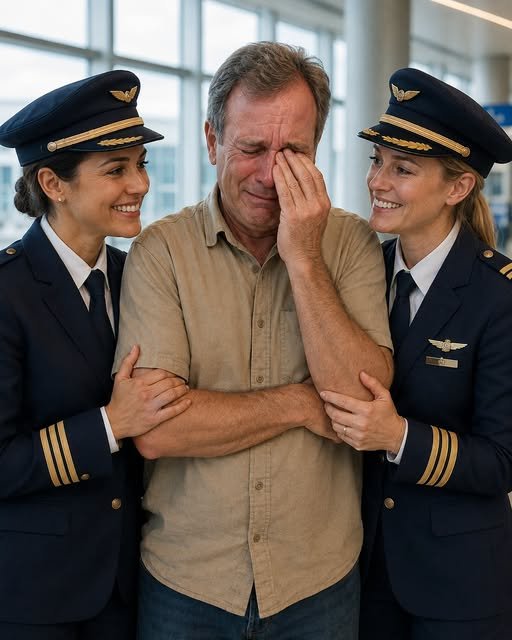
And near Gate 17, an elderly man in a faded brown jacket stood between two women in airline uniforms, crying so hard he could barely remain on his feet.
One woman wore four gold stripes on her shoulders.
The other wore three.
Both had polished black shoes, dark navy uniforms, and silver wings pinned above their hearts.
But the old man wasn’t looking at the wings.
He was looking at their faces.
“My girls,” he whispered.
His rough hands—hands scarred by years of concrete, farm tools, loading docks, and steering wheels—rose shakily toward them.
“My little girls.”
Captain Hannah Carter wrapped both arms around him.
Her younger sister, First Officer Lily Carter, pressed her forehead against his shoulder.
Their father, Samuel Carter, began sobbing again.
People nearby smiled, though none of them knew why the moment mattered.
They didn’t know that Samuel had once skipped dinner for three days so Hannah could attend a school science competition.
They didn’t know he had taught himself basic algebra at forty years old because Lily had been too embarrassed to tell her teacher she couldn’t understand her homework.
They didn’t know that he had sold the only home he had ever owned so his daughters could continue flight school.
They didn’t know that for nearly twenty years, whenever Samuel heard an airplane passing overhead, he would step outside, shield his eyes from the sun, and wonder if one of his daughters might be up there.
And they certainly didn’t know where Hannah and Lily were taking him that afternoon.
Samuel didn’t know either.
He only knew that his daughters had arrived at his small rented house outside Las Cruces three days earlier and told him to pack one good shirt.
“Where are we going?” he had asked.
Hannah smiled.
“You’ve spent your whole life taking us where we needed to go.”
Lily kissed his cheek.
“This time, Dad, we’re taking you.”
Now, standing inside the airport, Samuel stared through the huge glass windows at the aircraft waiting beyond the gate.
Its nose pointed toward the endless New Mexico sky.
For most passengers, it was simply another airplane.
To Samuel Carter, it was the end of a journey that had begun decades earlier in a house with a leaking roof, two frightened little girls, and a promise made beside his wife’s hospital bed.
A promise he had nearly broken a hundred times.
But never did.
Part 2 — The Promise
Twenty-eight years earlier, Samuel Carter had not been a remarkable man.
At least, that was what he believed.
He had grown up outside Deming, New Mexico, and left high school before graduation after his father injured his back.
By twenty-five, Samuel had worked more jobs than he could count.
He picked onions.
He repaired fences.
He stacked produce.
He poured concrete.
He drove an old delivery truck with a transmission that groaned every time he shifted into second gear.
He wasn’t ashamed of hard work.
But he had always been ashamed of one thing.
He struggled to read.
He could manage road signs, grocery labels, and simple instructions, but paperwork frightened him.
Whenever someone handed him a form, Samuel would usually say, “Forgot my glasses,” even though he didn’t own glasses.
Then he met Rebecca.
She worked at a small diner along Interstate 10 and had a laugh loud enough to turn every head in the room.
Rebecca never mocked Samuel when he stumbled over words.
Instead, she’d sit beside him after dinner and help him sound them out.
“You’re not stupid, Sam,” she once told him.
“Nobody taught you properly. That’s different.”
Samuel never forgot it.
They married in a courthouse ceremony with nine guests, a grocery-store cake, and seventy-three dollars left in their checking account.
Two years later, Hannah was born.
Then came Lily.
Their house was tiny—a weathered adobe place surrounded by dust, mesquite, and an endless horizon—but Samuel thought he was the richest man alive.
Until Rebecca got sick.
It happened quickly.
First came exhaustion.
Then appointments.
Then long drives to specialists.
Within a year, Samuel was spending nights in a hospital chair while neighbors watched the girls.
Hannah was five.
Lily was three.
On Rebecca’s last clear evening, Samuel sat beside her bed holding both of her hands.
She was too weak to speak loudly.
“Promise me something.”
“Anything.”
“Don’t let them shrink their dreams because we’re poor.”
Samuel’s jaw tightened.
“Becca…”
“They’re smart girls.”
“I know.”
“Make sure they know it too.”
Samuel bowed his head.
Rebecca squeezed his fingers.
“If they want something bigger than this town… don’t be afraid to let them go.”
Samuel looked at her then.
His eyes filled with tears.
“How am I supposed to raise them without you?”
Rebecca gave him the faintest smile.
“The same way you’ve always loved us. One day at a time.”
She died before sunrise.
For weeks afterward, Samuel moved through life like a man walking underwater.
He burned breakfast.
Forgot laundry in the washer.
Put Lily’s shoes on the wrong feet.
Sent Hannah to school with a lunch containing nothing but crackers, an apple, and an unopened can of beans because he hadn’t known what else to pack.
One morning, Hannah found him sitting on the kitchen floor.
He was holding one of Rebecca’s sweaters.
“Daddy?”
Samuel quickly wiped his face.
“Yeah, sweetheart?”
“Are we going to be okay?”
He looked at his five-year-old daughter.
Then at three-year-old Lily, dragging a blanket behind her.
Samuel had absolutely no idea.
But he remembered Rebecca’s words.
One day at a time.
So he stood.
He made pancakes.
They were terrible.
The girls ate them anyway.
And from that morning forward, Samuel Carter decided that whatever happened to him, his daughters would never grow up believing poverty was the same thing as destiny.

Part 3 — Rice, Pencils, and Airplanes
Life did not become easier because Samuel had made a promise.
If anything, it became harder.
His days began before five in the morning.
He worked construction when crews needed him. On other days, he unloaded produce trucks at a warehouse.
Three evenings a week, he cleaned classrooms at an elementary school.
On Saturdays, he repaired fences and hauled scrap metal for extra cash.
There were months when every dollar had a destination before Samuel even earned it.
Rent.
Electricity.
Gas.
School supplies.
Food.
There was rarely anything left.
Hannah and Lily wore thrift-store jeans and handed-down coats.
Samuel learned how to stitch torn knees because replacing pants wasn’t always possible.
He learned to braid hair after watching another father do it outside kindergarten.
His first attempts were crooked enough to make Lily cry.
“Daddy, I look weird.”
Samuel examined the lopsided braid.
“You look… aerodynamic.”
“What does that mean?”
“I have no idea, but it sounds good.”
Hannah burst out laughing.
Soon Lily did too.
Their home was poor, but Samuel fought fiercely to keep it from feeling hopeless.
On Sunday mornings, he made cinnamon toast.
On summer nights, they carried blankets outside and watched the stars.
Whenever one of the girls received a good grade, Samuel taped the paper to the refrigerator as though it were a diploma from Harvard.
Then came the airplanes.
Their house was not directly beneath a major flight path, but aircraft crossing southern New Mexico were common enough that the girls noticed them.
One afternoon, when Hannah was nine and Lily seven, Samuel took them to Albuquerque for the first time.
They couldn’t afford attractions, so he packed sandwiches and drove three hours north in his aging pickup.
On the way back, they stopped near the airport.
The girls stood beside a chain-link fence watching planes climb into the sky.
Hannah was speechless.
Lily jumped every time an engine roared.
“Dad!” she shouted. “Look how huge that one is!”
Samuel laughed.
“Hard to miss.”
A jet lifted gracefully from the runway.
Hannah pressed her fingers against the fence.
“What do you think it feels like?”
“To fly?”
She nodded.
Samuel had never flown in his life.
“Probably feels like the world got bigger.”
Hannah looked at him.
“Can girls fly planes?”
Samuel frowned.
“Why couldn’t they?”
“I’ve never seen one.”
“Doesn’t mean they aren’t up there.”
Another aircraft passed overhead.
Samuel pointed toward it.
“Maybe someday that’ll be you.”
Hannah laughed.
“Me?”
“Sure.”
Then he looked at Lily.
“Both of you. Two pilots.”
Lily giggled.
“You’re crazy, Dad.”
“Probably.”
He grinned.
“But if you two ever walked through an airport wearing those pilot uniforms, I’d be the loudest father in America.”
The girls forgot the conversation by dinner.
Samuel did not.
A few weeks later, he found a library book about airplanes.
It was written for children.
That was exactly why he borrowed it.
After the girls went to sleep, Samuel sat beneath the yellow light above the kitchen table and slowly worked through the words.
Altitude.
Navigation.
Engine.
Cockpit.
Runway.
He sounded each one out quietly.
The next night, he learned five more.
Samuel was teaching himself to read so he could help his daughters learn.
And strangely, the airplanes gave him courage too.
Part 4 — “People Like Us Don’t Do Things Like That”
By middle school, Hannah’s fascination with flying had become serious.
She read everything she could find about aviation.
She built model airplanes from discarded cardboard.
She memorized aircraft types.
At fourteen, she could explain lift better than most adults.
Lily was different.
She loved math.
Numbers made sense to her in ways people sometimes didn’t.
She began calculating distances between cities and estimating flight times for fun.
Samuel watched all of it with quiet amazement.
Maybe, he thought, that silly afternoon by the airport hadn’t been silly at all.
Then reality arrived.
During Hannah’s sophomore year, her class attended a career fair.
An aviation program had a booth there.
Hannah came home carrying brochures.
“Dad.”
Samuel was repairing the kitchen faucet.
“Yeah?”
“There are colleges where you can study aviation.”
He looked up.
“Okay.”
“And flight schools.”
“Okay.”
“And you can train to become a commercial pilot.”
Samuel smiled.
“Sounds like somebody’s been doing research.”
But Hannah wasn’t smiling.
She handed him the brochure.
He stared at the page.
The numbers might as well have been written in another language.
Tuition.
Flight hours.
Training fees.
Certifications.
Even with scholarships, it would cost more money than Samuel had seen in his entire life.
Hannah watched his face.
Then quietly took the brochure back.
“Forget it.”
Samuel straightened.
“What?”
“I said forget it.”
“Hannah—”
“It was stupid.”
She walked toward her room.
Samuel followed.
“Hold up.”
She turned.
Her eyes were wet.
“People like us don’t do things like that, Dad.”
The sentence hit him harder than any insult ever had.
People like us.
Those were exactly the words Rebecca had begged him to fight.
Samuel crossed the room.
“Who told you that?”
“Nobody had to.”
“Then don’t tell it to yourself.”
“You saw the price.”
“I saw numbers.”
“That’s the same thing.”
“No, it isn’t.”
Hannah stared at him.
Samuel pointed at her chest.
“Money is a problem. Problems can be worked on. But the minute you decide you don’t belong somewhere because you’re poor, you’ve solved the problem for everybody who ever doubted you.”
She looked away.
Samuel lowered his voice.
“You want to fly?”
A pause.
“Yes.”
“Then we’re going to figure out what it takes.”
“Dad, you can’t just—”
“I didn’t say I could pay for everything.”
He smiled.
“I said we’d figure it out.”
Lily had been listening from the hallway.
“What if I want to fly too?”
Samuel turned.
“You’re going to make me work until I’m ninety, aren’t you?”
Lily smiled.
“Probably.”
Samuel opened his arms.
“Then come here, troublemaker.”
Both girls hugged him.
That night, after they were asleep, Samuel spread the aviation brochures across the kitchen table.
He stared at the tuition estimates.
His hands trembled.
For the first time, he understood exactly how enormous their dreams were.
Then he pulled out a notebook.
At the top of the first page, in slow, uneven handwriting, he wrote:
Hannah and Lily — Flight School.
Below it:
Step 1: Find out how.
Part 5 — The Things He Sold
Over the next several years, Samuel became an expert in finding possibilities where other people saw closed doors.
He asked teachers about scholarships.
He called aviation programs.
When complicated forms arrived, he went to the library and asked for help rather than pretending he understood them.
That alone required more courage than his daughters realized.
Hannah earned strong grades and received academic aid to attend a state university with an aviation partnership.
Lily, two years behind her, earned scholarships of her own.
But flight training remained expensive.
There were medical examinations, instruction fees, aircraft rentals, testing costs, housing, books, transportation, and hour requirements.
So Samuel worked.
And worked.
And worked.
He sold his pickup and bought an older compact car.
He sold Rebecca’s old dining set after carefully asking the girls if they wanted to keep it.
He sold the small tractor he’d purchased secondhand.
Then, during Hannah’s second year in college and Lily’s senior year of high school, disaster came.
Samuel injured his shoulder lifting equipment at a warehouse.
The doctor told him heavy labor would have to stop for months.
The timing could not have been worse.
Hannah needed additional flight hours.
Lily had been accepted into an aviation program.
Samuel’s savings were almost gone.
One rainy evening, he called both daughters to the kitchen.
“There are a few things we need to talk about.”
Hannah immediately knew something was wrong.
“Are you okay?”
“I’m fine.”
“You’re lying.”
“I’m mostly fine.”
He smiled weakly.
Then he placed a folder on the table.
Inside were papers.
The house had been paid off several years earlier after Samuel received a small inheritance from an uncle and spent nearly every extra dollar reducing the mortgage.
It was the one piece of security he had.
Their childhood home.
Rebecca’s roses still grew beside the porch.
The pencil marks showing the girls’ heights were still inside the pantry door.
Samuel had put it up for sale.
Hannah went pale.
“No.”
“Honey—”
“No. Absolutely not.”
Lily looked equally horrified.
“Dad, this is our house.”
“It’s a house.”
“Mom lived here!”
Samuel’s voice softened.
“I know.”
Hannah pushed the folder away.
“We’ll quit.”
“No.”
“I can get another degree.”
“No.”
“Dad, listen to me!”
“I am listening.”
“You need somewhere to live!”
“I’ll rent.”
“You’re selling everything!”
Samuel leaned back in his chair.
For a moment, nobody spoke.
Then he said quietly, “Do you remember when you were little and I took you to watch airplanes?”
Hannah’s eyes filled.
“Dad, don’t.”
“I told you it’d be my greatest joy to see you fly.”
“We were kids.”
“I wasn’t.”
Lily covered her mouth.
Samuel looked toward the worn walls surrounding them.
“This house kept us safe. Your mother loved this place. So do I.”
His voice broke.
“But your mother never asked me to protect a building.”
Tears slipped down Hannah’s face.
“She asked me to protect your future.”
Lily stood and walked around the table.
She knelt beside her father.
“We can’t let you do this.”
Samuel placed his hand against her cheek.
“You girls think I’m sacrificing everything.”
He shook his head.
“You are my everything.”
The house sold six weeks later.
Samuel moved into a one-bedroom rental.
He kept only a few things from the old home.
Rebecca’s photograph.
The pantry door with the girls’ height marks, which he carefully removed and stored.
A chipped blue coffee mug Hannah had painted at age eight.
And the aviation book he’d borrowed so often from the library that years later, the librarian had given him an old discarded copy.
The money did not magically solve every financial problem.
Hannah and Lily still worked part-time.
They applied for grants.
They took responsible student loans.
They accepted every scholarship they could find.
They trained, studied, failed check rides, passed others, built hours as flight instructors, flew small charter routes, and lived in apartments with roommates.
Nothing came easily.
But whenever quitting felt tempting, they remembered the empty space where their childhood home had once stood.
Their father had bet his entire future on them.
They refused to waste it.

Part 6 — The Years in the Sky
The first phone call came on a Tuesday morning.
Samuel was working part-time as a shuttle driver at a retirement community.
His cell phone rang.
“Dad!”
It was Hannah.
She was crying.
Samuel immediately pulled to the side of the road.
“What happened?”
“I got the job.”
“What job?”
“The regional airline!”
For three seconds, Samuel said nothing.
Then he yelled so loudly that a resident sitting behind him dropped her crossword puzzle.
“My daughter is an airline pilot!”
The elderly passenger laughed.
Samuel turned around.
“My daughter is an airline pilot!”
“Congratulations!”
He called everyone he knew.
The librarian.
His old construction foreman.
Two former teachers.
A mechanic named Luis who had once repaired his car for free.
The cashier at the grocery store heard the story three times that week.
Two years later, Lily called.
“Dad.”
Samuel instantly recognized the tone.
“No.”
“Yes.”
“You got it?”
“I got it.”
Samuel sat down on the edge of his bed.
Both daughters were now professional pilots.
The dream that once sounded ridiculous in a dusty town had become real.
But success did not arrive all at once.
There were long reserve schedules.
Missed holidays.
Early mornings.
Training evaluations.
Red-eye flights.
Career setbacks.
Company changes.
Years of building seniority.
Samuel never complained when Christmas dinner happened on December 27.
He never minded answering phone calls at strange hours.
He kept a map beside his kitchen and marked cities his daughters mentioned.
Denver.
Phoenix.
Dallas.
Seattle.
Chicago.
Boston.
He had never visited most of them.
Sometimes, neighbors asked why he didn’t fly for free using family benefits.
Samuel always had an excuse.
“Too busy.”
“Maybe next year.”
“Airports are confusing.”
The truth was simpler.
Samuel had never flown.
The man who had spent half his life dreaming about airplanes was afraid of them.
Hannah discovered this by accident.
“You’re scared?”
“I am not scared.”
“Dad.”
Samuel sighed.
“Maybe a little.”
Lily laughed for ten straight minutes when Hannah told her.
But there was something else too.
Samuel had become so used to denying himself things that pleasure made him uncomfortable.
Buying new shoes felt wasteful.
Eating at a nice restaurant made him check prices before every bite.
Travel seemed like something meant for other people.
His daughters noticed.
And they began planning.
Years passed.
Hannah eventually became a captain for a major U.S. airline.
Lily joined the same company several years later as a first officer.
It took schedule changes, careful requests, and help from colleagues, but eventually something remarkable became possible.
The sisters were assigned to the same special employee-recognition flight.
Hannah would be captain.
Lily would serve as first officer.
And there would be one passenger aboard whose name mattered more to them than anyone else’s.
Samuel Carter.
Part 7 — “Put on Your Good Shirt”
Samuel was sixty-four when his daughters arrived unannounced at his rental house.
He was in the backyard trying to repair a lawn chair with duct tape.
Hannah looked at the chair.
“You know they sell new ones.”
Samuel frowned.
“This one has another ten years.”
“The seat is mostly tape.”
“High-quality tape.”
Lily walked past them carrying a suitcase.
Samuel stared.
“Why do you have luggage?”
“For you.”
“I didn’t ask for luggage.”
“We know.”
Hannah handed him a garment bag.
Inside was a dark navy suit.
Samuel looked from the suit to his daughters.
“What did you two do?”
“Nothing illegal,” Lily said.
“That answer is not comforting.”
“Pack for three days,” Hannah said.
“Where are we going?”
“Can’t tell you.”
“I don’t like surprises.”
“You raised two daughters alone. Your entire life has been surprises.”
Samuel tried every argument.
He had chores.
He needed to check his mail.
His neighbor might need help fixing a gate.
He hadn’t prepared.
Neither daughter listened.
Three mornings later, they walked into Albuquerque International Sunport.
Samuel wore his new suit.
Hannah and Lily wore civilian clothes.
At first.
Then they disappeared into a restroom.
When they emerged, both were in full uniform.
Samuel stopped walking.
The airport seemed to disappear around him.
He saw Hannah at nine years old, fingers curled through a chain-link fence.
He saw Lily standing beside her.
He heard his own younger voice.
Maybe someday that’ll be you.
Hannah approached.
“Dad?”
Samuel’s lips moved.
No sound came.
Then he touched the wings pinned above Hannah’s heart.
He turned to Lily and touched hers.
“You both…”
Lily smiled through tears.
“We both did it.”
Samuel’s face crumpled.
He pulled them into his arms.
That was the moment strangers began to stop and watch.
The old man crying between two pilots.
The daughters holding the father who had once held their entire world together.
Finally, Samuel stepped back.
“So where exactly are we going?”
Hannah looked toward Gate 17.
“You’ll see.”
At the gate, an airline manager greeted Samuel.
“Mr. Carter?”
“Yes?”
She held out her hand.
“I’ve heard a lot about you.”
Samuel glanced suspiciously at his daughters.
“What have you been telling people?”
“Mostly embarrassing things,” Lily said.
The manager smiled.
“We’d like you to be our guest of honor today.”
Samuel stared.
“Guest of what?”
Then the announcement began.
“Ladies and gentlemen, before boarding Flight 2087, we’d like to recognize a special passenger traveling with us today.”
Samuel froze.
Hannah squeezed his hand.
The gate agent continued.
“Nearly three decades ago, Samuel Carter raised two daughters by himself and encouraged them to pursue an impossible dream. Today, those daughters are the pilots operating this flight.”
Applause erupted around the gate.
Samuel shook his head rapidly.
“No, no, no…”
Lily whispered, “Too late.”
The gate agent smiled.
“Captain Hannah Carter and First Officer Lily Carter would like to welcome their father aboard his very first flight.”
Samuel covered his face.
People stood.
A few cheered.
Someone shouted, “Way to go, Dad!”
Samuel laughed through his tears.
And then he did something his daughters had waited nearly twenty years to see.
He walked down the jet bridge.
Toward an airplane.
Part 8 — The Seat by the Window
Before the other passengers boarded, Samuel was allowed to step into the cockpit while the aircraft remained safely at the gate.
He stood just inside the doorway.
Screens glowed.
Switches covered the panels.
The captain’s seat waited on the left.
The first officer’s seat stood on the right.
Hannah sat down.
Lily took her place beside her.
Samuel gripped the doorframe.
“So this is where you work?”
Hannah smiled.
“This is where we work.”
Samuel looked at the two women.
Not the uniforms.
Not the instruments.
His daughters.
For years, he had imagined this moment.
But imagination had never come close.
Lily pointed toward the jump seat behind them.
“Sit down for a minute, Dad.”
Samuel lowered himself carefully.
Hannah looked back at him.
“Remember the fence?”
He nodded.
“Remember what you said?”
His eyes filled.
“I said a lot of foolish things.”
“No.”
Hannah’s voice softened.
“You said the world would feel bigger from up here.”
Samuel swallowed.
“Well?”
Lily asked.
“Was I right?”
Samuel looked through the cockpit windshield at the runway beyond.
“I haven’t left the ground yet.”
They laughed.
Soon Samuel was escorted to his passenger seat in first class.
Window seat.
Naturally.
When the aircraft began taxiing, Samuel gripped both armrests.
A flight attendant named Melissa leaned toward him.
“You doing okay?”
“I’ve made some mistakes in my life.”
She laughed.
“You’ll be fine.”
The engines grew louder.
Samuel’s heart hammered.
The runway blurred.
Then suddenly—
the ground fell away.
Samuel gasped.
Albuquerque became smaller beneath him.
Roads turned into thin lines.
Buildings became blocks.
Mountains stretched toward the horizon.
And the sky—
the sky seemed endless.
Samuel pressed his hand against the window.
For the first ten minutes, he barely moved.
Then tears rolled silently down his face.
Not frightened tears.
Something deeper.
He thought of Rebecca.
He thought of the night she’d made him promise not to let their daughters shrink their dreams.
He thought of the bad pancakes.
The torn jeans.
The overdue bills.
The library forms.
The empty refrigerator.
The sold truck.
The sold tractor.
The sold house.
The tiny apartment.
The nights he wondered whether he had been foolish.
The years he questioned whether he had given too much.
And now his daughters were somewhere beyond the cockpit door, carrying more than a hundred people safely through the sky.
Samuel whispered toward the window.
“We did it, Becca.”
He wiped his eyes.
“They did it.”
The aircraft continued west.
Samuel still didn’t know the destination.
When Hannah finally made an announcement from the cockpit, her voice filled the cabin.
“Ladies and gentlemen, this is Captain Carter. We’re cruising comfortably and should arrive on schedule.”
Samuel smiled instantly.
Then Hannah continued.
“And Dad, if you’re listening…”
Passengers began laughing.
Samuel shook his head.
“Hannah…”
“Twenty-eight years ago, you told two little girls that flying would make the world feel bigger.”
Her voice trembled slightly.
“Today, Lily and I want to return the favor.”
A pause.
“We’re taking you to the place Mom always dreamed of seeing.”
Samuel stopped breathing.
Outside the window, clouds rolled beneath the aircraft like white mountains.
Hannah finished softly.
“Welcome aboard, Dad. Next stop, Honolulu.”
Samuel covered his mouth.
Rebecca had kept an old magazine picture of Hawaii taped inside a kitchen cabinet.
She used to joke that when they became rich, she wanted to see the Pacific Ocean.
They had never come close.
Samuel closed his eyes.
For a moment, he could hear her laugh.

Part 9 — The Place He Never Dared to Dream Of
When they landed in Honolulu, Samuel expected a hotel.
Instead, his daughters rented a car and drove him toward the coast.
Palm trees moved in the warm breeze.
The ocean flashed blue through gaps between buildings.
Samuel stared like a child.
“You two spent too much money.”
“We haven’t even told you the surprise yet,” Lily said.
Samuel groaned.
“There’s more?”
Hannah pulled onto a quiet road overlooking the water.
They stopped in front of a modest one-story house.
White walls.
Blue shutters.
A small porch.
Nothing enormous.
Nothing extravagant.
But beautiful.
Samuel frowned.
“Whose house is this?”
Hannah handed him a key.
He stared at it.
“No.”
Lily smiled.
“Yes.”
Samuel didn’t take it.
“What did you do?”
“We bought it.”
His face changed.
“For yourselves?”
“For you,” Hannah said.
Samuel stepped backward.
“No.”
“Dad—”
“No. Absolutely not.”
Lily laughed softly.
“You said exactly the same thing when you sold our house.”
“That was different.”
“How?”
“I was your father.”
“And we’re your daughters.”
Samuel looked at the key.
Then at the house.
His voice became unsteady.
“I can’t take something like this.”
Hannah moved closer.
“Do you know why we chose this place?”
Samuel shook his head.
“Not because it’s Hawaii.”
Lily pointed toward the side of the house.
There, growing beside the porch, was a young rosebush.
Rebecca’s favorite kind.
Hannah said, “We had cuttings propagated from the rosebush that used to grow outside our old house. Luis helped us track down the family who owns the property now.”
Samuel stared.
“You… what?”
Lily opened a wooden box she’d been carrying.
Inside was the old section of pantry door Samuel had saved—the one covered in pencil marks.
Hannah — age 7
Lily — age 5
Hannah — age 10
Lily — age 8
Samuel reached for it with both hands.
“We found it in your storage unit,” Lily said.
“We’re putting it in the kitchen.”
Samuel could no longer speak.
Hannah finally placed the key into his palm.
“You gave up your home because you believed we needed wings more than you needed walls.”
She looked toward the little house.
“So we’re giving you the walls back.”
Samuel shook his head, crying.
“I never wanted you to repay me.”
“We know.”
“You don’t owe me anything.”
“We know that too.”
“Then why?”
Lily smiled.
“Because love isn’t a debt.”
Hannah took his hand.
“And because you spent your whole life telling us we belonged in places we couldn’t imagine.”
She nodded toward the ocean.
“Now it’s your turn.”
They led him around the side of the house.
A path opened toward a lookout above the beach.
Samuel saw the Pacific Ocean for the first time.
Blue stretched all the way to the horizon.
He stood completely still.
Then he slowly removed his shoes.
“What are you doing?” Hannah asked.
Samuel smiled.
“Your mother always said if she made it to the Pacific, she’d put her feet in the water before doing anything else.”
So the three of them walked down to the beach.
Samuel rolled up his pants.
A wave washed over his feet.
He laughed.
Not politely.
Not quietly.
He laughed like the young man Rebecca had once married.
Hannah and Lily stood beside him.
A plane crossed high overhead.
Samuel looked up automatically.
For decades, he’d watched airplanes from the ground and imagined his daughters inside them.
Now his daughters followed his gaze.
“You still watching every plane?” Lily asked.
“Habit.”
Hannah slipped her arm through his.
Samuel watched the aircraft disappear into the distance.
Then he looked at the two women standing beside him.
“No,” he said softly.
“I don’t have to wonder anymore.”
Part 10 — What the Daughters Finally Understood
That evening, they sat on the porch watching the sunset.
Samuel held Rebecca’s photograph in his lap.
Hannah brought him a cup of coffee.
“Dad?”
“Hmm?”
“Can I ask you something?”
“Sure.”
“Were you ever angry?”
“About what?”
“Giving up everything.”
Samuel thought for a moment.
“Sometimes.”
Both daughters looked surprised.
He smiled.
“What? You thought I was some kind of saint?”
Lily laughed.
Samuel looked toward the ocean.
“There were days I was angry at your mother for leaving me, even though I knew she hadn’t chosen to.”
His fingers tightened around the photograph.
“There were days I was angry at life. Angry because other fathers got to rest and I didn’t. Angry because every time we saved a hundred dollars, something broke and cost a hundred and twenty.”
Hannah listened silently.
“There were nights after I sold the house when I wondered whether I’d made the dumbest decision of my life.”
He looked at them.
“But being afraid doesn’t mean you chose wrong.”
Lily leaned forward.
Samuel continued.
“I didn’t raise pilots.”
The sisters exchanged a glance.
“No?”
“I raised two good women.”
His voice softened.
“The pilot part is impressive. I’m proud of it. But that’s not what matters most.”
He pointed toward them.
“You still call each other when one of you is struggling. You treat people with respect. You remember where you came from without being ashamed of it.”
He smiled.
“That’s success.”
Hannah wiped her eyes.
Samuel looked once more at Rebecca’s picture.
“And I think your mother would say the same.”
They sat together until the sky turned dark.
For once, nobody needed to rush anywhere.
No second job.
No class.
No flight lesson.
No departure board.
No bill waiting on the kitchen table.
Just a father and his daughters.
Twenty-eight years after one frightened widower had promised his dying wife that poverty would never decide how far their children could go.
Epilogue — The Man Who Never Flew
Samuel eventually returned to New Mexico for part of each year.
He insisted that he was “not becoming one of those beach people,” although his daughters noticed that he kept sandals beside the front door in Hawaii.
He also began volunteering twice a week with an adult literacy program.
On his first day, a fifty-two-year-old man quietly admitted that he was embarrassed because reading had always been difficult.
Samuel smiled.
“I know exactly how that feels.”
The man looked surprised.
Samuel pointed toward a workbook.
“Start with one word.”
He paused.
“Then another.”
Years later, Hannah asked her father what he considered the proudest moment of his life.
She expected him to mention seeing both daughters in uniform.
Or his first flight.
Or the house in Hawaii.
Samuel shook his head.
“It was a Tuesday night.”
Hannah frowned.
“What Tuesday?”
“You were sixteen.”
“I don’t remember.”
“You probably wouldn’t.”
He smiled.
“You came home after getting the highest score in your math class. Lily was at the table doing homework. We had twenty-eight dollars left until payday, and the refrigerator was nearly empty.”
Hannah stared at him.
Samuel continued.
“You put that test on the fridge and said, ‘Dad, I think I might actually be good at something.’”
His eyes softened.
“That was when I knew.”
“Knew what?”
“That all I had to do was keep the door open long enough for you girls to see what I already saw.”
Hannah cried.
Samuel laughed and handed her a tissue.
People later told the Carter sisters that their father had given them wings.
They always corrected them.
“No,” Hannah would say.
“Dad gave us something more important.”
“He taught us,” Lily would add, “that where you begin doesn’t get to decide where you finish.”
And maybe that was the real miracle.
Not that two poor girls became pilots.
Not that an aging widower finally boarded an airplane.
Not even that a father who once sold his house was given another one beside the ocean.
The miracle was that Samuel Carter never allowed hardship to become a prophecy.
He had little money.
Little education.
No special connections.
No secret advantage.
What he had was a promise.
Two daughters.
And the stubborn belief that their future could be larger than their circumstances.
For years, he stood on the ground and pointed toward the sky.
“Someday,” he told them.
And twenty-eight years later, his daughters came home wearing silver wings.
Then they took their father’s hands…
and finally showed him how big the world really was.