
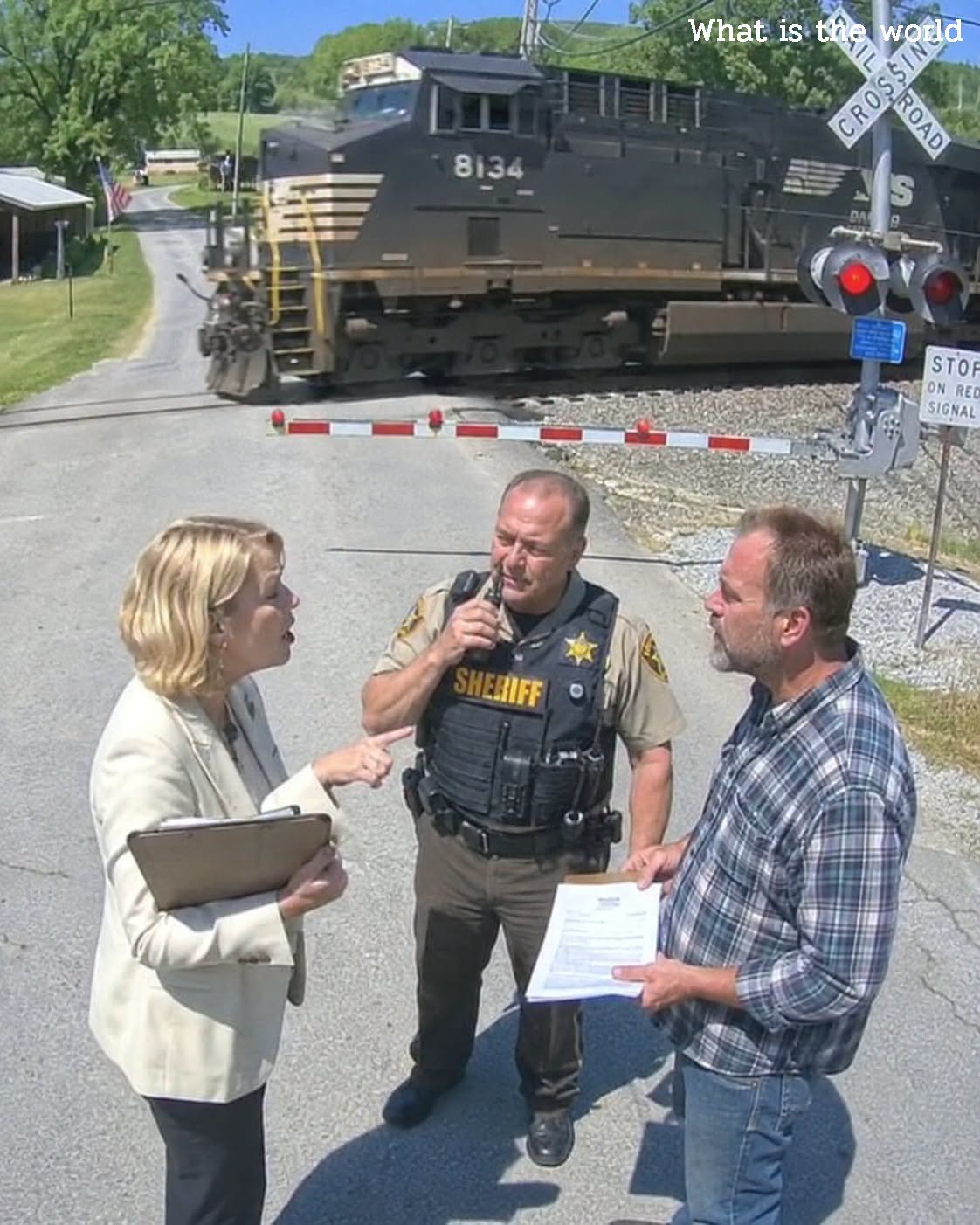
If a locomotive engineer or a dispatcher has any reason to suspect a crossing gate might be malfunctioning, or if there is excessive civilian interference at a public crossing, the protocol is clear.
The train must come to a full and complete stop.
The engineer must physically dismount, inspect the crossing arm, verify the safety mechanisms, log the inspection, and only then proceed.
It’s entirely legal. It’s entirely justified.
And stopping 60 tons of industrial steel in the middle of a suburban neighborhood is entirely unmistakable.
The morning of the run was cold.
The air in the cab of my Meridian Freight locomotive smelled like hot metal and diesel fumes.
My hands rested lightly on the controls as we rolled through the Harwick County hollows at a steady 35 miles per hour.
I knew exactly what was waiting for me.
The night before, Darlene had sent out an emergency email blast to all 200 homes in Ridgeline Pines.
She claimed the HOA was “under attack” by me, a rogue resident, and demanded a show of solidarity.
She wanted a crowd at the tracks to protest the train and prove to the county that the crossing was a nuisance.
As we rounded the curve past the Durban Road bridge, the crossing came into view.
The warning lights triggered. The bells started ringing. The striped gate arms began their descent.
I hit the horn. Two longs, a short, and a long. The federal standard.
And there she was.
Darlene Whitmore, wearing her cream blazer, holding her clipboard, standing at the edge of the gravel ballast.
Behind her were about seventeen neighbors, most of them in winter coats over their pajamas, looking cold and confused.
There was also a reporter from the Harwick County Ledger with a camera.
And, standing quietly near a utility pole, were two county code enforcement officers. I had a feeling my lawyer, Priscilla Farve, had tipped them off.
At 10:30 the previous night, Darlene had zip-tied a massive, unauthorized plastic protest sign directly to the federal crossing gate arm.
That is a serious code violation.
I began to apply the air brakes.
When you brake a freight train, it doesn’t just stop. It groans.
The sound of steel gripping steel vibrates right up through the floorboards and rattles your teeth.
The massive engine slowed, the hiss of the air brakes echoing off the vinyl siding of the million-dollar homes nearby.
I brought the nose of the locomotive to a halt exactly five feet from the crossing.
The engine idled, a deep, rhythmic thrumming that made the ground shake.
I put on my hard hat, grabbed my inspection tablet and the manila envelope containing the 1952 record, and opened the cab door.
The crisp October air hit my face as I climbed down the iron ladder.
My boots crunched on the gravel.
Seventeen neighbors stared at me. The reporter raised his camera.
Darlene stepped forward, her face flushed with fury.
“You have no right to stop this train here!” she yelled over the idle of the engine. “This is a residential zone! You are harassing this community!”
I didn’t look at her yet.
I walked methodically to the crossing gate arm.
One of the code enforcement officers, a square-jawed guy named Officer Dills, had just finished cutting Darlene’s illegal sign off the mechanism.
“Morning,” I said to Dills.
“Morning, Corbin,” he nodded.
I inspected the gate. I checked the hinges. I tapped my tablet, officially logging the mandatory gate check.
Then I turned to face the HOA president.
“This is a federally mandated safety inspection, Darlene,” I said, my voice carrying easily in the morning air. “Triggered by civilian interference with a railroad mechanism.”
“I am the president of this association!” she snapped, clutching her clipboard to her chest like a shield. “We are petitioning the county to have this crossing abandoned today! You’re trespassing!”
“Actually,” I said, pulling the thick, sealed manila folder from under my arm. “That’s why I brought this.”
I didn’t hand it to her. I held it up so the neighbors—and the reporter’s camera—could see it.
“This is a certified copy of the 1952 Harwick County Annexation Record,” I announced.
The crowd went dead silent. Only the low rumble of the locomotive filled the space between us.
“When Ridgeline Pines was zoned, the county recorded a perpetual, irrevocable access easement for this rail corridor. But they did something else, too.”
I looked directly at Darlene.
“They added a covenant. It states that any successor interest—including an HOA—that attempts to petition for the abandonment of this easement will be in material breach.”
Darlene’s eyes darted left and right. “That’s ancient history,” she scoffed. “Our bylaws supersede—”
“The penalty for that breach,” I interrupted, raising my voice just enough to cut through hers, “is a liquidated damages clause. The moment you file that petition today, this HOA will owe Harwick County $250,000 in penalties.”
A collective gasp swept through the neighbors in pajamas.
“A quarter of a million dollars,” I repeated. “Divided by 200 homes. That’s $1,250 per family. Plus the $18,000 special assessment you tried to force on us to pay your lawyer.”
“He’s lying!” Darlene shouted, but her voice cracked.
“It gets worse,” I said.
I looked at Ruth Ann, the honest board member who had braved the cold to stand with the neighbors. She gave me a small, firm nod.