
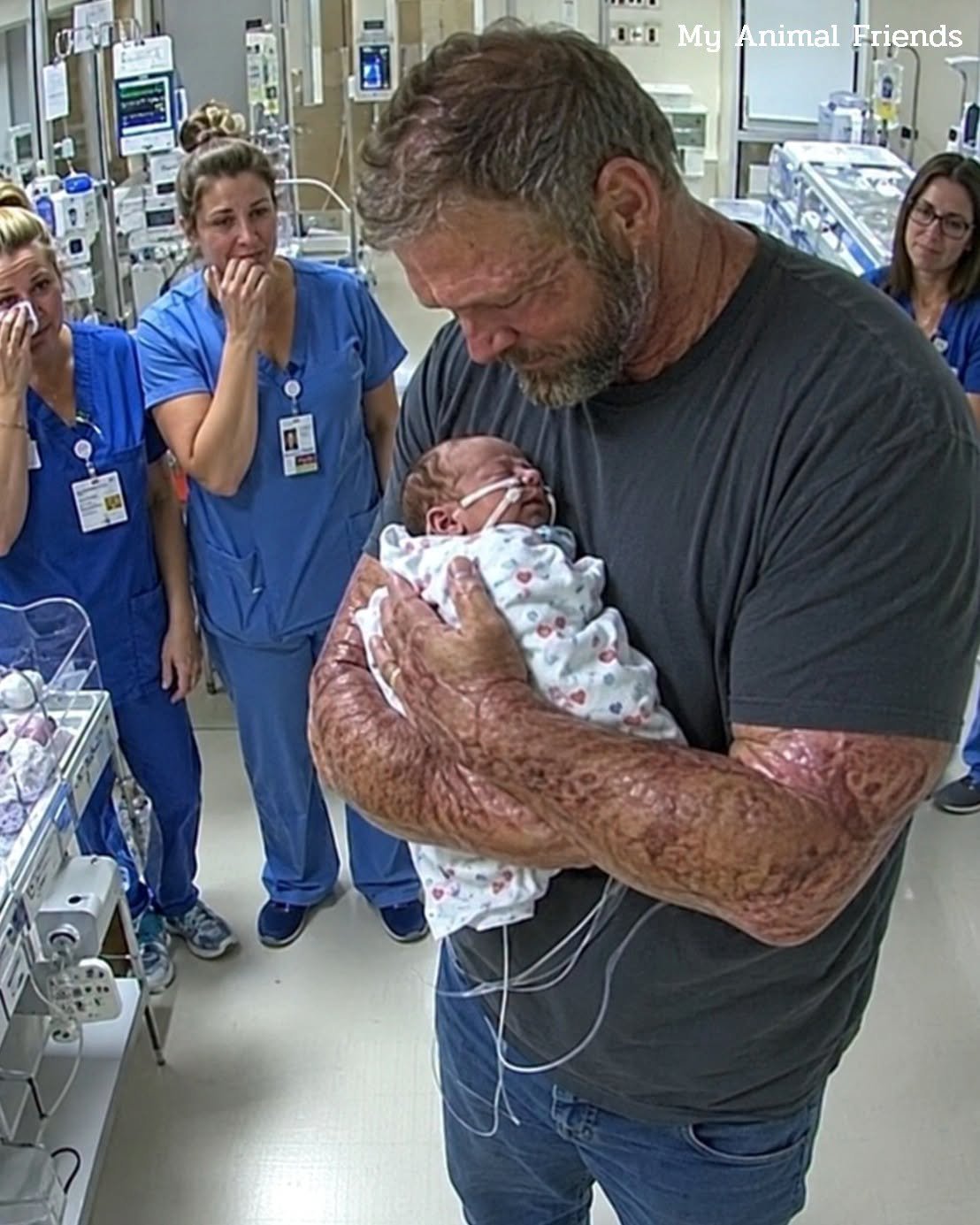
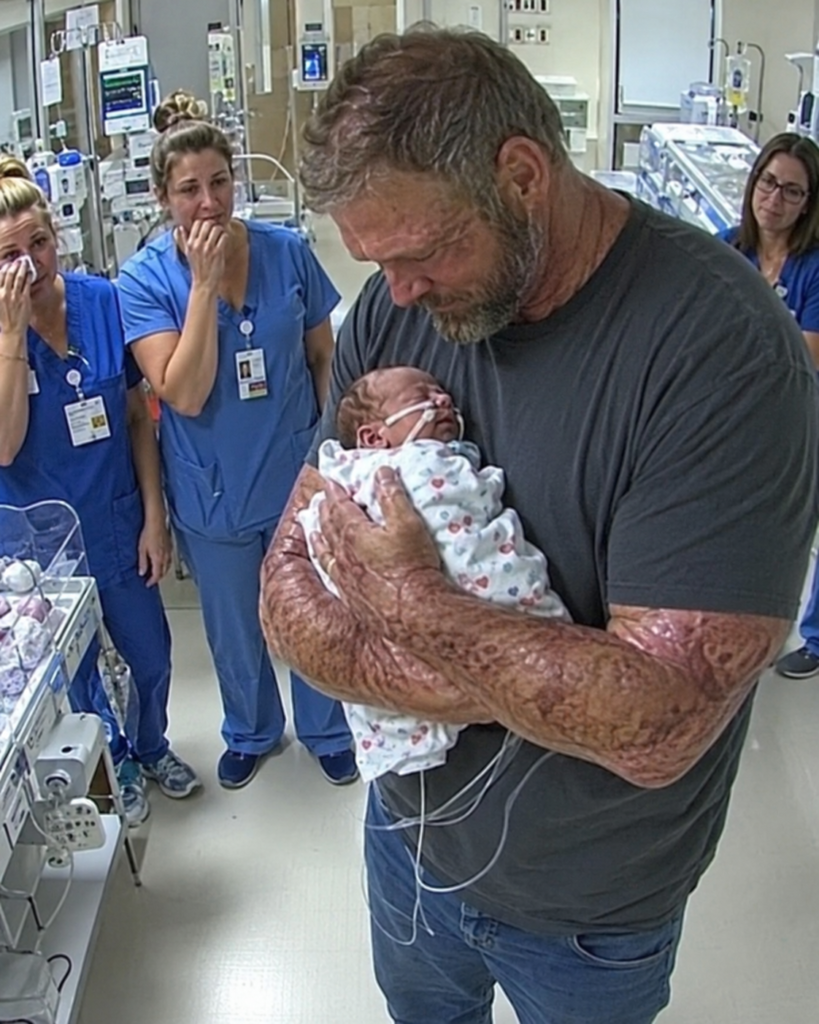
The towering veteran stepped closer to the incubator. “Is that the little one who needs someone to sit with her?” he asked. I hesitated. But the second he held her, and I saw the name engraved on his military dog tag, the entire hospital room fell completely silent…
PART 1

The first time Arthur Vance entered our NICU, I honestly thought he had walked into the wrong area.
I had worked as the charge nurse at St. Jude Medical Center in Omaha, Nebraska, for eleven years. Every part of that unit was familiar to me: the soft rhythm of the monitors, the warm glow around the incubators, and the quiet prayers parents whispered when they thought nobody was listening.
Arthur, though, seemed like he belonged somewhere else entirely.
He was a combat veteran in his early fifties, standing six feet four inches tall with wide shoulders, a strong square jaw, burn scars covering both arms, and huge hands that looked built for battlefields, heavy weapons, and rescuing soldiers from wreckage.
His worn tactical jacket had been removed outside, as hospital rules required. Under the disposable blue gown, he wore a dark shirt, but nothing could hide the slight shaking in his fingers or the hardened, haunted, intimidating presence he carried with him.
Then the tiny baby in bed seven began crying.
Everything changed.
Her chart listed her only as Baby Girl Sterling.
She had arrived far too early, far too fragile, and completely alone. Her mother had disappeared into the cold winter night before the admission paperwork was completed, leaving behind only a heartbreaking toxicology report. No father came forward. No grandparents called. No diaper bag or soft blankets sat beside her incubator.
Some newborns were surrounded by busy hallways, bright balloons, stuffed animals, and family members constantly asking for updates.
Baby Girl Sterling had none of that.
She had only a plastic ID bracelet, a temporary name, and a desperate cry that sounded like every part of her tiny body was begging for help. She was fighting a battle she had never chosen.
That morning, we had already tried every safe option available. We lowered the lights, followed every medical procedure, adjusted her swaddle, tracked her fragile vital signs, and watched every small change that could matter.
She continued crying, her tiny body curling from the pain.
Arthur turned toward the sound, his jaw tightening.
“Is that the little one who needs someone to sit with her?”
I looked at the volunteer badge attached to his gown. He had completed every background check. He had passed strict psychological evaluations. He had received official approval for the infant comfort program.
Still, my eyes went to his hands.
They were massive, deeply scarred, and trembling because of permanent nerve damage.
For one painful, embarrassing moment, I wondered if hands like his could safely hold a two-pound baby, or if the unseen weight he carried inside might overwhelm them both.
Despite every instinct warning me, I stepped aside.
He washed his hands at the sink, the water splattering unevenly against his shaking knuckles. Slowly, battling the violent tremors in his own body, he reached his large hands into the incubator.
The instant his rough skin touched the sterile blanket, the baby cried out sharply, making the other nurses freeze.
Arthur’s eyes widened. His pupils expanded. Sweat immediately formed on his forehead.
The alarms sounded—a sharp, repeating countdown.
He froze completely, his chest rising and falling rapidly.
To him, those chaotic sounds were not just hospital monitors.
They were warning signals.
He was back in the dirt.
“Mr. Vance, step back,” I ordered, reaching toward his arm.
“No,” he rasped, his voice strained, his eyes forcing themselves back into the present. “I’ve got her.”
And then, the enormous veteran did something that left everyone in the room completely stunned…
PART 2
Instead of removing his hands, Arthur took one deep, steady breath and closed his eyes until the shaking in his fingers began to calm.
He did not lift the baby right away.
With incredible care, he simply placed his right hand around her tiny trembling head while resting his left hand gently over her fragile chest.

He stayed completely still.
He became her anchor. As he leaned closer, the collar of his gown shifted slightly. A silver military dog tag slipped out, catching the fluorescent light above.
Etched into the worn metal was one line:
CPT ARTHUR VANCE — U.S. ARMY — S. STERLING (DONOR)
I froze.
My breath stopped.
The surname engraved on his dog tag—Sterling—was the same name listed on the abandoned baby’s chart.
Ten years earlier, a young soldier named Samuel Sterling had given his life in the Middle East while pulling his commander from a burning armored vehicle. Captain Arthur Vance survived that day, but he carried severe burn scars, permanent nerve damage, and a crushing burden of guilt ever since.
For ten years, Arthur had searched for Samuel’s family, only to discover later that Samuel’s younger sister had fallen into addiction and poverty. When she left her newborn at our hospital three days earlier, she had no idea the man her brother saved was living in the same city.
Arthur had not entered our NICU by coincidence.
He had been searching for this baby.
As he hummed a deep, rough melody—an old military marching tune slowed into a soft lullaby—the impossible happened.
The baby’s frantic, piercing cries began to fade.
Baby Girl Sterling’s heart rate, which had been dangerously high on the monitor, started slowly dropping.
180… 160… 140.
Her tiny shaking fingers reached outward and wrapped tightly around one of Arthur’s enormous, scarred thumbs.
The entire NICU became completely silent.
Nurses stopped where they stood.
The sharp alarms disappeared.
Arthur opened his eyes, tears slowly tracing down his scarred cheeks.
“I’m here, little one,” he whispered softly, his voice heavy with emotion. “Your uncle saved my life. Now it’s my turn to fight for yours.”
PART 3
For the next four weeks, Arthur did not miss a single day.
Every evening at 6:00 PM, the towering combat veteran would wash his hands, sit in the rocking chair beside bed seven, and hold the tiny baby against his chest for hours.
The trembling in his hands, which had followed him for a decade, vanished whenever he held her.
The warmth from his body helped regulate her temperature, and the steady beat of his heart soothed her nervous system.
With Arthur beside her, Baby Girl Sterling began to grow stronger.
Her weight doubled, her vital signs became stable, and the withdrawal symptoms that had troubled her first days slowly disappeared.
The hospital staff called her a medical miracle.
But we all understood the truth.
She did not only need treatment.
She needed to know that someone would stay.
When the state family services department began guardianship proceedings, Arthur was the first person to step forward.
With support from military commanders who provided character references, his flawless volunteer history, and clear medical evidence showing the baby’s improvement under his care, Arthur received temporary emergency custody.
On the day she was finally cleared to leave the hospital, the nurses gathered along the hallway to say goodbye.
Arthur wore his clean dress uniform, looking every bit like the commander he had always been.
In his arms, wrapped in a soft pink blanket, was the little girl who had once been abandoned in bed seven.

Before leaving, he stopped beside my desk.
“Thank you, Nurse Clara,” he said quietly. “For stepping aside that first day.”
I looked at the large man with scarred arms, now holding the tiny life he had promised to protect.
“I doubted you for a second, Arthur,” I admitted softly. “I thought your hands were too rough.”
Arthur looked down at the sleeping baby in his arms and smiled—a real, peaceful smile that finally reached his eyes.
“Sometimes, Clara,” he said softly, “it takes broken hands to hold something fragile.”
Then he turned and walked down the hallway toward the exit, his shoulders straight, his steps lighter, and his heart finally at peace.