
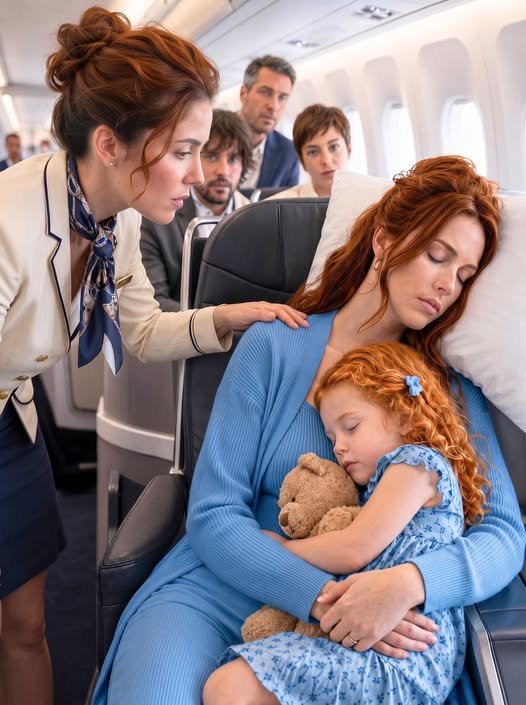
PART 1 — THE WOMAN IN SEAT 8A
For almost two hours, the overnight flight from New York to Madrid had been uneventful.
The commercial jet cruised high above the Atlantic while most of its nearly three hundred passengers settled into the familiar rhythm of a long international flight. Some watched movies beneath dimmed cabin lights. Others whispered quietly to their companions. Children slept against their parents’ shoulders while the endless darkness of the ocean stretched far below.
In seat 8A, thirty-eight-year-old Laura Vance had finally fallen asleep.
A soft blanket covered her legs. A closed book rested loosely in her hands, and she wore a simple green sweater that made her look like any other tired traveler hoping to reach Europe without interruption.
Nothing about her drew attention.
And that was exactly how Laura wanted it.
Then the captain’s voice came over the intercom.
“If there is anyone aboard with fighter-pilot experience, please identify yourself to a member of the cabin crew immediately.”
Within seconds, the atmosphere inside the aircraft changed.
Conversations stopped.
Passengers lowered their headphones.
Several people looked around as if they had misheard the announcement.
A fighter pilot?
On a commercial passenger jet?
Why would the captain possibly need one?
Uneasy murmurs spread through the rows.
Laura opened her eyes.
She remained motionless for a moment, staring at the dark window beside her.
Then the announcement came again.
“Ladies and gentlemen, this is your captain. We are dealing with a technical situation requiring immediate assistance. Anyone with military fighter-pilot experience should contact a flight attendant now.”
The wording was calm.
The voice was controlled.
But Laura heard something most passengers probably missed.
Fear.
Not panic.
Not yet.
But the carefully restrained fear of a pilot who knew a situation was getting worse faster than he could control it.
Laura knew that voice because she had once spoken with the same tone.
Years earlier, she had been one of the most accomplished fighter pilots in the United States Air Force.
She had flown F-16s in situations where hesitation could cost lives and where decisions measured in seconds could determine whether someone returned home.
Flying had once been more than her career.
It had been part of who she was.
But eighteen months earlier, everything had changed.
One terrible accident had ended that life.
Afterward, Laura wanted nothing to do with uniforms, medals, recognition, or people calling her brave.
She walked away from military aviation.
More importantly, she walked away from the responsibility of having other people’s lives depend on her judgment.
That was why she had chosen seat 8A.
A quiet window seat.
A place where she could become invisible.
Now a flight attendant hurried through the aisle, glancing from face to face.
Laura lowered her eyes.
She told herself there would be someone else.
Surely, among hundreds of passengers, another experienced pilot would come forward.
Someone current.
Someone who still belonged in a cockpit.
Someone who had not spent the last year and a half trying to forget what flying felt like.
But nobody stood.
The flight attendant reached Laura’s row.
“Excuse me, ma’am,” she said urgently. “Do you happen to know whether anyone near you has military aviation experience? The captain urgently needs a military pilot.”
Laura looked toward the aisle.
Across the cabin, a little boy clung to his mother’s arm.
A woman several rows ahead was holding her husband’s hand with both of hers.
Another parent leaned over a sleeping child as though simply being closer could somehow keep danger away.
Laura felt something tighten inside her.
For eighteen months, she had built walls around the part of herself that had once been Captain Laura Vance.
She had believed those walls were necessary.
Then an old principle came back to her with painful clarity.
A pilot did not walk away when people needed help.
Laura slowly released her seat belt.
“I’m a pilot.”
The flight attendant blinked.
“I’m sorry?”
Laura stood.
The exhausted traveler who had been curled against the window seemed to disappear.
Her shoulders straightened.
Her eyes sharpened.
Her voice became steady.
“I’m a former United States Air Force fighter pilot,” she said. “I flew F-16s.”
The man seated beside her stared openly.
“You?”
Laura gave him a small nod.
The flight attendant’s expression immediately changed.
Relief replaced uncertainty.
“Please come with me.”
Laura stepped into the aisle.
As she walked toward the front of the aircraft, passengers watched her pass.
She could feel their eyes following her.
None of them knew what she had once been.
None knew what it had cost her to leave that life behind.
And none knew that with every step toward the cockpit, Laura was walking directly back into memories she had spent eighteen months trying to escape.
The reinforced cockpit door opened.
Laura entered.
The first thing she noticed was the smell.
Hot electronics.
Coffee.
And something else that could not be smelled but could almost be felt.
Tension.
Captain Andrew Vance sat in the left seat with both hands gripping the controls.
Beside him, the first officer was slumped unconscious, an oxygen mask secured over his face.
Andrew turned briefly.
His eyes swept over Laura’s sweater and civilian clothes.
“You have military flight experience?”
“Yes.”
“What aircraft?”
“F-16 Falcons.”
“When did you last fly?”
Laura paused.
“About eighteen months ago.”
The captain’s expression tightened.
“I need someone current. Not someone depending on old experience.”
Laura might once have taken offense.
Now she understood.
He was responsible for hundreds of people.
He did not have the luxury of trusting a stranger simply because she claimed to know how to fly.
Before she could answer, the aircraft began to shake.
Not ordinary turbulence.
Laura immediately knew the difference.
The vibration repeated in a mechanical rhythm, traveling through the controls and airframe.
Her eyes moved across the instrument panel.
“How long has the control column been doing that?”
Andrew looked at her more carefully.
“About ten minutes.”
“What happened before it started?”
“The autopilot disconnected without warning. Then the flight-control computer began producing conflicting errors. A few minutes later, my first officer complained that his arm was going numb. Then he collapsed.”
Laura glanced at the unconscious man.
“Did you both eat the same meal?”
“No.”
“Drink the same thing?”
“No. He brought coffee from the airport.”
“Anyone else on board sick?”
“Not that we know of.”
The aircraft suddenly rolled slightly to the right.
Andrew reacted immediately, pulling against the controls.
Laura watched the instruments.
“Don’t fight it.”
“I have to stop the bank.”
“No,” she said firmly. “You’re fighting corrupted computer input. The system is correcting against you every time you make an input.”
Andrew shot her a look.
For a moment, neither moved.
Laura pointed toward the flight-control system.
“Isolate one of the secondary channels.”
It was an enormous request to make based on only seconds of observation.
Andrew knew it.
So did Laura.
But another violent vibration ran through the aircraft.
Andrew made his decision.
He disconnected the channel.
The jet shuddered once.
Hard.
Then the repeated vibration stopped.
For the first time since Laura entered the cockpit, everything became almost still.
Andrew stared at the instruments.
Then at Laura.
“You were right.”
Laura did not celebrate.
The sky ahead was filled with a powerful storm.
Fuel reserves were decreasing.
The first officer still had not regained consciousness.
And Laura had the uncomfortable feeling that they had solved only the smallest part of the problem.
A few minutes later, a doctor who had volunteered from the passenger cabin appeared at the cockpit entrance.
His expression was grave.
“Captain, I examined your first officer.”
Andrew turned.
“What’s wrong with him?”
The doctor hesitated.
“I don’t believe this was an ordinary medical event.”
Laura felt her body tense.
“What are you saying?”
“His symptoms are consistent with chemical poisoning.”
Silence swallowed the cockpit.
Laura looked toward the center console.
Something she remembered seeing when she first entered was no longer there.
“Where is the first officer’s coffee thermos?”
The flight attendant searched the nearby area.
“It was here.”
Laura felt cold despite the heat of the cockpit.
The damaged flight-control system.
A first officer suddenly incapacitated.
Now his coffee container had vanished.
One emergency could be bad luck.
Two might be coincidence.
But Laura had spent too much of her life analyzing danger to ignore patterns.
“Lock the cockpit door,” she said.
Andrew turned toward her.
“You think this was deliberate?”
Laura looked at the warnings still glowing across the panel.
“I think somebody wanted your first officer unable to fly.”
And suddenly the situation was no longer simply about getting through a storm.
Someone aboard the aircraft might have wanted the flight to fail.

PART 2 — THE LANDING
The decision was made quickly.
They would divert to an emergency airport in northern Spain.
The sooner they reached the ground, the sooner the passengers could be removed from danger and the authorities could determine what had happened.
But the aircraft seemed determined to make even that difficult.
As the jet began descending, another warning appeared.
Hydraulic pressure connected to the right landing-gear system was falling.
Andrew stared at the indicator.
Laura felt her pulse quicken.
Then came another sound.
A series of beeps from the cockpit security keypad.
Someone outside was attempting to enter.
Andrew checked the camera.
His face changed.
“It’s Richard Sterling.”
Laura looked at him.
“Who?”
“Director of Flight Operations for the airline. He’s traveling in first class.”
The lead flight attendant called through the interphone almost immediately.
“Captain, do not open the door. Mr. Sterling is demanding access. He says his executive position gives him the authority to enter.”
Laura’s eyes narrowed.
The timing was too convenient.
An executive from the airline happened to be aboard.
A flight-control malfunction.
A poisoned first officer.
Missing evidence.
And now that same executive was insisting on entering the cockpit during an emergency.
Nothing about the night felt random anymore.
A few moments later, another call came from the cabin.
“The doctor found something beneath the first officer’s seat,” the attendant reported. “A small plastic cap. It looks as though it came from a vial.”
Andrew and Laura exchanged a glance.
Neither needed to say what both were thinking.
But there was no time to investigate.
Rain hammered the windshield as the aircraft descended through the storm.
Runway lights finally appeared in the distance.
“We get everyone safely on the ground first,” Andrew said.
Laura nodded.
“Everything else comes afterward.”
She lowered herself into the unconscious first officer’s seat and tightened the harness across her body.
The cockpit felt unfamiliar in size and layout.
This was not an F-16.
She had never landed this model of commercial airliner.
And eighteen months had passed since she had last sat at the controls of any aircraft.
For one brief second, Gabriel’s face flashed through her mind.
She pushed the memory away.
Not now.
Andrew lowered the landing gear.
One green indicator appeared.
Then a second.
They waited for the third.
Nothing.
The right main landing gear had not confirmed that it was securely locked.
Andrew’s jaw tightened.
“If that gear collapses when we touch down, we could leave the runway.”
Laura studied the instruments and the runway ahead.
“I’ll back you up.”
Andrew glanced at her.
“You’ve never landed this type of aircraft.”
“No.”
She placed her hands on the secondary controls.
“But I know what it feels like when an aircraft stops behaving the way it should.”
The jet continued downward.
Rain streaked across the windshield.
Powerful crosswinds pushed against them.
Hundreds of people sat behind the cockpit door, unaware of exactly how narrow their margin had become.
Laura thought of the frightened boy she had seen while walking forward.
She remembered the mother holding him close.
There could be no mistakes.
“Threshold,” Andrew said.
The runway rushed toward them.
The main wheels hit.
The aircraft immediately tilted right.
A deep groan came from beneath them.
The questionable landing gear strained under the enormous weight of the jet.
Laura reacted instantly.
Rudder.
Asymmetric thrust.
Counter the pull.
Keep the aircraft straight.
Andrew fought to hold the nose on the centerline.
For a terrifying second, Laura felt the entire aircraft leaning toward disaster.
Then—
CLUNK.
A heavy mechanical sound echoed through the airframe.
The right landing gear had finally locked into place.
Andrew deployed reverse thrust.
The engines roared.
The jet slowed.
Faster.
Slower.
Slower still.
And finally—
It stopped.
For several seconds, Laura did not move.
Neither did Andrew.
They simply sat there listening to the rain.
Then sound erupted from behind the cockpit door.
Applause.
Crying.
Shouts of relief.
Nearly three hundred passengers were cheering.
Laura closed her eyes briefly.
They were alive.
That was enough.
Yet she could not shake the feeling that the emergency they had just survived was only the beginning.
Spanish police and emergency vehicles surrounded the aircraft almost immediately.
Passengers were escorted away while investigators secured the plane.
Richard Sterling was detained before he could disappear into the terminal.
Laura stood near the forward section of the aircraft when officers brought him past.
Sterling looked toward her.
Then stopped.
Recognition appeared in his eyes.
A strange smile crossed his face.
“Laura Vance,” he said softly. “Of all people, I never imagined you would be sitting in 8A tonight.”
Laura froze.
Andrew stepped beside her.
“You know her?”
Sterling gave a quiet, humorless laugh.
“I know quite a lot about her.”
The words struck Laura harder than she expected.
Because until that moment, the emergency had been frightening.
Now it had become personal.

PART 3 — THE TRUTH LAURA HAD WAITED EIGHTEEN MONTHS TO HEAR
Over the next forty-eight hours, investigators uncovered a story far larger than anyone aboard Flight 412 could have imagined.
Authorities alleged that Richard Sterling had been involved in an extensive fraud scheme built around falsified maintenance documents and counterfeit aircraft components.
Millions of dollars had been diverted.
An audit was approaching.
And according to investigators, Sterling believed that exposure was becoming inevitable.
The problems aboard the flight had not simply been an astonishing string of bad luck.
The compromised systems appeared to have been deliberately set up to fail.
The first officer had been intentionally incapacitated, leaving Captain Andrew to deal with the developing emergency alone.
Investigators believed the plan was horrifyingly simple.
If the aircraft suffered a catastrophic accident, both the people aboard it and evidence connected to the fraudulent aviation components could disappear with it.
Laura listened to the explanation in silence.
But then investigators uncovered something else.
Something that made everything around her seem to stop.
Years before his role with the airline, Sterling had worked with a defense contractor involved in supplying aviation equipment to a military logistics program.
That contractor had provided defective avionics components.
Some had eventually reached Laura’s former squadron.
And one of those defective systems had been linked to the accident that had killed Captain Gabriel Torres.
Laura’s wingman.
Her closest friend.
The man whose death had ended her flying career without technically ending it at all.
Eighteen months earlier, Laura and Gabriel had gone into the sky as they had many times before.
Only Laura returned.
From that day forward, she carried one question with her everywhere.
What should I have done differently?
She replayed the final mission endlessly.
Every instruction.
Every maneuver.
Every second.
She searched for the mistake she believed she had made.
Perhaps she had reacted too slowly.
Perhaps she had given the wrong command.
Perhaps there had been one final maneuver she could have ordered that would have brought Gabriel home.
No official explanation ever truly silenced the guilt.
Eventually, Laura could no longer climb into an aircraft without hearing his voice.
So she left.
People told her she still had a career ahead of her.
She did not care.
They reminded her of everything she had accomplished.
None of it mattered.
In Laura’s mind, she had failed the one person who had trusted her when it mattered most.
Then an investigator placed a document in front of her.
Federal officials had recovered records connected to Gabriel’s last flight, including a transcript of his final communications.
Laura stared at the pages for several seconds before touching them.
Her hands trembled.
She began to read.
Gabriel had reported that his controls were locking.
The aircraft was no longer responding properly.
It had been a mechanical failure.
Not Laura’s command.
Not her judgment.
Not hesitation.
There had been nothing she could have said or done to prevent what happened.
And near the end of the transcript was Gabriel’s final message.
He had understood what was happening.
More importantly, he had known Laura had done everything correctly.
Laura stared at the words.
For eighteen months, she had punished herself.
She had abandoned the sky.
She had walked away from the person she used to be.
She had believed surviving meant carrying Gabriel’s death forever.
But Gabriel had never blamed her.
Even in his final moments, he had known the truth.
The tears came before Laura could stop them.
Not dramatic tears.
Not the kind that arrive suddenly and disappear.
These were eighteen months of grief finally finding somewhere to go.
She bowed her head and cried for Gabriel.
For herself.
For all the mornings she had awakened carrying guilt that had never belonged to her.
And for the life she had refused to live because she thought moving forward would somehow mean leaving him behind.
Several weeks later, Laura traveled to Texas.
She stood outside Gabriel’s mother’s house for a long time before finding the courage to knock.
When the door opened, the older woman immediately recognized her.
For several seconds, neither woman spoke.
Then Gabriel’s mother stepped forward and wrapped Laura in her arms.
That was all it took.
“I’m sorry,” Laura whispered. “For so long, I believed I left him behind.”
Gabriel’s mother pulled back and held Laura’s hands between hers.
Her eyes were filled with sadness, but there was no accusation in them.
“You never abandoned Gabriel,” she said gently. “You carried him with you every single day. But you don’t have to stop living because he died.”
Laura never forgot those words.
In time, Richard Sterling was convicted on numerous serious federal charges connected to the fraud and sabotage scheme.
People began asking Laura whether she planned to return to military aviation.
She surprised them by saying no.
That chapter of her life had ended.
But Laura finally understood that ending one chapter did not mean she had to close the entire book.
She accepted a position at a commercial aviation academy, training young pilots.
On her first morning as an instructor, Laura entered the classroom carrying something none of the students expected.
Her old fighter-pilot helmet.
She placed it on the desk.
The room immediately became silent.
Several students exchanged excited looks.
They were certain they were about to hear stories about dangerous missions, extraordinary maneuvers, and moments of heroism.
Instead, Laura walked to the whiteboard.
She picked up a marker.
Then she wrote:
THE AIRCRAFT DOESN’T CARE WHO YOU USED TO BE.
She faced the class.
“Past accomplishments won’t save you during an emergency,” she told them. “Neither will ego. What matters is whether you understand what is happening, whether you can make the right decision, and whether you trust the people flying beside you.”
The students listened.
Laura looked around the room and realized something.
For the first time in a long while, being near aviation did not hurt.
It felt meaningful.
Passengers from Flight 412 continued telling the story of the mysterious woman in seat 8A.
The former fighter pilot who had been sleeping by the window when the captain asked for help.
The woman who walked into the cockpit and helped bring nearly three hundred people safely to the ground.
Some called her a hero.
Laura never liked the word.
She believed she had simply been someone with the right experience at the moment people needed it.
Then, one afternoon, a letter arrived at the academy.
It came from a boy who had been aboard Flight 412.
Laura remembered him immediately.
He had been sitting several rows from her.
The frightened child clinging to his mother while the cabin waited for someone to answer the captain’s call.
The boy wrote that he had been terrified.
But when Laura stood and walked toward the cockpit, she briefly looked in his direction and gave him a small, calm nod.
She probably had not even remembered doing it.
He did.
That tiny gesture had convinced him that maybe everything would be all right.
Laura smiled as she continued reading.
Then she reached the final sentence.
The boy was taking his first flying lesson.
Laura read those words twice.
Then she folded the letter carefully.
Beside her desk sat a small wooden box containing a photograph of Gabriel.
She opened the box and placed the letter beside it.
For years, Laura had believed grief worked like a locked door.
Something happened.
Someone disappeared.
And the life you once had remained permanently sealed on the other side.
Now she understood differently.
Loss did not vanish.
Pain did not magically disappear.
Gabriel would always be part of her.
But grief did not have to become a prison.
Later that afternoon, Laura walked outside and stood near the airfield.
A training jet accelerated down the runway.
Its nose lifted.
Seconds later, it climbed into a clear blue sky.
Laura watched it rise.
For eighteen months, the sound of aircraft engines had transported her back to the worst day of her life.
Every takeoff reminded her of Gabriel.
Every aircraft disappearing into the distance reminded her of the one that never returned.
But this time, something had changed.
Laura watched the training jet become smaller against the bright sky.
And for the first time since Gabriel died, she did not look upward and see everything she had lost.
She saw students beginning their journeys.
She saw people she could teach.
She saw second chances.
She saw a future.
Laura smiled.
Then, so quietly that no one else could hear, she whispered,
“I’m home.”