
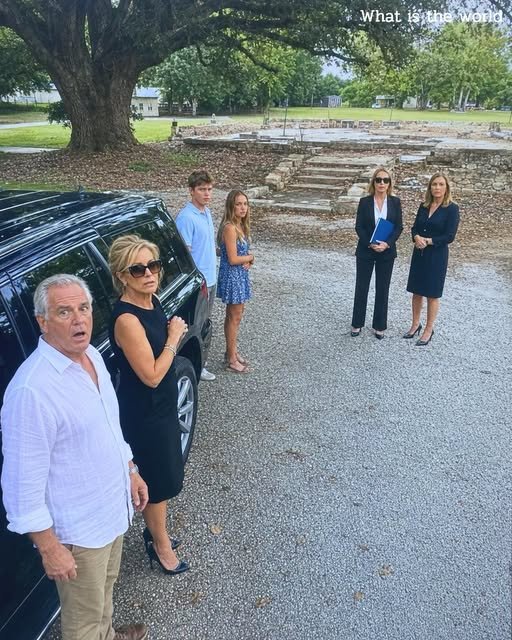
Elena placed the forged loan application on the hood of Adrian’s SUV, and the empty foundation behind him seemed to swallow every sound.
Kendra stared at the page first.
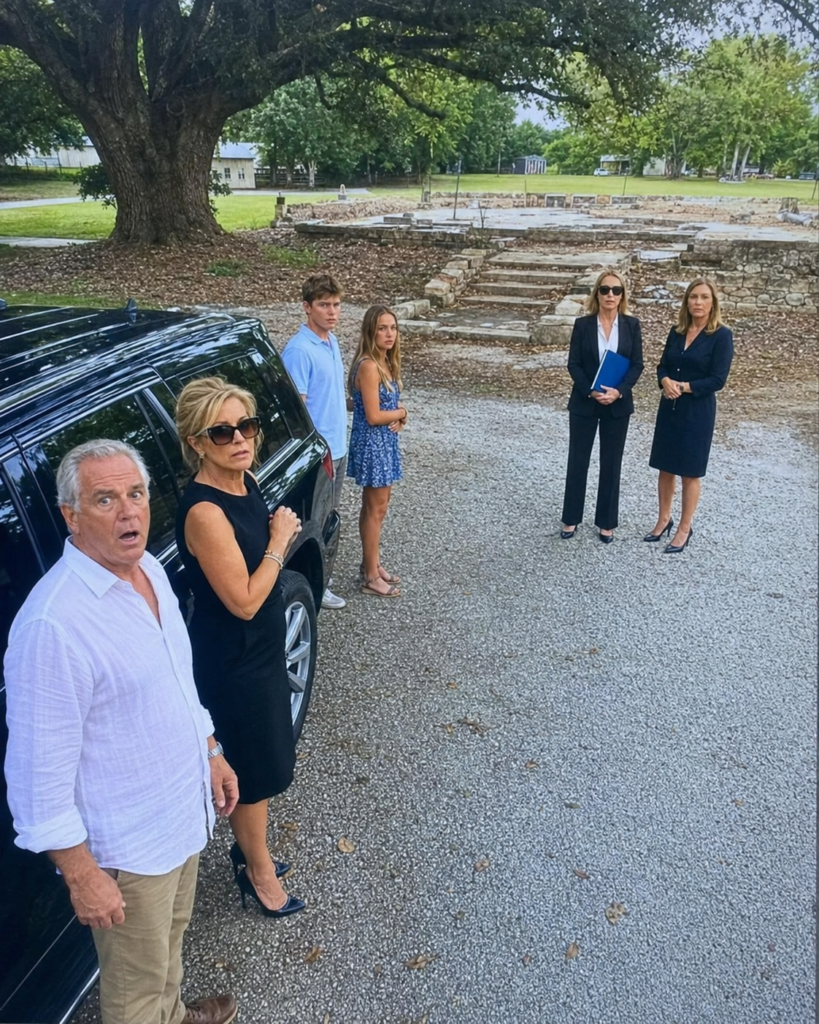
Marcus and Lila stood beside the open rear door, their hands locked together.
The county officer remained near Elena, while the lender’s representative opened a leather case and removed a second copy of the same document.
Adrian did not look at the signature.
He looked at me.
“What have you done?”
It was the question of a man who still believed consequences were actions committed against him.
I stood beneath the oak tree where my father had once hung a tire swing for Marcus.
“I protected my property.”
“Our property,” Adrian snapped.
Elena tapped the trust deed.
“No.
Her family’s property.
You were granted residential use while married to the trustee.
You were never given title, authority to sell, or permission to encumber it.”
Kendra turned toward Adrian.
“You told me the deed had already been transferred.”
“It was being handled.”
“You said you owned it.”
“I practically did.
I paid bills there for nineteen years.”
Elena’s expression did not change.
“Paying utility bills does not create ownership.
Neither does forging the trustee’s signature.”
The lender’s representative, a gray-haired man named Mr.
Holloway, placed the second application beside Elena’s copy.
“The bank approved a temporary credit line based on your declaration that you were sole owner.
We released eight hundred and forty thousand dollars before the title review was completed.”
Kendra’s lips parted.
The resort ceremony, the private villas, the flights, the jewelry, and the week of parties had not come from Adrian’s success.
They had been purchased with money borrowed against a house he did not own.
“You said the divorce settlement paid for everything,” Kendra whispered.
Adrian lowered his voice.
“Not here.”
“Where, then?” she asked.
“At the house that isn’t here?”
His mother, Celeste, climbed from the second vehicle behind the SUV.
She had spent nineteen years correcting my table settings, criticizing my clothes, and praising her son for tolerating a wife who lacked ambition.
Now she looked at the stone steps leading nowhere and pressed one hand to her throat.
“Adrian, tell them to put the house back.”
Elena almost smiled.
“It is not a sofa, Mrs.
Vance.”
Celeste turned on me.
“How could you do this to the children?”
Marcus answered before I could.
“Mom didn’t take us overseas to watch her marry someone else.”
The words struck harder because they came from the son who had spent the previous month copying his father’s coldness.
Adrian pointed toward the SUV.
“Both of you get inside.”
Neither child moved.
Lila pulled out her phone.
Her hands shook, but her voice did not.
“You lied to us.”
“Your mother has confused you.”
“Mom hasn’t spoken to us since we landed.”
Adrian stepped toward her.
The county officer shifted between them, one hand raised.
“Keep your distance, sir.”
Adrian froze.
Public resistance was unfamiliar to him.
At home, he had always lowered his voice instead of raising it.
He knew calm cruelty looked more respectable than rage.
In front of witnesses, however, the mask was beginning to slip.
Lila unlocked her phone.
“I recorded something at the resort.”
Marcus looked at her.
“When?”
“The night before the ceremony,” Lila said, holding the screen toward him. “Dad was talking to his brother on the patio.”
She hit play.
Adrian’s voice came through the speaker, crisp, clear, and stripped of the quiet charm he spent decades refining.
“She’ll take whatever settlement I offer because she has nothing else. The house is already tied up. Once the deed clears, I’ll leverage the rest. She won’t have the funds to hire a real lawyer, let alone fight me for custody.”
His brother’s voice followed. “What about Marcus and Lila?”
“They’ll come around. Kids follow momentum. Right now, Kendra represents the future. Nora is just history.”
The recording stopped.
Celeste turned her face away. Kendra took a slow step backward, her oversized sunglasses slipping down her nose as she looked at Adrian not as a benefactor, but as a liability.
“You told me your marriage was an administrative formality,” Kendra said, her tone flat. “You told me the trust was dissolved five years ago.”
“Kendra, quiet,” Adrian said, his voice tightening.
“Don’t tell me to be quiet!” she snapped, her composure shattering. “I put my career on the line for this. I let your family call me the new mistress of the estate. There is no estate! You’re drowning in debt!”
Mr. Holloway, the lender’s representative, retrieved his documents from the hood of the SUV. “Mr. Vance, because the collateral for your loan does not exist in your name—and because the signature of the primary trustee appears to be fraudulent—the bank is accelerating the note. Full payment of eight hundred and forty thousand dollars is due immediately. Furthermore, our legal department has already notified the district attorney’s office regarding loan fraud.”
Adrian’s jaw worked silently. For nineteen years, he had managed every narrative in our home. He had dictated when we laughed, how we spent our weekends, and how my family’s history was framed—as an anchor holding him back, rather than the foundation keeping him afloat.
He looked at me, his eyes dark with a sudden, sharp hatred.
“You think you’re clever,” he whispered, stepping closer despite the officer’s warning glance. “You ruined our family over a piece of land. Look at them, Nora. Look at what you’ve done to our kids.”
“I didn’t ruin anything, Adrian,” I said, my voice steady. “I simply stopped maintaining your illusion. Marcus, Lila, get your bags from the trunk.”
“They are coming with me,” Adrian ordered.
Marcus looked at his father. The seventeen-year-old boy who had spent the last three weeks looking at the floor finally raised his head. “To where, Dad? To a hotel paid for with Mom’s stolen house?”
He walked to the back of the SUV, popped the trunk, and pulled his duffel bag out. Lila followed, carrying her small suitcase. Neither of them looked back at Kendra, who was already on her phone, frantically calling her own attorney.
As my children walked toward my car, the structural relocation trucks were still visible on the ridge half a mile away, where the old timber house now sat on new concrete footings under the shade of ancient pines.
Adrian stood beside his mother and his fleeing bride, framed by nothing but an empty foundation and a pile of gravel.
PART 3
Six months later, the court proceedings were no longer about love, betrayal, or hurt feelings. They were reduced to numbers, ledgers, and forensic accounting.
Adrian’s firm suspended him the week after the lender filed formal fraud charges. Kendra resigned shortly after, issuing a statement that she had been misled by a senior partner. Without his salary, and with the bank freezing his personal accounts pending the criminal investigation, the polished life Adrian had promised everyone collapsed into a pile of court summonses.
I sat beside Elena in the family court deposition room. Across the table, Adrian looked ten years older. The tailored linen shirts were gone, replaced by a slightly oversized gray suit. His mother sat in the gallery behind him, silent for the first time in her life.
His lawyer opened a binder. “My client is willing to forgo all claims to the trust land and the relocated structure, provided Mrs. Vance drops the civil claims for back rent and withdraws her supporting affidavit in the bank’s fraud investigation.”
Elena didn’t even open her file.
“Your client has no legal claim to the trust property to forgo,” she replied smoothly. “He cannot trade something he never owned. As for the affidavit, the District Attorney is prosecuting the loan fraud independently. Mrs. Vance is simply a witness responding to a subpoena.”
Adrian leaned forward, placing his palms on the table. “Nora, please. If I go to prison, it destroys Marcus’s college fund. It ruins Lila’s future. Is this really what your father would have wanted?”
Using my father’s name was his last weapon. It was the same weapon he had used for two decades to make me feel small, to make me feel as though my inheritance was a burden rather than a gift.
“My father left clear instructions, Adrian,” I said, looking him in the eye. “He said a man who loves a home should know the difference between living in it and owning it. You never loved the home. You just wanted the authority.”
I pushed a single piece of paper across the table.
“This is the final divorce decree,” I continued. “You will surrender all rights to the children’s educational accounts—which were funded by my father’s estate, not your income. You will vacate your temporary apartment, pay the lender back through the liquidation of your personal assets, and you will never contact Marcus or Lila directly without their explicit consent.”
“They’re my children,” he said, his voice cracking slightly.
“They are,” I agreed. “And they spent three weeks watching you attempt to make their mother homeless.”
He looked at his attorney, hoping for an objection, a loop-hole, a legal shield. The attorney simply gave a brief, subtle shake of his head.
Two weeks later, the final papers were signed.
The timber house stood securely on the ridge, its old beams settling into the new soil. The kitchen doorframe with Marcus and Lila’s height marks was anchored safely in the hallway, untouched by the storm Adrian had brought upon himself.
That evening, Marcus was at the kitchen island, studying for his college entrance exams, while Lila sat at my mother’s piano near the window, playing a quiet melody she had learned over the summer.
The sun set over the ridge, casting long shadows across the valley below—where, half a mile away, a square pit of gray concrete sat completely empty, slowly filling with autumn leaves.