
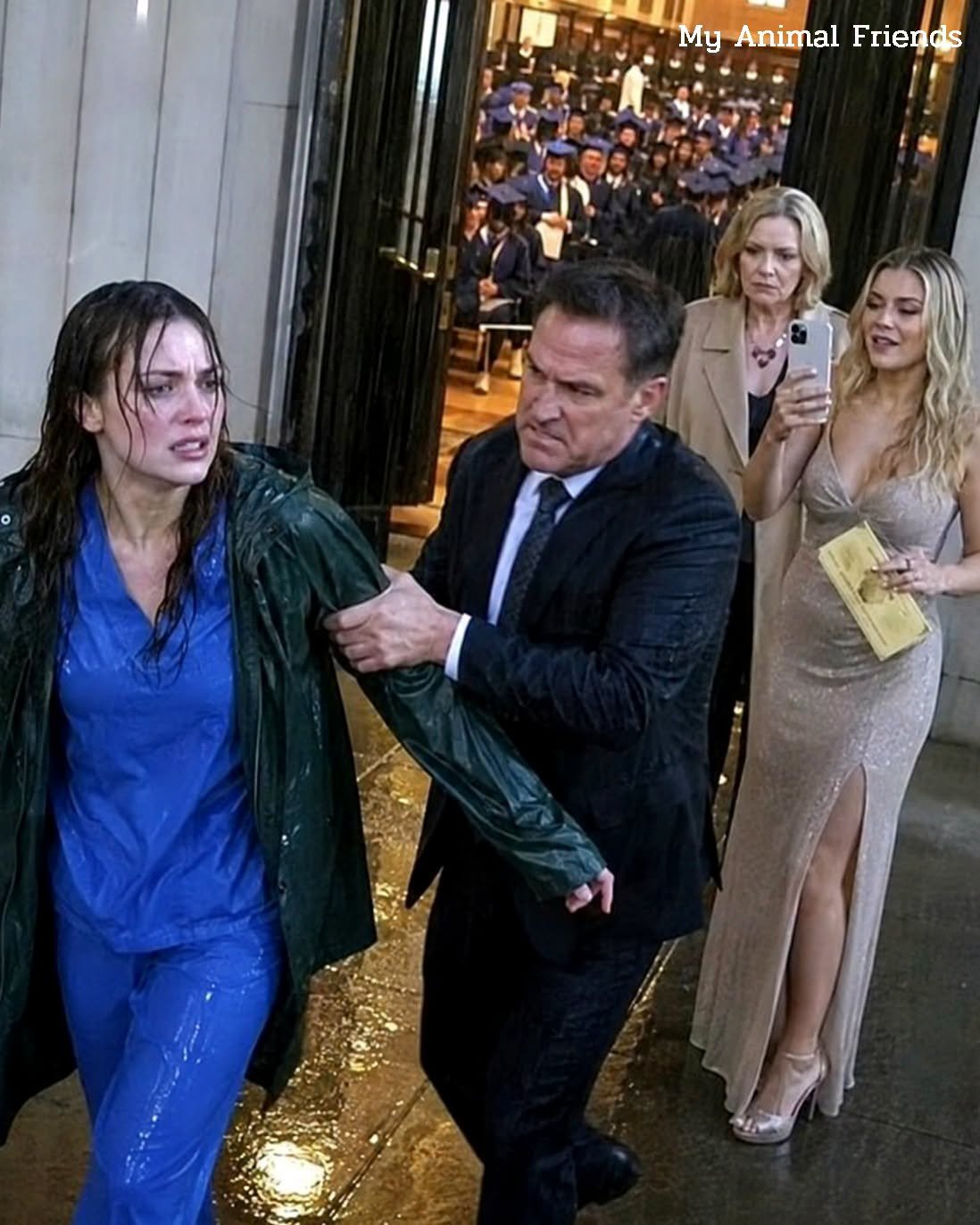
Dean Jonathan Bradley looked at the fading fingerprints on my arm, then back toward the auditorium doors.
His expression changed instantly.
“I believe someone owes you an apology,” he said quietly.
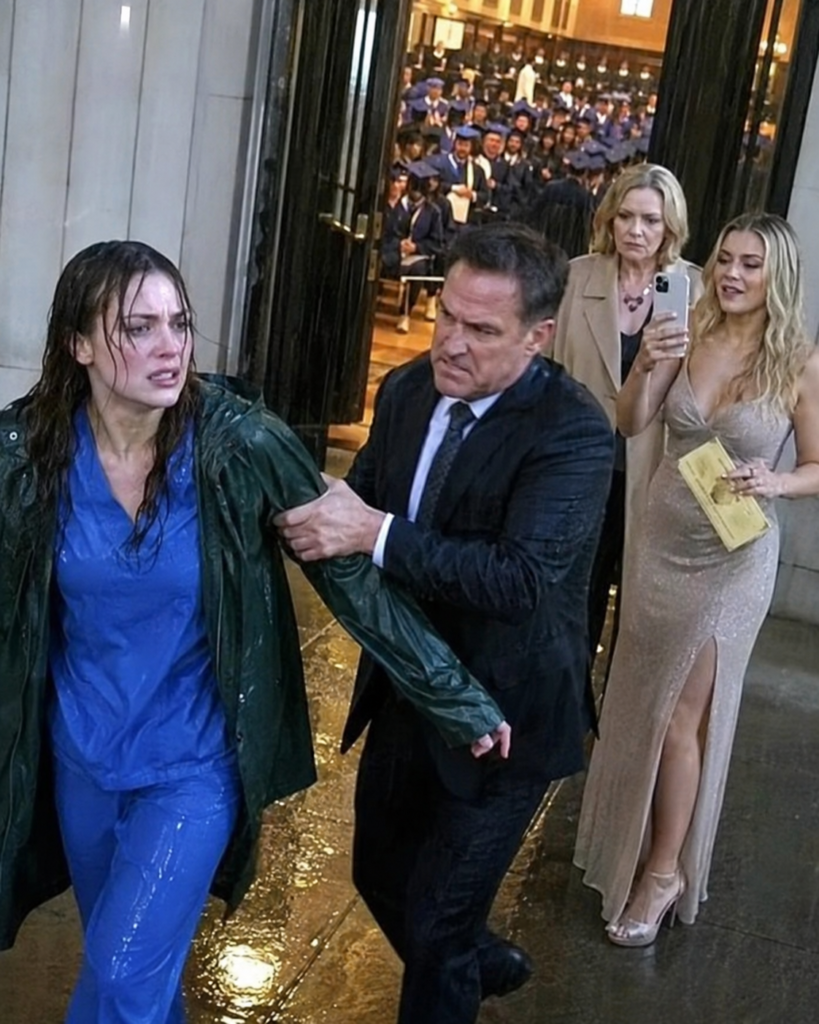
I forced a small smile.
“Let’s just begin the ceremony.”
He nodded and escorted me through a private entrance that led behind the stage.
The moment I stepped backstage, dozens of faculty members rushed toward me.
“There she is!”
“We were getting worried.”
“The orchestra has been waiting.”
A staff member gently adjusted my graduation hood while another handed me a towel to dry my soaked hair.
Someone brought me a fresh academic robe.
Someone else handed me a microphone.
For the first time in years, I felt seen.
Not because of pity.
Because of everything I had worked for.
Inside the auditorium, nearly three thousand people filled the seaTS.
Families laughed, cameras flashed, and graduates whispered excitedly.
In the front row, my father leaned comfortably in the VIP section.
Haley was busy taking selfies.
“I can’t wait until people see where I’m sitting,” she whispered.
My stepmother smiled proudly.
“This family finally gets the recognition we deserve.”
The lights dimmed.
The university orchestra began to play.
Dean Bradley walked to the podium.
“Good afternoon, graduates, families, distinguished guests, faculty, and friends.”
Applause echoed throughout the hall.
He smiled warmly.
“Before we begin today’s commencement exercises, we are honored to recognize an extraordinary member of this graduating class.”
My father barely looked up.
Haley continued checking her phone.
The Dean continued.
“This year’s valedictorian achieved the highest academic record in the College of Medicine while simultaneously working overnight hospital shifts to support herself.”
A few audience members gasped.
He continued.
“She also led groundbreaking cardiovascular research that has earned the University’s Presidential Research Medal and a multi-million-dollar medical research grant.”
Now people began looking around the auditorium.
My father frowned.
“Who is he talking about?” Haley whispered.
The Dean smiled.
“Please welcome our valedictorian, keynote speaker, and newest Doctor of Medicine…”
He paused.
“…Dr. Clara Hensley.”
Every spotlight turned toward the side entrance.
The auditorium erupted.
Thousands of people stood.
Faculty members applauded.
Doctors, researchers, donors, and students rose to their feet.
The standing ovation seemed endless.
My father slowly stood—not to applaud.
Simply because everyone else had.
His face had completely lost its color.
Haley’s phone slipped from her hand onto the carpet.
My stepmother stared at the program in disbelief.
“No…”
She whispered.
“That’s impossible.”
Then I walked onto the stage.
Not with anger.
Not with pride.
Simply with quiet confidence earned through years of sacrifice.
Dean Bradley shook my hand.
“It is my privilege,” he announced, “to introduce one of the finest graduates our university has produced in decades.”
Another wave of applause filled the room.
The Dean presented the Presidential Research Medal first.
Then came the announcement of the research grant.
Large screens displayed photographs from my years in medical school.
Images appeared of late-night laboratory work.
Hospital rotations.
Community clinics.
Free health screenings.
Research conferences.
Scholarship ceremonies.
Every achievement represented years my family had never bothered to ask about.
Dean Bradley continued.
“Dr. Hensley never once requested special treatment.
Instead, she quietly earned every opportunity through determination, compassion, and excellence.”
He turned toward me.
“Your story reminds us that true character is revealed not by recognition, but by perseverance when no one is watching.”
The audience applauded again.
Then he stepped aside.
“The podium is yours, Doctor.”
I looked across the sea of faces.
Near the front, my father could not meet my eyes.
My stepmother sat perfectly still.
Haley quietly lowered her phone.
I took a deep breath.
“My entire life,” I began, “people assumed they knew who I was.”
The room became silent.
“They saw part of my journey and believed it was the whole story.”
I smiled gently.
“They saw hospital uniforms but never imagined medical textbooks waiting beside my bed.”
A few people nodded.
“They saw exhaustion but never the dreams that caused it.”
I looked toward the graduates.
“Many of you know what it’s like to keep working even when no one notices.”
More applause.
“There were moments when I questioned whether all the sacrifices mattered.”
I paused.
“But today reminds me that recognition eventually finds honest work.”
The room remained completely still.
“I’ve learned something even more important.”
I glanced briefly toward the VIP section.
“You cannot spend your life trying to convince people to value you.”
Silence.
“Some hearts simply are not ready to see what is standing in front of them.”
Then I smiled.
“So instead of chasing approval, build a life that reflects your values.”
“Serve.”
“Learn.”
“Be kind.”
“And never allow someone else’s opinion to define your future.”
The audience rose once again.
The applause lasted several minutes.
After the ceremony, graduates celebrated across campus.
Families embraced.
Photographers hurried from group to group.
I had just finished taking pictures with my classmates when I heard footsteps behind me.
“Clara…”
It was my father.
For the first time in years, his voice sounded uncertain.
“I…I didn’t know.”
I looked at him quietly.
“No,” I answered.
“You never asked.”
His shoulders dropped.
“I thought…”
“You thought I wasn’t worth your attention.”
He lowered his eyes.
“I’m sorry.”
They were words I had wanted to hear for years.
But somehow they no longer carried the weight I once imagined.
Forgiveness, I realized, doesn’t erase the past.
It simply frees you from carrying it forever.
“I hope you become a better man,” I said honestly.
“But I can’t build my future around waiting for that day.”
Tears filled his eyes.
“I missed so much.”
“Yes.”
“You did.”
There was nothing more to add.
A familiar voice called my name.
“Dr. Hensley!”
Dean Bradley approached with several physicians.
“We’d like you to meet the director of our residency program.”
He smiled.
“And someone from the research foundation would also like a word.”
One of the donors extended his hand.
“Congratulations, Doctor.
We would be honored to support your work.”
Another physician smiled.
“Our hospital has been hoping you’ll accept our residency offer.”
As they welcomed me into the next chapter of my life, I noticed my father quietly step aside.
For once, he understood.
Not every opportunity can be recovered.
Some moments pass only once.
Three years later, the research funded by that grant helped develop a treatment that gave new hope to patients with serious heart disease.
The university invited me back—this time as a guest speaker.
As I stood at the same podium, I looked across another graduating class filled with hopeful faces.
I ended my speech with the lesson life had taught me that rainy morning.
“Your worth is never determined by the people who fail to recognize it.”
“It is revealed by the courage to keep becoming the person you were created to be.”
The graduates stood and applauded.
Outside, sunlight covered the campus.
The storm that had once left me standing alone had become nothing more than a memory.
Sometimes the people who overlook your light are simply standing with their backs to it.
Keep shining anyway.

PART 2
The silence after my address at the university podium three years later was different from the silence of that rainy afternoon. It wasn’t the heavy, suffocating quiet of neglect; it was the soft, resonant space left by truth.
As I walked down the steps of the auditorium, the Director of Cardiovascular Medicine, Dr. Evelyn Thorne, fell into step beside me.
“Remarkable speech, Clara,” she said, her voice steady and warm. “The board just approved the expansion of the research wing. They’re naming the new pediatric unit after your foundation.”
“Thank you, Evelyn,” I replied, adjusting the collar of my white coat. “It’s only possible because we stopped waiting for permission to build it.”
She smiled, nodding toward the heavy double doors leading to the faculty lounge. “There is someone waiting for you in the lobby. He didn’t want to interrupt the reception.”
I paused, a familiar tightness rising in my chest before I consciously dissolved it. I didn’t need to ask who it was.
Sitting on the far end of the leather bench near the high glass walls of the atrium was Arthur Hensley.
He looked smaller than he had three years ago. The crisp, arrogant posture that had once defined him in my childhood home had softened into a slight stoop. His hair, once impeccably dark, was now thoroughly grayed at the temples. Beside him sat a single, worn leather briefcase—the one he used to carry when he managed the family’s modest logistics business.
As my footsteps echoed across the polished marble, he stood up quickly, almost clumsily.
“Clara,” he said. The word was hesitant, tested carefully on his tongue as if he wasn’t sure he still had the right to pronounce it.
“Father,” I said neutrally, stopping a respectful few feet away.
He looked at me—really looked at me—taking in the tailored navy suit, the silver pin of the Presidential Research Award on my lapel, and the quiet composure that no longer sought his validation.
“I read about the new grant in the medical journal last week,” he began, his hands clasping together in front of him. “I buy the journal now. Every issue.”
“You don’t need to do that,” I said gently.
“I know,” he swallowed, his throat moving heavily. “I… I just wanted to see your name. It’s the only way I get to know what you’re doing.”
He paused, glancing out at the sunlit courtyard where students were taking photos with their families—the exact spot where he had handed my single VIP ticket to Haley three years ago while the rain soaked through my thin blouse.
“Haley dropped out of her master’s program last spring,” Arthur said quietly, the confession spilling out without prompt. “Your stepmother… Patricia and I are separating. The house is being sold.”
I listened, feeling neither joy nor bitterness at the collapse of the illusion he had sacrificed our relationship to maintain. For years, he had traded my worth to buy the temporary affection of a woman and a stepdaughter who valued him only for what he could provide. Now that the stage lights were off, the theater was empty.
“I’m sorry to hear that,” I said honestly.
“Don’t be,” he whispered, looking down at his polished shoes. “It’s just… justice, I suppose. I built a house on sand because I thought it looked prettier than the foundation you were laying with your own hands. I was a fool, Clara. A blind, foolish man.”
“Arthur,” I said, using his name for the first time in my life. He flinched slightly, but kept his eyes on mine. “You don’t have to carry the guilt to punish yourself. But you also cannot use it to build a bridge back to me. The gap was created a long time ago. The rain just made it visible.”
He took a slow, trembling breath, pulling an old, yellowed envelope from his inner coat pocket.
“I found this when I was packing up your old bedroom,” he said, holding it out with a shaking hand. “You left it under the desk when you moved out for undergrad.”
I hesitated, then took the envelope. Inside was a drawing I had made when I was seven years old—a crude crayon portrait of a little girl in a white coat holding a stethoscope, standing next to a tall man with a bright red tie. At the bottom, in childish block letters, it read: FOR DADDY, SO HE IS PROUD WHEN I AM A DOCTOR.
“I never saw it,” he choked out, tears finally breaking past his lower lids. “It was behind the radiator. It had been there for fifteen years. You were already trying to show me who you were… and I was too busy looking at things that didn’t matter.”
I looked at the drawing. The seven-year-old girl in that picture had cried herself to sleep on birthdays, had worked three jobs to pay for entrance exams, and had stood in the pouring rain while her father drove away with another man’s daughter in the front seat.
I carefully folded the paper and slipped it back into the envelope. Then, I handed it back to him.
“Keep it,” I said softly.
He stared at the envelope in his hands. “Why?”
“Because the girl who drew that doesn’t need your pride anymore,” I said, meeting his tear-filled eyes with absolute clarity. “She found her own. But maybe… maybe it will remind you to look closer at the people in your life moving forward. Don’t miss another child’s light.”
Arthur held the envelope to his chest like a sacred text. He didn’t ask for a hug. He didn’t ask for dinner. He simply bowed his head, acknowledging the boundaries of the space I had claimed for myself.
“Thank you, Dr. Hensley,” he whispered, his voice cracking on my title.
“Goodbye, Arthur.”
I turned and walked back toward the auditorium where my team was waiting. Outside the glass doors, the sun was bright, warm, and entirely clear of clouds.
I didn’t look back to see if he was watching me leave. I didn’t need to. Some stories don’t end with a grand reconciliation or a tearful family reunion. Some stories end simply with the rain stopping, the ground drying up, and the quiet realization that you were strong enough to walk through the storm all along.